Home Shop Setup Cost: $1,500 to $28,000 Breakdown by Shop Type (2026)
Quick Budget Snapshot
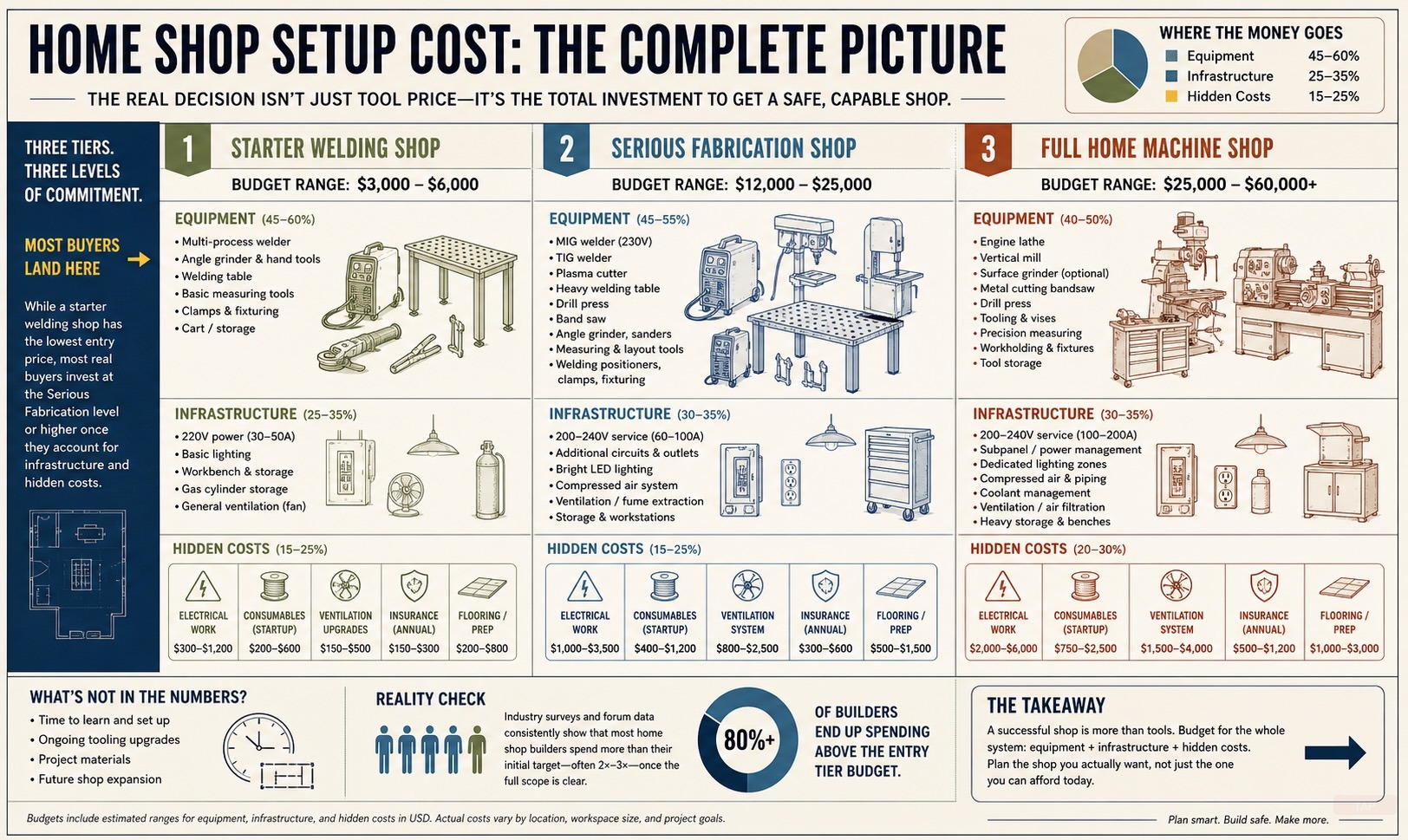
| Shop Tier | Realistic Budget | What It Covers |
|---|---|---|
| Starter welding shop | $1,500–$2,500 | MIG welder, grinder, helmet, table, safety gear, starter consumables |
| Serious fabrication shop | $5,000–$10,000 | Better welder, plasma cutter, bandsaw, drill press, compressor, upgraded electrical |
| Full home machine shop | $18,000–$28,000 | Lathe, mill, tooling, subpanel work, lighting, ventilation, climate control |
Most buyers who want a shop they actually use every week — not just assemble once — land in the middle tier. Below are the full itemized breakdowns for all three tiers using 2026 retail prices from Grizzly Industrial, Lincoln Electric, Hobart, DeWalt, and Amazon, with electrical, ventilation, consumables, and insurance costs that most guides skip.
Tier 1: Basic Welding & Fabrication Shop ($1,500–$2,500)
This is the entry point: enough equipment to weld, grind, and do basic metal fabrication in a two-car garage. Tier 1 covers MIG welding on mild steel up to 3/16” thick — sufficient for furniture, brackets, trailer repairs, and most hobby fabrication.
Equipment Budget
| Item | Recommended Pick | Est. Price |
|---|---|---|
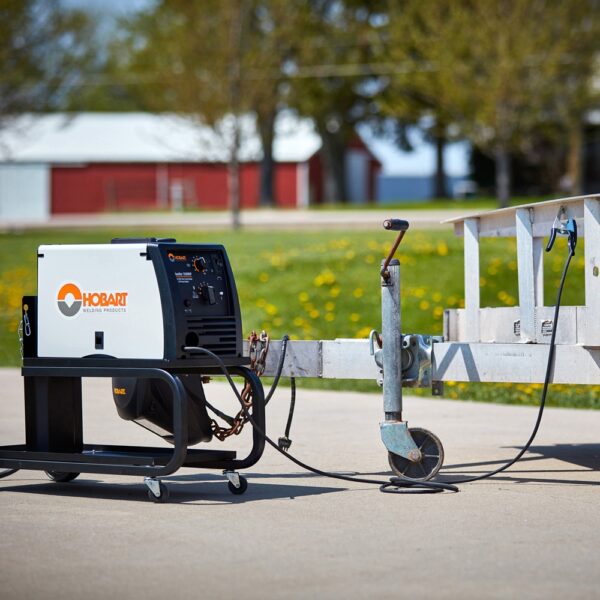
| MIG welder | Hobart Handler 140 | $450–$550 |
| Auto-darkening helmet | Hobart 770890 | $80–$100 |
| Angle grinder (4.5”) | DeWalt DWE4011 | $45–$65 |
| Welding table or cart | Steel welding cart | $100–$200 |
| Clamps, squares, magnets | Assorted set | $100–$150 |
| Welding consumables (wire, gas, tips) | Starter supply | $150–$200 |
| Safety gear (gloves, jacket, glasses) | — | $80–$120 |
| Fire extinguisher (ABC rated, 10 lb) | — | $30–$50 |
Equipment Subtotal: $1,035–$1,435
Infrastructure Costs
| Item | Est. Price |
|---|---|
| 240V/30A circuit (electrician install) | $300–$800 |
| Ventilation (box fan + open bay door or window fan) | $50–$150 |
Infrastructure Subtotal: $350–$950
Tier 1 Total: $1,385–$2,385
Rounding for contingency and small items (tape measures, wire brushes, Sharpies, C-clamps): $1,500–$2,500 is a realistic all-in budget.
For detailed MIG welder comparisons at this price point, see the best MIG welders for beginners guide. Helmet selection matters more than most beginners expect — the auto-darkening welding helmet comparison covers the trade-offs between budget and mid-range options.
Who This Tier Is For
Hobbyists, garage fabricators, and anyone who wants to weld mild steel without outsourcing every bracket and repair. This setup handles most projects that do not require cutting thick plate or machining precision parts.
Who This Tier Is NOT For
Anyone planning to weld aluminum, stainless, or chromoly needs TIG capability (Tier 2). Anyone who needs to cut plate thicker than 3/16” will quickly outgrow a 140A MIG welder. And anyone doing production work — even small-batch — will find the lack of a bandsaw and drill press to be a constant bottleneck.
Tier 2: Fabrication + Cutting Shop ($5,000–$10,000)
Tier 2 is the serious hobbyist and side-business setup. It adds TIG welding for aluminum and stainless, plasma cutting for fast material separation, and proper cutting and drilling equipment. This is the tier where a home shop starts replacing paid machine shop visits.
Equipment Budget (Tier 2 Additions)
| Item | Recommended Pick | Est. Price |
|---|---|---|
| Upgraded MIG welder | Hobart 210MVP (replaces Handler 140) | $750–$900 |
| TIG welder | AHP AlphaTIG 200X | $350–$450 |
| Plasma cutter | Hobart Airforce 27i | $600–$750 |
| Horizontal bandsaw | Grizzly G0622 | $400–$600 |
| Bench grinder (8”) | DeWalt DW758 | $120–$170 |
| Drill press (floor-standing) | Grizzly G7943 | $300–$500 |
| Heavy-duty steel workbench | — | $300–$500 |
| Air compressor (60-gallon, single-stage) | — | $400–$600 |
| Helmet, safety gear, clamps (upgraded) | — | $200–$300 |
| Consumables (TIG filler, plasma tips, extra gas) | — | $200–$300 |
Tier 2 Equipment Subtotal: $3,620–$5,070
Infrastructure Costs (Tier 2 Additions)
| Item | Est. Price |
|---|---|
| Additional 240V circuits (2–3 circuits) | $500–$1,000 |
| Upgraded ventilation (wall-mount exhaust fan) | $100–$250 |
| Shop lighting (LED, 4-fixture minimum) | $100–$200 |
Tier 2 Infrastructure Subtotal: $700–$1,450
Tier 2 Total: $5,000–$10,000
When combined with Tier 1 baseline costs — or more realistically, factoring in the upgraded MIG welder replacing the budget unit — the all-in Tier 2 shop lands between $5,000 and $10,000 depending on whether electrical work is needed and how aggressively deals are pursued.
For plasma cutter details, the best plasma cutters under $1,000 guide covers the Hobart Airforce series and alternatives. The bench grinder comparison and angle grinder guide cover the grinding equipment in depth. TIG welder options are compared in the best TIG welders for beginners guide. Stock preparation gets its own coverage: the drill presses for metal comparison covers the floor-standing units in the Tier 2 list, and shop air compressor sizing determines whether the 60-gallon single-stage unit budgeted here delivers enough CFM for the air tools it will feed. Shops that press bearings, bushings, and press-fit assemblies typically add a hydraulic shop press at this tier.
Who This Tier Is For
Fabricators building roll cages, custom bumpers, trailers, furniture, and art. Side-business operators taking on small welding and fabrication jobs. Makers who are tired of paying a machine shop for cuts and holes they could do themselves.
Who This Tier Is NOT For
This tier does not include precision machining. Without a lathe and mill, there is no way to turn shafts, bore holes to tight tolerances, or cut threads beyond what a tap-and-die set allows. For that, Tier 3 is required.
Tier 3: Full Machine Shop ($18,000–$28,000)
Tier 3 adds manual machining capability: a lathe, a mill, precision measuring instruments, and the electrical infrastructure to run it all. This is a genuine home machine shop — capable of making parts from raw stock to finished dimensions.
Equipment Budget (Tier 3 Additions)
| Item | Recommended Pick | Est. Price |
|---|---|---|
| Benchtop lathe (10” x 22” or similar) | Grizzly G0752 | $2,200–$2,800 |
| Benchtop mill | Precision Matthews PM-25MV | $1,500–$1,800 |
| Surface plate (12” x 18” granite) | — | $80–$120 |
| Precision measuring tools (caliper, micrometer set, indicator) | — | $200–$400 |
| Belt grinder (2” x 72”) | Grizzly G1015 | $350–$450 |
| Tooling (lathe toolholders, mill end mills, collets, vise) | — | $500–$800 |
| Tool storage (Kennedy-style roller chest) | — | $400–$800 |
| Dust/chip collection system | — | $200–$400 |
Tier 3 Equipment Subtotal: $5,430–$7,570
Infrastructure Costs (Tier 3 Additions)
| Item | Est. Price |
|---|---|
| Subpanel upgrade (100A, multiple 240V circuits) | $1,000–$2,000 |
| Concrete floor leveling or epoxy coating | $200–$500 |
| Additional shop lighting | $50–$100 |
| Climate control (space heater or mini-split, depending on region) | $200–$1,500 |
Tier 3 Infrastructure Subtotal: $1,450–$4,100
Tier 3 Total: $18,000–$28,000
Combining all three tiers — Tier 1 baseline, Tier 2 fabrication and cutting additions, and Tier 3 machining additions — the fully equipped home machine shop comes in between $18,000 and $28,000 at 2026 prices. The wide range reflects variables like electrical work scope, whether climate control is needed, and tooling depth.
The benchtop lathe comparison and benchtop milling machine guide cover the core Tier 3 machines in detail. For belt grinder selection, see the belt grinder guide. The rotary screw compressor guide is relevant if upgrading from the Tier 2 reciprocating compressor for higher-duty-cycle air tools.
Who This Tier Is For
Home machinists, prototype developers, gunsmiths, clockmakers, and anyone making parts that require dimensional accuracy better than 0.010”. Also appropriate for small-batch production operators who need in-house machining to maintain margins.
Who This Tier Is NOT For
Tier 3 is not a CNC shop. Adding CNC capability — even a CNC mill for a small job shop or a CNC lathe conversion — adds $3,000–$15,000 depending on the path. That is a separate planning exercise. Tier 3 is also not a production facility; anyone running a machine shop as a primary business will outgrow benchtop equipment within a year or two and should plan for full-size machines, 3-phase power, and proper building space.
The Hidden Costs Everyone Forgets
Equipment lists account for roughly 60–70% of actual setup cost. The rest hides in infrastructure, consumables, and ongoing expenses. Based on common forum reports and electrical contractor estimates, here is what gets missed.
Electrical Work
Most residential garages are wired with 120V/15A or 120V/20A circuits. That is enough for a bench grinder and some lights — not a welder. According to National Electrical Code (NEC) requirements:
- A MIG welder rated at 140A typically requires a 240V/30A dedicated circuit. Installation cost: $300–$800 depending on panel distance and local labor rates.
- A Tier 2 shop with multiple 240V tools (welder, plasma cutter, air compressor) needs 2–3 dedicated circuits. Cost: $800–$1,500.
- A Tier 3 shop often requires a dedicated subpanel (60A–100A) run to the garage or outbuilding. Cost: $1,500–$2,500 installed.
This is the single largest hidden cost. Ignoring it leads to tripped breakers, undersized wiring (a fire hazard), and frustration.
Consumables
Welding and metalworking consume materials at a rate that surprises newcomers. Based on current retail pricing, a moderately active Tier 2 shop operator can expect:
| Consumable | Monthly Cost | Annual Cost |
|---|---|---|
| Welding wire (ER70S-6, 10 lb spool) | $30–$50 | $360–$600 |
| Grinding/cutting discs | $20–$40 | $240–$480 |
| Argon/CO2 shielding gas (80/20, 80 cf tank refill) | $40–$60 per refill (every 6–10 weeks) | $250–$500 |
| TIG filler rod | $15–$25 | $180–$300 |
| Plasma consumables (tips, electrodes) | $15–$30 | $180–$360 |
| Cutting fluid, drill bits, bandsaw blades | $20–$40 | $240–$480 |
| Total | — | $1,450–$2,720 |
The often-cited figure of “$500 a year in consumables” is realistic only for light-duty Tier 1 use. A Tier 2 shop running 10–15 hours per week should budget $1,500–$2,500 per year in consumables alone.
Ventilation
Welding fumes are a documented health hazard. The American Welding Society (AWS) recommends mechanical ventilation for all indoor welding. Options range from minimal to proper:
- Minimum viable: Box fan in a window + open garage door. Cost: $30–$50. Adequate for occasional MIG welding only.
- Better: Wall-mount exhaust fan (500–1,000 CFM). Cost: $150–$300 installed.
- Proper: Source-capture fume extraction arm. Cost: $500–$1,000 for a bench-mount unit.
This is not optional. It is a health and safety requirement, and the cost should be in the initial budget, not treated as an afterthought.
Insurance
Standard homeowners insurance policies often exclude or limit coverage for workshops with welding, compressed gas, or flammable material storage. Based on common policy structures:
- A rider or endorsement to an existing homeowners policy: $200–$500/year.
- A separate business policy for side-income shop work: $500–$1,200/year.
This is worth verifying with an insurance agent before starting any shop that involves open flame, compressed gas cylinders, or flammable liquids.
Concrete and Flooring
Machine tools — especially lathes and mills — need a level, solid floor. Residential garage floors often have cracks, slope for drainage, and no coating. Relevant costs:
- Epoxy floor coating (DIY, 2-car garage): $200–$500 in materials.
- Professional epoxy coating: $1,500–$3,000.
- Leveling shims and anti-vibration pads for machines: $50–$150.
For Tier 1 and Tier 2, the existing concrete is usually adequate. For Tier 3 with a lathe and mill, floor condition directly affects machining accuracy.
Cost Per Hour: Is It Worth It?
This is the question behind the question. A home shop is a capital investment. Whether it pays back depends on how much shop time would otherwise be outsourced.
Based on current market rates, commercial machine shops and fabrication shops charge:
- General fabrication/welding: $75–$125/hour
- Machine shop work (lathe, mill): $100–$150/hour
- Specialty work (TIG stainless, aluminum): $125–$175/hour
Using a Tier 2 shop as the example — all-in cost of approximately $7,500 (midpoint) — here is the break-even math:
| Outsource Rate | Break-Even Hours | At 10 hrs/month |
|---|---|---|
| $75/hour | 100 hours | 10 months |
| $100/hour | 75 hours | 7.5 months |
| $125/hour | 60 hours | 6 months |
| $150/hour | 50 hours | 5 months |
For a Tier 3 shop at $23,000 (midpoint) replacing $125/hour machine shop visits:
| Outsource Rate | Break-Even Hours | At 10 hrs/month |
|---|---|---|
| $100/hour | 230 hours | ~23 months |
| $125/hour | 184 hours | ~18 months |
| $150/hour | 153 hours | ~15 months |
These calculations do not account for consumable costs, which reduce the effective savings. Adding $150/month in consumables to the Tier 2 example changes the equation: at $125/hour outsource rate, break-even extends from 6 months to roughly 8–9 months.
The takeaway: for anyone doing 10+ hours of metalwork per month, a Tier 2 shop typically pays for itself in under a year. A Tier 3 shop takes 18–24 months at moderate use. For purely recreational use with no outsourcing offset, the financial case is weaker — but “cost per hour of enjoyment” is a personal calculation, not a financial one.
Where to Save (and Where Not To)
Not every dollar in a shop budget carries equal weight. Based on common forum consensus and repair-shop failure data, here is where cutting costs is reasonable and where it creates problems.
Acceptable Places to Save
- Welding table: Building a welding table from scrap steel is a classic first project and saves $100–$300 over buying one.
- Hand tools: Used wrenches, hammers, and pliers from estate sales and flea markets work identically to new ones.
- Clamps: Harbor Freight welding clamps and C-clamps perform adequately for most applications. Overspending on clamps is unnecessary.
- Storage: Used toolboxes and shelving from Craigslist or Facebook Marketplace save 50–70% over new.
- Workbench: A welded steel frame with a 3/8” plate top can be built for under $100 in material.
Do Not Save On These Items
- Welder: Budget welders under $300 frequently produce unstable arcs, inconsistent wire feed, and premature failures. The frustration cost is real. According to manufacturer specs, the Hobart Handler 140 and 210MVP consistently appear in reliability surveys for good reason.
- Welding helmet: An auto-darkening helmet with inconsistent sensors or slow reaction time is a direct risk to eyesight. Budget at least $80 for a name-brand unit.
- Angle grinder: A failed angle grinder disc at 11,000 RPM is a safety hazard. Name-brand grinders from DeWalt, Makita, or Milwaukee have better guard design and switch reliability.
- Measuring tools: A caliper that reads 0.003” off renders precision work impossible. Mitutoyo, Starrett, or iGaging digital calipers are the floor for useful measurement.
- PPE: Welding gloves, safety glasses, and hearing protection are not categories for bargain hunting.
Where to Find Used Shop Equipment
A Tier 2 or Tier 3 shop built from new equipment costs $8,000–$28,000. The same capability assembled from used equipment typically costs $4,000–$15,000 — a 40–50% reduction. The trade-off is time, knowledge, and tolerance for uncertainty.
Online Marketplaces
eBay Industrial & Commercial is the deepest national source for machine tools. Lathes, mills, grinders, drill presses, and industrial welders ship freight from anywhere in the country. Search by brand and model to compare known units. Freight adds $200–$600 for a lathe; condition is self-reported by the seller.
Facebook Marketplace and Craigslist surface local finds you can inspect and transport yourself. Garage shops closing out, estates with tool collections, and small machine shops liquidating are the typical sources. Check daily — good machines move fast. Always run the machine under load before paying; never buy sight-unseen from these platforms.
OfferUp has improved its tool inventory in metro areas and is worth checking alongside Facebook Marketplace for local results.
Industrial Auction Platforms
IronPlanet and Ritchie Bros. Auctioneers auction industrial equipment from shop closures, plant downsizing, and fleet liquidations. IronPlanet provides OnsiteIQ inspection reports for many items. Ritchie Bros. holds unreserved auctions at regional yards where you can attend in person and inspect before bidding.
GovPlanet and Public Surplus auction surplus government equipment — machines from community colleges, vocational schools, military depots, and municipal operations. Community college shop equipment tends to be well-maintained and recently calibrated. Reserve prices at government auctions are set by policy rather than market research, so pricing is often below private-market equivalents for identical machines.
What to Inspect Before Buying a Used Machine Tool
For lathes and mills, these are the inspection points that separate a good buy from an expensive anchor:
- Spindle runout: Measure with an indicator in the spindle taper. A quality benchtop lathe should show under 0.001” TIR. Over 0.003” indicates a worn spindle — not a maintenance issue, a replacement problem.
- Dovetail and gib wear: Move the carriage, cross-slide, and compound under hand pressure. Backlash larger than roughly half a turn of the handwheel indicates significant wear in the drive system.
- Bed condition: Check the ways near the headstock for wear ridges using a straightedge and feeler gauge. Wear is worst where most cuts happen.
- Motor and electrical: Verify clean startup, no excessive vibration, and no bearing noise at idle. Run it for 10 minutes before committing.
- Tooling package: A lathe with a full set of boring bars, tool holders, and a 4-jaw chuck is worth considerably more than the same machine bare. Factor tooling cost into the comparison.
For welders: run a test bead. An arc that surges, pops, or requires constant adjustment indicates electrical problems. Inspect the wire feed for worn drive rolls and liner condition; a worn liner is a $20 fix, a worn feed motor is $150+.
For compressors: time the pressure cycle from cutout to cutout. Unusually fast cycling indicates a worn pump, reduced tank volume from internal rust, or a significant air leak. Listen for crankshaft knock at startup — that indicates worn bearings and a rebuild, not a tune-up.
Realistic Prices on the Used Market (2026)
| Equipment | Running, Complete | New Reference |
|---|---|---|
| Benchtop lathe (9–12” swing) | $600–$1,500 | $1,500–$3,000 |
| Benchtop mill (BP-style knee) | $1,200–$3,500 | $2,500–$5,000 |
| Floor drill press (15–20”) | $150–$400 | $400–$700 |
| Horizontal bandsaw (4–6” capacity) | $200–$600 | $400–$800 |
| MIG welder (140–200A) | $150–$350 | $500–$900 |
| TIG welder (200A+) | $400–$1,200 | $700–$2,000 |
| Rotary screw compressor (5–10 HP) | $1,500–$4,000 | $3,500–$8,000 |
For lathes and mills, South Bend, Atlas/Craftsman, and older Grizzly machines have strong parts communities and well-documented service histories. Avoid orphaned brands where replacement parts are no longer manufactured — without parts availability, a worn machine becomes a parts donor rather than a production tool.
Frequently Asked Questions
Can a welding shop be set up in a standard two-car garage?
Yes, and most home welding shops are exactly that. The key requirements are a 240V electrical circuit, adequate ventilation (at minimum an exhaust fan and open door during welding), and fire-safe surroundings (no gasoline storage, exposed insulation, or combustible clutter within 15 feet of the welding area). Per OSHA guidelines, a dedicated welding area should have non-combustible flooring — concrete qualifies.
What is the minimum budget for a functional home metal shop?
A Tier 1 welding and fabrication setup can be assembled for approximately $1,500 including electrical work. Below that number, critical items get cut and the shop becomes frustrating to use. Used equipment can reduce the number by 30–40%, but introduces uncertainty about condition and remaining service life.
Is 3-phase power required for a home machine shop?
No. All equipment listed in this guide operates on single-phase 240V power, which is standard residential service. Three-phase power becomes relevant only for full-size (not benchtop) machine tools — typically machines weighing over 1,000 lbs with motors above 3 HP. A rotary phase converter ($300–$800) or variable frequency drive ($200–$500) can run individual 3-phase machines from single-phase service if needed later.
How much space is needed?
A Tier 1 shop fits in a single garage bay (roughly 10’ x 20’). A Tier 2 shop benefits from a full two-car garage with one bay dedicated to the shop. A Tier 3 shop with lathe and mill realistically needs 400+ square feet of dedicated space — either a full two-car garage or a separate outbuilding.
What about used equipment?
Used equipment can reduce costs by 30–50%, particularly for machine tools (lathes and mills) which depreciate heavily. The trade-offs are: unknown maintenance history, potential alignment issues, difficulty sourcing parts for discontinued models, and no warranty. For welders and grinders, buying new is generally preferred due the safety implications. For lathes and mills, a well-maintained used machine from a known brand (South Bend, Bridgeport, Jet, Grizzly) can be an excellent value.
What You’ll Also Need
- Welding table top plate — steel — A flat steel surface plate provides a stable, heat-resistant base for weld fixturing; 1/2-inch plate with pre-drilled holes for clamps is the standard for small shop welding tables. Search: “welding table top plate steel,” “steel fixture table top plate.” Check price on Amazon →
- Angle grinder flap discs — bulk pack — Flap discs are among the highest-consumption consumables in any metalworking shop; buying in multipacks of 10 or more reduces per-disc cost significantly compared to single purchases. Search: “angle grinder flap discs bulk,” “flap disc 4.5 inch multipack.” Check price on Amazon →
- Wire brush wheel — bench grinder — A bench-mounted wire wheel handles deburring, rust removal, and part cleaning tasks that would otherwise consume flap discs; rated for the RPM of your specific grinder. Search: “wire brush wheel bench grinder,” “bench grinder wire wheel 6 inch.” Check price on Amazon →
- Grinding discs — 4.5 inch, metal, 10-pack — Depressed-center Type 27 grinding discs are essential for weld cleanup, beveling, and stock removal; stocking a supply prevents project delays waiting for consumables. Search: “grinding disc 4.5 inch metal,” “4.5 inch metal grinding wheel pack.” Check price on Amazon →
- Safety glasses — ANSI Z87.1 — ANSI Z87.1-rated safety glasses are the minimum eye protection for grinding, cutting, and general shop work; clear lenses for indoor use, tinted for cutting operations near bright arc light. Search: “safety glasses ANSI Z87.1,” “Z87 safety glasses clear lens.” Check price on Amazon →
- Leather welding gloves — Heavy split-leather welding gloves protect against spatter, radiant heat, and sharp metal edges; MIG gloves are heavier and less dexterous than TIG gloves, so match glove style to primary welding process. Search: “leather welding gloves,” “MIG welding gloves leather.” Check price on Amazon →
Sources
- Manufacturer MSRPs and current retail pricing from Grizzly Industrial (grizzly.com), Lincoln Electric (lincolnelectric.com), Hobart Welders (hobartwelders.com), DeWalt (dewalt.com), and Amazon.com — accessed March 2026.
- National Electrical Code (NEC) 2023 Edition — requirements for branch circuits, dedicated circuits, and subpanel installations in residential garages and outbuildings.
- American Welding Society (AWS) — ventilation guidelines for indoor welding operations.
- Precision Matthews product pricing (precisionmatthews.com) — benchtop mill specifications and MSRPs.
- OSHA 29 CFR 1910.252 — general requirements for welding, cutting, and brazing, including fire prevention and ventilation.
- Community-reported pricing data from r/Welding, r/Machinists, and Practical Machinist forums — used for consumable cost estimates and electrical contractor pricing ranges.
- eBay Industrial & Commercial and IronPlanet completed listing data — used-equipment price ranges, accessed May 2026.
- Ritchie Bros. Auctioneers and GovPlanet — industrial auction pricing and inventory sourcing notes.
- ASME B5.57 standard for lathe spindle runout measurement criteria.