Best Plasma Cutters Under $1000 in 2026
Plasma cutting uses an electrically conductive gas to transfer energy from a power source through a torch to the workpiece, cutting through steel, aluminum, and other conductive metals with precision. According to the American Welding Society, plasma cutting offers faster cutting speeds and cleaner cuts than oxy-fuel for materials under 1” thick.
This guide evaluates plasma cutters under $1000 based on manufacturer specifications, focusing on cutting capacity, duty cycle, input power flexibility, air supply requirements, and overall value for hobbyists and light fabrication work.
Understanding Plasma Cutter Specifications
Before comparing models, it helps to understand what the key specifications actually mean for real-world cutting performance.
- Clean cut capacity: Maximum thickness the unit can cut with a smooth, dross-free edge suitable for welding or finishing without grinding. This is the spec that matters most for production work.
- Severance capacity: Maximum thickness the machine can physically cut through, but with a rough edge that requires significant cleanup. Useful in demolition or scrap work, but not for fit-up or finished parts.
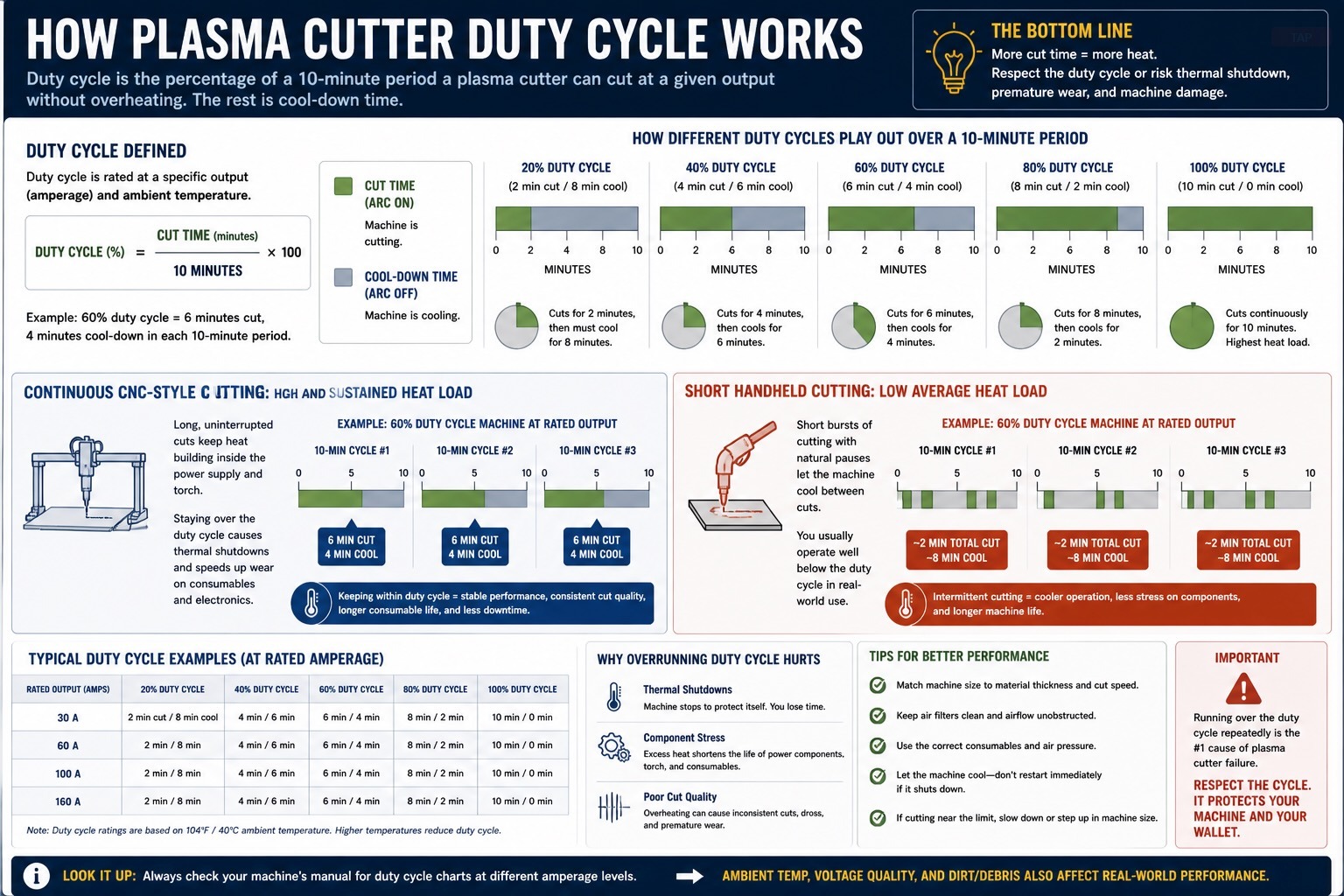
- Duty cycle: Percentage of a 10-minute cycle the unit can run at rated output before requiring cooldown. A 60% duty cycle at 60A means 6 minutes of cutting followed by 4 minutes of rest. For intermittent hobbyist cutting, 40% is typically sufficient. For production cutting or CNC use, 60% or higher is strongly preferred.
- Amperage range: Lower amps (15-20A) allow cutting thin sheet metal without excessive warping. Higher amps (50-60A) are needed for thicker plate. A wider range provides more versatility across material thicknesses.
- Pilot arc type: High-frequency (HF) start uses a high-voltage spark to initiate the arc. Non-HF (blow-back or contact start) is safer for use near sensitive electronics, CNC controllers, and computers. Per manufacturer documentation, non-HF start is required for CNC plasma table use.
- Torch type: Hand torches are designed for freehand cutting. Machine torches mount to CNC tables or track cutters for automated cuts. Some units include both; others require purchasing a machine torch separately.
Top Plasma Cutters Under $1000
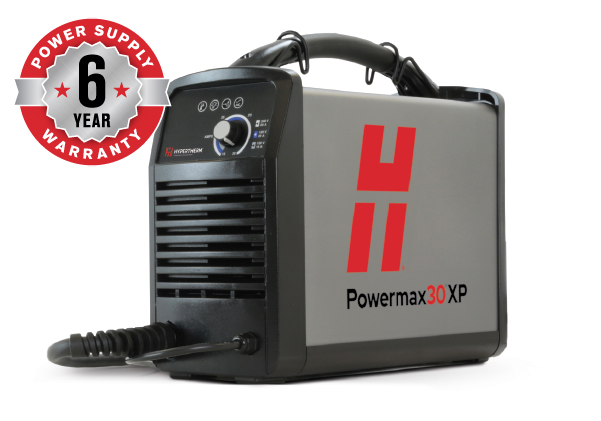
Hypertherm Powermax30 XP — Best Cut Quality
| Specification | Value |
|---|---|
| Clean Cut Capacity | 3/8” steel |
| Severance Capacity | 5/8” steel |
| Amperage Output | 15-30A |
| Duty Cycle | 50% at 30A |
| Input Power | 120V / 240V (auto-sensing) |
| Air Requirements | 4.0 CFM at 90 PSI |
| Torch Type | Hand torch (Duramax LT) |
| Weight | 21 lbs |
| Warranty | 3 years |
| Price Range | $900-1000 |
According to Hypertherm’s specifications, the Powermax30 XP delivers a cut quality that outperforms many 50A units on thinner materials. Their proprietary SmartSense™ technology automatically adjusts gas pressure based on torch lead length and mode (cutting vs. gouging). Per Hypertherm’s published data, the Duramax LT torch is drag-cut capable, meaning the nozzle can rest directly on the workpiece for straighter cuts without a standoff guide.
Consumable costs are higher than competitors — electrode and nozzle sets run $15-22 per set from Hypertherm — but the company’s testing data indicates longer consumable life (2-3 hours of active cutting) compared to budget alternatives. Third-party consumables are available at lower cost, though Hypertherm’s documentation cautions that non-OEM consumables may reduce cut quality and torch life.
One notable limitation: at 30A maximum output, this unit tops out at 3/8” clean cuts. For buyers who anticipate regularly cutting 1/2” or thicker material, the Powermax30 XP will fall short.
Best for: Users prioritizing cut quality on material 3/8” and under who are willing to pay premium consumable costs.
Miller Spectrum 375 X-TREME — Best Portability
| Specification | Value |
|---|---|
| Clean Cut Capacity | 3/8” steel |
| Severance Capacity | 1/2” steel |
| Amperage Output | 10-30A |
| Duty Cycle | 40% at 30A |
| Input Power | 120V / 240V (Auto-Line™) |
| Air Requirements | 4.5 CFM at 90 PSI |
| Torch Type | Hand torch (ICE-25C) |
| Weight | 22 lbs |
| Warranty | 3 years |
| Price Range | $850-950 |
Miller’s Spectrum 375 features their Auto-Refire™ technology, which per Miller’s documentation, automatically restarts the pilot arc when cutting expanded metal, grating, or perforated material — a significant convenience for maintenance and repair work where interrupted cuts are common. The Auto-Line™ power management accepts any single-phase input from 120V to 240V without manual switching.
At 22 lbs with a shoulder strap, the Spectrum 375 is designed for mobile use. Per Miller’s specifications, the unit draws only 20A on a 120V circuit at maximum output, meaning it can run on a standard household outlet without tripping breakers — though cutting capacity is reduced on 120V input.
The 40% duty cycle at 30A is the lowest among the units in this guide. For sustained cutting sessions, this unit will require more frequent cooldown breaks compared to the Everlast or YesWelder options.
Best for: Mobile fabricators, maintenance crews, and job site work where portability and multi-voltage flexibility are priorities.
Everlast PowerPlasma 60S — Best Cutting Capacity
| Specification | Value |
|---|---|
| Clean Cut Capacity | 3/4” steel |
| Severance Capacity | 1” steel |
| Amperage Output | 20-60A |
| Duty Cycle | 60% at 60A |
| Input Power | 240V only |
| Air Requirements | 5.5 CFM at 70 PSI |
| Torch Type | Machine torch included (IPT-60 style) |
| Weight | 45 lbs |
| Warranty | 5 years |
| Price Range | $700-800 |
The Everlast 60S delivers specifications that compete with units at twice its price point. Per Everlast’s data, the non-HF pilot arc is safe for use near electronics and CNC controllers. The included machine torch (as opposed to a hand torch) provides CNC compatibility out of the box — a significant value addition, since aftermarket machine torches typically cost $100-200.
At 60A output with 3/4” clean cut capacity, this unit handles substantially thicker material than the 30A Hypertherm or Miller options. The 60% duty cycle at full output also supports longer, uninterrupted cutting sessions.
The tradeoffs are weight and input power flexibility. At 45 lbs, the Everlast 60S is more than double the weight of the Hypertherm or Miller units. It also requires 240V input — there is no 120V option. Shops without 240V service will need an electrician to install a dedicated circuit (typically $200-500 depending on panel distance).
Best for: Shops needing thicker cutting capacity and CNC compatibility at a budget price, where 240V power is already available.
YesWelder CUT-55DS — Best Budget Option
| Specification | Value |
|---|---|
| Clean Cut Capacity | 1/2” steel |
| Severance Capacity | 3/4” steel |
| Amperage Output | 10-55A |
| Duty Cycle | 60% at 55A |
| Input Power | 220V only |
| Air Requirements | 4.5 CFM at 65 PSI |
| Torch Type | Hand torch (AG-60 style) |
| Weight | 26 lbs |
| Warranty | 2 years |
| Price Range | $350-450 |
YesWelder’s CUT-55DS offers entry-level pricing with mid-range specifications. According to YesWelder’s documentation, it features non-HF arc start and a 2T/4T trigger mode — 2T for short cuts (press to start, release to stop) and 4T for extended cuts (press to start, release to continue, press again to stop), reducing hand fatigue during longer operations.
Consumables use a common AG-60 compatible design, widely available from third-party suppliers at $1-3 per piece. This dramatically lowers the ongoing cost of ownership compared to Hypertherm or Miller proprietary consumables.
The tradeoff is build quality and support. YesWelder offers a 2-year warranty versus 3-5 years from the established brands. Replacement parts availability and long-term service support are less certain. For occasional hobby use, this may be an acceptable tradeoff. For daily production cutting, the risk calculus shifts toward the established brands.
Best for: Beginners and hobbyists on a strict budget who want capable specifications without the premium brand price.
Used and refurbished plasma cutters from Hobart, Miller, and Hypertherm are often available on eBay → at significant discounts versus new pricing.
Full Comparison Table
| Specification | Hypertherm 30 XP | Miller 375 | Everlast 60S | YesWelder 55DS |
|---|---|---|---|---|
| Clean Cut | 3/8” | 3/8” | 3/4” | 1/2” |
| Severance | 5/8” | 1/2” | 1” | 3/4” |
| Amperage | 15-30A | 10-30A | 20-60A | 10-55A |
| Duty Cycle | 50% @ 30A | 40% @ 30A | 60% @ 60A | 60% @ 55A |
| Input Power | 120/240V | 120/240V | 240V only | 220V only |
| Air (CFM/PSI) | 4.0 / 90 | 4.5 / 90 | 5.5 / 70 | 4.5 / 65 |
| Torch Type | Hand | Hand | Machine | Hand |
| Weight | 21 lbs | 22 lbs | 45 lbs | 26 lbs |
| Warranty | 3 years | 3 years | 5 years | 2 years |
| Price | $900-1000 | $850-950 | $700-800 | $350-450 |
Input Power Considerations
Input power is a frequently overlooked specification that can determine whether a plasma cutter actually works in a given shop.
- 120V / 240V dual-voltage units (Hypertherm, Miller) offer flexibility. They can run on a standard 120V household outlet for lighter work and switch to 240V for full-rated output. This matters for mobile fabricators or garage shops without dedicated 240V circuits.
- 240V-only units (Everlast, YesWelder) require a dedicated circuit. According to the National Electrical Code, a 60A plasma cutter on 240V typically needs a 30-40A breaker and appropriate wiring. If the shop panel is full or distant from the work area, installation costs can add $200-500 to the total investment.
- Circuit breaker sizing: Per manufacturer specifications, the Hypertherm 30 XP draws 20A at 120V and 10A at 240V. The Everlast 60S draws 32A at 240V. Undersized circuits will trip breakers during cutting, especially at higher amperages.
For buyers without existing 240V service in their shop, the total cost of ownership for a 240V-only unit should include the electrical installation cost.
Air Compressor Requirements
None of the plasma cutters in this guide include a built-in compressor. An external air supply is required, and an undersized compressor is one of the most common causes of poor cut quality and premature consumable wear.
Minimum compressor sizing by unit:
| Unit | CFM Required | PSI Required | Recommended Compressor Size |
|---|---|---|---|
| Hypertherm 30 XP | 4.0 | 90 | 20+ gallon, 5+ CFM @ 90 PSI |
| Miller 375 | 4.5 | 90 | 20+ gallon, 6+ CFM @ 90 PSI |
| Everlast 60S | 5.5 | 70 | 30+ gallon, 7+ CFM @ 90 PSI |
| YesWelder 55DS | 4.5 | 65 | 20+ gallon, 6+ CFM @ 90 PSI |
According to manufacturer documentation, compressor CFM ratings should exceed the plasma cutter’s requirement by at least 25% to account for pressure drops in lines, fittings, and filters. A compressor rated at exactly the minimum will struggle to keep up during continuous cutting, leading to pressure drops that degrade cut quality.
Air quality matters as much as quantity. Per Hypertherm’s technical documentation, moisture and oil in the air supply are the leading causes of premature consumable failure. A moisture separator (inline filter) is considered essential. For humid climates or heavy use, a refrigerated air dryer ($150-400) can extend consumable life significantly. Contaminated air causes the electrode and nozzle to erode faster, increasing long-term operating costs.
Buyers who do not already own a suitable compressor should budget $300-600 for a 20-30 gallon unit with adequate CFM — a cost that may shift the overall value calculation between models.
Consumable Costs and Long-Term Ownership
Consumable costs are an ongoing expense that varies dramatically between brands. Over a year of regular use, consumable spending can approach or exceed the initial cost of a budget plasma cutter.
| Brand | Electrode Cost | Nozzle Cost | Est. Life per Set | Annual Cost (moderate use) |
|---|---|---|---|---|
| Hypertherm (OEM) | $8-12 | $6-10 | 2-3 hours cutting | $200-400 |
| Miller (OEM) | $6-10 | $5-8 | 1.5-2 hours | $175-350 |
| Everlast (OEM) | $3-5 | $2-4 | 1-1.5 hours | $100-250 |
| YesWelder / AG-60 | $2-3 | $1-2 | 1 hour | $75-200 |
Consumable life varies significantly based on amperage, material type, air quality, and cutting technique. Annual cost estimates assume approximately 2-4 hours of active cutting per week.
Per manufacturer documentation, factors that accelerate consumable wear include: cutting at maximum amperage for extended periods, poor air quality (moisture or oil contamination), excessive piercing (starting cuts in the middle of material rather than from an edge), and allowing the arc to extinguish and re-strike repeatedly.
Total cost of ownership perspective: The YesWelder CUT-55DS at $350 with $150/year in consumables costs roughly $650 over two years. The Hypertherm Powermax30 XP at $950 with $300/year in consumables costs roughly $1,550 over two years. However, the Hypertherm’s superior cut quality may reduce grinding and cleanup time — a labor cost that is harder to quantify but relevant for production work.
Who This Is NOT For
Plasma cutters under $1000 are capable machines, but they are not the right tool for every cutting application. Consider alternatives if:
-
The primary work involves material over 1” thick. Even the Everlast 60S tops out at 1” severance capacity with a rough edge. For regular cutting of 1”+ steel plate, an oxy-fuel torch ($200-400 for a quality setup) has no thickness limit and lower operating costs on thick material. According to AWS data, oxy-fuel is more economical than plasma on steel thicker than 1”.
-
Precision CNC cutting with tight tolerances is required. While the Everlast 60S includes a machine torch, sub-$1000 plasma cutters generally lack the arc voltage height control (THCAD) integration and consistent cut quality needed for precision CNC work with tolerances under 0.020”. For buyers considering a CNC setup, see our guide to CNC plasma tables for table and plasma source pairing, and the CrossFire PRO vs XR comparison for a specific table sizing decision. Industrial CNC plasma systems from Hypertherm (Powermax45 XP and above) or dedicated CNC units start around $1,500-2,500 and offer significantly better cut consistency.
-
The budget cannot accommodate a compressor. Plasma cutting requires clean, dry compressed air. Without an existing compressor, the additional $300-600 for a suitable unit pushes total investment well above the machine cost alone. Shops running plasma cutters alongside air tools and sandblasters should consider a rotary screw compressor for continuous duty. For occasional cuts, an angle grinder with a cut-off wheel ($50-100) or a reciprocating saw with metal blades may be more practical.
-
Non-conductive materials need to be cut. Plasma only cuts electrically conductive metals — steel, aluminum, stainless, copper, brass. It cannot cut wood, plastic, stone, or other non-conductive materials.
-
The shop lacks adequate ventilation. Per OSHA guidelines (29 CFR 1910.252), plasma cutting generates metal fumes, UV radiation, and fine particulate that require either outdoor cutting, forced ventilation, or a fume extraction system. Cutting galvanized steel produces zinc oxide fumes that are particularly hazardous. Enclosed garage cutting without ventilation is a serious health risk.
Safety Considerations
According to OSHA and AWS safety guidelines, plasma cutting requires:
- Welding helmet with appropriate shade (typically shade 5-8 for plasma, depending on amperage — higher amps require darker shade)
- Leather gloves and long sleeves (synthetic fabrics can melt)
- Proper ventilation or fume extraction, especially for galvanized, stainless, or painted material
- Fire-resistant work surface — plasma cutting produces molten metal spray that travels several feet
- Clear area free of combustibles within a 35-foot radius per OSHA recommendations
- Hearing protection when cutting at higher amperages (plasma arc noise can exceed 90 dB)
Frequently Asked Questions
How thick can a plasma cutter cut?
Cutting capacity depends on the unit’s amperage. According to manufacturer specifications, a 30-amp plasma cutter cleanly cuts up to 3/8-inch steel, a 55-amp unit handles up to 1/2 inch, and a 60-amp unit manages up to 3/4 inch with a clean edge. Severance capacity (rough cuts requiring cleanup) is typically 1/4 to 3/8 inch beyond the clean cut rating.
Do I need an air compressor for a plasma cutter?
Yes. All plasma cutters in this guide require an external compressed air supply — none include a built-in compressor. Per manufacturer documentation, the minimum requirement is typically 4.0-5.5 CFM at 65-90 PSI, which means a 20-30 gallon compressor rated at least 25% above the plasma cutter’s CFM requirement. Buyers without an existing compressor should budget $300-$600 for this additional equipment.
What is duty cycle on a plasma cutter?
Duty cycle is the percentage of a 10-minute period that the unit can operate at rated output before requiring cooldown. A 60% duty cycle at 60 amps means 6 minutes of cutting followed by 4 minutes of rest. According to manufacturer specifications, 40% duty cycle is adequate for intermittent hobbyist use, while 60% or higher is recommended for production cutting or CNC table operation.
What You’ll Also Need
- Plasma cutter consumables kit — nozzle and electrode — Nozzles and electrodes are wear items that degrade with each start; a fresh set restores cut quality, reduces dross, and prevents torch damage from arcing inside a worn nozzle. Search: “plasma cutter consumables,” “plasma cutter tip and electrode kit.” Check price on Amazon →
- Plasma cutter nozzle replacement — The nozzle orifice erodes from the plasma arc and should be inspected every few hours of cutting; a worn nozzle produces a wider, less focused arc that increases kerf width. Search: “plasma cutter nozzle replacement,” “plasma cutting nozzle tip.” Check price on Amazon →
- Plasma cutter electrode replacement — The hafnium insert in the electrode wears with each arc start; manufacturer specs typically recommend replacement when the pit depth exceeds 1/16 inch to prevent torch body damage. Search: “plasma cutter electrode replacement,” “plasma cutter electrode hafnium.” Check price on Amazon →
- Inline air dryer and filter — plasma cutter — Moisture in the air supply is the leading cause of poor cut quality and premature consumable failure; a coalescing filter and desiccant dryer in the air line protects the torch. Search: “air dryer filter plasma cutter,” “inline air filter moisture separator plasma.” Check price on Amazon →
- Plasma cutting circle guide — A circle-cutting guide attaches to the torch and pivots around a center pin to cut precise circles and arcs; essential for flanges, hole plates, and decorative work. Search: “plasma cutting guide circle,” “plasma cutter circle cutting attachment.” Check price on Amazon →
- Drag shield — plasma cutter torch — A drag shield allows the torch tip to contact the work surface while maintaining the correct standoff distance; critical for consistent cuts on thin material and for new operators developing technique. Search: “plasma cutter drag shield,” “plasma torch drag cup shield.” Check price on Amazon →
Sources
- Hypertherm Powermax30 XP technical specifications and operator manual
- Miller Spectrum 375 X-TREME product data sheet
- Everlast PowerPlasma 60S specifications and user documentation
- YesWelder CUT-55DS product documentation
- American Welding Society (AWS) — Welding Handbook, Volume 2: Welding Processes
- OSHA 29 CFR 1910.252 — General Requirements for Welding, Cutting, and Brazing
- National Electrical Code (NEC) Article 630 — Electric Welders