Best Rotary Screw Air Compressors for Small Shops in 2026
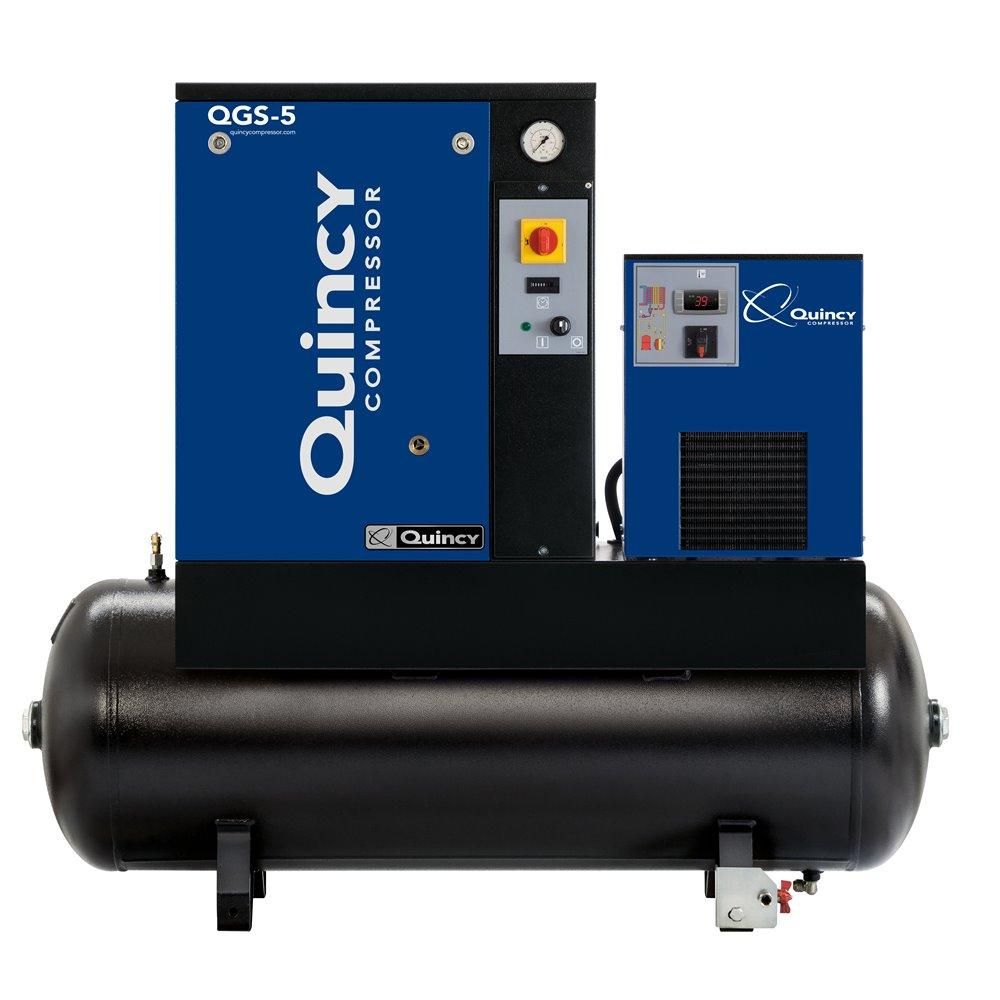
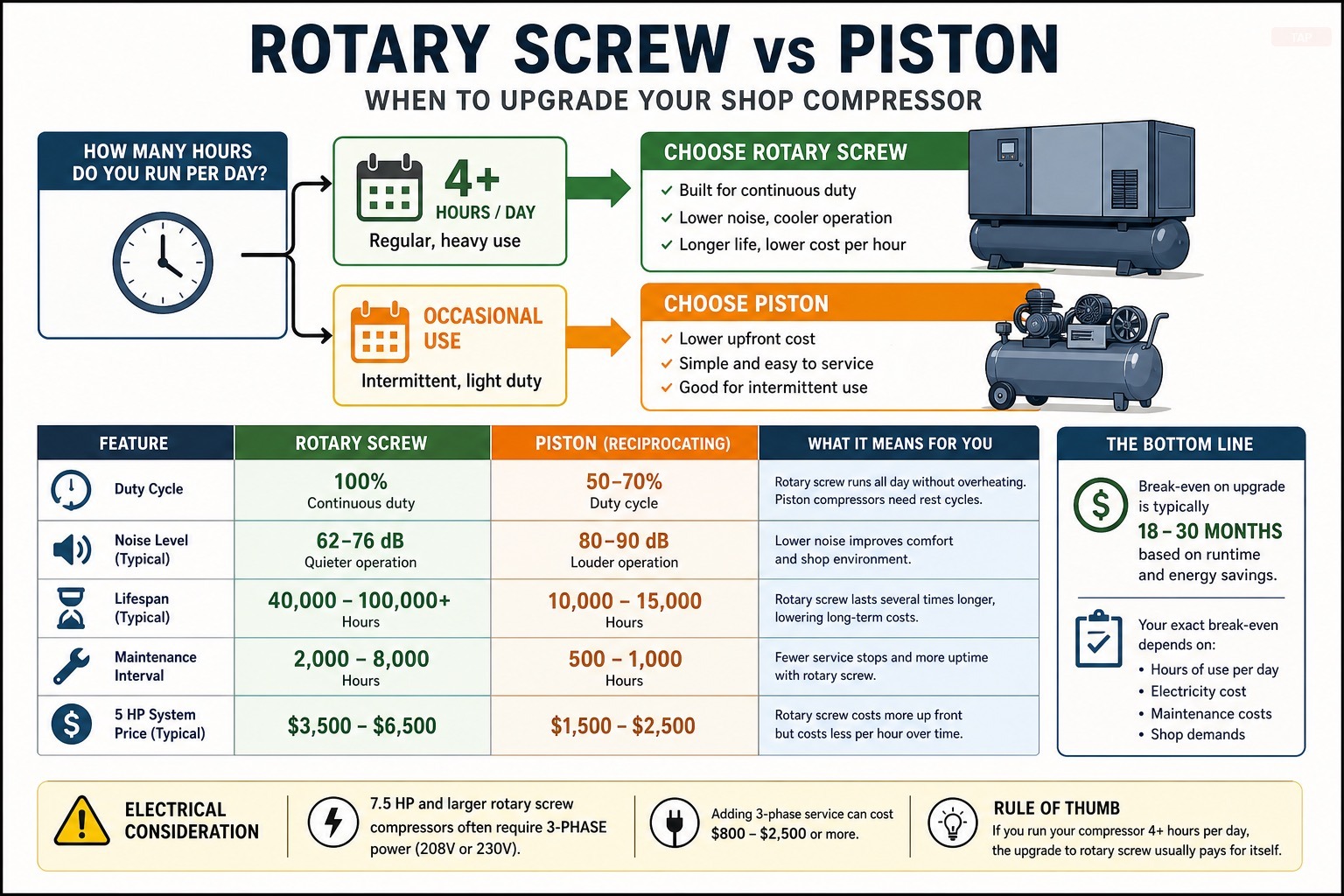
The best rotary screw air compressor for a small shop is the one whose published CFM, at the PSI the tools use, covers the tools that run together for the hours they run. That duty decision comes before the brand. A 5 HP screw fits when blast, spray, or plasma-plus-tools need air across a shift and the building has 230V. Nailers, tire fills, and short impacts do not clear that bar.
What the shortlist is judged on: CFM at a stated PSI, duty cycle, 230V single-phase versus three-phase, noise where the maker prints it, tank included or not, belt versus another drive, and whether Amazon is even a checkout.
- Small-shop screw: Quincy QGS-5. Current model-spec table: 16.8 ACFM at 145 psig, 5 HP, 62 dBA, 60-gallon receiver, V-belt, 100% duty cycle. Quincy’s CAGI index still lists a single-phase sheet and a three-phase sheet, both at 145 PSI.
- Service channel: Ingersoll Rand UP6-5-125. IR’s shop lists 14.9 CFM at 125 PSI max, including 230V single-phase.
- Higher airflow: Atlas Copco G5. The US CAGI sheet dated February 29, 2024 (G5-145 Single Phase) lists 25.2 acfm at 138 psig and a 7 hp nominal motor. The old 5 HP / 15.4 CFM / 62 dB description does not match that sheet.
- Not the default single-phase fab shop: Kaeser SX 5. 21.2 cfm at 125 psig, 63 dB(A), and no receiver on the base row. The US page does not print phase.
- Intermittent use or 120V: do not buy a screw. Quincy QT-54 (15.2 ACFM at 175 PSIG) is the 230V piston example. The usual exit is the shop air compressor guide.
120V nailers, impacts, and light spray belong on that guide. California Air Tools, Makita, Rolair, and DeWalt classes are reviewed there. Their specs are not copied here.
Best Rotary Screw Air Compressor: CFM at PSI and Duty Cycle
Demand marked “typical” is a planning range. Plasma and blast figures point at this site’s guides.
| Your shop | Simultaneous demand | Duty | Buy |
|---|---|---|---|
| Brad nailer, tire fill, short impacts a few times a day | Low single-digit CFM at 90 PSI (typical; read the tool plate) | Minutes | Piston — shop air compressors |
| Die grinder and impact in bursts, a few hours a day or less | Mid single digits to low teens at 90 PSI (typical). Add only tools that run together | Intermittent | QT-54 class or the shop-air page |
| HVLP on panels, a small blast cabinet, or plasma plus hand tools across a shift | Teens of CFM at the gun or machine pressure. Cutters on the plasma guide publish about 4.0–5.5 CFM. Pressure cabinets on the sandblaster guide are often 14–18 CFM at 90 PSI | Hours | 5 HP-class screw if 230V matches. QGS-5 publishes 16.8 ACFM at 145 psig only |
| Several bays or about 25 CFM continuous | Above the QGS-5 point. QGS-7.5 is 25.3 ACFM at 145 psig on the same Quincy table | All day | Dealer sizing. Not a 25–60 HP plant review |
- Read CFM at the PSI the tool needs. A 145 or 175 PSI rating is not a 90 PSI rating. Quincy does not publish a 100 PSI point for the QGS-5.
- Add simultaneous tools only.
- 100% duty cycle means loaded running is allowed continuously. It does not turn 16.8 ACFM into 25 ACFM.
- Piston duty is not one number. Quincy rates the QT 5–15 HP line at 100% duty cycle. Many 120V pistons are intermittent. The Rolair JC10 on the shop-air guide is marketed as continuous.
Earlier CFM figures for the QGS-5 on this page, including a 22 CFM line in the fab and body sections, are withdrawn. Reseller sheets still disagree with each other. Every QGS-5 flow number below is the current Quincy model-spec table: 16.8 ACFM at 145 psig.
| Quincy QT piston | Screw shortlist | |
|---|---|---|
| Duty | QT 5–15 HP: 100% (QT page) | QGS page: 100%. UP6, G5, and SX sheets checked here do not print a percent |
| Noise | Not on the QT model table | QGS-5 62 dBA. SX 5 63 dB(A). UP6 shop page and the G5 CAGI sheet do not print dB |
| Service | Splash-lubricated piston | QGS: 8,000-hour synthetic fluid |
| Price snapshot | QT-54 60-gal about $1,999–$2,374 | QGS-5 tank-mount $7,435. UP6-5-125 80-gal 230V 1-phase $8,452 on IR’s shop, before shipping and tax |
| Air | 15.2 ACFM at 175 PSIG | Lubricated screws. Dryer and filter are extra unless the quote includes them |
| Checkout | 120V: shop-air page. QT-54: dealer or eBay | Dealer or eBay |
A maintenance-dollar savings and an 18-to-30-month payback used to be attributed to Quincy and Ingersoll Rand. They are not on the sheets above.
When a Piston Compressor Wins
Under a few hours a day, or under about 10 CFM continuous, buy a piston. A screw that sits unloaded is 100% duty you are not using. Amazable 120V units are on the shop air compressor guide: California Air Tools, Makita, Rolair, and DeWalt. See that guide. Specs are not repeated here.
230V, still bursty. The Quincy QT-54 is the on-page two-stage example. Quincy’s table: 5 HP, single-phase 208/230V, vertical simplex, 15.2 ACFM at 175 PSIG, 1,350 RPM, about 350 lb, 60-gallon tank (an 80-gallon row is listed too). The QT 5–15 HP series is 100% duty cycle rated. That rating does not make it a screw. The flow point is 175 PSIG, the pump is a piston, and the price is different. Dealers checked 2026-09-30: $1,999 at TP Tools and FactoryPure, $2,373.99 at Eastwood. Quincy prints no street price and no sound level on that row. The QTS-5 row (18.4 ACFM at 100 PSI) is a different pump.
Buy the QT-54 from a dealer or eBay. This refresh did not find an Amazon page for that pump.
120V only. No screw here runs on 120V. QGS-5, UP6-5, and G5-145 single-phase packages are 230V. Use the shop air compressor guide. A phase converter is an electrician’s job. This page does not price one or treat it as a way onto a three-phase plant compressor.
Low annual hours. The threshold this page uses is under about 500 hours a year. That is a buying line, not a Quincy specification. At that use, a QGS-5 tank-mount near $7,435 does not have the hours against a QT-54 near $2,000–$2,400 or a 120V piston.
Cheapest rotary screw is the same fork. When the table says piston, the lower-cost correct machine is the piston. There is no import-screw bargain list here.
Key Specs for Shop Buyers
CFM at pressure, not horsepower. Match rated CFM at the tool pressure to tools that run at the same time.
Noise. Quincy prints 62 dBA on the QGS-5. Kaeser prints 63 dB(A) on the SX 5. The UP6 shop listing and the 2024 G5 CAGI sheet do not print a decibel, so those two are not noise-ranked.
Electrical:
| Package | Current sheet |
|---|---|
| QGS-5 | CAGI: 5 HP, 1PH and 3PH, 145 PSI. Dealer part QGS 5 TM-1 is 230V single-phase |
| QGS-7.5 | CAGI: 1PH and 3PH. 25.3 ACFM at 145 psig. 7.5 HP is not “almost always three-phase” |
| UP6-5-125 | 230V 1-phase, 230V 3-phase, 460V 3-phase |
| G5-145 | CAGI title: Single Phase. 7 hp nominal motor |
| SX 5 | Phase not printed. Base unit has no receiver. Not the default single-phase fab-shop package |
Fluid and tank. QGS: 8,000-hour synthetic fluid, and a 60-gallon receiver on the model-spec row. Base-mount and tank-mount-with-dryer are separate configurations. A 100% duty rating does not delete the receiver when several tools hit at once. The SX 5 base row is the case with no receiver.
Drive. The current QGS page specifies a long-life V-belt on the 5–40 HP range. The QGS-5 is that belt-drive package. Quincy’s variable-speed QGSV line is a different family.
Top Rotary Screw Compressors for Small Shops
Quincy QGS-5 — Best small-shop screw on 230V
The 5 HP single-phase package is still on Quincy’s CAGI index.
| Spec | Quincy QGS page unless noted |
|---|---|
| Flow | 16.8 ACFM at 145 psig (only point on the 5 HP row) |
| Noise / duty / drive | 62 dBA · 100% duty · V-belt |
| Power | 5 HP. Single-phase and three-phase CAGI sheets. QGS 5 TM-1 is 230V, 1 phase |
| Tank / fluid | 60 gal on the spec row. Also base-mount, and tank-mount with dryer. 8,000-hour synthetic fluid |
| Warranty | True Blue 5-year with authorized startup: drive motor, airend, air and fluid heat exchanger, air/fluid receiver |
| Price | Not on Quincy’s page. $7,435 QGS 5 TM-1 at Compressor World and ASE Deals. $7,107 base-mount and $10,371 with dryer at Compressor World |
Quincy describes low oil carryover, synthetic fluid, and an air/fluid receiver. That is a lubricated screw. A dryer does not make it oil-free. The $7,435 figure is the tank-mount without the dryer.
Where to buy: a Quincy dealer, or eBay. Amazon ASIN B00CRVKGU4 (model 4152002723, titled as this 5 HP 230V single-phase package) was unavailable with no featured offer on 2026-09-30. It is not the checkout. A 15–25 HP QGS listing is a different machine.
Best for: a small fab, body, or farm shop on 230V whose simultaneous load fits inside 16.8 ACFM at 145 psig and runs for hours.
Ingersoll Rand UP6-5 — Service-channel 5 HP
The UP6-5-125 is a current IR shop product.
| Spec | IR shop, UP6-5-125 |
|---|---|
| Flow / pressure | 14.9 CFM, 125 PSI max. The 150 PSI row (UP6-5-150) is 12.9 CFM |
| Drive | Poly-V belt |
| Power | 5 HP. 230V single-phase, 230V three-phase, 460V three-phase |
| Tank / dryer | 80 or 120 gal horizontal. Total Air System dryer is optional, not on the base SKU |
| Duty / noise | Not printed on the shop listing |
| Price | $8,452 for 230V, 1-phase, 80 gal, excluding shipping and tax. Shop text: ship in about 7–10 business days |
The old 18.5 CFM at 125 PSI line does not match this shop rating. Use 14.9 CFM at 125 PSI max for the UP6-5-125. The reason to pay more than a QGS-5 tank-mount is IR’s own sales and service channel, not a higher CFM. This page does not claim a dealer-count ranking.
Where to buy: IR’s shop or eBay.
Best for: a 5 HP screw bought from the company that also services it, at 14.9 CFM and 125 PSI.
Atlas Copco G5 — Higher flow on a single-phase sheet
| Spec | 2024-02-29 CAGI sheet, G5-145 Single Phase |
|---|---|
| Flow | 25.2 acfm at 138 psig. Maximum full-flow pressure 145 psig |
| Motor | 7 hp nominal. Dealers often advertise the family as 7.5 HP |
| Type | Lubricated rotary screw |
| Duty / noise | Not on this sheet |
| Tank / dryer | Not on the sheet. Full Feature means the dryer is in that package. One dealer (part 8152103805) describes a 53-gallon tank-mount; that is one listing, not the only build |
| Price | Not on the sheet. Portland Compressor listed a G5-145T 230V single-phase tank-mount at $8,596.88 (list $13,755) |
The G5 is the step up in published airflow from the 5 HP QGS and UP6, still lubricated, with a single-phase CAGI sheet. It is not called quietest here. The sheet this page cites has no decibel.
Where to buy: an Atlas Copco dealer, or eBay. No ASIN.
Best for: simultaneous load past 16.8 ACFM at 145 psig, still on single-phase, after sound level and tank are on the quote.
Kaeser SX 5 — 21.2 cfm at 125 psig, receiver extra
| Spec | Kaeser US SX 5 page |
|---|---|
| Flow | 21.2 cfm at 125 psig, 17.0 at 160, 12.7 at 217 |
| Noise | 63 dB(A) |
| Base unit | 23 × 25 × 38 in, 320 lb. No receiver on this row |
| With dryer / tank | SX 5T is Kaeser’s integrated-dryer description. AIRCENTER adds dryer, receiver, and optional filtration (23 × 43 × 62 in, 639 lb on that row) |
| Airend | Kaeser attributes the design to its SIGMA PROFILE airend. That stays Kaeser’s claim |
| Phase / price | Not printed |
A two-person shop on 230V single-phase should start with the QGS-5 or UP6-5, where phase and tank are on a current sheet. An SX 5 quote has to show motor voltage and the receiver line before it is comparable to a tank-mounted QGS-5.
Where to buy: a Kaeser dealer, or eBay.
Best for: a buyer who wants the published 21.2 cfm at 125 psig and will spec phase, tank, and dryer. Not the default single-phase fab shop.
Comparison Table
These CFM cells are not one test pressure. The PSI is part of the number.
| Model | Type | CFM at stated PSI | Duty | Noise | Electrical | Tank | Dryer | Price (2026-09-30) | Where to buy |
|---|---|---|---|---|---|---|---|---|---|
| Quincy QGS-5 | Lubricated screw, V-belt | 16.8 ACFM at 145 psig | 100% | 62 dBA | 1PH and 3PH sheets; TM-1 is 230V 1-phase | 60 gal tank-mount | Option | $7,435 tank-mount; $10,371 with dryer | Dealer or eBay |
| IR UP6-5-125 | Oil-flooded screw, Poly-V belt | 14.9 CFM, 125 PSI max | Not printed | Not printed | 230V 1-phase and 3-phase; 460V 3-phase | 80 or 120 gal | Optional TAS | $8,452 on IR’s shop, 80 gal 230V 1-phase, before shipping and tax | IR shop or eBay |
| Atlas Copco G5-145 | Lubricated screw | 25.2 acfm at 138 psig (max 145) | Not printed | Not printed | Single-phase sheet, 7 hp nominal | Package-specific | Full Feature package only | One dealer: $8,596.88 / $13,755 list | Dealer or eBay |
| Kaeser SX 5 | Lubricated screw | 21.2 cfm at 125 psig (also 17.0 at 160, 12.7 at 217) | Not printed | 63 dB(A) | Not printed | Receiver extra; AIRCENTER adds one | SX 5T or AIRCENTER | Not on the spec page | Dealer or eBay |
| Quincy QT-54 | Two-stage piston | 15.2 ACFM at 175 PSIG | 100% on the QT 5–15 HP line | Not printed | 208/230V, 1 phase | 60 gal vertical (80 gal listed) | No | About $1,999–$2,374 | Dealer or eBay |
Best Fit by Shop Type
Fabrication. Plasma cutters on the plasma guide publish about 4.0–5.5 CFM. That load alone does not require a screw. The screw question is plasma plus grinders across a shift, sized against 16.8 ACFM at 145 psig (QGS-5) or 14.9 CFM at 125 PSI (UP6-5-125). This page does not rank cutters.
Auto body. HVLP CFM belongs on the gun plate, usually at low gun pressure, often described in the teens. That pressure is not 145 PSI, so 16.8 ACFM at 145 psig is not an automatic pass for every gun. Hours of spraying are the screw case. Occasional spraying stays on the QT-54 or the shop-air page.
Machine shop. Downstream moisture and oil are a dryer and filter problem. These four screws are lubricated. Dry air here means a dryer and filtration, not an oil-free compressor. G5 Full Feature and QGS TMD include a dryer. Base QGS and base UP6 do not.
Cabinet shop. A pocket-hole jig or a few clamps do not require a screw. Stay on the shop air compressor guide until several stations run air for hours.
Farm shop. Tire fills and impacts a few times a week stay on the shop-air page. Step up for blast or all-day air in the busy season. Nozzle CFM is on the sandblaster guide. This is not a tractor page.
Tire bays. Several impacts at once can pass the QGS-5’s 16.8 ACFM at 145 psig. A 1/2-inch impact is often in the mid single digits of CFM at 90 PSI (typical; read the tool). Four bays are a different sum, and 90 PSI is not 145 PSI. Continuous demand at that level is a QGS-7.5 conversation (25.3 ACFM at 145 psig, single-phase sheet available), not a bigger number written onto the 5 HP row.
Who This Is NOT For
- Weekend use, under about 500 hours a year. Piston: QT-54 or the shop air guide.
- 120V circuits. These screws are 230V. The 120V exit is the shop-air guide.
- Continuous demand past the 5 HP sheets. Ceiling on the QGS-5 row is 16.8 ACFM at 145 psig. UP6-5-125 is 14.9 CFM at 125 PSI. Next published steps are QGS-7.5 (25.3 ACFM at 145 psig) and G5 (25.2 acfm at 138 psig).
- 25–60 HP plant compressors and VSD lead-lag systems. Out of scope.
- Cheapest screw on Amazon, with no duty-cycle need. Buy the piston. A large three-phase QGS with an ASIN is not this shop’s machine.
A shop running air tools, a MIG welder, and a plasma cutter across a full day on 230V is the reader the shortlist is for. The screw does not choose the welder. It keeps the compressor from being why the plasma or the gun waits on the tank.
What You’ll Also Need
Prices move. Confirm them on the listing.
- Flexzilla Pro 3/8 in. × 50 ft (ASIN B007QV1UDW): $32.54 and in stock on Amazon when checked. A 3/8 in. hose is the shop default once the drop is more than a few feet away. Amazon listing.
- Milton S-210-class couplers: Amazon search slot, not one fixed kit ASIN. Fittings.
- Wilkerson-class filter, regulator, and lubricator: point-of-use pressure, plus oil for tools that call for it. Amazon search slot. FRL.
- Refrigerated dryer: paint, powder, and machine tools. Hankison HPR-class link is eBay, not an Amazon SKU. A QGS with dryer was $10,371 (QGS 5 TMD-1) against $7,435 without, at Compressor World. Dryer listings.
If the quote is already a G5 Full Feature or a QGS TMD, do not add a second dryer without a reason. This page does not rank dryers.
Frequently Asked Questions
What is the best rotary screw air compressor for a small shop?
For continuous CFM on 230V, the Quincy QGS-5: 16.8 ACFM at 145 psig, 5 HP, 62 dBA, 60-gallon tank-mount, belt drive, 100% duty, with single-phase and three-phase CAGI sheets. Intermittent use or 120V goes to the shop air compressor guide or the QT-54.
When should I buy a piston compressor instead?
Intermittent use, under about 10 CFM continuous, low annual hours, or 120V. The 120V classes are on the shop air compressor guide. On 230V with bursty high-pressure work, the QT-54 is 15.2 ACFM at 175 PSIG, about $1,999–$2,374 at the dealers checked here.
What does CFM at PSI mean, and why isn’t horsepower enough?
CFM is volume at a stated pressure. The QGS-5 point is 16.8 ACFM at 145 psig. Horsepower does not identify that pressure, and a withdrawn 22 CFM line is not the sheet. Add only simultaneous tools.
What is a 100% duty cycle?
The compressor is rated to run loaded without a mandatory rest. CFM stays the same. Quincy prints 100% on the QGS and on the QT 5–15 HP piston line. Other pistons are intermittent. Read the pump.
Can I run a 5 HP rotary screw on single-phase 230V?
Yes for the QGS-5 (CAGI 1PH sheet and dealer TM-1), the UP6-5-125 (IR shop, 230V, 1 phase), and the G5-145 Single Phase sheet. All are 230V, not 120V. Quincy also lists a single-phase QGS-7.5, so 7.5 HP is not automatically three-phase. The SX 5 page does not print phase.
How many hours a day before a rotary screw is worth the price?
Those sheets do not say. The gap from about $1,999–$2,374 (QT-54) to $7,435 (QGS-5 tank-mount) is the number, before dryer and electrical. Hours of real CFM demand justify the screw. Bursts, or under about 500 hours a year, justify the piston. A four-hour workshop rule of thumb is not a Quincy or IR specification.
Is a used rotary screw a good idea?
Only after hours, airend, and tank are checked in the used shop air compressor buying guide. This page does not repeat that list. eBay compressor listings are a search, not an inspected machine.
Related Guides
- Best shop air compressors — 120V and small pistons when a screw is the wrong tool.
- Used shop air compressors buying guide — hours, airend, and tank before any used purchase.
- Best plasma cutters under $1,000 — cutter CFM, not compressor rankings.
- Best sandblasters for home shops — cabinet CFM that often decides whether 5 HP is enough.
- Best MIG welders for beginners — the welding choice, separate from the air supply.