Best Angle Grinders Under $100 (2026): Picks for Shop & Fab Work
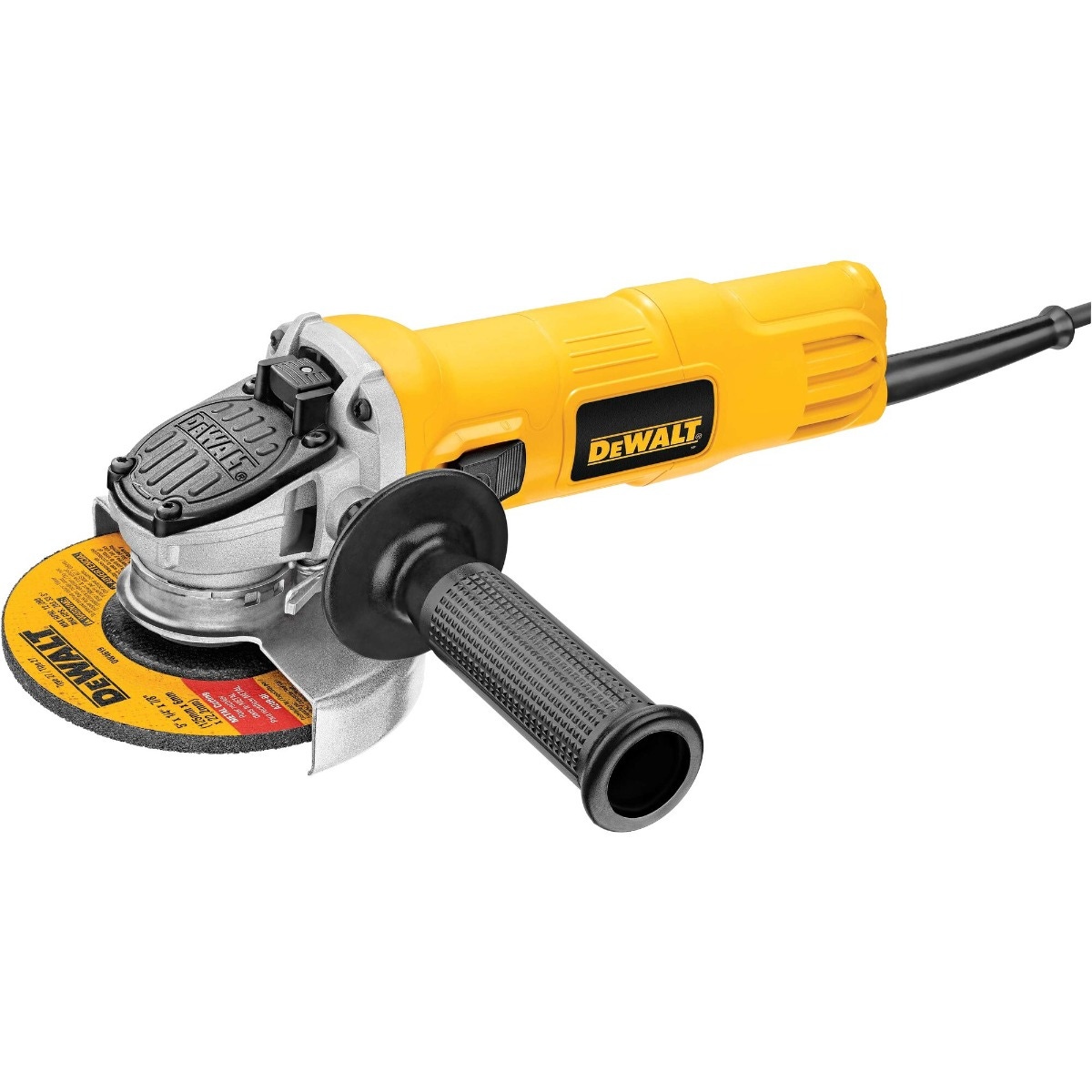
The fast answer: for most buyers under $100, the DeWalt DWE4011 ($45-$65) is the right pick — 4.0 lbs, 12,000 RPM, paddle (deadman) switch, 3-year warranty. Step up to the Bosch GWS13-50VS ($85-$100) if you need variable speed and 13-amp power; drop to the Milwaukee 6130-33 ($40-$55) if light weight and a 5-year warranty matter more than the safer paddle switch.
Check DeWalt DWE4011 price on Amazon →
Top 5 Sub-$100 Angle Grinders at a Glance
| Pick | Model | Price | Amps | Weight | Switch | Warranty |
|---|---|---|---|---|---|---|
| Best overall | DeWalt DWE4011 | $45-$65 | 7 | 4.0 lbs | Paddle | 3 yr |
| Best value kit | Makita 9557PBX1 | $65-$85 | 7.5 | 4.5 lbs | Paddle + lock-on | 1 yr |
| Lightest + longest warranty | Milwaukee 6130-33 | $40-$55 | 7 | 3.5 lbs | Slide | 5 yr |
| Heaviest cutting | Metabo HPT G12SE2 | $50-$70 | 9.5 | 4.6 lbs | Slide | 5 yr |
| Variable speed | Bosch GWS13-50VS | $85-$100 | 13 | 4.8 lbs | Paddle + lock-on | 1 yr |
An angle grinder under $100 handles the tasks that justify the purchase for most shop owners: cutting rebar, grinding weld beads, cleaning rust, shaping metal stock, and preparing surfaces for paint or welding. The category spans bare-bones corded models at $35 to tool-only cordless units brushing the $100 ceiling. The decision comes down to how much power, runtime, and ergonomic refinement that budget buys.
This guide evaluates five angle grinders — four corded and one cordless — all priced under $100 based on published manufacturer specifications. All claims, price ranges, and performance data are sourced from manufacturer product data sheets and publicly available documentation. Buyers weighing the corded-vs-cordless tradeoff should review the corded vs cordless angle grinder comparison before deciding; battery-platform owners considering an LXT, M18, or 20V MAX bare tool should see the best cordless angle grinders guide. For stationary sharpening, deburring, and tool-grinding work the angle grinder is the wrong tool — see the best bench grinders for home shops instead.
Quick Picks by Buyer Type
If you searched “best corded angle grinder under $100” and want the fast answer first:
- Best overall value: DeWalt DWE4011
- Best heavy-cutting option: Metabo HPT G12SE2
- Best variable-speed upgrade: Bosch GWS13-50VS
- Best kit value: Makita 9557PBX1
- Best compact grinder: Milwaukee 6130-33
For most buyers, the DeWalt wins because it gets the switch style, weight, warranty, and price balance right. The other models only move ahead if a specific use case matters more than all-around value.
Choose by workload before ranking
Treat the top-rated pick as a starting point, not a universal answer. Occasional rust removal, weld cleanup, and short cuts call for a compact 4.5-inch grinder and its widely available wheels. Repeated cutting or longer material-removal sessions shift the priority to sustained-duty capability, while a 5-inch-compatible grinder matters only when the added wheel diameter helps the cut. Set the power source after those needs: choose based on the work location and any battery platform you already use; the comparison below covers that trade-off.
Corded vs Cordless Under $100: Which One Actually Wins?
| Corded | Cordless (bare tool) | |
|---|---|---|
| True cost under $100 | Yes — power included | No — add $50–$120 battery + $30–$60 charger unless you own a matching platform |
| Sustained power | Unlimited — runs as long as plugged in | 10–25 min continuous cutting on a 2.0–5.0 Ah pack |
| Right for first-time buyers? | Yes | Only if you already own M18, 20V MAX, or LXT batteries |
| Right for platform owners? | Fine | Yes — bare tool at $60–$89 is a real deal |
| Best pick | DeWalt DWE4011 ($45–$65) | Your existing platform’s bare tool |
At this price point, corded wins for first-time buyers. The full power source is included in the purchase price, and the five corded grinders in this guide are compared head-to-head below. Cordless at sub-$100 is only defensible when a battery and charger already exist on the shelf — otherwise the “under $100” label is misleading.
RPM vs Disc Size: Why This Matters for Safety
One of the most critical — and most often overlooked — relationships in angle grinder use is the match between the grinder’s no-load RPM and the maximum RPM printed on the disc. Per ANSI B7.1 and abrasive manufacturer data, using a disc whose maximum rated RPM falls below the grinder’s no-load speed is a disc-burst hazard. The disc is engineered to withstand a specific centrifugal load; exceeding that load at speed can cause catastrophic failure.
No-Load RPM by Disc Size (Typical Ranges)
| Disc Diameter | Typical No-Load RPM Range | Notes |
|---|---|---|
| 4.5 inch (115mm) | 10,000–12,000 RPM | Most sub-$100 corded grinders; standard for general metalworking |
| 5 inch (125mm) | 9,000–10,000 RPM | Slightly lower RPM ceiling; Bosch GWS13-50VS in this category |
| 6 inch (150mm) | 8,500–9,000 RPM | Less common in sub-$100 range; typically higher-amperage tools |
The physical reason: a larger disc has more material at a greater radius. At the same RPM, the rim speed (surface velocity) of a 6-inch disc is 33% higher than a 4.5-inch disc. Abrasive wheel manufacturers design their RPM limits based on allowable rim speed, not raw RPM — which is why larger discs carry lower RPM ratings despite running on less powerful tools.
The rule: The disc’s maximum RPM rating must equal or exceed the grinder’s no-load RPM. Check the disc label and compare to the nameplate on the grinder before every installation. A 10,200 RPM-rated disc is not safe on a 12,000 RPM grinder.
Key Specifications Explained
Motor power (amps for corded, volts/Ah for cordless): For corded grinders, amperage is the primary power indicator. According to manufacturer data, most sub-$100 corded grinders fall in the 6-11 amp range. Higher amps generally mean more sustained cutting power before the motor stalls under load. For cordless, the battery voltage (18V/20V max) and amp-hour (Ah) rating determine both power output and runtime.
Disc size (4.5-inch vs 5-inch): The standard sub-$100 grinder uses 4.5-inch (115mm) discs. Some models accept 5-inch (125mm) discs, which offer slightly deeper cutting capacity — approximately 0.25 inches more depth per pass according to abrasive manufacturer specifications. Both sizes use the same 7/8-inch arbor. The 4.5-inch discs are more widely available and less expensive.
Speed (RPM): No-load speed for most 4.5-inch grinders ranges from 10,000 to 12,000 RPM. Variable-speed models can dial down to 2,800-3,000 RPM, which matters for specific applications: wire wheel work on soft metals, polishing, and surface conditioning where excessive speed damages the workpiece or loads the disc.
Paddle switch vs slide switch: Paddle switches (also called deadman switches) require continuous hand pressure to keep the grinder running — release the grip and the tool stops. Per OSHA guidelines and manufacturer safety documentation, paddle switches are the safer design because the tool cannot continue spinning if dropped or if the operator loses control. Slide switches lock in the “on” position. Some models include a lock-on button with a paddle switch, giving the operator the choice.
Corded vs cordless: At the sub-$100 price point, corded grinders deliver more sustained power per dollar. According to manufacturer specifications, a 7-amp corded grinder produces continuous output equivalent to what an 18V cordless unit delivers in short bursts. Cordless grinders at this price are typically sold as tool-only (no battery), meaning the true cost includes a $50-$150 battery and charger unless the buyer already owns compatible batteries.
Top Picks Based on Specifications
DeWalt DWE4011 — Best Overall Value
| Spec | Value |
|---|---|
| Disc Size | 4.5-inch |
| Motor | 7 Amps |
| No-Load Speed | 12,000 RPM |
| Switch Type | Paddle (deadman) |
| Spindle Thread | 5/8”-11 |
| Weight | 4.0 lbs |
| Cord Length | 6 ft |
| Warranty | 3 years limited |
| Price Range | $45-$65 |
According to DeWalt’s product data sheet, the DWE4011 uses a 7-amp motor with a dust ejection system designed to channel debris away from the motor and bearings. Per DeWalt’s documentation, the paddle switch with lock-off provides the safety of a deadman switch with an optional lock-on feature for extended cuts.
The low-profile gear case is specified at 2.4 inches in height, which per manufacturer data allows access into tighter spaces than grinders with taller gear housings. At 4.0 lbs, it is among the lightest full-featured corded grinders available, reducing fatigue during overhead or extended use. The one-touch guard adjustment allows repositioning the wheel guard without tools.
Best for: Shop owners who need a reliable, lightweight corded grinder for general metalworking — weld cleanup, cutting rebar and angle iron, rust removal, and surface prep. The combination of paddle switch safety, low weight, and a 3-year warranty at under $65 makes this the strongest value proposition under $100.
Limitation: At 7 amps, the motor has less headroom than 11-13 amp models for sustained heavy cuts through thick stock. According to abrasive manufacturer guidelines, aggressive cuts through material over 3/8-inch thick benefit from higher amperage to maintain disc speed under load.
Makita 9557PBX1 — Best Corded Kit Value
| Spec | Value |
|---|---|
| Disc Size | 4.5-inch |
| Motor | 7.5 Amps |
| No-Load Speed | 11,000 RPM |
| Switch Type | Paddle (deadman) with lock-on |
| Spindle Thread | 5/8”-11 |
| Weight | 4.5 lbs |
| Cord Length | 8 ft |
| Warranty | 1 year limited |
| Price Range | $65-$85 |
Per Makita’s product data sheet, the 9557PBX1 is a kit model that ships with an aluminum carrying case, a 4.5-inch grinding wheel, a 4.5-inch cut-off wheel, and a wire brush wheel. According to Makita’s specifications, the 7.5-amp motor produces slightly more output than the DeWalt’s 7-amp unit, and the labyrinth construction seals the motor and bearings from dust and debris.
Makita specifies an AC/DC switch, meaning this grinder can operate on both alternating current (standard wall outlet) and direct current (generator or battery-powered inverter) without modification. Per manufacturer data, this is a meaningful advantage for job site work where only a generator is available. The 8-foot cord is longer than most competitors in this price range.
Best for: Buyers who want a complete starter kit with multiple disc types and a carrying case. The included accessories have a retail value of approximately $20-$30 if purchased separately, making the effective tool cost competitive with the DeWalt. The AC/DC capability is a practical advantage for users who work off generators.
Limitation: The 1-year warranty is the shortest on this list — significantly less coverage than DeWalt’s 3-year or Bosch’s 1-year-plus terms. At 4.5 lbs, it is marginally heavier than the DeWalt. Per manufacturer specs, the 11,000 RPM no-load speed is adequate for most tasks but slightly lower than the 12,000 RPM offered by competing models.
Milwaukee 6130-33 — Best Compact Corded Grinder
| Spec | Value |
|---|---|
| Disc Size | 4.5-inch |
| Motor | 7 Amps |
| No-Load Speed | 11,000 RPM |
| Switch Type | Slide (lock-on) |
| Spindle Thread | 5/8”-11 |
| Weight | 3.5 lbs |
| Cord Length | 6 ft |
| Warranty | 5 years limited |
| Price Range | $40-$55 |
According to Milwaukee’s product specifications, the 6130-33 is one of the lightest corded 4.5-inch grinders available at 3.5 lbs. Per Milwaukee’s documentation, the compact body design uses a smaller-diameter barrel grip compared to higher-amperage models, which improves control and reduces hand fatigue for operators with smaller hands.
Milwaukee specifies a 5-year limited warranty on this model, which is the longest warranty coverage among the corded grinders evaluated here. Per manufacturer data, the 7-amp motor is adequate for light to moderate grinding and cutting tasks, positioned as a general-purpose tool rather than a heavy-duty unit.
Best for: Buyers who prioritize light weight, compact size, and long warranty coverage. At 3.5 lbs with a slim barrel, this grinder is well-suited for extended overhead work, tight-access grinding, and operators who value reduced fatigue over maximum power.
Limitation: The slide switch is the primary trade-off. Unlike the paddle switches on the DeWalt and Makita, the slide switch locks in the “on” position, meaning the grinder continues to spin if dropped. Per OSHA safety standards, paddle (deadman) switches are the preferred design for angle grinders. Buyers who value this safety feature should consider the DeWalt DWE4011 or Makita 9557PBX1 instead.
Metabo HPT G12SE2 — Best Mid-Range Power
| Spec | Value |
|---|---|
| Disc Size | 4.5-inch |
| Motor | 9.5 Amps |
| No-Load Speed | 10,000 RPM |
| Switch Type | Slide with lock-on |
| Spindle Thread | 5/8”-11 |
| Weight | 4.6 lbs |
| Cord Length | 6.6 ft |
| Warranty | 5 years limited (Hitachi/Metabo HPT) |
| Price Range | $50-$70 |
Per Metabo HPT’s product data sheet, the G12SE2 delivers 9.5 amps — the highest motor amperage among the corded models on this list. According to manufacturer specifications, the additional amperage provides measurably more sustained cutting power through thick stock compared to 7-amp models. The motor uses an anti-vibration elastomer grip that per Metabo HPT’s documentation reduces transmitted vibration to the operator’s hands during extended use.
Metabo HPT specifies a labyrinth seal construction for the motor and bearings, similar to the Makita design. The 5-year warranty is tied for the longest on this list. Per manufacturer data, the 10,000 RPM no-load speed is lower than the 11,000-12,000 RPM offered by competing models, but the higher amperage compensates by maintaining disc speed better under load.
Best for: Buyers who need the most cutting and grinding power available in a sub-$100 corded grinder. The 9.5-amp motor handles thicker stock and longer cuts without the motor bogging down. A strong choice for fabrication shop use where the grinder sees heavy daily use.
Limitation: The slide switch carries the same safety trade-off as the Milwaukee. At 4.6 lbs and with the highest amperage motor, this grinder runs warmer under sustained load. Per manufacturer guidelines, allowing the motor to cool between heavy cuts extends motor life.
Bosch GWS13-50VS — Best Variable Speed
| Spec | Value |
|---|---|
| Disc Size | 5-inch |
| Motor | 13 Amps |
| No-Load Speed | 2,800 - 11,500 RPM (variable) |
| Switch Type | Paddle (deadman) with lock-on |
| Spindle Thread | 5/8”-11 |
| Weight | 4.8 lbs |
| Cord Length | 10 ft |
| Warranty | 1 year limited |
| Price Range | $85-$100 |
According to Bosch’s product specifications, the GWS13-50VS is the most powerful and feature-rich grinder on this list. The 13-amp motor is nearly double the amperage of the 7-amp entry-level models. Per Bosch’s data sheet, the variable speed dial adjusts from 2,800 to 11,500 RPM, enabling the operator to match disc speed to the application — lower speeds for wire wheel work, polishing, and surface conditioning; higher speeds for cutting and aggressive grinding.
Bosch specifies a 5-inch maximum disc size, which per abrasive manufacturer data provides approximately 1/4-inch deeper cutting capacity than 4.5-inch models. The 10-foot cord is the longest among all grinders evaluated, reducing the need for extension cords in shop environments. Per Bosch’s documentation, the tool includes a constant-speed electronic control that maintains RPM under load and a soft-start feature that ramps the motor up gradually rather than snapping to full speed.
Best for: Buyers who need both heavy grinding power and the versatility of variable speed for polishing, surface conditioning, or wire wheel work. The 13-amp motor with constant-speed electronics is the most capable unit on this list. The paddle switch with lock-on provides both safety and sustained-use convenience.
Limitation: At $85-$100, this grinder pushes the upper boundary of the sub-$100 category. The 1-year warranty is the shortest among the corded models evaluated. At 4.8 lbs and with the most powerful motor, the tool generates more heat and vibration than lower-amperage models. Per Bosch’s specifications, the soft-start helps, but this is a more physically demanding tool during extended use.
Disc Types and Application Guide
The disc determines what the angle grinder actually does. Selecting the wrong disc type for an application is a common source of both poor results and disc failure. Per ANSI B7.1 and abrasive manufacturer data:
| Disc Type | Thickness | Application | Do NOT Use For |
|---|---|---|---|
| Cut-off wheel (Type 1) | 0.045”–1/8” | Cutting steel, rebar, angle iron, pipe | Side grinding — disc will shatter |
| Grinding disc (Type 27) | 1/4” | Aggressive material removal, bevel prep, deburring | Cutting — too thick, creates heat |
| Flap disc (Type 29) | — | Weld blending, surface finishing, feathering | Heavy stock removal |
| Wire cup brush | — | Rust removal, scale, paint stripping, weld splatter | Any abrasive cutting task |
| Diamond cup wheel | — | Concrete grinding, tile leveling, masonry | Metal — disc will clog |
| Strip disc | — | Paint, adhesive, and coating removal from metal | Anything structural |
RPM rating is mandatory. Per ANSI B7.1, every disc must be rated at or above the grinder’s maximum RPM. A 12,000 RPM grinder requires discs marked “12,000 RPM minimum” or higher. Using an under-rated disc is a disc-burst hazard. Check the disc label before mounting — RPM is printed on the blotter (paper label bonded to the disc face).
Flap disc vs grinding disc: Flap discs (overlapping abrasive cloth segments) produce a smoother finish and conform to contours. Grinding discs (solid bonded abrasive) remove material faster and handle concave surfaces and tight corners. For weld cleanup, start with a grinding disc to remove the bead, finish with a flap disc to blend the surface. For rust removal across flat stock, a flap disc alone is usually sufficient.
Disc grit for common tasks:
- 36–40 grit: Heavy rust removal, aggressive weld bead removal, shaping
- 60–80 grit: Weld blending, moderate surface prep before paint
- 120 grit: Final surface prep, feathering paint edges, light finishing
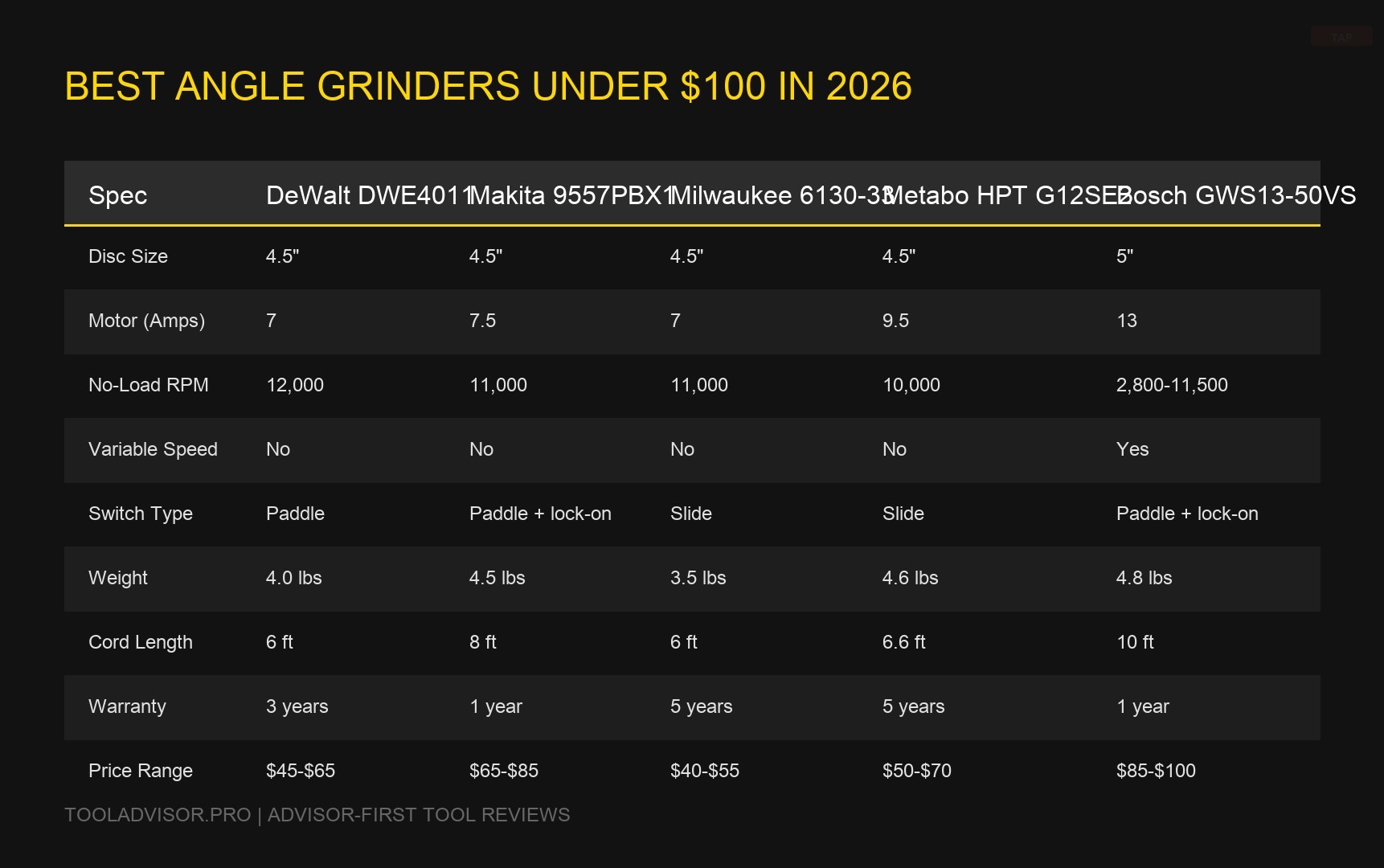
Full Comparison Table
| Spec | DeWalt DWE4011 | Makita 9557PBX1 | Milwaukee 6130-33 | Metabo HPT G12SE2 | Bosch GWS13-50VS |
|---|---|---|---|---|---|
| Disc Size | 4.5” | 4.5” | 4.5” | 4.5” | 5” |
| Motor (Amps) | 7 | 7.5 | 7 | 9.5 | 13 |
| No-Load RPM | 12,000 | 11,000 | 11,000 | 10,000 | 2,800-11,500 |
| Variable Speed | No | No | No | No | Yes |
| Switch Type | Paddle | Paddle + lock-on | Slide | Slide | Paddle + lock-on |
| Weight | 4.0 lbs | 4.5 lbs | 3.5 lbs | 4.6 lbs | 4.8 lbs |
| Cord Length | 6 ft | 8 ft | 6 ft | 6.6 ft | 10 ft |
| Warranty | 3 years | 1 year | 5 years | 5 years | 1 year |
| Price Range | $45-$65 | $65-$85 | $40-$55 | $50-$70 | $85-$100 |
DeWalt Alternatives: When to Choose a Different Brand
The DeWalt DWE4011 wins on weight (4.0 lbs), paddle switch safety, and 3-year warranty for most use cases. Four situations call for a different model:
Choose Makita 9557PBX1 instead if: The job site runs off a generator. Per Makita’s specifications, the AC/DC switch is the only feature in this price range that allows the grinder to operate on DC power from a generator or inverter without modification. If the work takes place at remote locations, barns, or off-grid construction sites where generator power is the norm, this feature is worth the extra $15-$20 over the DeWalt.
Choose Milwaukee 6130-33 instead if: Weight and warranty are the primary concerns. At 3.5 lbs — 0.5 lbs lighter than the DeWalt — and with a 5-year warranty against the DeWalt’s 3-year, the Milwaukee makes sense for operators who do extended overhead grinding or who want maximum coverage on a shop tool. The trade-off is the slide switch: the Milwaukee lacks the paddle (deadman) switch the DeWalt provides. Operators who have trained on paddle-switch grinders may not want to switch.
Choose Metabo HPT G12SE2 instead if: The primary task involves cutting or grinding through thick steel — 3/8-inch plate, structural tubing, or heavy bar stock. At 9.5 amps versus the DeWalt’s 7, the Metabo HPT maintains disc speed better under sustained load. According to abrasive manufacturer guidelines, motor bog-down during cutting is a disc-safety risk, not just a productivity issue. For heavy fabrication where the grinder runs hard for long stretches, the additional amperage is worth the slide-switch trade-off.
Choose Bosch GWS13-50VS instead if: The work spans both aggressive cutting and precision surface conditioning or polishing. The variable speed dial from 2,800 to 11,500 RPM is the only feature in this price range that legitimately serves both applications. A single-speed grinder at 12,000 RPM is too fast for wire wheel work on thin or soft metals; the Bosch dials down to a safe speed. At $85-$100, this is the top of the sub-$100 category, but the 13-amp motor and variable speed justify the premium for shops that use their grinder across multiple disc types.
Stick with DeWalt if: The work is general shop use — weld cleanup, cutting rebar and angle iron, rust removal, surface prep before paint or welding. The DeWalt’s paddle switch, 3-year warranty, and 4.0 lb weight cover the most common use cases without compromise.
Best Angle Grinder for Your Trade
Fabrication shops and heavy production cutting favor the Metabo HPT G12SE2 (9.5 amps) or Bosch GWS13-50VS (13 amps, variable speed). Construction sites and generators favor the Makita 9557PBX1 for its AC/DC switch. General shop, farm, and welding cleanup favor the DeWalt DWE4011 for its paddle switch, light weight, and 3-year warranty.
Fabrication shop (daily heavy use): The Metabo HPT G12SE2 or Bosch GWS13-50VS. Fabrication work involves frequent cuts through structural steel, extended bead grinding, and surface prep that pushes a 7-amp motor hard. The Metabo HPT’s 9.5 amps handle sustained material removal without motor bog; the Bosch adds variable speed for surface conditioning between cuts. Either withstands production-level use better than lower-amperage models.
Construction site and job site: The Makita 9557PBX1. The AC/DC switch is the differentiator for construction environments where generator power is common. The included kit — carrying case, grinding wheel, cut-off wheel, wire brush — handles the range of tasks that come up on a job site without additional supply runs. The 8-foot cord provides useful reach in large work areas.
Farm and ranch shop (occasional to regular use): The DeWalt DWE4011. Farm shop use typically spans rust removal on implements, cutting bolts and chain, cleaning up welds on repairs, and occasional surface prep. The DeWalt’s 7 amps are adequate for these tasks, and the 3-year warranty matters in environments where the grinder might sit unused for weeks between heavy sessions. Lighter weight reduces fatigue during awkward repairs on machinery in the field.
Welding shop (cleanup and prep): The Milwaukee 6130-33 or DeWalt DWE4011. Welding shops use angle grinders primarily for weld bead cleanup, slag removal, and pre-weld surface prep — tasks that require more control than raw power. The Milwaukee’s 3.5 lbs and compact grip make it easy to handle during precise overhead or positional weld grinding. The DeWalt’s paddle switch and low-profile gear case reach tight joint areas more easily.
Variable applications (polishing, conditioning, cutting): The Bosch GWS13-50VS. Any shop that uses an angle grinder for wire wheel work on soft metals, flap disc polishing, surface conditioning on stainless, or strip disc paint removal benefits from variable speed control. Running any of these applications at 12,000 RPM risks damaging the workpiece or overloading the disc; the Bosch’s dial-down to 2,800 RPM matches disc speed to the task.
A Note on Cordless Under $100
Cordless angle grinders from DeWalt, Milwaukee, Makita, and Ryobi are available as tool-only (bare tool, no battery) in the $60-$100 range. According to manufacturer specifications, an 18V/20V max cordless grinder delivers similar instantaneous power to a 7-8 amp corded unit, with runtime limited by battery capacity — typically 10-25 minutes of continuous cutting on a 2.0-5.0 Ah battery.
The tool-only price fits under $100, but the total investment including a battery ($50-$120) and charger ($30-$60) does not. Cordless makes sense for buyers already invested in a battery platform. For first-time buyers without existing batteries, a corded grinder delivers more sustained performance per dollar. This guide focuses on corded models for that reason, though a cordless tool-only purchase is a reasonable option for buyers who already own compatible batteries.
Angle Grinder Safety: What Generic Articles Skip
Angle grinders cause more severe injuries per hour of use than most other power tools, according to CPSC NEISS injury data. The injuries that result from disc failure or kickback at 10,000–12,000 RPM are categorically more serious than those from most other hand tools. The following covers the failure modes that account for the majority of grinder injuries — and the specific practices that prevent them.
Guard Removal: The #1 Risk Factor
Per OSHA Standard 1926.303 and ANSI B7.1, the wheel guard is a mandatory safety device, not a convenience feature. The guard is designed to deflect disc fragments away from the operator in the event of a disc burst. Removing or repositioning the guard beyond the manufacturer’s specified range creates a direct exposure path to a disc traveling at rim speeds of 70–100 mph.
Common rationalizations for guard removal — “better visibility,” “easier access,” “the disc fits the guard position” — do not change the injury exposure. Per ANSI B7.1, the guard must be positioned to protect the operator at all times. If the disc cannot fit the work area with the guard in place, the angle grinder is the wrong tool for that cut.
Practical rule: Never operate an angle grinder without the guard installed and positioned correctly for the disc in use. Grinding disc guards and cut-off wheel guards position differently — verify the guard orientation matches the current disc type.
Disc Inspection and Pre-Use Checks
Per ANSI B7.1, every disc must be inspected before mounting, including new discs from sealed packaging. Shipping damage, improper storage (extreme cold followed by rapid warming, moisture exposure for certain disc types), and manufacturing defects can compromise disc integrity before the first use.
Inspection checklist per ANSI B7.1:
- Check for visible cracks, chips, or missing segments — any of these is a discard condition
- Inspect the blotter (paper label) for tears or moisture damage that may indicate a compromised bond
- For grinding and cut-off wheels: perform the ring test — hold the disc by the center hole and tap with a non-metallic object. A sound disc rings clearly; a cracked disc gives a dull thud
- Verify the maximum RPM printed on the disc equals or exceeds the grinder’s no-load speed (per the RPM/disc-size table above)
- Check the disc center hole fit — the disc should seat on the spindle flange without forcing
Per ANSI B7.1, new discs should be run at operating speed for 60 seconds before bringing the disc near any workpiece. This operational run-in allows any latent defect to manifest before the disc contacts material.
Flange and Locking Nut Torque
Improper flange and locking nut installation is a disc-security failure mode that creates vibration, disc wobble, and in severe cases allows the disc to loosen under load. Per manufacturer installation procedures:
- The backing flange (inner flange) seats flat against the spindle shoulder — debris or damage on the flange seat causes disc runout
- The disc seats against the backing flange with the center relief (depressed center, for Type 27) facing the correct direction: toward the grinder, not toward the work
- The retaining nut (outer flange) is tightened with the spanner wrench provided — hand-tight is insufficient for disc security at operating speed
- Overtightening is also a risk: according to abrasive manufacturer guidelines, overtightening the retaining nut can crack the disc center. Snug with the spanner wrench, then firm — not torqued to the stop
Note that the retaining nut on most angle grinders is reverse-threaded (left-hand thread) on the right side of the spindle. This design causes the nut to self-tighten as the disc spins — but it also means the nut loosens by turning clockwise (opposite of the usual direction). Per manufacturer instructions, always refer to the tool’s documentation to confirm the loosening direction before attempting disc changes.
Kickback and Pinching
Kickback is the sudden violent rotation of the grinder body when the disc binds or stalls in a cut. At 10,000–12,000 RPM, a stall event transfers rotational energy into the grinder body within milliseconds — faster than an operator can react. Per ANSI B7.1 and manufacturer safety documentation:
- Two-hand operation is mandatory for grinders 4.5 inches and larger. The side handle must be installed and used. One-handed operation is a compliance violation and the primary position that allows uncontrolled kickback
- Never position the body in the cutting plane — stand to the side of the cut path, not in front of or behind the disc rotation plane
- For cut-off operations: never use a cut-off wheel (Type 1) for side grinding. Cut-off wheels are designed exclusively for plunge and linear cuts. Lateral force on a cut-off wheel causes disc shatter, not kickback — the result is disc fragments at operating speed in all directions
- Watch for pinching: if the material closes on the disc during a cut (common when cutting without support), the disc binds and kickback follows. Support both sides of the cut, or use a cut-off saw for unsupported material
The paddle (deadman) switch design is the primary mechanical mitigation for kickback injury: releasing grip stops the disc. The slide switches on the Milwaukee 6130-33 and Metabo HPT G12SE2 do not provide this protection — a dropped or kicked-back grinder continues spinning until deliberately switched off.
Who This Is NOT For
Sub-$100 angle grinders are inadequate for sustained heavy cutting through material over 1/2-inch thick, precision grinding, masonry cutting without dust control, or operators without prior grinder experience. Specific situations:
-
The work requires sustained heavy cuts through material over 1/2-inch thick. According to abrasive manufacturer data, sub-$100 grinders with 7-amp motors lose disc speed significantly when cutting thick steel plate or structural tubing. For regular heavy cutting, a higher-amperage grinder ($100-$200 range) or a dedicated cut-off saw is more efficient and safer.
-
Precision is the primary requirement. Angle grinders are material removal tools, not precision instruments. Per manufacturer documentation, the disc runout and operator variability inherent to handheld grinding make tolerances tighter than approximately 1/32-inch impractical. For precision grinding, a bench grinder with a jig or a belt sander is more appropriate.
-
The primary application is cutting tile, concrete, or masonry. While angle grinders can cut these materials with diamond blades, the dust generated is hazardous (silicosis risk from crystalline silica). Per OSHA guidelines, wet cutting or a grinder with a dust shroud and HEPA vacuum attachment is required. Most sub-$100 grinders lack dust shroud compatibility. A dedicated tile saw or concrete saw with integrated water feed is safer and more efficient.
-
The tool will be used by operators without angle grinder experience. Angle grinders have a higher injury rate per hour of use than most other power tools, according to injury data reported by the U.S. Consumer Product Safety Commission. Kickback, disc breakage, and entanglement are the primary hazards. Inexperienced operators should receive training and start with supervised use before working independently.
-
A used industrial grinder is available. At the sub-$100 price point, a used Metabo, Fein, or Bosch industrial-grade grinder from a pawn shop, estate sale, or surplus dealer may offer substantially more tool per dollar than a new consumer-grade model. The trade-off is no warranty and potential wear, but industrial grinders are built to tighter tolerances with more durable components. A visual inspection of the brushes, bearings (spin the shaft by hand — it should be smooth with no grinding or lateral play), and cord condition can identify units with significant remaining service life.
Related Guides
Angle grinders often work alongside other shop metalworking tools. For related buying decisions:
- Best Bench Grinders for Home Shops — stationary grinding for sharpening and deburring
- Best MIG Welders for Beginners — the welds that angle grinders clean up
- Best Plasma Cutters Under $1,000 — for cutting tasks that exceed angle grinder capacity
Frequently Asked Questions
What size angle grinder do I need?
A 4.5-inch angle grinder is sufficient for most shop tasks including cutting rebar, grinding weld beads, cleaning rust, and surface prep. According to manufacturer specifications, 4.5-inch discs are the most widely available and least expensive, making them the standard for sub-$100 grinders. A 5-inch model provides approximately 1/4-inch deeper cutting capacity per pass but at a higher price point.
Can I use an angle grinder to cut metal?
Yes. An angle grinder with a thin cut-off wheel (typically 0.045 inches thick) cuts steel, aluminum, and stainless steel efficiently. Per abrasive manufacturer guidelines, cut-off wheels are rated for cutting only and should never be used for side grinding, which can cause the disc to shatter. Always use wheels rated for the grinder’s maximum RPM.
What is the difference between corded and cordless angle grinders?
For buyers under $100, corded grinders deliver more sustained power per dollar. A 7-amp corded grinder runs indefinitely; a cordless grinder tool-only at this price point still requires a battery ($50–$120) and charger ($30–$60) unless the buyer already owns a compatible platform. Per manufacturer specifications, an 18V/20V cordless unit delivers comparable instantaneous power to a 7-amp corded model but with runtime limited to 10–25 minutes of continuous cutting on a 2.0–5.0 Ah battery. For first-time buyers without an existing battery platform, corded is the correct choice. For buyers already on M18, 20V MAX, or LXT, a bare-tool cordless purchase at this price point is defensible.
Are DeWalt alternatives worth it for angle grinders?
Yes, in specific situations. Per the manufacturer specifications compared in this guide: choose the Makita 9557PBX1 if you work off generators (its AC/DC switch is the only feature in this price range that operates on DC power without modification). Choose the Metabo HPT G12SE2 if the primary work involves thick steel — its 9.5-amp motor holds disc speed better under sustained load than 7-amp models. Choose the Milwaukee 6130-33 if weight and warranty are the priority (3.5 lbs, 5-year coverage). Stick with DeWalt DWE4011 for general shop use where paddle-switch safety, light weight, and 3-year warranty coverage is the correct balance.
What is the difference between a grinder and a sander?
An angle grinder is a material removal tool designed for aggressive cutting, grinding, and deburring on metal and masonry. A sander is a finishing tool designed for smooth surface preparation on wood, composites, and painted surfaces. According to manufacturer documentation, using a grinding disc on wood removes material too aggressively for controlled results, while sanding discs on an angle grinder can work for rough surface prep but lack the precision of a dedicated random orbital sander.
Is a 4.5-inch or 5-inch angle grinder better?
For most shop use, 4.5-inch is the correct choice. Per abrasive manufacturer data, 4.5-inch (115mm) discs are the most widely stocked and least expensive — roughly 20–30% cheaper per disc than 5-inch equivalents. The 5-inch (125mm) disc provides approximately 1/4-inch more cutting depth per pass, which matters only when cutting through stock thicker than what a 4.5-inch disc reaches in a single pass. The Bosch GWS13-50VS is the only sub-$100 grinder that accepts 5-inch discs. For a buyer whose work regularly involves thick plate or structural tubing, the 5-inch capacity is worth the premium; for general shop and farm use, 4.5-inch is the better value.
What is the best disc for removing rust?
For surface rust on flat stock, a 40-grit flap disc removes rust efficiently and leaves a surface profile suitable for primer without further prep. For heavy rust, pitting, and scale on welds or irregular surfaces, a knotted wire cup brush is faster than abrasive discs — it reaches into pits and crevices where a flat disc can’t follow. Per abrasive manufacturer guidelines, strip discs (open-web nylon abrasive) are effective for light rust and mill scale without removing base metal, which matters when the part has tight dimensional tolerances. For automotive rust, surface conditioning discs at lower RPM (per the Bosch variable-speed option) reduce the risk of heat-warping thin sheet metal.
How do I change a disc on an angle grinder?
Per manufacturer safety procedures: (1) Disconnect power — unplug corded models before changing discs. (2) Use the spanner wrench supplied with the grinder to loosen the locking nut; the nut is reverse-threaded on most grinders (turn clockwise to loosen). (3) Inspect the backing flange and disc seat for debris before mounting the new disc. (4) Verify the new disc’s RPM rating meets or exceeds the grinder’s maximum speed. (5) Hand-tighten the locking nut, then snug it with the spanner wrench — overtightening can crack the disc center. (6) Per ANSI B7.1, run new grinding discs for 60 seconds at full speed with the guard in place before bringing the disc near any workpiece.
What You’ll Also Need
- Flap discs — 4.5 inch, 40 grit — The go-to consumable for aggressive weld blending and rust removal; a single disc typically lasts 15–30 minutes of hard use on steel. Search: “flap disc 4.5 inch 40 grit,” “flap disc 4.5 inch zirconia.” Check price on Amazon →
- Flap discs — 4.5 inch, 60 grit — A finer grit for finishing passes after initial stock removal; keeps surface profile smoother before paint or coating. Search: “flap disc 60 grit 4.5 inch,” “flap disc type 29 60 grit.” Check price on Amazon →
- Cut-off wheels — 4.5 inch, metal — Thin reinforced wheels for cutting angle iron, rebar, and sheet stock; rated for the RPM of your specific grinder. Search: “cut-off wheel 4.5 inch metal,” “cutting disc 4.5 inch steel.” Check price on Amazon →
- Grinding disc — 4.5 inch — Thicker Type 27 depressed-center disc for rapid material removal and beveling; required for any weld prep or deburring work. Search: “grinding disc 4.5 inch,” “metal grinding wheel 4.5 inch type 27.” Check price on Amazon →
- Wire cup brush — angle grinder — Essential for heavy rust removal, scale, and paint stripping from weld areas; knotted wire versions are more aggressive than crimped. Search: “wire cup brush angle grinder,” “knotted wire cup brush 4.5 inch.” Check price on Amazon →
- Diamond cup wheel — concrete — Required for grinding concrete, mortar, and masonry; a standard grinding disc will load immediately on concrete. Search: “diamond cup wheel concrete,” “diamond grinding cup wheel 4.5 inch.” Check price on Amazon →
For the full disc-type breakdown — flap vs grinding vs cut-off, grit selection, and RPM safety — see the best angle grinder discs guide.
Sources
- DeWalt DWE4011 product specifications and data sheet (dewalt.com)
- Makita 9557PBX1 product data sheet and specifications (makitatools.com)
- Milwaukee 6130-33 product specifications (milwaukeetool.com)
- Metabo HPT G12SE2 product data sheet and specifications (metabo-hpt.com)
- Bosch GWS13-50VS product specifications and data sheet (boschtools.com)
- Norton Abrasives — angle grinder disc selection guidelines and RPM rating methodology
- ANSI B7.1-2010 — Safety Requirements for the Use, Care, and Protection of Abrasive Wheels (ring test procedure, guard requirements, disc inspection checklist, flange torque guidance)
- OSHA Standard 1926.303 — Abrasive Wheels and Tools (guard requirements, two-hand operation)
- U.S. Consumer Product Safety Commission — National Electronic Injury Surveillance System (NEISS) data
- Saint-Gobain Abrasives / Norton — wheel burst and rim speed engineering guidelines