Best MIG Welders for Beginners in 2026
MIG welding (Gas Metal Arc Welding) is widely considered the easiest welding process to learn, making it ideal for beginners. According to the American Welding Society, MIG welding’s continuous wire feed and shielding gas create a more forgiving process compared to stick or TIG welding. The wire acts as both the electrode and the filler metal, which means there is one less variable to manage during the weld. If you have not yet settled on MIG over the other arc processes, the MIG vs TIG vs Stick welding guide compares them on materials, skill, and cost before you commit to a machine.
This guide evaluates beginner-friendly MIG welders based on published specifications, focusing on ease of setup, power range, duty cycle, material thickness capacity, and overall value. All prices, specs, and claims are sourced from manufacturer data sheets and publicly available technical documentation.
What Makes a Good Beginner MIG Welder?
Based on manufacturer specifications and industry standards, beginners should look for these core attributes:
- Power range: 30-140 amps covers most hobbyist projects (up to 3/16” mild steel in a single pass; some units rated for 1/4”)
- Duty cycle: Minimum 20% at max output for continuous work. A 20% duty cycle at 90A means the machine can weld for 2 minutes out of every 10 at 90 amps before needing to cool down. For beginners running shorter beads, this is typically adequate.
- Wire feed speed: Smooth, adjustable feed speed (50-500 IPM typical). Inconsistent wire feed is the single most common frustration for new welders.
- Setup simplicity: Tool-less polarity changes and clear controls. Infinite adjustment dials are more flexible; stepped selectors are more forgiving.
- Weight: Under 60 lbs for portability. Machines under 40 lbs are significantly easier to move between workstations.
110V vs. 220V: Which Input Voltage Do Beginners Need?
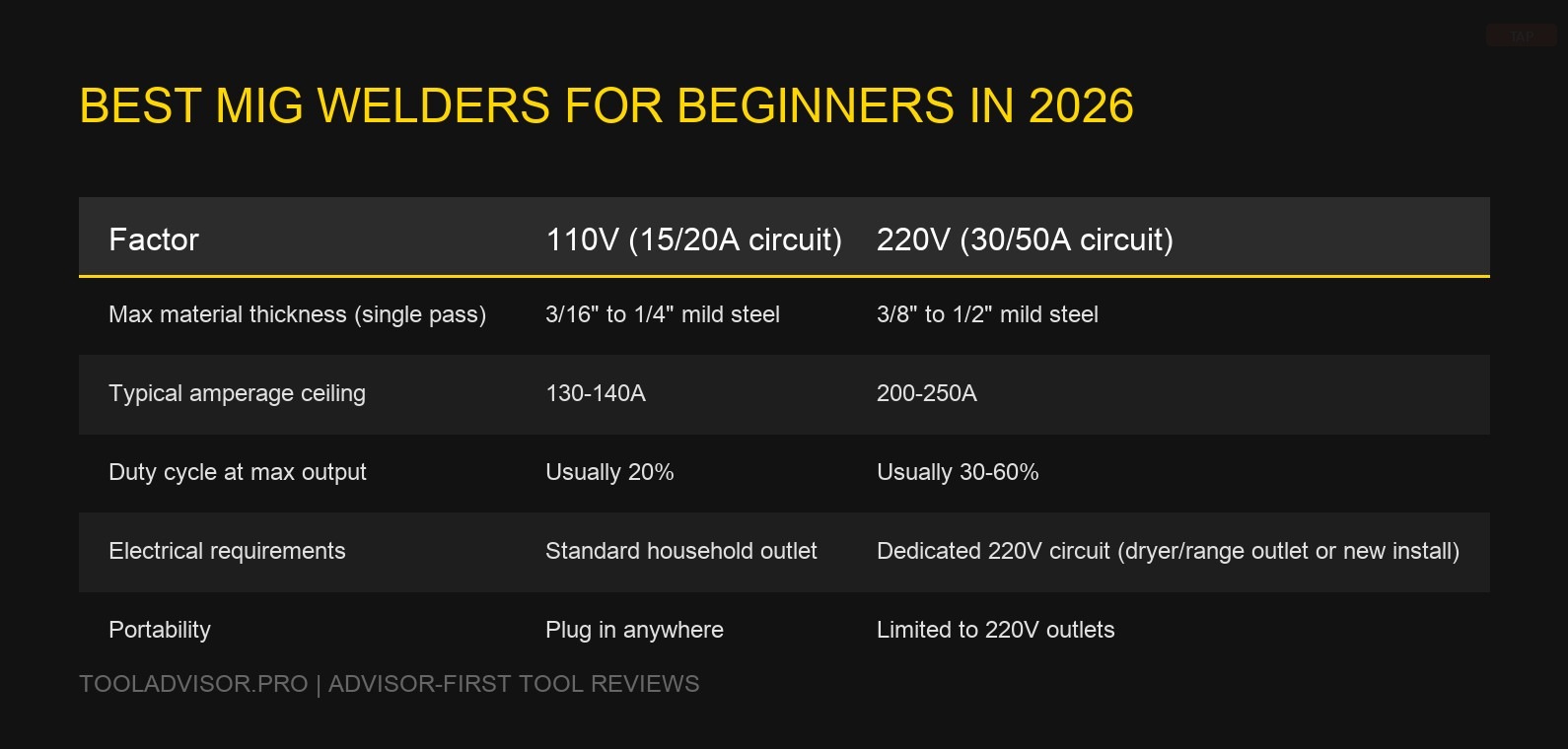
Every machine in this guide runs on a standard 110/115/120V household outlet. This is the right starting point for most beginners because it requires zero electrical upgrades. However, there are trade-offs worth understanding:
| Factor | 110V (15/20A circuit) | 220V (30/50A circuit) |
|---|---|---|
| Max material thickness (single pass) | 3/16” to 1/4” mild steel | 3/8” to 1/2” mild steel |
| Typical amperage ceiling | 130-140A | 200-250A |
| Duty cycle at max output | Usually 20% | Usually 30-60% |
| Electrical requirements | Standard household outlet | Dedicated 220V circuit (dryer/range outlet or new install) |
| Portability | Plug in anywhere | Limited to 220V outlets |
For hobby welding, auto body repair, light fabrication, and projects involving steel up to 3/16” thick, 110V machines are sufficient. If future projects will involve structural work, trailer building, or material thicker than 1/4”, consider a dual-voltage (MVP) machine like the Hobart Handler 210MVP, which can run on either 110V or 220V.
Gas-Shielded MIG vs. Gasless Flux-Core
All machines in this guide support both gas-shielded MIG and gasless flux-core wire (FCAW). These are different processes with different strengths:
- Gas-shielded MIG (solid wire + 75/25 Argon/CO2): Cleaner welds, less spatter, better appearance, easier to learn. Requires a gas cylinder ($50-80 to fill) and regulator. Not practical outdoors in wind.
- Gasless flux-core (tubular wire, no external gas): Works outdoors, deeper penetration, tolerates dirty/rusty metal better. More spatter, requires more cleanup, slag removal needed.
Per manufacturer recommendations, beginners should start with gas-shielded MIG on clean mild steel. The learning curve is shorter, and weld quality issues are easier to diagnose. Flux-core capability is valuable as a fallback for outdoor work or when a gas refill is not immediately available. The full comparison of MIG versus flux-core welding breaks down when each wire type is the better choice.
Top Picks Based on Specifications
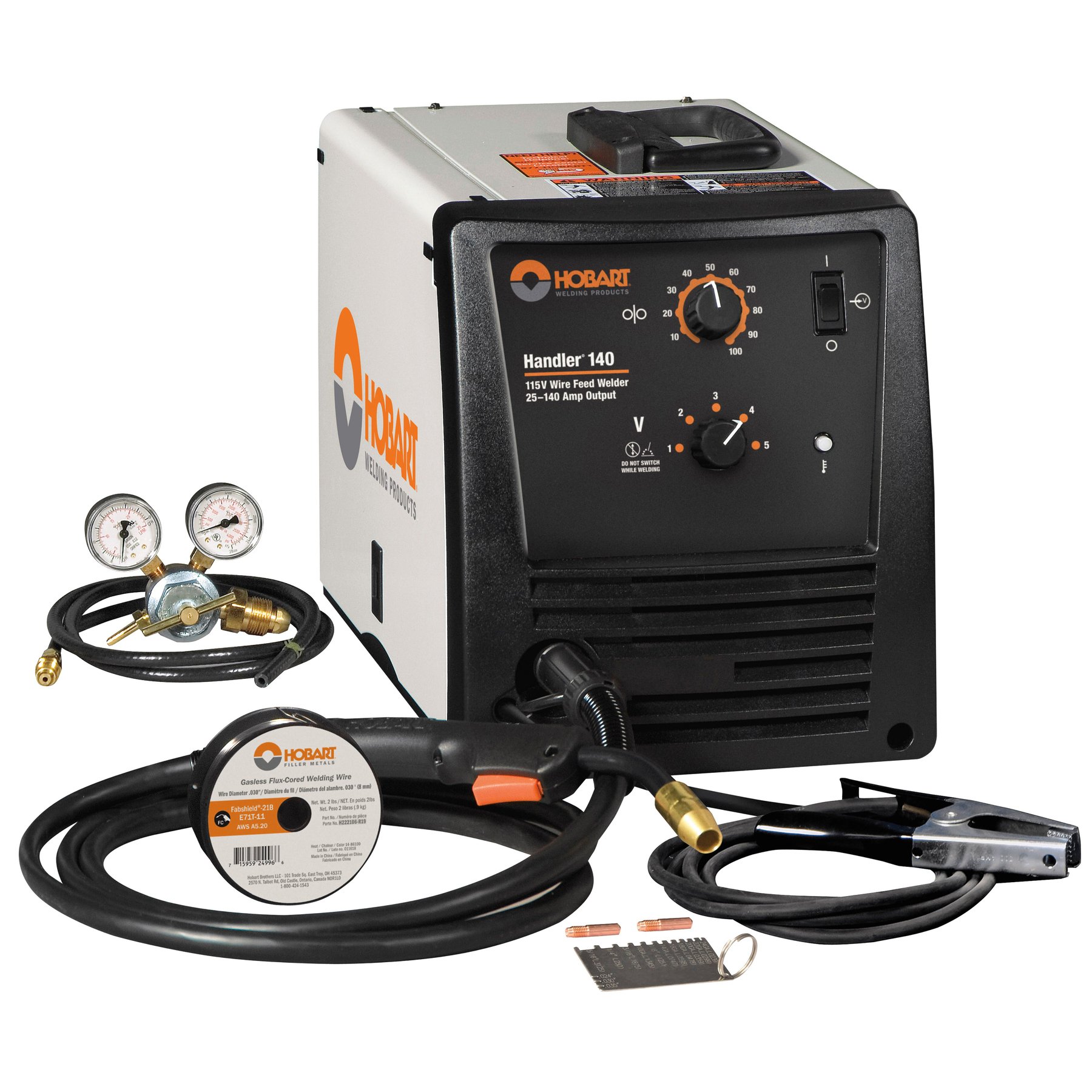
Hobart Handler 140 — Best Overall Value
| Spec | Value |
|---|---|
| Input Power | 115V, 20A circuit |
| Amperage Range | 25-140A |
| Wire Feed Speed | 40-740 IPM |
| Duty Cycle | 20% at 90A |
| Wire Diameter | .024-.035” |
| Max Steel Thickness (single pass) | 1/4” |
| Weight | 57 lbs |
| Dimensions | 19.5” x 11” x 13” |
| Warranty | 5/3/1 year (transformer/drive/gun) |
| Price Range | $550-650 |
According to Hobart’s specifications, the Handler 140 welds up to 1/4” steel in a single pass on a standard 115V household outlet. The 5-position voltage selector simplifies setup for beginners — each position corresponds to a material thickness range printed on the inside of the wire compartment door. ITW Welding (parent company) reports this as their top-selling consumer unit.
The 5/3/1 tiered warranty is the strongest in this price bracket: five years on the transformer, three on the drive system, and one year on the MIG gun. Per Hobart’s documentation, the cast aluminum drive system uses a dual-groove drive roll that accepts both solid MIG wire and flux-core wire without purchasing additional components.
Check price on Amazon → Used Hobart Handler 140 on eBay →
Best for: Hobbyists who want industrial-quality construction at a consumer price point. The wide wire feed speed range (40-740 IPM) provides room to grow into more advanced techniques.
Limitation: At 57 lbs, it is the heaviest 110V machine on this list. Portability is adequate but not a strength.
Lincoln Electric PowerMIG 140C — Best Ease of Use
| Spec | Value |
|---|---|
| Input Power | 120V, 20A circuit |
| Amperage Range | 30-140A |
| Wire Feed Speed | 50-500 IPM |
| Duty Cycle | 20% at 90A |
| Wire Diameter | .025-.035” |
| Max Steel Thickness (single pass) | 3/16” |
| Weight | 46 lbs |
| Dimensions | 18.5” x 10.6” x 14” |
| Warranty | 3 years |
| Price Range | $600-700 |
Lincoln’s PowerMIG 140C features their “Precision Full Color” wire drive, which according to Lincoln’s technical documentation, reduces wire feeding issues common with entry-level machines. The diamond-core technology is rated to improve arc starts by providing consistent electrical contact at the drive roll.
Lincoln rates the 140C for 3/16” maximum single-pass thickness on mild steel — slightly more conservative than Hobart’s 1/4” rating. Per Lincoln’s spec sheet, the machine uses a brass-to-brass gun connection rather than the plastic connectors found on some competitors.
Check price on Amazon → Used Lincoln Easy-MIG 140 on eBay →
Best for: Beginners prioritizing reliability and brand support. Lincoln’s dealer and service network is the largest in North America, which matters if warranty service is needed.
Limitation: Narrower wire feed speed range (50-500 IPM) compared to the Hobart, and the higher price point does not translate to higher amperage or duty cycle.
Eastwood MIG 135 — Best Budget Option
| Spec | Value |
|---|---|
| Input Power | 120V, 20A circuit |
| Amperage Range | 25-135A |
| Wire Feed Speed | 78-394 IPM |
| Duty Cycle | 20% at 90A |
| Wire Diameter | .023-.035” |
| Max Steel Thickness (single pass) | 3/16” |
| Weight | 38 lbs |
| Dimensions | 16” x 8.5” x 13” |
| Warranty | 3 years |
| Price Range | $300-400 |
The Eastwood MIG 135 offers specifications comparable to units twice its price. Per Eastwood’s product data, it includes infinite voltage and wire speed control rather than stepped settings, providing finer adjustment for beginners learning to dial in their settings. Infinite adjustment is a genuine advantage — stepped machines force jumps between settings, while infinite dials allow precise tuning.
At 38 lbs, it is the lightest machine on this list by a significant margin. According to Eastwood’s spec sheet, the compact dimensions (16” x 8.5” x 13”) make it suitable for small garage shops where floor space is limited.
Best for: Budget-conscious beginners and occasional hobbyists. At the $300-400 price point, the cost of entry is low enough that the machine pays for itself quickly if it replaces even a few paid welding jobs.
Limitation: The narrower wire feed speed range (78-394 IPM) and slightly lower 135A ceiling limit growth potential. Duty cycle and build quality are adequate for hobbyist use but not designed for daily production.
Miller Millermatic 141 — Best Build Quality
| Spec | Value |
|---|---|
| Input Power | 120V, 20A circuit |
| Amperage Range | 30-140A |
| Wire Feed Speed | 60-600 IPM |
| Duty Cycle | 20% at 90A |
| Wire Diameter | .024-.035” |
| Max Steel Thickness (single pass) | 3/16” |
| Weight | 51 lbs |
| Dimensions | 21” x 11.5” x 15” |
| Warranty | 3 years |
| Price Range | $900-1000 |
Miller’s Auto-Set feature, according to their technical documentation, automatically sets voltage and wire feed speed based on material thickness and wire diameter. The operator selects wire diameter and material thickness, and the machine configures itself. This removes guesswork for beginners and reduces the chance of burning through material or producing cold, weak welds.
Per Miller’s spec sheet, the Millermatic 141 uses a tool-less design for polarity changes, drive roll changes, and wire spool loading. The fan-on-demand cooling system only runs when the machine needs cooling, which according to Miller reduces power consumption and internal contamination from dust.
Best for: Beginners willing to invest in professional-grade equipment they will not outgrow. The Auto-Set feature is genuinely useful for new welders, and the build quality supports years of regular use.
Limitation: At $900-1000, it costs nearly twice as much as the Hobart Handler 140 while offering similar amperage and duty cycle specifications. The premium is for build quality, Auto-Set, and the Miller brand — not for more welding capability.
YesWelder MIG-205DS — Best Multi-Process Value
| Spec | Value |
|---|---|
| Input Power | 110V/220V dual voltage |
| Amperage Range | 30-200A (at 220V) |
| Wire Feed Speed | 78-394 IPM |
| Duty Cycle | 60% at 200A (220V) |
| Wire Diameter | .023-.035” |
| Max Steel Thickness (single pass) | 1/4” (at 220V) |
| Weight | 26 lbs |
| Dimensions | 18.5” x 8.5” x 14” |
| Warranty | 2 years |
| Price Range | $280-350 |
Per YesWelder’s product data, the MIG-205DS is a multi-process machine supporting MIG, flux-core, lift TIG, and stick welding. The dual-voltage capability (110V/220V) is notable at this price point — most dual-voltage machines from major brands start at $700+. At 26 lbs, it is by far the lightest and most portable option on this list.
The 60% duty cycle at 200A (on 220V) significantly exceeds every other machine listed here. According to YesWelder’s specifications, synergic MIG mode adjusts wire feed speed automatically based on voltage selection, similar in concept to Miller’s Auto-Set but at a fraction of the price.
Best for: Budget buyers who want multi-process capability and dual voltage in a compact, portable package. A strong option for those who anticipate needing 220V power in the future.
Limitation: YesWelder is a newer brand without the dealer or service network of Lincoln, Miller, or Hobart. Per user reports aggregated on third-party review sites, quality control can be inconsistent. The 2-year warranty is the shortest on this list.
Full Comparison Table
| Spec | Hobart Handler 140 | Lincoln PowerMIG 140C | Eastwood MIG 135 | Miller Millermatic 141 | YesWelder MIG-205DS |
|---|---|---|---|---|---|
| Input Voltage | 115V | 120V | 120V | 120V | 110V/220V |
| Amperage Range | 25-140A | 30-140A | 25-135A | 30-140A | 30-200A (220V) |
| Wire Feed Speed | 40-740 IPM | 50-500 IPM | 78-394 IPM | 60-600 IPM | 78-394 IPM |
| Duty Cycle | 20% @ 90A | 20% @ 90A | 20% @ 90A | 20% @ 90A | 60% @ 200A (220V) |
| Wire Diameter | .024-.035” | .025-.035” | .023-.035” | .024-.035” | .023-.035” |
| Max Thickness | 1/4” | 3/16” | 3/16” | 3/16” | 1/4” (220V) |
| Weight | 57 lbs | 46 lbs | 38 lbs | 51 lbs | 26 lbs |
| Warranty | 5/3/1 yr | 3 yr | 3 yr | 3 yr | 2 yr |
| Price Range | $550-650 | $600-700 | $300-400 | $900-1000 | $280-350 |
| Multi-Process | No | No | No | No | MIG/TIG/Stick |
Material Thickness Guide
One of the most common questions from beginners: what thickness can each machine actually handle? Per manufacturer ratings, here is what to expect on mild steel:
| Material | Typical Gauge | Thickness | Minimum Amperage Needed |
|---|---|---|---|
| Sheet metal (auto body) | 20-22 gauge | 0.030-0.036” | 25-40A |
| Light tubing / brackets | 18 gauge | 0.048” | 40-60A |
| Standard tubing / frames | 16 gauge | 0.060” | 55-75A |
| Angle iron / plate | 14 gauge | 0.075” | 70-90A |
| Structural plate | 11 gauge | 0.120” | 90-110A |
| 3/16” plate | — | 0.188” | 120-140A |
| 1/4” plate (max for 110V) | — | 0.250” | 140A+ (multiple passes) |
All five machines listed handle material from sheet metal through 3/16” plate. For 1/4” plate, manufacturer specs indicate the Hobart Handler 140 and YesWelder MIG-205DS (on 220V) can manage single-pass welds. The Lincoln, Eastwood, and Miller units may require multiple passes at 1/4”. For cutting material to size before welding, a plasma cutter handles steel, aluminum, and stainless far more efficiently than a grinding disc.
Who This Is NOT For
Not every buyer should start with a MIG welder. Consider alternatives if:
-
You need to weld thin sheet metal under 24 gauge (< 0.025”). MIG welding at low amperages can still blow through very thin material. According to AWS process guidelines, TIG welding offers finer heat control for sheet metal work under 0.025” thick. Auto body restoration on patch panels is a common case where TIG or oxy-acetylene may be more appropriate than MIG.
-
Your primary work is aluminum or stainless steel. While all five machines listed above can run flux-core wire for mild steel, MIG welding aluminum requires a spool gun or push-pull setup (additional $200-400), plus 100% argon shielding gas instead of the standard 75/25 mix. Stainless steel MIG welding requires a trimix gas (helium/argon/CO2). At hobbyist volumes, a TIG welder may be more cost-effective for these materials because it avoids the spool gun expense and uses a single gas (argon) for both aluminum and stainless.
-
You need to weld outdoors regularly. MIG welding requires shielding gas, which disperses in wind as low as 5 mph. Per AWS guidelines, stick welding (SMAW) or gasless flux-core (FCAW-S) is more practical for outdoor and field work. All machines on this list support flux-core, but the results differ from gas-shielded MIG in appearance and cleanup requirements.
-
Your projects are primarily structural or load-bearing. Beginner MIG welders on 110V produce welds adequate for non-critical fabrication — furniture, art, garden structures, light equipment repairs. Per AWS D1.1 structural welding code, load-bearing welds on structures require certified welders and proper inspection. A beginner machine is not the limiting factor; operator skill and certification are.
-
Your budget is under $250. Sub-$250 MIG welders exist but typically have limited duty cycles (often 10% or less at max output), poor wire feed consistency, and restricted amperage ranges that limit them to very thin material. At this price point, a used name-brand welder is almost always a better investment. Check manufacturer refurbished programs — Lincoln and Miller both offer factory-reconditioned units with limited warranties.
-
You need to weld cast iron. MIG welding cast iron is technically possible with specialty wire (nickel-based), but it is not a beginner process. Cast iron requires preheating, slow cooling, and careful technique to avoid cracking. Stick welding with nickel rod is the more common approach for cast iron repair.
What You’ll Also Need
According to AWS safety standards and manufacturer setup guides, MIG welding requires additional equipment beyond the welder itself. Budget $150-300 for these essentials, and see the welding setup cost guide for a full accounting of what a complete rig costs:
- Auto-darkening welding helmet (Shade 10-13 for MIG): $50-150. Per ANSI Z87.1 standards, the lens must meet impact and optical clarity requirements. Avoid helmets under $40 — slow lens switching speed increases flash burn risk. For detailed comparisons, see the best auto-darkening welding helmets guide.
- Welding gloves (leather, MIG-specific): $15-30. MIG gloves are thinner than stick welding gloves to maintain dexterity for trigger control.
- 75/25 Argon/CO2 shielding gas: $50-80 per cylinder fill for a standard 40 cu ft tank. Larger 80 cu ft tanks cost $150-200 to buy but reduce per-fill cost. Many welding supply shops offer tank exchange programs.
- Welding wire: $10-30 per 10 lb spool. Per manufacturer recommendations, .030” ER70S-6 solid wire is the most versatile for beginners on mild steel. Use .023” or .025” for thin material (22 gauge and under) to reduce heat input.
- Contact tips, liners, and nozzles: $15-40 per consumables kit. These are the parts that wear out first — tips burn back, liners kink, nozzles clog with spatter. The best MIG welding consumables guide covers which tip style fits each machine on this list (Tweco/Binzel vs Hobart/Miller guns are not interchangeable).
- Welding cart or table: $50-150. A stable work surface at proper height reduces fatigue and improves weld quality. Per ergonomic guidelines, the work surface should be at elbow height. See the best welding carts guide for options that hold the machine, cylinder, and consumables together.
- Safety glasses, ear protection, and a fire extinguisher: Required. Welding produces UV radiation, sparks, and noise. A Class ABC fire extinguisher rated for metal fires should be within arm’s reach.
Frequently Asked Questions
Can I run a MIG welder on 110V?
Yes. All five MIG welders in this guide run on a standard 110/115/120V household outlet, requiring only a 20-amp circuit. According to manufacturer specifications, 110V machines typically produce 130-140 amps maximum and can weld mild steel up to 3/16 inch (and in some cases 1/4 inch) in a single pass. For thicker material or higher duty cycles, a 220V or dual-voltage machine is required.
What gas do I need for MIG welding?
For MIG welding mild steel, the standard shielding gas is a 75% argon / 25% CO2 mix (commonly called C25 or 75/25). Per AWS process guidelines, this blend provides a clean arc, minimal spatter, and good penetration for most hobby and light fabrication work. A standard 40 cubic foot tank costs $50-$80 to fill and lasts approximately 4-8 hours of welding depending on flow rate settings.
How thick can a 140 amp MIG welder weld?
According to manufacturer ratings, a 140-amp MIG welder on 110V can weld mild steel up to 3/16 inch in a single pass, with some models rated for 1/4 inch using multiple passes. Per the material thickness guide published by major manufacturers, 140 amps is sufficient for most hobbyist projects including light tubing, brackets, angle iron, and structural plate up to 11 gauge (0.120 inches).
Consider Buying Used
For MIG welders in the $280-$1,000 range, used equipment from reputable sellers can save 30-50% over new pricing. Per industry resale data, MIG welders from Hobart, Lincoln, and Miller hold their value exceptionally well, and a well-maintained used unit welds identically to new. Check current listings:
Find used MIG welders on eBay →
When buying used, verify: the machine powers on and the wire feed runs smoothly at multiple speeds, the gun trigger fires the arc consistently, the ground clamp has a solid connection, and the gas solenoid opens when the trigger is pulled (listen for the click and feel for gas flow at the nozzle). For any used MIG welder, budget $30-$50 for a new contact tip, nozzle, and liner — these are consumable parts that should be replaced at purchase.
Not sure which welding process is right for you? The Welder Quiz asks 6 questions about your materials, power, budget, and experience — and recommends the right process with a specific machine and honest trade-offs.
Sources
- Hobart Handler 140 product specifications and owner’s manual (hobartwelders.com)
- Lincoln Electric PowerMIG 140C product data sheet (lincolnelectric.com)
- Eastwood MIG 135 product specifications (eastwood.com)
- Miller Millermatic 141 technical documentation (millerwelds.com)
- YesWelder MIG-205DS product specifications (yeswelder.com)
- American Welding Society (AWS) — welding process guides and safety standards
- ANSI Z87.1 eye and face protection standards
- AWS D1.1 Structural Welding Code — Steel (reference only for structural welding context)