How Much Does Small Farm Equipment Cost in 2026? Full Breakdown
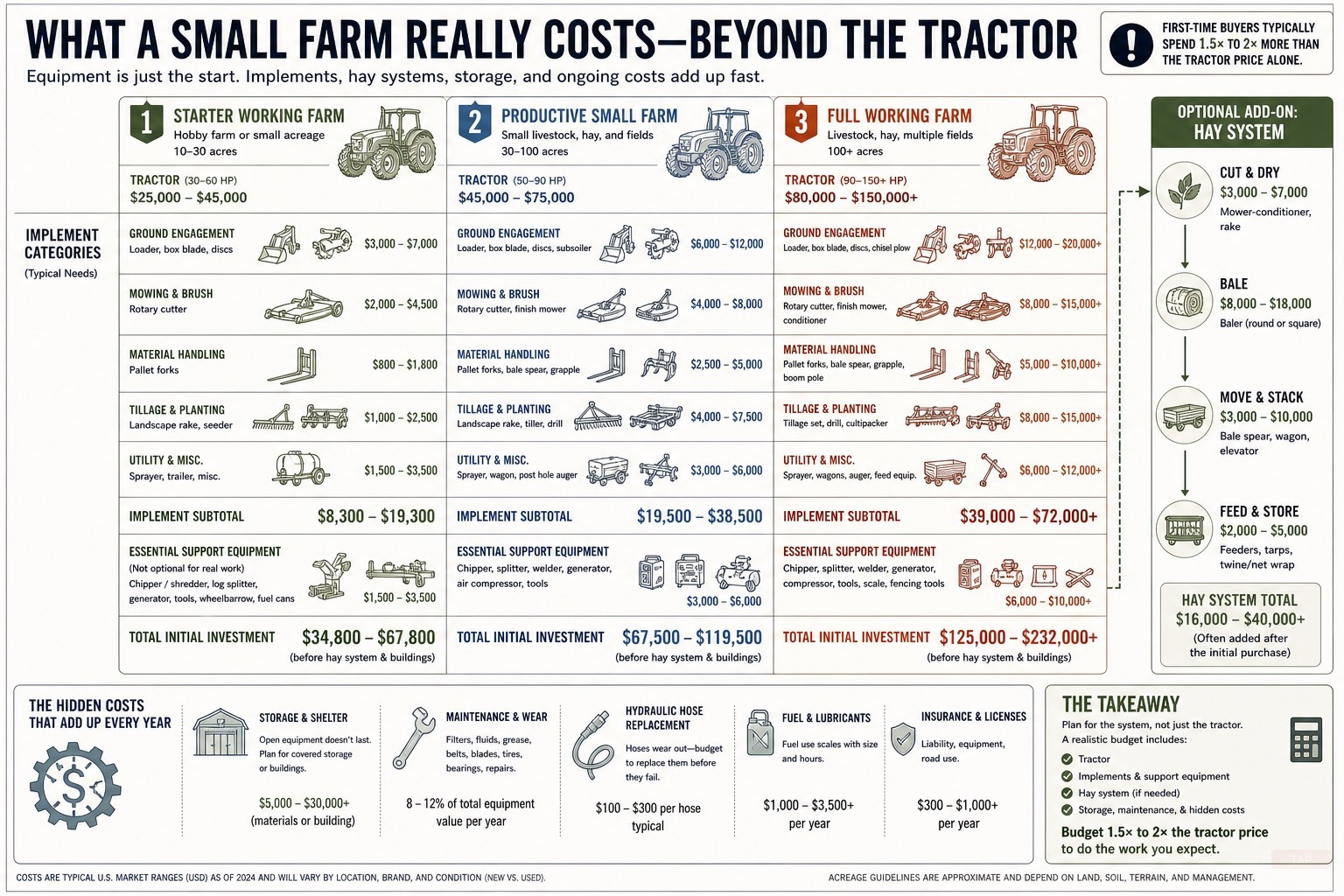
“How much does it cost to set up a small farm?” gets the same useless answers as every other equipment question: “it depends.” This guide is different. It provides itemized costs at three realistic tiers for 5-50 acre operations — including tractors, implements, annual ownership costs, and financing terms — covering the numbers most first-time buyers never see before signing a dealer contract.
All pricing reflects 2026 retail and used-market conditions. New equipment from major manufacturers (Kubota, John Deere, New Holland, Land Pride, Woods) is priced at or near MSRP. Where used equipment is the superior value proposition — and it often is — that is stated explicitly.
For tractor-specific decisions, see our best compact tractors for small farms guide. For specific implement categories, see our best tractor implements for small farms overview.
What This Guide Covers
This guide covers the full equipment cost picture for a working small farm — tractors, implements, annual ownership costs, and financing. Implement categories covered:
- Land clearing and maintenance
- Tillage and seedbed preparation
- Hay and forage equipment
- Livestock fencing
- Utility and infrastructure
Tractor + Core Implement Cost Overview (2026)
Before breaking costs into tiers, this table gives a consolidated view of what buyers are actually pricing in 2026 — tractors and the most common implements, with new and realistic used price ranges.
Per manufacturer list pricing from Kubota, John Deere, and New Holland, and used-market data from MachineFinder and TractorHouse:
Tractor Costs by Class
| Tractor Class | HP Range | Typical Use Case | New Price Range | Realistic Used (3–7 yr) |
|---|---|---|---|---|
| Subcompact | 20–25 HP | Gardens, small lots (<5 acres) | $18,000–$28,000 | $10,000–$18,000 |
| Compact | 25–50 HP | Working farms 5–30 acres | $28,000–$55,000 | $15,000–$35,000 |
| Utility | 45–80 HP | Multi-use farms 30–100 acres | $45,000–$75,000 | $25,000–$50,000 |
Note: Prices above are tractor-only, without loader. A factory-matched front-end loader adds $4,000–$9,000 to compact and utility tractor costs. Per Kubota and John Deere dealer pricing, loader packages purchased at the same time as the tractor typically cost less than retrofitting a loader later.
Core Implement Costs
| Implement | Typical HP Req. | New Price Range | Realistic Used |
|---|---|---|---|
| Front-end loader (match to tractor) | — | $4,000–$9,000 | $2,500–$5,500 |
| Box blade (6 ft) | 20–30 HP | $800–$1,600 | $350–$900 |
| Finish mower (5–6 ft) | 20–35 HP | $1,500–$3,500 | $700–$2,000 |
| Rotary cutter / brush hog (5–6 ft) | 25–40 HP | $1,800–$3,200 | $800–$2,000 |
| Post hole digger (3-point) | 20–35 HP | $700–$1,400 | $300–$800 |
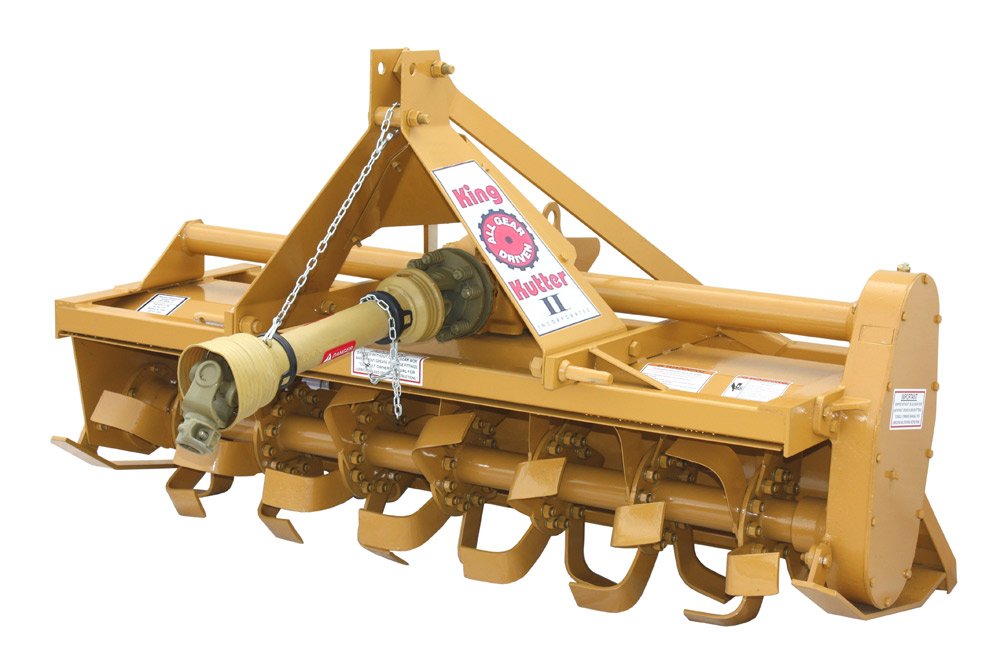
| Rotary tiller (5–6 ft) | 25–45 HP | $1,200–$2,500 | $600–$1,500 |
| Disc harrow (6–7 ft) | 30–50 HP | $1,500–$3,000 | $700–$1,800 |
| Subsoiler / ripper | 35–60 HP | $1,200–$3,000 | $500–$1,500 |
| Disc mower (5–6 ft) | 35–55 HP | $4,500–$8,000 | $2,500–$5,000 |
| Hay tedder (4-rotor) | 30–50 HP | $2,500–$5,000 | $1,200–$3,000 |
| Hay rake (4-wheel) | 30–50 HP | $2,500–$5,500 | $1,200–$3,000 |
| Small square baler | 40–65 HP | $15,000–$30,000 | $7,000–$18,000 |
| Round baler (variable chamber) | 50–80 HP | $25,000–$55,000 | $12,000–$32,000 |
Tier 1 — Starter Working Farm: $8,000–$18,000 in Implements
The minimum equipment to maintain a 5-20 acre operation for hay production, pasture management, and basic tillage.
Core Implements
| Implement | Purpose | New Price Range |
|---|---|---|
| Rotary cutter (5-6 ft) | Pasture/brush mowing | $1,800–$3,200 |
| Box blade (6 ft) | Grading, driveway maintenance | $800–$1,600 |
| Post hole digger (3-point) | Fence post installation | $700–$1,400 |
| Rotary tiller (5-6 ft) | Garden and seedbed prep | $1,200–$2,500 |
| Disc harrow (6-7 ft) | Tillage, residue incorporation | $1,500–$3,000 |
Box blades, some tillers, and post-hole diggers are the Tier 1 items most often sold through online retail; rotary cutters and disc mowers are typically dealer-quoted. Compare models before treating the table ranges as a shopping cart:
- Best box blades for compact tractors — Titan, King Kutter, Land Pride, and Behlen by cutting-edge thickness and hitch category. Titan 72-inch box blade on Amazon →
- What size box blade for your tractor — width and lift-capacity matching before purchase
- Best rotary tillers for compact tractors
- Best post hole diggers for small farms
- What size brush hog for your tractor — PTO HP and gearbox rating before quoting a 5–6 ft cutter
Tier 1 implement subtotal: $6,000–$11,700
Hay and Forage (if cutting hay)
Adding hay production capability requires three additional machines that work as a system:
| Implement | Purpose | New Price Range |
|---|---|---|
| Disc mower (5-6 ft) | Cutting hay | $4,500–$8,000 |
| Hay tedder (4-rotor) | Spreading and drying | $2,500–$5,000 |
| Hay rake (4-wheel) | Windrow formation | $2,500–$5,500 |
Hay system addition: $9,500–$18,500
For detailed guidance on hay equipment, see our best disc mowers for small farms, best hay tedders for small farms guides.
What Tier 1 Does NOT Include
- Baler: Small square balers start at $15,000–$30,000 new. Round balers start at $25,000+. These are categorically Tier 2 equipment decisions. See our best small square balers for small farms guide for the full cost analysis.
- Spreader/seeder: Lime spreaders, fertilizer spreaders, and seeders add $800–$3,000 depending on type.
- Front-end loader: If the tractor didn’t come with one, a compatible loader adds $3,000–$8,000. See our best front-end loaders for compact tractors guide.
Tier 1 Total (without hay): $6,000–$11,700
Tier 1 Total (with hay cutting but no baler): $15,500–$30,200
Tier 2 — Productive Small Farm: $30,000–$60,000 in Implements
A full working operation capable of producing and baling hay, managing fencing, and handling heavier tillage and land improvement work.
Upgraded and Added Implements
| Implement | Upgrade from Tier 1 | New Price Range |
|---|---|---|
| Rotary cutter (7-8 ft, heavy-duty) | Larger acreage, heavier brush | $3,500–$6,000 |
| Small square baler | Hay production for sale or storage | $15,000–$30,000 |
| Hay mower-conditioner (7+ ft) | Faster drying vs disc mower alone | $8,000–$18,000 |
| Subsoiler / ripper | Deep tillage, compaction relief | $1,200–$3,000 |
| Boom sprayer (25-50 gal) | Herbicide and fertilizer application | $800–$2,500 |
| Fertilizer/lime spreader | Fertility management | $900–$2,500 |
| Snow blade or blade (6-7 ft) | Winter infrastructure management | $700–$1,800 |
Tier 2 equipment additions: $30,100–$63,800
Hidden Costs at This Tier
Implement storage: A 40x60 implement shed runs $15,000–$35,000 constructed. Leaving tillage equipment and hay tools outside accelerates bearing wear, seal deterioration, and paint rust — particularly on disc blades and mower blades. Budget storage as a real cost.
Service and maintenance: Per USDA beginning farmer budget templates, annual maintenance on a mid-tier implement package runs 3–5% of replacement value. On $40,000 of equipment, that’s $1,200–$2,000 per year in parts, belts, blades, and bearings.
Hydraulic hose replacement: Any implement with hydraulic cylinders — loaders, post hole diggers, blades — will need hose replacement every 5–8 years. Budget $300–$600 per implement per service event.
Tier 3 — Full Working Farm: $70,000–$120,000+ in Implements
A complete multi-function farm operation capable of hay production and baling at commercial scale, intensive tillage, pasture renovation, and heavy land improvement.
Tier 3 Equipment
| Implement | Purpose | New Price Range |
|---|---|---|
| Round baler (variable chamber) | High-volume hay baling | $25,000–$55,000 |
| Large disc mower (9+ ft) | High-volume hay cutting | $15,000–$30,000 |
| Tedder (6+ rotor) | Large acreage drying | $6,000–$14,000 |
| Merger/wrapper (add-on) | Bale wrapping for haylage | $12,000–$25,000 |
| Land plane / grader | Pond dam, driveway, lot work | $3,500–$8,000 |
| Grain drill | Row crop seeding | $5,000–$15,000 |
| Finishing mower (wide area) | Orchard or lawn finishing | $1,500–$4,000 |
See our best round balers for small farms guide for the baler decision specifically.
Tier 3 Total Implements: $68,000–$151,000
At this tier, used equipment becomes the economically correct strategy for most buyers. A 5–8 year-old round baler with service records may cost 40–60% of new price while having 70–80% of its service life remaining, per dealer experience data. The risk is higher maintenance costs and limited manufacturer support, but well-maintained used equipment from reputable brands (New Holland, Vermeer, Krone) offers strong value.
Annual Ownership Cost Breakdown
Purchase price is only part of the real cost of farm equipment. Per USDA NASS farm production expenditure data and Iowa State University farm management extension budgets, annual ownership costs typically run as follows for a compact tractor plus a mid-tier implement set:
Tractor Annual Ownership Costs (Compact, 35–50 HP)
| Cost Category | Annual Estimate | Notes |
|---|---|---|
| Depreciation | $2,500–$4,500 | Roughly 8–12% of purchase price in early years; slows after year 5 |
| Fuel | $600–$1,800 | Assumes 100–300 operating hours/year at $4.50/gal diesel |
| Routine maintenance | $400–$900 | Oil, filters, grease, coolant per manufacturer service schedule |
| Tires | $200–$500 | Amortized; tractor tires last 8–15 years depending on surface use |
| Insurance | $250–$600 | Farm equipment rider or standalone inland marine policy |
| Repairs / unexpected | $300–$800 | Increases significantly after year 8–10 |
Compact tractor annual ownership: $4,250–$9,100/year
For a subcompact tractor (20–25 HP), scale these figures down by roughly 30–40%. For a utility tractor (50–80 HP), scale up by 30–50%.
Implement Annual Ownership Costs
Implements have lower fuel and insurance costs but still carry depreciation and maintenance obligations:
| Implement Category | Annual Maintenance Estimate | Depreciation (% of new/yr) |
|---|---|---|
| Box blade, post hole digger | $50–$150 | 4–6% |
| Rotary tiller | $100–$250 | 6–8% |
| Rotary cutter / brush hog | $150–$400 (blade replacement) | 6–9% |
| Disc mower | $300–$700 (knife sets, gearbox) | 8–12% |
| Small square baler | $400–$1,200 (belts, twine, knotter) | 7–10% |
| Round baler | $600–$1,800 (belts, net wrap mechanism) | 8–11% |
A starter implement set (Tier 1, no hay baler) running $10,000–$15,000 new carries roughly $700–$1,500 per year in combined depreciation and maintenance. A full Tier 2 package including a baler can run $3,000–$6,000 per year in ongoing costs.
Total annual cost of ownership (compact tractor + Tier 1 implements): $5,000–$10,600/year
This figure is frequently omitted from dealer discussions but should be a primary input to any lease-vs-buy or custom-hire analysis.
Financing and Leasing Options
Most small farm equipment is purchased through dealer financing, but there are meaningful differences in terms across channels.
Dealer Financing (Manufacturer Captive Finance)
Kubota Credit, John Deere Financial, and CNH Industrial Capital (New Holland) each offer promotional financing directly through dealers:
- 0% APR promotional terms: Typically 12–48 months on new equipment. Available seasonally (spring and fall) and on slow-moving inventory. These offers are genuine but require good credit (typically 700+ score) and have strict term structures — missing a payment ends the promo rate.
- Standard financing rates (2026): Outside promotional windows, expect 6.5–9.5% APR for qualified buyers on 60–84 month terms. Per dealer rate sheets, utility tractors over $45,000 sometimes carry slightly better rates than smaller equipment.
- Down payment: Typically 10–20% for standard financing; some promotional offers require zero down.
Farm Credit / FCS Programs
Farm Credit Services of America, AgriBank, and regional FCS entities are cooperatives designed specifically for agricultural borrowers. Key distinctions from dealer financing:
- Competitive long-term rates: Fixed and variable rate options, typically 60–120 month terms. Rates in 2026 are running roughly 6.0–8.5% for qualified farm borrowers.
- Operating lines of credit: FCS can structure equipment alongside operating capital in a single borrowing relationship — useful for buyers financing equipment, seed, and inputs simultaneously.
- Patronage dividends: As cooperatives, FCS entities return earnings to borrowers. Net effective borrowing rate can be 0.5–1.5% lower than the stated rate after patronage.
- Beginning farmer programs: USDA FSA Beginning Farmer loan guarantees can backstop FCS or commercial bank loans up to $1.825 million, with reduced down payment requirements.
Lease vs. Buy: When Leasing Makes Sense
Farm equipment leasing (operating leases, not finance leases) is less common than automotive leasing but available through manufacturer finance arms and some independent lessors. The general threshold:
- Buy if: Equipment will be used 200+ hours per year, you intend to own 7+ years, and resale value matters to you. Ownership builds equity and allows modification.
- Lease if: Use is under 150 hours per year, you want to update equipment every 3–5 years, or cash flow management is the primary constraint. Operating leases keep debt off the balance sheet for FSA loan calculations.
- Custom hire beats both: For hay equipment specifically, if annual use is under 100 hours (roughly 200–300 acres cut per year), paying a custom operator typically costs less than ownership once all-in annual costs are factored. Custom hay cutting rates in the Midwest run $15–$30/acre depending on region; baling runs $8–$18/bale for square bales.
Per Farm Credit extension resources, the break-even point where equipment ownership beats custom hire is typically 400–600 bales per year for small square baler operations.
The Used Equipment Case
For most small farm buyers, used implements are the financially superior choice across nearly every category except high-wear items (disc blades, tines) where refurbishment costs make used risky.
Best used equipment candidates (reliable used value):
- Post hole diggers — simple, few wear parts
- Box blades — near-zero mechanical failure risk
- Rotary tillers — check gearbox, tines are cheap to replace
- Small square balers — complex but repairable, parts widely available
Higher-risk used categories (proceed carefully):
- Disc mowers — knife condition, gearbox, and driveline state critical
- Hay rakes — spindle/hub condition determines rebuild cost
- Round balers — chamber wear, belt condition, and net wrap mechanism complexity
Rule of thumb from farm equipment auction data: a 3-5 year-old implement in good condition sells at 55–70% of new price. A 10-year-old implement in fair condition sells at 25–40%. The value tier for new buyers is often 5–8 year old equipment at 45–55% of new — recent enough to have modern features, old enough to have settled to a fair price.
Who This Is NOT For
-
Hobby gardeners on under 2 acres: The implement cost structure above is designed for working farms. For small garden-scale tillage on 1/4 to 2 acres, a walk-behind tiller ($500–$1,500) or a garden tractor (under $5,000) is more appropriate than a full 3-point hitch implement set.
-
Buyers without a confirmed multi-year commitment: Farm equipment is highly illiquid. Selling a compact tractor and implement set within 2–3 years of purchase typically results in a 20–35% loss versus the purchase price, per used market data. If land control is uncertain (lease expiring, property purchase pending), equipment acquisition should wait.
-
Operations under 5 acres: Subcompact tractors and light implements are technically functional on 3–5 acres, but the payback period on even a $25,000 tractor + basic implement set is difficult to justify on acreage this small. Per USDA farm budget benchmarks, equipment costs per acre drop substantially as acreage scales; under 5 acres, cost-per-acre math rarely favors ownership over rental or custom hire.
-
Buyers who haven’t selected a tractor first: Implement selection is constrained by tractor PTO horsepower and 3-point hitch category. A 25 HP subcompact cannot run an 8-foot heavy-duty rotary cutter. Confirm tractor HP and hitch category before purchasing implements. See our best subcompact tractors guide for the tractor-first decision.
-
Operators considering custom hire: For operations under 50 acres producing hay for personal use only, custom hire (paying a neighbor to bale your hay) often beats equipment ownership on a per-bale cost basis until production volume crosses roughly 500 bales per year.
Related Guides
- Best Compact Tractors for Small Farms — tractor selection before implements
- Best Tractor Implements for Small Farms — implement overview
- Best Small Square Balers for Small Farms — baling system cost breakdown
- Best Round Balers for Small Farms — round baler comparison
- Best Front-End Loaders for Compact Tractors — loader pricing and compatibility
Sources
- Kubota BX and B-series tractor and implement pricing (kubotausa.com)
- John Deere 1-series and 2-series tractor and implement catalog pricing (deere.com)
- New Holland Workmaster series pricing (newholland.com)
- Land Pride implement product pricing and specifications (landpride.com)
- Woods Equipment product pricing (woodsequipment.com)
- Tractor Supply Company retail implement pricing (tractorsupply.com)
- Farm Credit Services of America financing terms and beginning farmer programs (fcsamerica.com)
- USDA FSA Beginning Farmer loan guarantee program terms (fsa.usda.gov)
- Iowa State University Extension farm machinery cost estimates
- USDA NASS farm production expenditure survey data 2024
- Farm auction sale data — used implement price benchmarks (machinefinder.com, tractorhouse.com, purplewave.com)