Best Tractor Implements for Small Farms in 2026
A tractor without implements is a slow truck. The implements attached to the 3-point hitch and PTO are what convert horsepower into productive farm work — moving soil, cutting brush, drilling seeds, or shredding crop residue. For small farm owners acquiring their first compact or subcompact tractor, understanding which implements to prioritize is more financially consequential than the tractor choice itself.
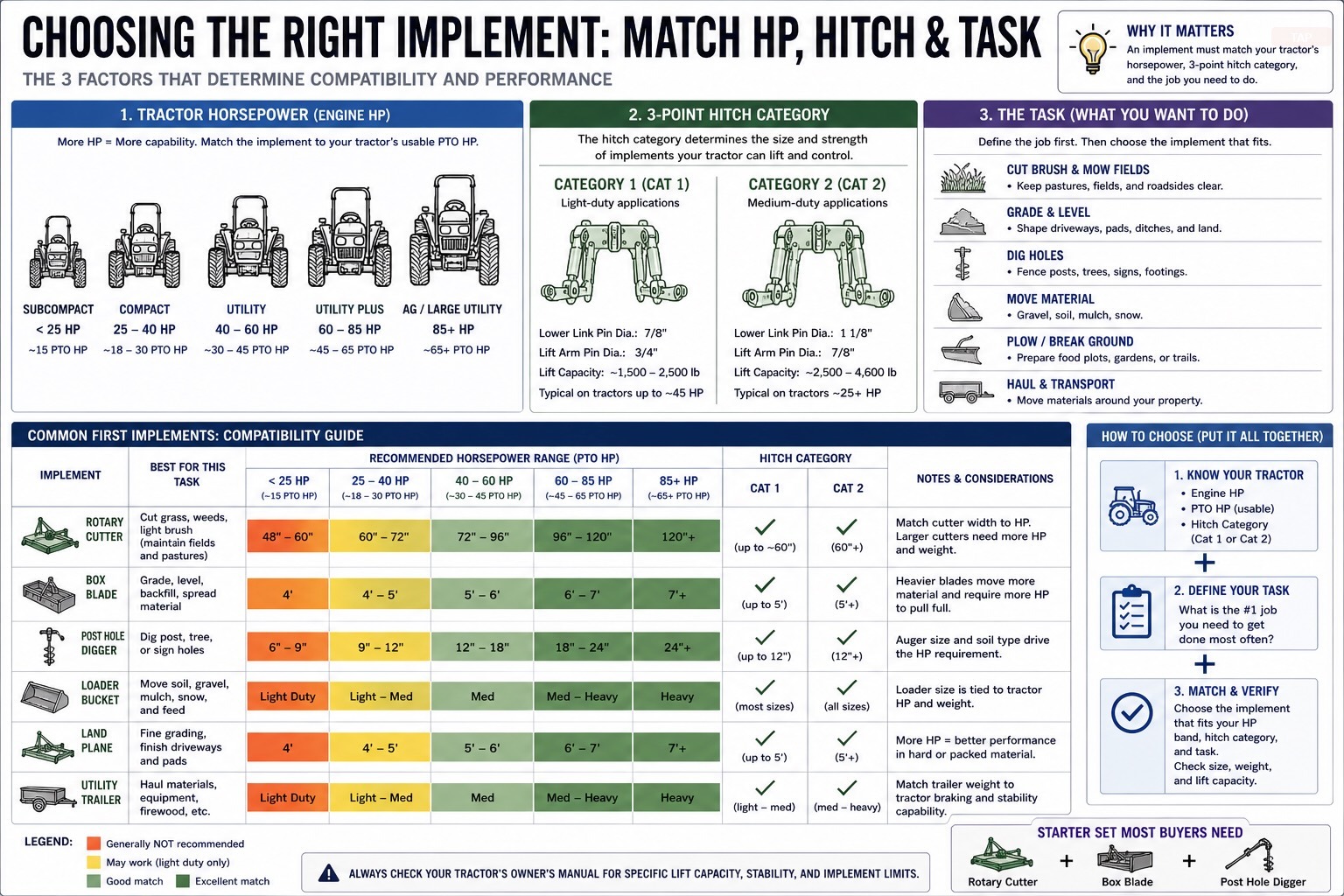
This guide covers the seven implement categories that deliver the highest utility per dollar for small farms: box blades, rotary cutters, rotary tillers, post hole diggers, hay equipment, front-end loaders, and wood chippers. Each has distinct tractor HP requirements, Category 1 or 2 hitch compatibility, and use cases that determine whether they earn their place in a small farm lineup.
For detailed comparisons within specific categories, see: front-end loaders, post hole diggers, rotary tillers, wood chippers, round balers, and disc mowers.
Understanding the 3-Point Hitch System
The 3-point hitch is the universal attachment interface on tractors. Per ASAE standards, there are five categories:
- Category 0: Subcompact tractors under 20 HP (top link pin 5/8”)
- Category 1: Compact tractors 20-45 HP (top link pin 7/8”) — most common for small farms
- Category 2: Utility tractors 40-100 HP (top link pin 1-1/8”)
Most small farm implements are built for Category 1, Category 1/2 (universal), or Category 2. Mismatching categories requires adapters that can work but may reduce implement stability. Per equipment dealer guidance, confirm category compatibility before purchase — not all implements are labeled clearly.
PTO implements require a live PTO shaft connection in addition to 3-point hitch mounting. Rotary tillers, mowers, chippers, and hay equipment are PTO-driven. Box blades, blades, and rippers are not PTO implements — they use only the tractor’s hydraulic 3-point lift.
Essential Implement Categories
1. Box Blade — Land Management Foundation
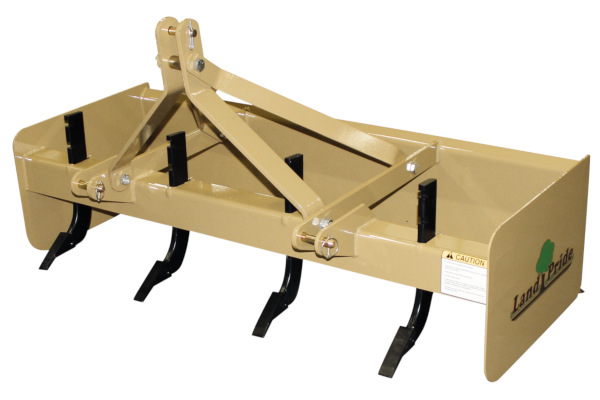
A box blade (also called a box scraper) is a three-sided steel box attached to the 3-point hitch that grades, levels, and backdrags soil and gravel. Per dealer survey data, the box blade is the most commonly purchased implement among new tractor owners.
What it does: Grades driveways, levels uneven ground, spreads gravel, clears light snow, backdrags and smooths garden areas. Optional scarifier shanks break up hard-packed surfaces before grading.
Recommended: King Kutter BB-660 (60 in, Category 1, scarifier shanks, $600-$900)
HP requirement: 15-60 HP (no PTO required). Works on subcompact through utility tractors.
Who needs it: Anyone with a gravel driveway, pasture lane, or construction site on their property. The box blade handles more daily tasks than any other implement in a small farm lineup.
2. Rotary Cutter (Bush Hog) — Brush and Pasture Maintenance
A rotary cutter (commonly called a “bush hog” after the leading brand) mounts to the 3-point hitch and uses PTO power to spin a heavy steel blade that cuts brush, saplings, and dense grass up to 1-inch diameter stems.
What it does: Maintains pastures, cuts fence lines, mows roadsides, shreds crop residue, clears brush up to 1-inch diameter.
Recommended: Land Pride RCR1260 (60 in, Category 1, 540 PTO, $1,100-$1,600) or Rhino SE5 (60 in, Category 1, $900-$1,300)
HP requirement: 20-55 HP at PTO. Heavier brush requires more HP.
Who needs it: Any farm with pasture to maintain. A rotary cutter is arguably the second most universal implement after a box blade, and it’s the reason many small farm owners buy a tractor in the first place.
3. Rotary Tiller — Seedbed Preparation
A rotary tiller uses PTO-driven L-shaped or C-pick tines to chop and incorporate soil in a single pass. It’s the essential implement for garden expansion, market garden beds, and food plot preparation.
What it does: Prepares garden beds, incorporates cover crops and amendments, breaks up compacted surface soil, prepares food plots.
Recommended: King Kutter TG-60-Y (60 in, Category 1, 25-50 HP, $700-$950) — see the full rotary tiller guide for complete comparison.
HP requirement: 25-65 HP depending on width and soil conditions.
Who needs it: Operations with gardens, food plots, or annual tilled crops. Not needed on grass-only operations or farms buying all inputs.
4. Post Hole Digger — Fencing and Structures
A post hole digger (PHD) mounts to the 3-point hitch and uses PTO power to drive a hydraulic or mechanical auger into the ground. It’s the implement that makes fence installation manageable on hard ground.
What it does: Drills holes for fence posts (6”, 9”, 12” diameters), mailbox posts, tree planting, deck footings, and any other post installation.
Recommended: Titan Attachments HD (Category 1, 9/12” auger included, $450-$650) — see the post hole digger guide for full comparison.
HP requirement: 15-45 HP. Most compact tractors handle a standard PHD.
Who needs it: Any farm installing fencing. Drilling even 50 fence post holes by hand in clay or rocky soil is exhausting; a tractor-mounted PHD reduces that work by an order of magnitude.
5. Front-End Loader — Year-Round Utility
A front-end loader attaches to the front of the tractor and provides lifting, loading, and pushing capability. It’s the most expensive implement category but also the most versatile — cleaning stalls, moving bales, loading trucks, grading with a bucket, and clearing snow.
What it does: Lifts pallets, moves round bales, cleans stalls, loads trucks and trailers, grades with bucket, handles forks and grapple attachments.
Recommended: Brand-matched to tractor (JD 120R, Kubota LA535, etc.) — see the front-end loader guide for full comparison.
HP requirement: 20-60+ HP depending on loader rated capacity.
Who needs it: Any farm with material handling needs — compost, gravel, feed, bales. The loader justifies the tractor investment for many small farm owners.
6. Hay Equipment — Disc Mowers, Tedders, and Balers
Hay production requires a chain of implements: a disc mower or sickle bar to cut, a tedder to accelerate drying, a rake to windrow, and a baler to package. Each is a separate implement purchase.
Entry-level hay chain cost estimate (used equipment): Disc mower ($2,500-$5,000), tedder ($1,500-$3,000), rake ($1,000-$2,500), small square baler ($5,000-$12,000) — total $10,000-$22,000 for a minimal hay operation.
For individual implement guides: disc mowers, hay tedders, small square balers, round balers.
Who needs it: Farms with livestock that consume hay, or operations producing hay as a cash crop. For fewer than 15 acres, purchasing custom farming or buying hay is typically more economical.
7. Wood Chipper — Land Clearing and Compost
A PTO-driven wood chipper processes brush, limbs, and trimmings into wood chip mulch. For farms with wooded lots, fence lines with overgrowth, or active land clearing, a chipper converts a waste stream into a usable mulch product.
Recommended: Wallenstein BX42S (4” capacity, Category 1/2, 25-55 HP, $2,800-$3,500) — see the wood chipper guide for full comparison.
HP requirement: 20-55 HP depending on chipper size and material diameter.
Who needs it: Operations with active land clearing, wooded properties, or fruit/nut orchards requiring annual pruning disposal. Not cost-effective for occasional trimmings — renting is more economical below 10+ hours of use per year.
Implement Priority for New Tractor Owners
Per equipment dealer guidance, the recommended sequence for first-time buyers:
- Box blade — immediate payback on driveway and property maintenance
- Rotary cutter — pasture and brush management
- Front-end loader — adds year-round utility across all tasks
- Post hole digger — fencing investment protects livestock and property
- Rotary tiller — garden and crop production
- Hay equipment — only if producing hay, significant capital investment
New vs. Used Implements
Per agricultural equipment dealer data, 3-point hitch implements hold value well. A used box blade or rotary cutter in good condition typically sells for 50-70% of new price and performs identically — the mechanical simplicity of non-PTO implements (box blades, blades, rippers) means there is minimal wear risk in used purchases.
PTO implements (tillers, chippers, post hole diggers) warrant more inspection before used purchase: check gearbox oil condition, tine/blade wear, and shear bolt history. A used tiller with a scored gearbox housing or worn tines may cost more to restore than the discount justifies.
Who This Is NOT For
- Buyers without a tractor. All implements in this guide require a tractor with a 3-point hitch and (for PTO implements) a live 540 RPM PTO shaft. There are no standalone versions
- Operators expecting one implement to do everything. The “universal attachment” category (skid steers, excavators) exists for operations needing maximum flexibility from a single machine. Tractor implements are task-specific tools
- Very small lots under 2 acres. For sub-2-acre properties, walk-behind tillers, handheld augers, and push mowers are more economical than buying a tractor plus implement for occasional use
What You’ll Also Need
- 3-point hitch quick hitch adapter (Category 1) — A quick hitch adapter eliminates crawling under the tractor to connect implement lower pins — the operator drives onto the quick hitch and connects with a single handle pull. Dramatically speeds implement changes. Search: “3 point quick hitch adapter Category 1,” “tractor quick connect hitch Cat 1.” Check price on Amazon →
- PTO driveline shaft (6-spline, 1-3/8”) — Some used implements arrive without a driveline. A replacement PTO shaft with overrunning clutch (standard 1-3/8” 6-spline on Category 1 tractors) must be length-matched to the implement distance. Search: “PTO driveline shaft 1-3/8 6-spline implement,” “tractor PTO shaft replacement 540 RPM.” Check price on Amazon →
- Implement mounting pins and linch pins — Lower link mounting pins are frequently mismatched or missing on used implements. A set of Category 1 lower link pins (1” diameter) with linch pin clips ensures proper hitch engagement. Search: “3 point hitch lower link pins Category 1,” “implement hitch pins linch pin set.” Check price on Amazon →
- Hydraulic top link, Category 1 (adjustable) — A hydraulic top link replaces the manual screw-adjust top link and allows the operator to level implements from the tractor seat using the tractor’s remote hydraulics. Saves significant time when implement leveling needs frequent adjustment (box blade on sloped ground). Search: “hydraulic top link Category 1 tractor,” “3 point hitch top link hydraulic adjustable.” Check price on Amazon →
- Implement touch-up paint (CAT yellow, JD green, Kubota orange) — Used implements show rust and scratched paint. Surface rust on non-critical areas is cosmetic, but bare metal on gearbox housings and structural welds can advance quickly in outdoor storage. Brand-matched implement paint maintains appearance and limits rust progression. Search: “John Deere green spray paint implement,” “Kubota orange implement paint spray,” “Cat yellow implement paint.” Check price on Amazon →
Not sure which implements to buy first? The Tractor Implement Finder matches your HP and tasks to specific implements with prices, compatibility checks, and honest limitations.
Sources
- USDA NRCS — small farm equipment guides and implement compatibility standards
- Penn State Extension — selecting farm equipment for small acreage operations
- King Kutter product catalog (kingkutter.com)
- Land Pride implement specifications (landpride.com)
- Woods Equipment implement product data (woodsequipment.com)
- Wallenstein Equipment product documentation (wallensteinequipment.com)