Best Hay Tedders for Small Farms in 2026
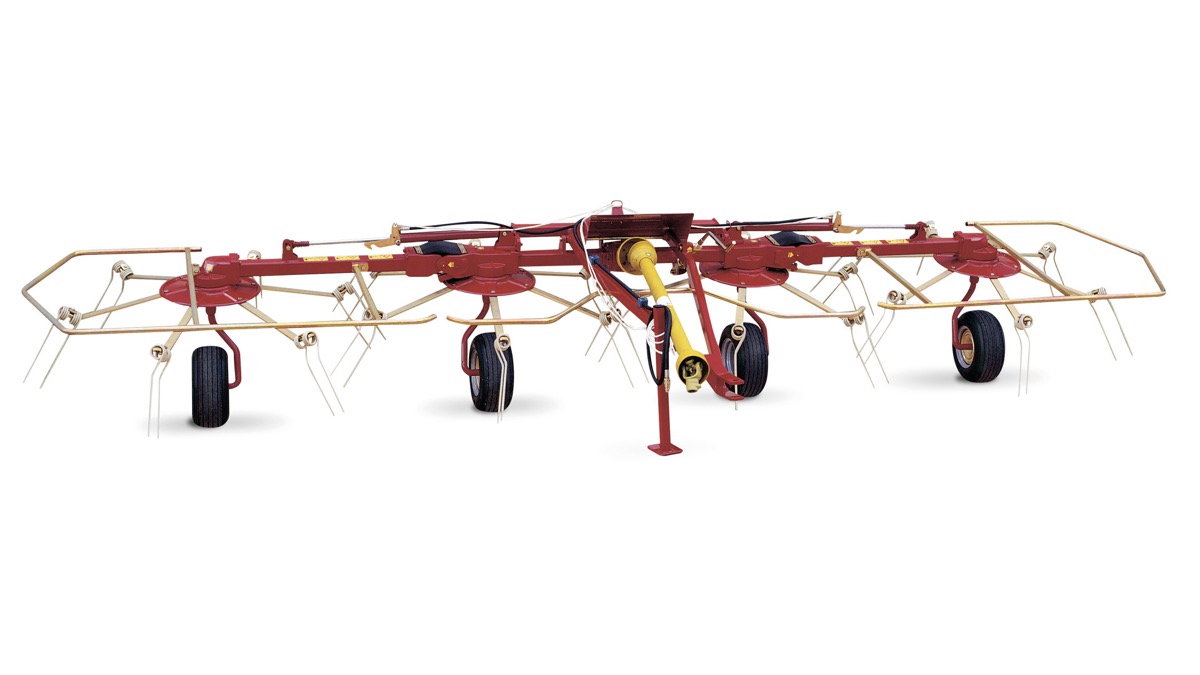
A hay tedder’s job is simple and consequential: flip and aerate cut hay to accelerate drying before baling. Per USDA forage research data, tedding can reduce field dry-down time by 25-40% compared to undisturbed swaths, which directly translates to fewer rain-exposure windows and better hay quality scores on protein and TDN. On small farms where one weather event can ruin an entire first cutting, a tedder is high-leverage equipment relative to its cost.
The key decisions are working width (how many passes to cover a field), rotor count (wider coverage per pass), and tine design (how aggressively the crop is turned). This guide compares four models commonly used on operations with 20-80 acres of hay ground. For cutting hay, see our disc mower guide; for gathering the dried crop into windrows after tedding, see our best hay rakes for small farms guide; for baling the dry crop, see our round baler and small square baler articles.
How Tedders Work
Rotary tedders use PTO-driven rotor assemblies fitted with curved spring tines. As each rotor spins, the tines pick up cut crop from the swath and throw it into the air, spreading it in a wider, more aerated layer that allows air circulation and solar radiation to accelerate moisture loss.
Rotor count determines how many swaths can be covered in a single pass. A 4-rotor tedder covers approximately 13-15 feet; a 6-rotor covers 18-20 feet. More rotors = fewer passes on large fields but more HP requirement and higher cost.
Tine design: Straight tines are more aggressive, better for heavy first cuttings. Curved tines are gentler, preferred for second and third cuttings with more delicate leaves. Tine condition matters — bent or missing tines leave untedded strips and reduce hay quality.
Working speed: Most tedders are designed for 6-9 mph working speeds. Faster operation increases daily acreage but requires the tractor and field conditions to support sustained speed.
Top Hay Tedders for Small Farms
Sitrex TK 6 Pro — Best Overall Value
| Specification | Value |
|---|---|
| Rotors | 6 |
| Working Width | 19.7 ft (6.0 m) |
| Transport Width | 8.5 ft |
| PTO Requirement | 35-60 HP |
| Working Speed | 5-9 mph |
| Tine Type | Double-bow spring tines |
| Hitch | 3-point, Category 1/2 |
| Weight | 770 lbs |
| Price Range | $2,200-$3,000 |
According to Sitrex’s product specifications, the TK 6 Pro uses a gear-driven transmission rather than chain drive, which per Sitrex documentation requires less maintenance and produces more consistent rotor speed across field speeds. The double-bow spring tines are designed for resilience against ground contact — they flex over obstacles rather than bending permanently.
The 19.7-foot working width covers substantial acreage per pass for a 6-rotor machine. Per the Sitrex spec sheet, the transport folding system reduces width to 8.5 feet for road travel, which fits in a single lane. The Category 1/2 universal hitch fits compact and utility tractors in the 35-60 HP range.
Best for: Small farms with 20-60 acres of hay ground and tractors in the 35-60 HP range. The gear-driven design reduces chain replacement costs common in comparable machines.
Kuhn GA 4521 — Best Precision Tedding
| Specification | Value |
|---|---|
| Rotors | 4 |
| Working Width | 14.8 ft (4.5 m) |
| Transport Width | 8.2 ft |
| PTO Requirement | 30-50 HP |
| Working Speed | 5-8 mph |
| Tine Type | Spring steel curved tines |
| Hitch | 3-point, Category 1/2 |
| Weight | 628 lbs |
| Price Range | $4,200-$5,800 |
Per Kuhn’s product documentation, the GA 4521 uses a central PTO gearbox with individual rotor drive shafts — each rotor is independently connected via a driveshaft rather than a shared chain. According to Kuhn specifications, this design allows rotor replacement without disturbing adjacent rotor assemblies and maintains consistent rotor phasing regardless of chain wear.
The curved spring tines are gentler on leaf-heavy crops. Per Kuhn’s product data, the tine holder design allows individual tine replacement without removing the entire tine set — a practical advantage in the field when a tine is bent or broken mid-session. Kuhn’s dealer network is strong in North America, with parts availability that supports the higher acquisition price over time.
Best for: Operations with leafy crops (alfalfa, mixed grass-legume) where aggressive tedding causes leaf shatter and quality loss. The gentler curved tines preserve more leaf material, which drives forage protein value.
H&S Manufacturing 1214 — Best North American Build
| Specification | Value |
|---|---|
| Rotors | 4 |
| Working Width | 13.8 ft (4.2 m) |
| Transport Width | 8.0 ft |
| PTO Requirement | 25-45 HP |
| Working Speed | 4-8 mph |
| Tine Type | Double-bow spring tines |
| Hitch | 3-point, Category 1/2 |
| Weight | 550 lbs |
| Price Range | $2,800-$3,800 |
According to H&S Manufacturing’s specifications, the 1214 is built in Marshfield, Wisconsin, with a galvanized rotor arm design that resists corrosion from morning dew and wet crop conditions better than standard painted steel. Per H&S’s product documentation, the rotor height is independently adjustable to accommodate uneven ground without scalping on high spots.
H&S is a family-owned manufacturer with a focused product line — dealers carry full parts inventory rather than stocking parts for dozens of competing lines. Per dealer reports, H&S parts turnaround is typically faster than European brands in regions where H&S has dealer coverage.
Best for: Operations in the northern tier states and Canada where corrosion resistance from wet morning conditions matters, and where domestic manufacturer support is preferred over European brands.
New Holland 258 Rotor Tedder — Best Entry Point
| Specification | Value |
|---|---|
| Rotors | 4 |
| Working Width | 12.8 ft (3.9 m) |
| Transport Width | 8.5 ft |
| PTO Requirement | 20-40 HP |
| Working Speed | 4-7 mph |
| Tine Type | Spring steel straight tines |
| Hitch | 3-point, Category 1/2 |
| Weight | 480 lbs |
| Price Range | $2,000-$2,800 |
Per New Holland’s product specifications, the 258 uses the lightest frame in this comparison at 480 lbs, which makes it compatible with subcompact utility tractors in the 20-40 HP range — the other models are borderline for sub-30 HP machines. According to New Holland’s data, the straight tine design is optimized for heavy first-cut grass where aggressive crop flipping is needed.
The 12.8-foot working width is narrower than competing 4-rotor units, which means more passes on larger fields. For 20-40 acre operations making one to three cuttings per year, the additional pass time is acceptable given the lower acquisition cost and tractor compatibility.
Best for: Smaller operations (under 30 acres) with subcompact or light compact tractors in the 20-35 HP range who need a functional tedder without overpowering the tractor’s hydraulic and PTO capacity.
Comparison Summary
| Model | Rotors | Working Width | HP Req. | Price |
|---|---|---|---|---|
| Sitrex TK 6 Pro | 6 | 19.7 ft | 35-60 HP | $2,200-$3,000 |
| Kuhn GA 4521 | 4 | 14.8 ft | 30-50 HP | $4,200-$5,800 |
| H&S Manufacturing 1214 | 4 | 13.8 ft | 25-45 HP | $2,800-$3,800 |
| New Holland 258 | 4 | 12.8 ft | 20-40 HP | $2,000-$2,800 |
Who This Is NOT For
- Farms with fewer than 15 acres of hay. Below 15 acres, the drying time saved by tedding rarely justifies the implement cost over simply purchasing hay. Custom farming (hiring a neighbor with a tedder) is the more economical path at small scale
- Operators without a tractor. Hay tedders are 3-point hitch, PTO-driven implements — there is no standalone, pull-behind version at practical cost. An ATV-mounted tedder exists but covers minimal acreage at low efficiency. A tractor is prerequisite equipment
- Haylage or baleage operations. Haylage is intentionally harvested at high moisture content (50-70% moisture) and ensiled in bags or pits. Tedding defeats the purpose by over-drying the crop. Haylage operations should skip the tedder and bale directly at the correct moisture window
- Operations in consistently dry, low-humidity climates. In arid regions where hay dries to baling moisture in 24-36 hours without assistance, a tedder adds cost and fuel consumption for minimal gain. Evaluate actual dry-down time in your region before purchasing
What You’ll Also Need
Tedders are dealer-purchased equipment, but replacement parts and service items are available online:
- Replacement hay tedder tines — Tines are the highest-wear item on any tedder. Bent, broken, or missing tines leave untedded rows and uneven drying. A set of 10-20 replacement tines stored in the shop prevents a single bent tine from creating a second trip to town. Search: “hay tedder tine replacement universal,” “rotary tedder spring tines set.” Check price on Amazon →
- Tedder tine holder clips — Tine clips secure individual tines to the rotor arm. These small clips are frequently lost when a tine breaks under load. A bag of 20-30 replacement clips is low-cost insurance. Search: “tedder tine holder clip replacement,” “hay tedder tine retaining clip.” Check price on Amazon →
- PTO driveline shear bolt kit — Like disc mowers, tedders use shear bolts to protect the driveline from overload. A zip-lock bag of the correct bolt size in the tractor tool kit prevents a broken shear bolt from stopping the day. Search: “PTO shear bolt kit 3/8 grade 5,” “tractor implement shear bolt assortment.” Check price on Amazon →
- Grease gun with flex hose — Tedders have multiple grease zerks on rotor bearings, gearbox inputs, and frame pivots. A flex-hose attachment on a grease gun reaches zerks in tight rotor assemblies without repositioning. Search: “grease gun flex hose attachment 18 inch,” “right angle grease gun coupler.” Check price on Amazon →
- NLGI 2 lithium grease cartridges — Standard multi-purpose grease for all zerk fittings. Most tedder manufacturers specify NLGI 2 lithium or calcium-complex grease. Search: “NLGI 2 lithium grease cartridge 14 oz,” “multi-purpose bearing grease cartridges.” Check price on Amazon →
- Hay moisture meter — Tedding decisions require knowing actual crop moisture. Baling too wet causes mold; baling too dry causes leaf shatter. A handheld probe meter eliminates guesswork on when to stop tedding and start raking. Search: “hay moisture meter probe,” “forage moisture tester digital.” Check price on Amazon →
Sources
- Sitrex TK 6 Pro specifications (sitrex.com)
- Kuhn GA 4521 product documentation (kuhn.com)
- H&S Manufacturing 1214 product specifications (hsmfg.com)
- New Holland 258 Rotor Tedder product data (newholland.com)
- USDA National Agricultural Statistics Service — hay harvesting efficiency and forage quality publications