Best Small Round Baler 2026: 4 Picks From $8K Mini to $26K Net-Wrap (15-50 HP)
HP and acreage notes — one email
When a new implement-sizing note ships, it goes to this list. Tractor HP or acres in the subject if you want; the only field required is email. Spec-grounded, no hype.
Quick answer for small-farm hay operations in 2026:
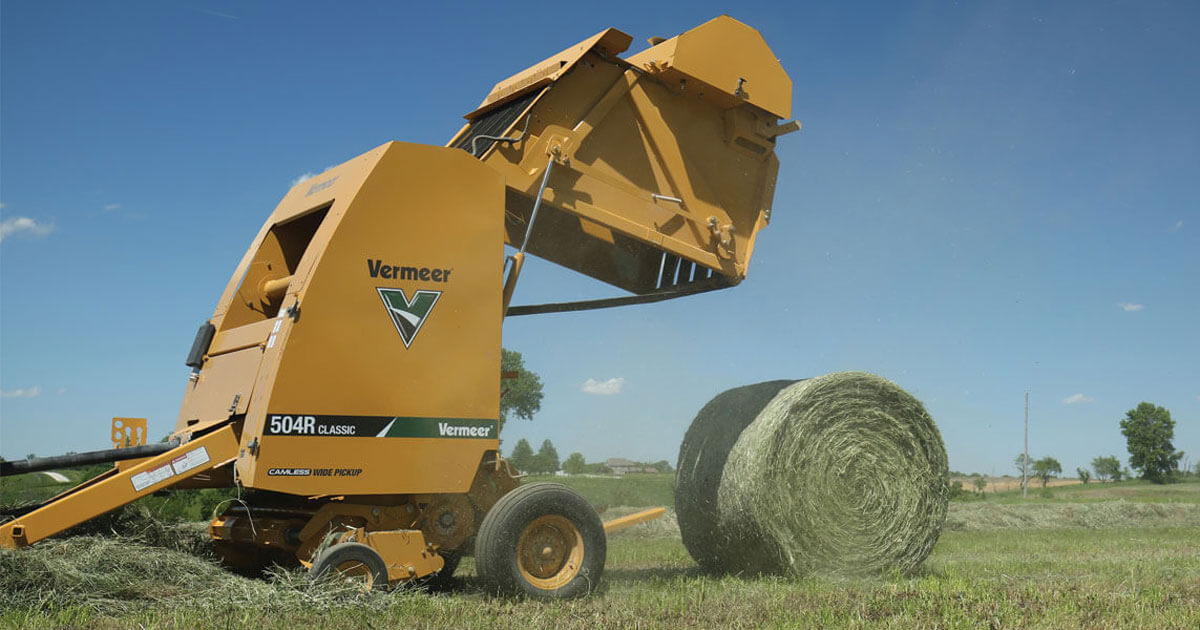
- 25-100 acres, 50+ HP tractor: Vermeer 504R Classic — $18-24K, 4’×5’ bales, 40 HP minimum PTO.
- 35-55 HP tractor: John Deere 450M — $16-21K, 35 HP minimum, sized to avoid overloading lighter tractors.
- Outdoor bale storage: Massey Ferguson RB3130F — $20-26K, net wrap standard (saves $1,500-$3,000 vs optional).
- Subcompact tractor (15-25 HP): Abbriata M60 — $8-12K, 3’3” mini bales one person can move without a spear.
Round balers turn cut, dried hay into cylindrical bales that can be stored outdoors with minimal spoilage — a significant advantage over square bales for operations without covered storage. For small farms running 10-100 acres of hay, selecting the right round baler means matching bale size, tractor requirements, and throughput to your actual operation rather than buying capability you’ll never use.
According to ASABE standards, round bales range from small “mini” bales (3’x3’) weighing 200-400 lbs to full-size bales (5’x6’) weighing 800-1,500 lbs depending on crop density. Small farm operations typically produce 4’x4’ or 4’x5’ bales — large enough for efficient handling but manageable with compact and utility tractors.
Matching Baler to Tractor
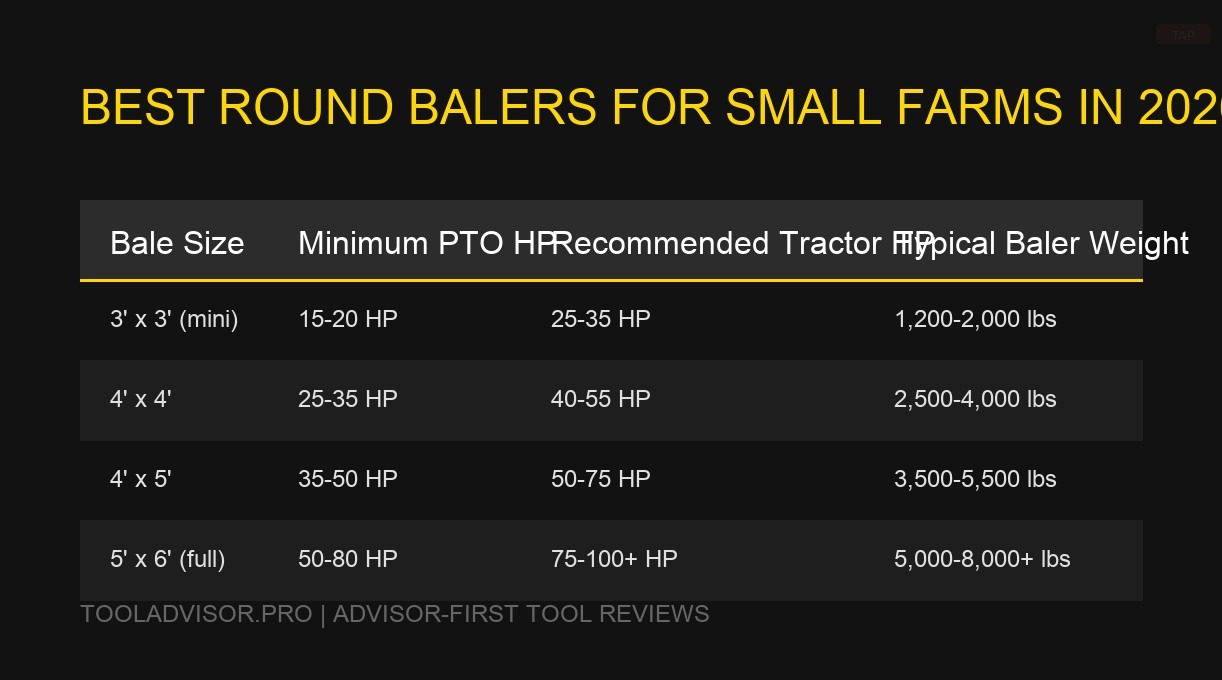
The most common mistake in baler selection is buying a baler that exceeds your tractor’s PTO capacity. If you are still selecting a tractor, our compact tractor guide covers PTO HP ratings and how gross HP translates to actual PTO output. According to manufacturer specifications across the category:
| Bale Size | Minimum PTO HP | Recommended Tractor HP | Typical Baler Weight |
|---|---|---|---|
| 3’ x 3’ (mini) | 15-20 HP | 25-35 HP | 1,200-2,000 lbs |
| 4’ x 4’ | 25-35 HP | 40-55 HP | 2,500-4,000 lbs |
| 4’ x 5’ | 35-50 HP | 50-75 HP | 3,500-5,500 lbs |
| 5’ x 6’ (full) | 50-80 HP | 75-100+ HP | 5,000-8,000+ lbs |
Beyond PTO horsepower, verify your tractor’s:
- 3-point hitch lift capacity (for mounted models) or drawbar (for pull-type)
- Hydraulic remotes: Most balers need 1-2 sets of rear remotes for tailgate and wrapping functions
- PTO speed: 540 RPM is standard for small/mid-size balers; some larger models require 1000 RPM
Once PTO horsepower and chamber size are set, a Vermeer-class 4x5 baler is used iron — Amazon does not stock an $18–24k machine. Inspect belts, pickup teeth, and a full wrap cycle before money changes hands. The consumable this machine actually uses is 64-inch net wrap (or twine if the chamber is twine-only):
Consumable this machine actually uses — 64” net wrap / twine →
Top Round Balers for Small Operations
Vermeer 504R Classic — Best Overall for Small Farms
| Specification | Value |
|---|---|
| Bale Size | 4’ x 5’ (adjustable 3.5’-5’ diameter) |
| Chamber Type | Fixed chamber |
| PTO Requirement | 40 HP minimum (540 RPM) |
| Pickup Width | 51” |
| Net Wrap | Optional |
| Twine Tie | Standard (2 arms) |
| Baler Weight | 4,300 lbs |
| Price Range | $18,000-$24,000 (new) |
According to Vermeer’s specifications, the 504R Classic uses a fixed-chamber design with 4 belts and a full-width floor roller for consistent bale shape. The 51” pickup width accommodates the standard small-farm windrows formed by a 4-wheel or rotary hay rake. Vermeer’s dealer network is extensive in agricultural regions, with most dealers maintaining parts inventory for current models.
Best for: Small farms running 25-100 acres of hay with 50+ HP tractors. The fixed-chamber design is simpler to maintain than variable-chamber alternatives.
John Deere 450M — Best Compact Round Baler
| Specification | Value |
|---|---|
| Bale Size | 4’ x 4.7’ maximum |
| Chamber Type | Fixed chamber |
| PTO Requirement | 35 HP minimum (540 RPM) |
| Pickup Width | 53” |
| Net Wrap | Optional |
| Twine Tie | Standard |
| Baler Weight | 3,800 lbs |
| Price Range | $16,000-$21,000 (new) |
Per John Deere’s product documentation, the 450M is designed specifically for compact and utility tractors in the 35-60 HP range. The MegaWide pickup uses 5-bar design for cleaner field pickup in light windrows. The smaller maximum bale diameter (4.7’) keeps bale weight manageable for lighter tractors during transport and handling.
Best for: Operations with 35-55 HP tractors that need a properly matched baler without overloading the tractor. The 4’ width fits standard equipment well.
Massey Ferguson RB3130F — Best Value Full-Size
| Specification | Value |
|---|---|
| Bale Size | 4’ x 5’ (adjustable) |
| Chamber Type | Fixed chamber |
| PTO Requirement | 45 HP minimum (540 RPM) |
| Pickup Width | 53” |
| Net Wrap | Standard |
| Twine Tie | Standard |
| Baler Weight | 4,600 lbs |
| Price Range | $20,000-$26,000 (new) |
According to Massey Ferguson’s specifications, the RB3130F includes net wrap as standard equipment — a feature that’s optional (and $1,500-$3,000 extra) on many competing models. Per manufacturer data, net-wrapped bales shed water better than twine-tied bales, reducing dry matter loss by 5-15% during outdoor storage. The hydraulic pickup flotation system adjusts ground pressure to reduce crop contamination.
Best for: Farms storing bales outdoors where weather protection matters. The included net wrap pays for itself over 2-3 seasons through reduced spoilage.
Abbriata M60 — Best for Compact Tractors (Mini Baler)
| Specification | Value |
|---|---|
| Bale Size | 3’3” x 3’3” maximum |
| Chamber Type | Fixed chamber |
| PTO Requirement | 15 HP minimum (540 RPM) |
| Pickup Width | 40” |
| Net Wrap | Not available |
| Twine Tie | Standard |
| Baler Weight | 1,320 lbs |
| Price Range | $8,000-$12,000 (new) |
The Abbriata M60 is an Italian-made mini round baler specifically designed for compact tractors. Per the manufacturer, the M60 produces bales light enough for one person to handle. The 15 HP PTO minimum makes it compatible with subcompact tractors like the Kubota BX series and John Deere 1025R.
Best for: Small acreage (under 10 acres) with subcompact tractors. The bales are manageable without specialized handling equipment like spear attachments or bale forks.
Mini Round Balers
A mini round baler is a different machine class than a “small” 4-foot by 5-foot baler sold for 40 HP tractors. Buyers searching mini round baler are usually matching a 15–25 HP subcompact (Kubota BX, John Deere 1025R class), not downsizing a utility-tractor chamber.
Per ASABE dimensional conventions and the manufacturer specs above:
- Bale size: typically about 3 feet by 3 feet up to 3-foot-3-inch diameter, 200–400 lbs depending on crop density — light enough that many operations move bales by hand instead of with a spear.
- PTO requirement: 15–20 HP minimum at 540 RPM. The Abbriata M60 lists 15 HP PTO; that is compatible with subcompact tractors and is below the 35–45 HP PTO floor of the 4x5 machines in this guide.
- Wrap system: twine is standard. The M60 does not offer net wrap, so outdoor-storage dry-matter loss follows the twine figures in the wrap comparison below, not the net-wrap figures.
- Who this class fits: under about 10 acres of hay per season, no loader spear, and a tractor that cannot pull a 35–40 HP chamber without bogging.
- Who this class does not fit: commercial 4x5 density, outdoor net-wrap storage, or throughput beyond a few dozen bales per cutting. Those jobs need the Vermeer / John Deere / Massey Ferguson class — and a tractor with the PTO and ballast to match.
If the tractor has 35 HP PTO or more and the handling plan already includes a bale spear, skip the mini class. The lower purchase price is offset by more bales per acre, slower field time, and no net-wrap option. Buyers already committed to a mini chamber and shopping used iron should run belts, pickup teeth, and a full wrap cycle before money changes hands — see the used mini round baler inspection guide.
Comparison Summary
| Model | Bale Size | Min PTO HP | Net Wrap | Price |
|---|---|---|---|---|
| Vermeer 504R Classic | 4’ x 5’ | 40 HP | Optional | $18-24K |
| John Deere 450M | 4’ x 4.7’ | 35 HP | Optional | $16-21K |
| Massey Ferguson RB3130F | 4’ x 5’ | 45 HP | Standard | $20-26K |
| Abbriata M60 | 3.3’ x 3.3’ | 15 HP | No | $8-12K |
Net Wrap vs Twine: Which Wrapping System to Choose
Every round baler secures bales with either twine or net wrap. The choice affects outdoor storage losses, per-bale cost, and handling speed.
Twine-tied bales use 2–3 wraps of sisal or poly twine around the bale circumference. Twine is standard on nearly all balers, costs less per bale, and cuts cleanly at feedout. Per University of Missouri Extension forage storage research, twine-tied bales stored outdoors in humid climates lose 10–25% of dry matter through weathering — moisture works into the bale along the uncovered cylindrical surface.
Net-wrapped bales cover the full exposed surface with a plastic mesh net. Per University of Missouri Extension and University of Nebraska forage storage data, net wrapping reduces outdoor dry matter loss to 5–8% — a significant improvement for operations without covered storage. Net wrap also reduces windrow and wildlife intrusion compared to loose twine ends.
| Factor | Twine | Net Wrap |
|---|---|---|
| Consumable cost per bale | $0.15–$0.30 | $0.40–$0.65 |
| Outdoor dry matter loss | 10–25% | 5–8% |
| Wrapping speed | Slower (2–3 rotations) | Faster (1–2 rotations) |
| Baler compatibility | All round balers | Requires net wrap system (standard or optional add-on) |
| Wildlife intrusion resistance | Lower (birds peck twine) | Higher |
| Feedout ease | Fast (cut twine cleanly) | Slightly slower (net must be removed before feeding) |
Which to choose: If bales are stored indoors with roof coverage, twine is adequate and cheaper per bale. If bales are stored outdoors in rows — common on small farms without a large hay shed — the 5–15% dry matter preservation advantage of net wrap typically offsets the $0.20–$0.35 per-bale consumable cost within a single season of weather exposure.
Of the balers reviewed above, only the Massey Ferguson RB3130F includes net wrap as standard. The Vermeer 504R Classic and John Deere 450M offer it as an optional add-on at $1,500–$3,000 extra; the Abbriata M60 does not support net wrap at all.
Fixed Chamber vs. Variable Chamber
Round balers use one of two designs:
Fixed chamber balers form bales against a fixed set of rollers or belts. The bale grows until it fills the chamber, producing consistent-diameter bales. According to manufacturer data, fixed-chamber balers are simpler mechanically, easier to maintain, and less expensive. They handle dry hay well but can struggle with very dense crops.
Variable chamber balers use belts that expand as the bale grows, allowing adjustable bale diameter. Per industry specifications, these balers produce denser core starts (better for wet conditions) and handle varying crop volumes more flexibly. However, they cost 20-40% more and have more components subject to wear.
For small farms making dry grass hay, fixed-chamber balers offer the best balance of simplicity, reliability, and cost. Variable-chamber models become more justified for operations baling multiple crop types or working in wetter climates.
Owning vs. Custom Baling: The Cost-Per-Bale Math
The most important question before buying any round baler is whether owning makes economic sense for the acreage and volume involved.
Custom baling rates — hiring a neighbor or dedicated custom operator — typically run $12–$20 per bale for twine-wrap and $14–$22 for net-wrap, supply your own consumables. Rates vary by region and current diesel prices.
The cost-per-bale for ownership depends on:
| Component | Assumption | Cost Per Bale |
|---|---|---|
| Equipment depreciation | $20,000 baler, 15-year life, 300 bales/year | $4.44 |
| Net wrap | 9,000 ft roll (~$280), ~600 bales per roll | $0.47 |
| Fuel | 1.5 gal/hr × 4 min/bale × $4.50/gal | $0.45 |
| Tractor wear/maintenance share | Estimated at $1.50–$2.50/hr, 4 min/bale | $0.10–$0.17 |
| Baler maintenance (bearings, belts, chains) | $300–$800/year at 300 bales/year | $1.00–$2.67 |
| Estimated total | $6.50–$8.20 per bale |
At 300 bales per year, owning typically beats custom baling by $6–$12 per bale — a savings of $1,800–$3,600 per year. Payback on a $20,000 baler at that differential runs 6–11 years.
At 100 bales per year, fixed depreciation costs per bale rise above $13, making custom baling competitive or cheaper depending on local rates. Below 50 bales per year, custom baling is almost always the lower-cost option when full depreciation and opportunity cost are included.
The 150-bale threshold is a useful rule of thumb: below 150 bales per year, run the ownership math carefully before buying. Above 250 bales per year, ownership typically makes clear economic sense. These calculations do not account for the convenience value of baling on your own schedule — a real consideration when hay moisture windows are short.
Who This Is NOT For
- Farms producing fewer than 50 bales per year. At that volume, hiring custom baling ($12-20 per bale including twine/wrap) is almost certainly more economical than owning equipment that depreciates whether you use it or not
- Operations that need 4-foot by 5-foot bales behind a tractor under 25 HP. Mini round balers in the 15 HP PTO class produce ~3-foot bales, not mid-size 4x5 bales. If the handling plan assumes a spear and 600–1,000 lb bales, the tractor is undersized for that chamber. Small square balers have more compact-tractor offerings when the crop must stay in small packages.
- Producers selling hay commercially. Commercial hay buyers strongly prefer small square bales (easier to handle and resell) or large commercial round bales (5’x6’). The mid-size 4’x4’ and 4’x5’ bales common to small farms have limited resale market
- Properties without bale handling equipment. A 4’x5’ round bale weighs 600-1,000+ lbs. Moving these requires a tractor with a bale spear, pallet forks, or a dedicated bale mover. Budget $200-$800 for handling attachments
Buying Used Round Balers
Used round balers represent significant savings — 40–60% off new prices is common for well-maintained equipment in the 5–15 year age range. Budget $8,000–$12,000 for a used mid-size fixed-chamber baler in good operating condition, compared to $16,000–$24,000 new.
Before you inspect the machine, request:
- Service records or any dealer maintenance history
- Hours (if the baler has an hour meter — many older units do not)
- What crop type and conditions it has baled (wet hay is harder on belts and wrapping systems than dry grass)
- Whether it has had belt replacements, and when
Physical inspection checklist:
- Belt condition: Check all belts for cracks, delamination, fraying edges, and uneven wear across the width. Per manufacturer service guidelines, cracked or delaminated belts are a replacement item, not a run-it-and-see item. Belt replacement on a 4-belt fixed-chamber baler runs $1,500–$3,000 in parts plus installation.
- Pickup teeth and guards: Walk the full width of the pickup. Bent, broken, or missing teeth reduce feeding efficiency and leave crop on the ground. Individual teeth are inexpensive ($2–$6 each), but count them — a heavily worn pickup has 20–30 damaged teeth and the labor to replace all of them adds up.
- Drive chain condition: Find every drive chain and apply light pressure to the slack span mid-chain. Per roller chain service standards, chains with more than 3% elongation should be replaced. Excessive slack throughout the system indicates deferred maintenance across the drivetrain, not just one chain.
- Bearings on rollers and idlers: Spin each roller by hand and listen for grinding, clicking, or roughness. Failed bearings are a common wear item on high-use balers and run $15–$80 each plus labor. Multiple failed bearings indicate a machine that was run past service intervals.
- Tailgate hinges and latches: Open and close the tailgate manually. It should move freely, latch securely, and show no stress cracks at the hinge weldments. Tailgate problems are expensive to repair because the tailgate carries significant load during bale ejection.
- Twine or net wrap system: Test-run a complete tying or wrapping cycle with material loaded. These mechanisms are the most failure-prone systems on any round baler — worn knives, fouled sensors, and worn twine discs are common on high-hour machines. A failed test cycle is a negotiating point, not a deal-breaker, but the repair cost should be factored in.
- PTO driveline: Check the telescoping driveshaft for worn U-joints (clunk at startup or speed change), damaged shielding, and secure yoke fit on both the tractor and baler ends. Per ASABE safety standards, a baler PTO driveline with missing shielding should not be operated.
The test bale requirement: Do not complete a purchase without watching the baler form and wrap at least one full bale under field or simulated field conditions. A seller who will not allow a test bale is signaling that the machine has a problem they prefer you discover after the sale.
Parts availability check: Before finalizing any used baler purchase, search the manufacturer’s parts catalog online for pickup teeth, belts, and idler bearings by model number. If parts are discontinued, backordered, or available only from overseas suppliers, factor that into the long-term ownership cost.
What You’ll Also Need
Round balers require a steady supply of consumables bought season after season — regardless of whether the baler came from a dealer or the used equipment market.
- Round baler net wrap — 64” x 9,000 ft — the dominant wrap method on modern round balers. A 9,000-foot roll covers approximately 500–700 bales depending on bale diameter and overlap setting. Search: “round baler net wrap 64 inch,” “baler net wrap 9000 ft.” Check price on Amazon →
- Round baler twine — poly or sisal, 9,000 ft spool — twine-wrap balers use two strings per bale; a pair of 9,000-foot spools covers a full small-farm season. Search: “round baler twine 9000 ft,” “poly twine baler sisal.” Check price on Amazon →
- Baler pickup teeth replacements — pickup teeth break on rocks and hard ground mid-season. Keep a set of spares on hand; they’re model-specific. Search: “Vermeer 504 pickup teeth replacement,” “John Deere 450 baler pickup teeth.” Check price on Amazon →
- Bale spear — 3-point hitch mount — a 3-point bale spear is required to move finished round bales. A standard single-spike spear handles bales up to 1,500 lbs. Search: “bale spear 3 point hitch,” “round bale mover tractor attachment.” Check price on Amazon →
- Agricultural roller chain — #50 or #60 pitch — baler drive chains are wear items; having a spare length and master links on hand prevents a lost day waiting on parts. Search: “agricultural roller chain 50 pitch,” “baler drive chain #50.” Check price on Amazon →
- Lithium grease — NLGI 2, 14 oz cartridges — round balers have 40–80 grease fittings per the manufacturer service schedule. A full-size cartridge is consumed in a few greasing sessions at peak season. Search: “lithium grease NLGI 2 cartridge,” “baler grease 14 oz.” Check price on Amazon →
FAQ
What is the minimum PTO horsepower for a small round baler?
Match PTO horsepower, not marketed engine HP. Per the manufacturer minimums in this comparison: Abbriata M60 lists 15 HP PTO at 540 RPM; John Deere 450M lists 35 HP PTO; Vermeer 504R Classic lists 40 HP PTO; Massey Ferguson RB3130F lists 45 HP PTO. A compact tractor in the 35–55 HP class can typically pull the 4x4 / 4x5 chambers if hitch lift, remotes, and ballast also match. A 15–25 HP subcompact cannot. Sizing the chamber at or above continuous PTO output is the usual failure mode — the tractor bogs, belts slip, and bale density falls.
Used vs new — when is a used round baler the smarter buy?
Used is often the lower-cost path at 40–60% of new for a 5–15 year fixed-chamber machine, provided belts, pickup teeth, drive chains, and the wrap system can be inspected and the seller allows a test bale. New makes more sense when net wrap must be standard or factory-optioned (the RB3130F includes it; used twine-only machines do not grow a net kit cheaply), when parts for the model are discontinued, or when the machine cannot be run through a full wrap cycle before money changes hands. Budget $1,500–$3,000 for a 4-belt replacement if the used belts are cracked or delaminated — that cost belongs in the bid, not after delivery.
Own a baler or hire custom baling?
Custom rates commonly run $12–$20 per bale (twine) and $14–$22 (net wrap). Ownership math in this guide puts a $20,000 baler at roughly $6.50–$8.20 per bale at 300 bales per year. At 100 bales per year, depreciation alone can exceed $13 per bale, which makes custom competitive or cheaper. Below about 150 bales per year, run the numbers with local custom rates; below 50 bales per year, custom is almost always the lower-cost option when full depreciation is counted. Convenience during a short moisture window is a real factor, but it is not a substitute for the cost-per-bale table.
Should a small farm use net wrap or twine?
Per University of Missouri Extension forage storage research, twine-tied bales stored outdoors in humid climates can lose 10–25% of dry matter; net wrap reduces that outdoor loss to roughly 5–8%. Twine is cheaper per bale and adequate under roof. Of the machines compared here, only the Massey Ferguson RB3130F includes net wrap as standard; the Vermeer 504R and John Deere 450M offer it as a $1,500–$3,000 option; the Abbriata M60 does not support net wrap.
What size round baler fits a compact tractor?
A compact in the 35–55 HP class is typically matched to a 4x4 or 4x5 chamber with a 35–40 HP PTO minimum (John Deere 450M or Vermeer 504R Classic), if hitch lift and ballast can handle 3,000–5,000 lb baler weight. Subcompacts in the 15–25 HP class need a mini chamber (Abbriata M60, 15 HP PTO) or a different hay system. See best subcompact tractors and best hay rakes for small farms for the rest of that match.
What is a mini round baler?
A mini round baler produces bales in the roughly 3-foot by 3-foot class (about 200–400 lbs depending on crop density) instead of 4x4 or 4x5 bales. Per manufacturer specs, machines such as the Abbriata M60 list a 15 HP PTO minimum at 540 RPM and typically twine only. That class fits a subcompact that cannot pull a 40 HP chamber. It does not produce commercial-density 4x5 bales.
Sources
- Vermeer 504R Classic specifications (vermeer.com)
- John Deere 450M product documentation (deere.com)
- Massey Ferguson RB3130F specifications (masseyferguson.com)
- Abbriata M60 product data (abbriata.com)
- ASABE Standard S351.3 for round bale dimensions and density
- University of Missouri Extension — Round Bale Storage Losses guide
- ASABE Standard S210.3 — Operator protection and PTO driveline shielding requirements
- University of Nebraska-Lincoln Farm Custom Rates survey (2024–2025 edition)
- Net wrap coverage and pricing — Vermeer and Agri-Supply current product data
- ASME B29.1 — Roller chain elongation and replacement criteria