Used Shop Air Compressors: Inspection Checklist, Fair Prices, and Where the Real Deals Are in 2026
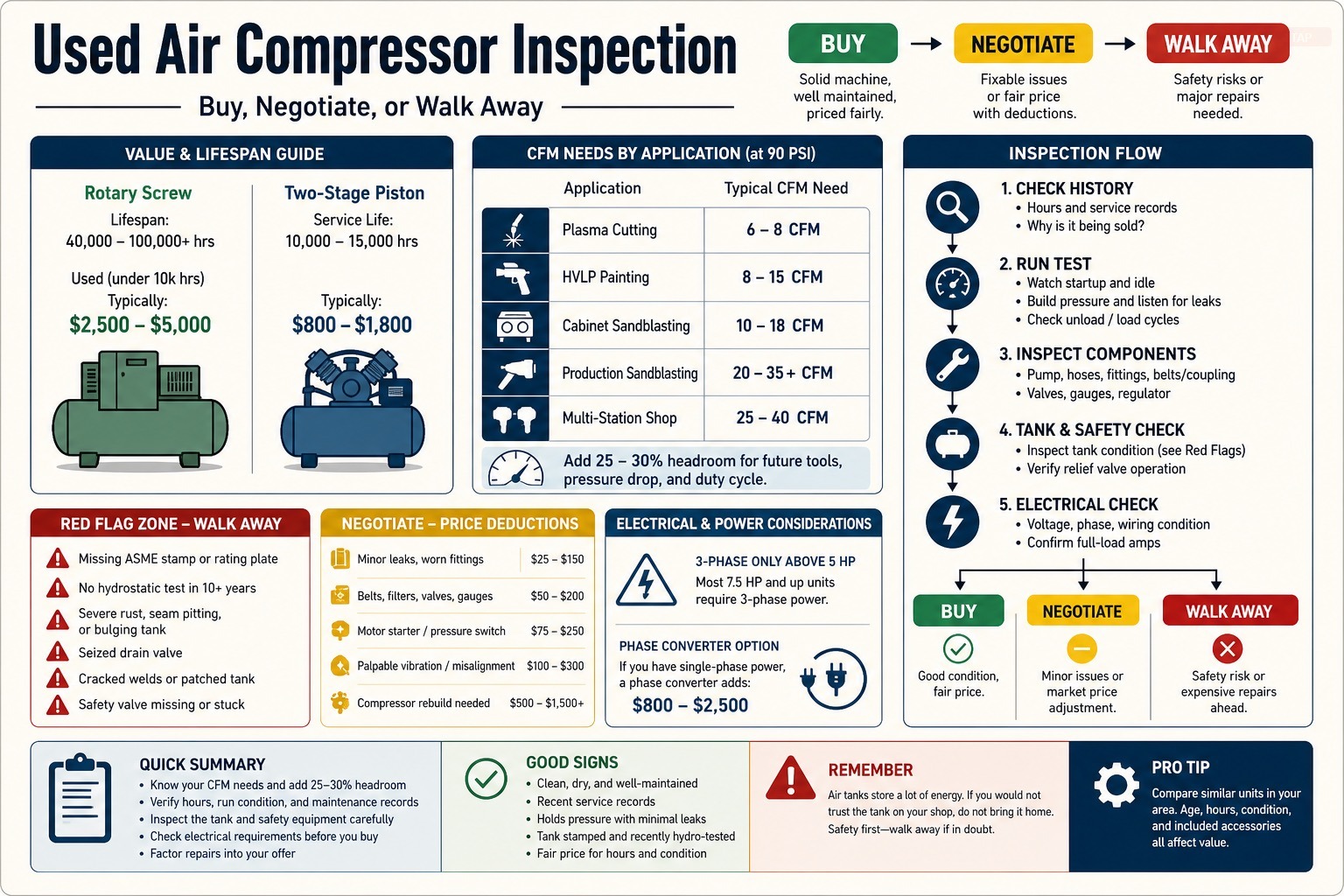
The used shop air compressor market is one of the few places where buying older American industrial equipment is genuinely the smarter financial call. A 1990s or 2000s Ingersoll Rand T30, Quincy QT-series, or Kaeser rotary screw — properly inspected, with verifiable hours and a sound tank — typically sells for 30–55% of equivalent new pricing while delivering longer remaining service life than most current import-grade single-stage units. The catch: a corroded ASME tank is a fragmentation hazard, a worn rotary screw airend is a $4,000–$8,000 rebuild, and a single-phase vs three-phase mismatch can strand a buyer with an unusable machine and freight bills already paid.
For new compressor decisions, see the best shop air compressors and best rotary screw compressors guides.
Rotary Screw vs. Piston in the Used Market
The decision logic shifts in the used market. Per Ingersoll Rand, Quincy, and Kaeser service documentation, an industrial rotary screw airend has a 40,000–100,000 hour design life when oil and air filtration are maintained. A two-stage cast-iron piston pump is rated for roughly 10,000–15,000 hours before valve and ring service. That advantage means a used 7.5 HP rotary screw at 8,000 hours often has more remaining life than a used two-stage piston at 4,000 hours.
For shops needing 20+ CFM continuously — sandblasting, paint booth, plasma plus pneumatic tools — a used rotary screw frequently wins on total cost. A Quincy QGS-7.5 or Ingersoll Rand UP6-7.5 with verifiable service records and under 10,000 hours typically sells for $2,500–$5,000 against $7,000–$9,500 new. The catch: most used rotary screws above 5 HP are three-phase only.
For shops under 15 CFM continuous demand, or where three-phase power is unavailable, a used two-stage piston (Ingersoll Rand 2475, T30, or Quincy QT-54) at $800–$1,800 remains the rational choice.
CFM Sizing by Use Case
Per manufacturer and tool documentation, sustained CFM at 90–125 PSI is the only spec that determines fit:
| Application | CFM Demand at 90 PSI |
|---|---|
| Plasma cutter (40–60A) | 6–8 CFM |
| Die grinder, random orbital sander | 6–10 CFM |
| HVLP spray gun (single, light panels) | 8–15 CFM |
| Body shop (multiple guns + sanders) | 25+ CFM |
| Cabinet sandblaster | 10–18 CFM |
| Production sandblasting (3/16” nozzle) | 20–35+ CFM |
| Multi-station shop (3+ tools simultaneous) | 25–40 CFM |
Add 25–30% headroom over peak measured demand. A compressor running at 95–100% of rated CFM continuously runs hot, shortens oil life, and accelerates wear.
Brands That Hold Value
Ingersoll Rand. The 2475, T30, and 2545 two-stage cast-iron pumps are the benchmark American shop pistons. Parts are interchangeable across decades; rebuild kits are widely available. Ingersoll Rand UP6 and SSR rotary screws hold value because the service network is the deepest in North America.
Quincy. The QT-series two-stage piston (QT-5, QT-7.5, QT-54) is the closest competitor to the Ingersoll Rand T30 — pressure-lubricated, slow-RPM, designed for industrial duty. Quincy QGS and QSI rotary screws hold value strongly; the QGS direct-drive airend has an 8,000-hour synthetic coolant interval.
Kaeser, Sullair, Atlas Copco, Champion. Premium rotary screw and two-stage piston brands. The airends rebuild rather than replace — a Kaeser Sigma rotor pack or Sullair airend can be reconditioned at roughly half new airend cost, extending service life another 20,000–40,000 hours.
Eaton Compressor and Industrial Air (budget tier). Import-grade units sold new as “industrial” but built with thinner castings and lower-grade bearings. Resale is poor — a 5-year-old unit often trades at 25–35% of new pricing because dealers and serious buyers avoid them. Not a poor purchase if the price reflects the class, but do not pay used premium prices.
Pre-Purchase Inspection Checklist
The Tank — Highest Safety Risk
Per ASME Section VIII pressure vessel guidelines, a receiver tank that has held compressed air with undrained moisture for years can corrode internally to the point where wall thickness no longer meets the design pressure rating. A failure under pressure is a fragmentation event.
- ASME stamp. Verify the tank carries a stamped ASME “U” or “UM” certification on the data plate. Non-ASME tanks are not legal in most commercial settings and not insurable.
- Hydrostatic test currency. A tank that has not been hydro-tested in 10+ years on a heavily-used compressor is a red flag. Budget $200–$500 for a hydro test if documentation is missing.
- External corrosion. Inspect every welded seam, the area beneath the drain valve, and around the pressure switch port. Interior pitting almost always shows externally first as bubbled paint or weeping rust. Walk away from any tank with visible exterior pitting at welded seams.
- Drain valve operation. A seized drain means the tank was rarely drained. Internal corrosion is likely advanced.
Hour Meter and Service Records
A two-stage piston’s first major service comes around 5,000 hours; a rotary screw airend rebuild typically lands between 30,000 and 60,000 hours. Sub-1,000 hours commands a premium. 5,000+ hours requires negotiation leverage and an honest view of upcoming service costs. A seller who cannot produce service records on a 5,000+ hour machine is selling on faith.
Motor and Electrical
- Amp draw under load. Run the compressor up to cutoff with a clamp-on ammeter on the motor leads. Sustained draw 10–15% above the nameplate full-load amp rating indicates failing bearings or starting capacitor.
- Single-phase vs three-phase. Most used industrial compressors above 5 HP are three-phase only. Verify shop electrical service before transport. A three-phase compressor on single-phase power requires a rotary phase converter ($800–$2,500) or a VFD.
- Starting capacitor (single-phase). Listen for prolonged startup delay or motor humming before spin-up — a failing capacitor.
Pump or Airend
Piston (reed valve) leakage: Run to cutoff, kill the motor, and time pressure recovery. Per CAGI guidance, a healthy two-stage should hold pressure with under 5–10 PSI loss over 10 minutes. Faster bleed-down indicates worn reed valves, rings, or a leaking check valve.
Check valve. A failing check valve dumps tank pressure backward through the pump on shutdown — audible as a hiss from the unloader. Cheap to replace but reveals seller diligence.
Rotary screw airend. Per Kaeser and Sullair service documentation, bearing wear shows as oil sample contamination, elevated discharge temperature, and audible whine at the upper RPM band. Request a recent oil analysis report on any rotary screw under consideration. Spectroscopic oil analysis ($25–$40) detects bearing wear, water intrusion, and thermal degradation.
Air/oil separator (rotary screw). A clogged separator causes oil carryover into the air system. Replacement is $200–$500 in parts.
Cooler fins. Clogged fins mean elevated operating temperatures and accelerated oil oxidation. Fins should be visibly clean.
Belt wear (belt-drive piston). Cracked, glazed, or improperly tensioned belts are a $30–$60 fix but indicate maintenance neglect throughout the machine.
Fair Price Ranges (2026)
Based on Surplus Record, Bidspotter, eBay completed listings, and used-equipment dealer pricing:
| Configuration | Hours | Fair Price |
|---|---|---|
| Ingersoll Rand T30 / 2475, 5 HP, two-stage | <2,000 | $900–$1,500 |
| Ingersoll Rand T30 / 2475, 5 HP, two-stage | 2,000–5,000 | $600–$1,100 |
| Quincy QT-5 / QT-54, 5 HP, two-stage | <2,000 | $1,000–$1,800 |
| Quincy QT-54, 5 HP, two-stage | 5,000+ | $500–$900 |
| Ingersoll Rand UP6-7.5, rotary screw | <5,000 | $4,000–$5,500 |
| Ingersoll Rand UP6-7.5, rotary screw | 10,000–20,000 | $2,000–$3,500 |
| Quincy QGS-7.5, rotary screw | <5,000 | $4,500–$6,000 |
| Quincy QGS-7.5, rotary screw | 15,000+ | $2,000–$3,500 |
| Kaeser SX/SM-7.5, rotary screw | <10,000 | $4,500–$6,500 |
| Sullair ShopTek 7.5, rotary screw | <10,000 | $3,500–$5,500 |
| Champion R-series, 5–7.5 HP, two-stage | varies | $700–$2,000 |
Subtract any required repair cost from the offer. A machine with $700 reed valve service due is worth $700 less than the equivalent machine just serviced.
Where to Find Used Inventory
Surplus Record (surplusrecord.com) — the longest-running used industrial machinery service in the US. Listings include hours, electrical specs, and dealer contact. Pricing tends toward dealer retail.
Used industrial equipment dealers. Regional dealers typically inspect, service, and offer 30–90 day warranties on rotary screw and large piston units. Prices run 15–25% above auction; the inspection is done.
Facebook Marketplace and Craigslist. Estate sales, retiring machinists, and shop downsizings produce honest inventory at fair prices. Beware seasonal flooding after economic downturns.
Plant closeouts and IRS auctions. Bidspotter and PPL Group aggregate industrial liquidations. IRS public auctions occasionally surface high-value compressors at distressed prices. Pre-auction inspection is essential — these sell as-is.
Maintenance Items to Stock Before Energizing
A used compressor purchase usually triggers a first-year service. Have these on hand:
- Compressor pump oil (ISO 100 / SAE 30 non-detergent or synthetic per manufacturer spec). Drain factory oil immediately on any used pump. Check price on Amazon →
- Intake air filter element. Check price on Amazon →
- Tank drain valve replacement. A seized drain is the most common reason tanks corrode. Check price on Amazon →
- Inline coalescing filter and water separator. Check price on Amazon →
Who This Is NOT For
- First-time compressor buyers without inspection capability. A used purchase requires either a working understanding of pumps, motors, and pressure vessels, or a dealer premium for an inspected unit. Buyers without either should buy new — see the best shop air compressors guide.
- Shops without three-phase power considering rotary screw upgrades. Most used industrial rotary screws above 5 HP are three-phase only. The combined cost of a phase converter or service upgrade often eliminates the used-vs-new savings.
- Buyers needing immediate productivity. A used purchase typically takes 2–6 weeks from inspection to commissioning.
- Operations that cannot tolerate downtime. Even a thoroughly inspected used machine carries higher unscheduled-failure risk than new.
- Anyone considering a tank without ASME certification. Walk away regardless of price — non-ASME tanks are not legal in most commercial settings and represent a real safety hazard.
Related Guides
- Best Shop Air Compressors — new piston compressor comparison and CFM sizing
- Best Rotary Screw Compressors for Small Shops — when continuous-duty rotary screw is the right call new
- Home Shop Setup Cost Guide — full shop buildout budget context
- Best Sandblasters for Home Shops — sandblasting CFM demand and cabinet selection
- Best Plasma Cutters Under $1000 — plasma air requirements
Sources
- Ingersoll Rand T30, 2475, and UP6 product and service documentation (ingersollrand.com)
- Quincy Compressor QT-series and QGS-series owner manuals and service bulletins (quincycompressor.com)
- Kaeser SX/SM service documentation (kaeser.com)
- Sullair ShopTek product data sheets (sullair.com)
- Compressed Air and Gas Institute (CAGI) — performance data sheets and selection guidelines
- ASME Section VIII Division 1 — pressure vessel design and inspection requirements
- National Board Inspection Code — hydrostatic testing standards for air receivers
- Surplus Record industrial equipment listings (surplusrecord.com)
- Bidspotter industrial auction completed sale records (bidspotter.com)
- eBay completed listings — industrial compressor sale prices, Q1 2026