Best Stick Welders in 2026
Stick welding (SMAW) is the process to buy when the work is outside, the steel is rusty or painted, and there is no gas bottle in the truck. Per AWS process descriptions, flux on the electrode makes its own shield — wind that would blow MIG or TIG gas off the puddle does not stop a stick arc. Farm repair, fence posts, and trailer frames still run on rods for that reason.
If the process is still undecided, the MIG vs TIG vs Stick welding guide compares materials, skill, and cost. This article assumes stick is the constraint. Specs are from manufacturer data sheets; prices are 2026 street ranges.
What Matters on a Stick Welder
Peak amps are the marketing number. Polarity, input voltage, duty cycle at a usable amp, and which rods the machine will actually run decide the purchase.
AC vs DC. DC (most inverters) is the preferred SMAW polarity: fewer outages, less sticking, and correct E7018 behavior. AC — the Lincoln AC225 tombstone — still welds carbon steel and cast iron, but 7018 must be an AC-rated electrode. Per Lincoln Fleetweld literature, E6011 is the rod that starts on small AC machines with modest open-circuit voltage.
Input and duty cycle. 120V inverters top out around 80–145A. 230/240V unlocks 160–225A. Dual-voltage inverters cover both; the tombstone does not. Duty cycle is minutes of weld time per 10-minute window: Lincoln rates the AC225 at 225A/25V/20%; Hobart rates the Stickmate 160i at 160A/30% on 240V. Inverter hot start / arc force / anti-stick help rod starts; transformers rely on OCV and technique.
Rod vs amps. Manufacturer charts cluster 3/32” around 70–110A, 1/8” around 90–150A, 5/32” around 130–200A. A 90A 120V machine is a 3/32”–1/8” tool. Lincoln’s AC225 sheet rates 3/16” mild-steel electrodes at 225A.
Top Picks Based on Specifications
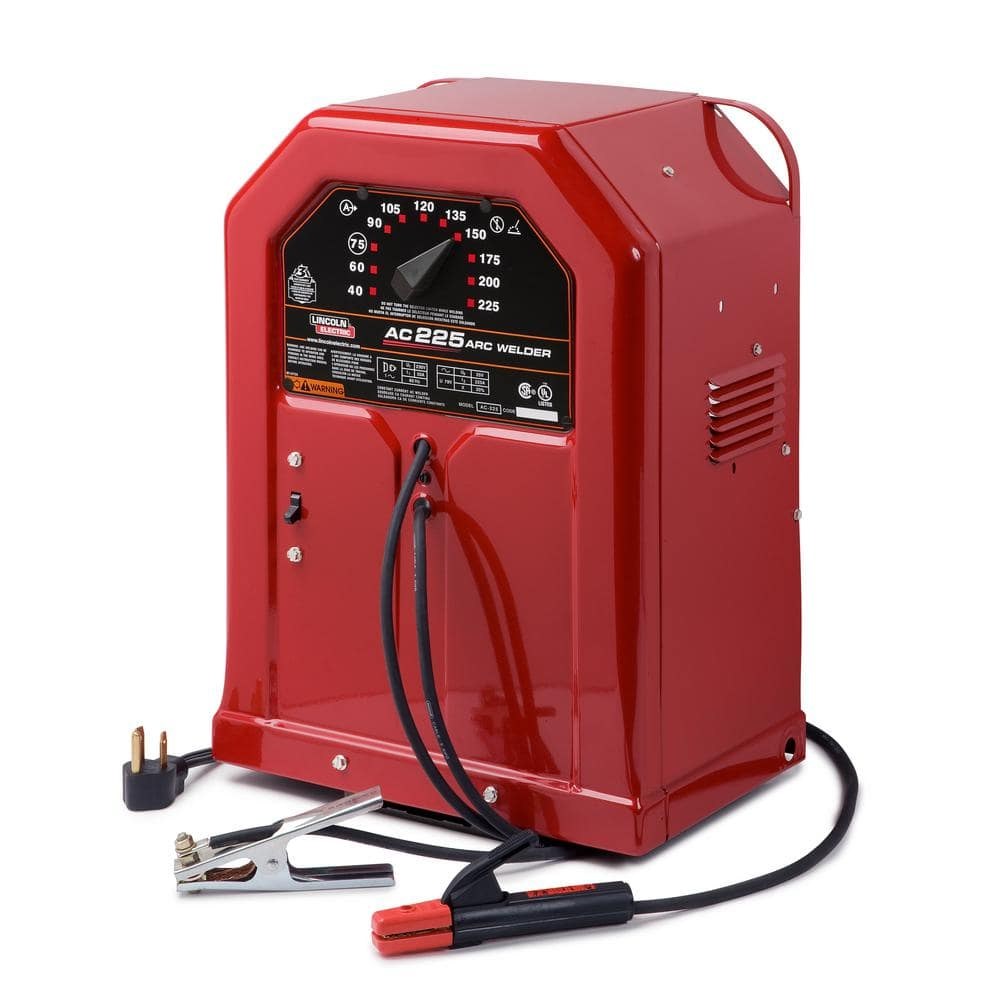
Lincoln Electric K1170 AC225 — Best Overall for Shop and Farm Power
| Spec | Value |
|---|---|
| Process / polarity | Stick (SMAW), AC only |
| Input | 230V / 1-ph / 60 Hz, 50A, NEMA 6-50P |
| Output | 40–225A AC; 225A / 25V / 20% |
| Electrode / material | 3/16” mild steel (Lincoln); 16 ga and heavier |
| Weight / warranty | 96 lbs (current Lincoln page; older sheets 109 lbs) · 3 years |
| Price Range | $700–$900 |
According to Lincoln’s AC225 data, the K1170 is a fan-cooled AC transformer with a 40–225A selector, 6 ft input cable, holder, and work clamp. Amazon still lists the K1170 AC225S under ASIN B0000CBIKA. No feeder, no gas solenoid — cables and the selector are the wear items. At ~96–109 lbs it is a shop or truck-bed machine. It will not run DC-only 7018. Use E6011 for dirty steel and Lincoln 7018 AC when low-hydrogen on AC power is required.
Check price on Amazon → Used Lincoln AC225 on eBay →
Best for: Barns, shops, and farms that already have a 230V welder outlet and want a machine that still arcs after a decade in the dust.
Limitation: AC-only, 20% duty cycle at 225A, and a dedicated 50A circuit. Not the pick if the only outlet is 120V.
Hobart Stickmate 160i — Best DC Inverter with a Real Warranty
| Spec | Value |
|---|---|
| Process | DC stick (SMAW) |
| Input / output | 120/240V MVP · 20–80A (120V) · 20–160A (240V) |
| Rated output | 65A / 20% (120V); 160A / 30% (240V) |
| Thickness / rods | 1/8” (120V), 3/8” (240V); 6010/11/13/7018 (6010 not for 120V open root) |
| Weight / warranty | 15 lb · 5/3/1 year |
| Price Range | $500–$700 |
Hobart sheet 279109 lists 1-amp control, Hot Start, 10 ft leads, and tool-free 120/240V adapters. DC is why this costs more than a $150 inverter: E7018 runs as AWS A5.1 intends, and the 5/3/1 warranty matches the Handler MIG line. On 120V it is a 20–80A repair tool. The 160A / 3/8” numbers assume 240V.
Best for: Operators who want DC 7018, portability, and a North American service network without a transformer’s weight.
Limitation: Stick only — no built-in lift TIG. Priced close to some dual-process inverters.
YesWelder ARC-205DS — Best Budget Dual-Voltage Inverter
| Spec | Value |
|---|---|
| Process | Stick + lift TIG (torch often sold separately) |
| Input / stick output | 110/220V · 20–145A @ 110V · 20–205A @ 220V |
| Duty cycle | 60% @ 205A (220V); 60% @ 145A (110V) per YesWelder |
| Weight / rods | 8.4 lb · 6010, 6011, 6013, 7018 |
| Price Range | $140–$220 |
YesWelder lists IGBT inversion, adjustable hot start and arc force, and anti-stick. Amazon ASIN B086SNKTTK is the common 205A LED listing. On 220V the 205A / 60% ratings beat the Stickmate 160i on paper; on 110V both sit in the same 80–145A band. The gap is warranty and QA — a one-year-class import is not Hobart’s 5/3/1. Fine for gates and brackets; not fine if year-four service is the requirement.
Best for: Dual-voltage portability and 7018 on a tight budget, including optional lift TIG later.
Limitation: Import warranty and variable kit contents (some listings include a TIG torch, some do not). Confirm what ships.
Forney Easy Weld 100 ST — Best 120V-Only Starter
| Spec | Value |
|---|---|
| Process | Stick + lift TIG capable (torch not included) |
| Input / output | 120V · 90A max · 30% at 80A (Forney) |
| Electrode / plate | Up to 1/8” rod · 16 ga–5/16” (Forney) |
| Weight / warranty | 9.65 lb · 1 year |
| Price Range | $160–$230 |
Forney item 298 is a 120V ~90A inverter, not the dual-voltage Easy Weld 180 ST (item 291). It runs 3/32” and many 1/8” rods. The 5/16” plate range is not a single-pass structural rating — joint type and multiple passes are assumed.
Best for: Apartment-shop or household-circuit buyers who need stick outdoors without installing 240V.
Limitation: 90A ceiling. Step to the 180 ST or a dual-voltage 160A-class inverter before the work moves past light repair.
Rods to Buy With the Machine (E6011 and E7018)
Buy the AWS A5.1 class the joint needs, not a mixed scrap tube.
E6011 — Fast-freeze cellulose, AC or DC, all-position. Digs through mill scale, rust, paint, and galvanizing. This is the farm-repair rod and the rod that makes an AC tombstone usable. 1/8” is the default once the machine has ~90A+.
E7018 — Low-hydrogen structural/code rod. Prefers DCEP. Wet flux means porosity and hydrogen cracking — keep sealed tubes, not a damp barn shelf. On the AC225, buy 7018 AC, not DC-only 7018. E6013 is a practice rod, not a 6011 or 7018 substitute.
Who This Is NOT For
-
Thin sheet / auto-body skin. Lincoln process notes generally keep SMAW off material under 1/8” (3 mm). The AC225 “16 gauge and heavier” line is the optimistic bound, not a reason to weld 22-gauge patch panels. MIG for beginners or TIG belongs here.
-
People who need MIG wire. Clean indoor steel, long fillets, one-handed travel: a wire feeder is the tool. Stick will join that steel, slower, with slag between passes. The welding setup cost guide itemizes a starter MIG rig including gas.
-
Aluminum as the primary metal. SMAW aluminum rods exist and are uncommon for a reason. AC TIG or spool-gun MIG is the standard path. High-volume indoor production likewise loses to MIG on clean shop steel.
What Else the Setup Needs
Budget a helmet (shade 10–13 for typical stick amps — see auto-darkening helmets), heavy stick gloves, chipping hammer, wire brush, and a Class ABC extinguisher. 120V machines want a 20A circuit and 12-gauge cord; the AC225 wants the 6-50 plug Lincoln ships — not a 15A household outlet. Used tombstones are common: inspect selector, fan, insulation, and cable lugs.
Sources
- Lincoln Electric, AC225 Stick Welder K1170 product specifications and input/output table (lincolnelectric.com)
- Lincoln Electric, Fleetweld E6011 / Lincoln 7018 AC electrode data (lincolnelectric.com)
- Hobart Welding Products, Stickmate 160i spec sheet 279109 and OM-278400 (hobartwelders.com)
- YesWelder, ARC-205DS / ARC-205DS PRO product specifications (yeswelder.com)
- Forney Industries, Easy Weld 100 ST item 298 spec sheet P-10822 (forneyind.com)
- American Welding Society, A5.1 carbon steel electrode classifications; SMAW process notes
- ANSI Z87.1 eye and face protection (helmet pairing)