Best Hay Rakes for Small Farms in 2026: Wheel Rakes vs Rotary Rakes
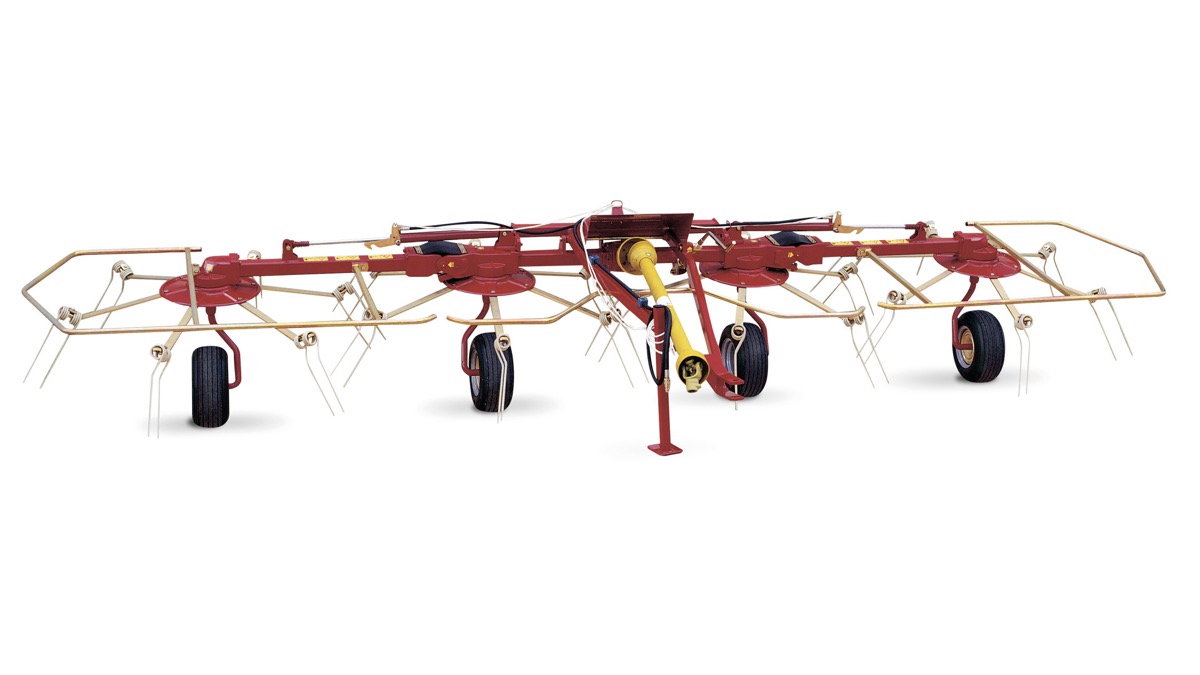
A hay rake is the third machine in the hay-making sequence — after the mower cuts and the tedder spreads the crop to dry, the rake consolidates the dry hay into windrows for baling. For small farm operators, rake selection directly affects bale quality, baling speed, and crop loss — a poorly formed windrow leads to uneven feed rates through the baler, which produces inconsistent bale density and missed hay at the field edges.
This guide covers the two rake types relevant to small farms — wheel rakes and rotary rakes — and recommends specific models for operations under 100 acres. If you’re still deciding between wheel, belt, and rotary rakes for your tractor and baler, our hay-rake type selector walks through the constraint logic before you compare models. For the broader hay-making system, see our best disc mowers for small farms and best hay tedders for small farms guides.
Wheel Rake vs Rotary Rake: The Core Decision
| Factor | Wheel Rake | Rotary Rake |
|---|---|---|
| Working width | 10–16 ft (typical small farm) | 15–25 ft |
| Drive method | Ground-driven (no PTO) | PTO-driven |
| Tractor HP requirement | 20–35 HP | 40–75 HP |
| Leaf loss on legumes | Higher | Lower |
| Windrow quality | Good | Excellent |
| Mechanical complexity | Low | High |
| Maintenance cost | Low | Higher |
| New price (small farm size) | $2,500–$6,000 | $8,000–$20,000 |
| Used price availability | High | Moderate |
The bottom line: For most small farm operators on 5–75 acres, a wheel rake is the correct choice. The cost, simplicity, and broad tractor compatibility outweigh the rotary rake’s advantage in windrow uniformity and leaf retention for operations at this scale. Rotary rakes earn their cost on operations over 100 acres or in high-value hay markets where leaf loss on alfalfa or clover significantly affects hay quality grade.
Top Picks
H&S 4-Wheel Hay Rake — Best Overall for Small Farms
| Spec | Value |
|---|---|
| Type | 4-wheel parallel bar |
| Working width | 12–15 ft (adjustable) |
| Wheel count | 4 |
| Drive | Ground-driven |
| Tractor category | Category 1 |
| Minimum HP | 20 HP |
| Windrow width | Adjustable 3–6 ft |
| Weight | 550–700 lbs |
| Price | $2,500–$4,500 |
H&S (H&S Manufacturing) produces wheel rakes that are widely used in the Midwest and Northeast small farm market, per dealer sales data. The 4-wheel configuration — two lead wheels and two trailing wheels — forms a windrow by lifting and converging two swaths into a single row in one pass. This eliminates the need for multiple tedder and raking passes on many small operations.
The ground-driven mechanism requires no PTO connection — the wheels rotate from ground contact, keeping mechanical inputs minimal and maintenance requirements low. Per H&S specifications, the rake is compatible with any tractor with a Category 1 three-point hitch and minimum 20 HP.
Best for: Small farm operators on 5–75 acres who need a reliable, low-maintenance rake that works with compact tractors. The most common rake type in the small farm market for good reason.
Limitation: Higher leaf loss than rotary rakes on legume crops (alfalfa, clover) due to the mechanical tine action. For pure grass hay, leaf loss is not a concern.
Sitrex MK-8 — Best Budget Entry Wheel Rake
| Spec | Value |
|---|---|
| Type | 8-wheel star rake |
| Working width | 10–13 ft |
| Wheel count | 8 small-diameter |
| Drive | Ground-driven |
| Tractor category | Category 1 |
| Minimum HP | 18 HP |
| Windrow width | 3–5 ft |
| Weight | 420 lbs |
| Price | $1,800–$3,200 |
Per Sitrex’s product documentation, the MK-8 uses a multi-wheel configuration with smaller-diameter star wheels rather than the larger parallel bar wheels on 4-wheel rakes. This configuration handles lighter crop volumes well at a lower entry price. The star-wheel design is gentler on lighter hay crops and produces a fluffy windrow that allows continued air circulation — useful in humid climates where hay needs additional drying after raking.
The MK-8 is appropriate for light grass hay operations on 5–30 acres, particularly where budget is the binding constraint.
Best for: First-time hay producers on light grass hay acreage. Budget entry with a simpler mechanical design than 4-wheel parallel rakes.
Limitation: Not recommended for heavy, dense alfalfa or clover crops — the star wheel configuration can struggle with high-yield, heavy windrows. For legume hay, step up to a 4-wheel or rotary rake.
Kuhn GA 4121 — Best Rotary Rake for Expanding Operations
| Spec | Value |
|---|---|
| Type | Single rotor tedder-rake |
| Working width | 13.8 ft |
| Drive | PTO (540 RPM) |
| Tractor HP | 40–75 HP |
| Swath forming | Yes (side delivery) |
| Tedding function | Yes (dual function) |
| Rotor diameter | 13.5 ft |
| Weight | 1,100 lbs |
| Price | $6,000–$10,000 |
Per Kuhn’s product specifications, the GA 4121 is a single-rotor machine that functions as both a tedder and a rake — saving one pass and one implement for farms that are expanding beyond the capacity of wheel rakes. The PTO-driven rotor moves crop more gently than ground-driven wheel rakes, which significantly reduces leaf loss on alfalfa and mixed legume/grass hay.
The dual tedder/rake function reduces the need for a separate tedder on operations where one machine must do both jobs, which is relevant for small farms where implement storage space and capital allocation are limiting factors.
Best for: Operators with 50–150 acres of mixed legume/grass hay who are considering upgrading from a wheel rake. The dual function justifies the higher investment compared to a single-function wheel rake.
Vermeer R23 — Best Parallel Bar Wheel Rake for Higher Volume
| Spec | Value |
|---|---|
| Type | Parallel bar wheel rake |
| Working width | Up to 23 ft |
| Wheel count | 4 large-diameter |
| Drive | Ground-driven |
| Tractor category | Category 2 |
| Minimum HP | 40 HP |
| Windrow width | Adjustable |
| Weight | 900 lbs |
| Price | $4,500–$7,500 |
Per Vermeer’s product documentation, the R23 is a scaled-up parallel bar wheel rake for operations with higher daily hay volume — 50–200 acre operations where the 23-foot working width meaningfully reduces the number of passes and total raking time. The larger-diameter wheels handle heavier windrows than star-wheel or small-frame wheel rakes.
Best for: Operations scaling up from 50 to 200 acres with a 40+ HP tractor. The higher working width reduces raking passes and daily field time on larger acreage.
Windrow Placement and Baler Compatibility
The rake’s job is to form a windrow that feeds consistently into the baler. Key parameters that affect baler performance:
| Baler Type | Ideal Windrow Width | Windrow Density |
|---|---|---|
| Small square baler (16x18) | 2.5–3.5 ft | Medium — not too fluffy |
| Small square baler (14x18) | 2.5–3 ft | Medium |
| Round baler (4x5 ft) | 4–5 ft | Even — avoid clumps |
| Round baler (5x6 ft) | 5–6 ft | Heavier density OK |
A windrow that’s too wide relative to the baler pickup causes the pickup to miss hay at the edges. Too narrow, and the baler underfeeds and produces loose, underdense bales. Per baler manufacturer guidelines, windrow width should match the baler pickup width at 80–90% for optimal feed.
For balers used on the same operation, see our best small square balers for small farms and best round balers for small farms guides.
Buying New vs. Used
Wheel rakes are one of the easier used implement buys in hay equipment. The mechanical design is simple — ground-driven wheels with no PTO shaft, no electronics — and the wear parts (tines, wheel hubs) are designed to be replaced. A well-maintained used 4-wheel or 8-wheel rake typically trades at 50–65% of new retail. The used market is well-supplied through farm dispersal auctions and estate sales.
Before purchasing used: inspect each wheel for bent or missing tines (individual tine cost is typically $3–$8 each), verify hub bearings spin freely without grinding, check the frame for straightness at the wheel pivot arms (a bent pivot arm causes the affected wheel to drag rather than spin), and confirm the 3-point hitch arms and top link bracket are free of cracks.
Search used hay rakes on eBay →
What You’ll Also Need
- Hay tedder: The rake works best when the hay has been properly spread and dried by a tedder first. See our best hay tedders for small farms guide.
- Disc mower or sickle bar mower: The cutting tool that starts the hay-making process. See our best disc mowers for small farms guide.
- Tractor with compatible hitch and HP: All rakes listed require a minimum HP and hitch category. Confirm compatibility before purchasing.
Who This Is NOT For
- Operators without a mower and tedder: A rake alone does not make hay. The full sequence — mow, ted, rake, bale — requires all four machines. Buying only a rake without the rest of the system is an incomplete investment.
- Very small acreage (under 3 acres): Hand-raking or a small walk-behind tractor is more economical than a 3-point hitch implement for micro-acreage hay production.
- Operators in high-value alfalfa markets without a rotary rake: If the operation’s economics depend on premium alfalfa hay prices, wheel rake leaf loss is a real quality and revenue concern. In that context, a rotary rake or a tedder-rake combo like the Kuhn GA 4121 is the economically correct tool.
Related Guides
- Best Disc Mowers for Small Farms — first step in hay production
- Best Hay Tedders for Small Farms — second step in hay production
- Best Small Square Balers for Small Farms — final step
- Best Round Balers for Small Farms — round baler alternative
- Small Farm Equipment Cost Guide — full implement cost context
Sources
- H&S Manufacturing 4-wheel hay rake product specifications (hsmanfg.com)
- Sitrex MK-8 star wheel rake product data (sitrexusa.com)
- Kuhn GA 4121 product specifications and dual-function documentation (kuhn.com)
- Vermeer R23 wheel rake product specifications (vermeer.com)
- New Holland hay tools product data (newholland.com)
- University Extension hay quality and harvest management guidelines