MIG vs Flux Core Welding: Which Process for Your Shop in 2026?
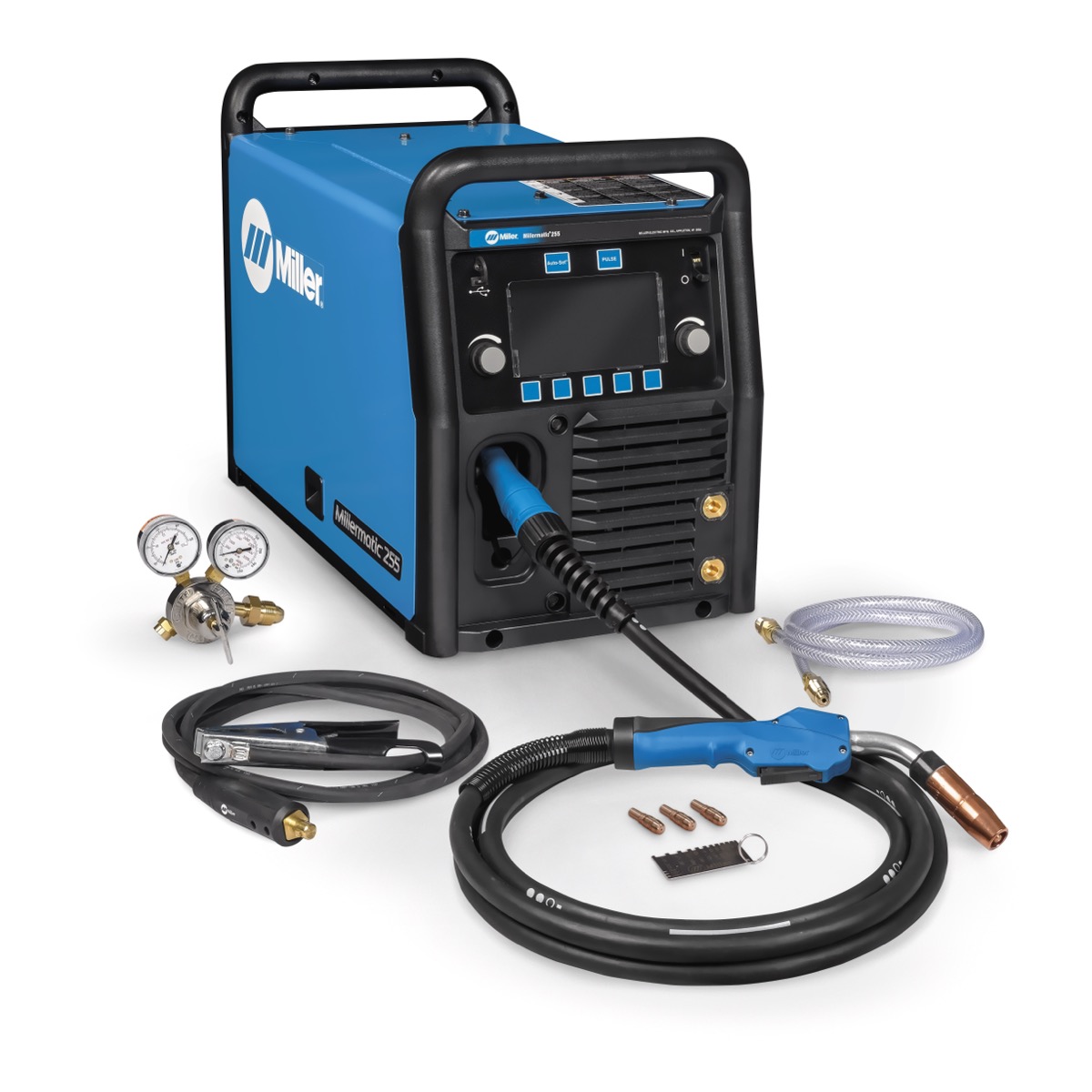
MIG and flux core welding use similar equipment — a wire-feed machine, a gun, and a work clamp — and produce welds on similar materials. The difference is in the shielding method, which changes everything downstream: spatter levels, weld appearance, material thickness range, portability, and cost.
Understanding the distinction saves buyers from purchasing the wrong machine or the wrong wire for their actual work. This guide covers both processes at the specification level, comparing outputs rather than opinions. For the broader welding process comparison that includes TIG and stick, see our MIG vs TIG vs Stick welding guide.
How Each Process Works
MIG Welding (GMAW — Gas Metal Arc Welding)
MIG feeds a solid steel wire electrode continuously through a gun. An electric arc melts the wire into the joint. An externally supplied shielding gas — typically 75% argon / 25% CO2 for mild steel, per Lincoln Electric and Miller guidelines — flows through the gun nozzle and shields the molten weld pool from atmospheric oxygen and nitrogen contamination. The weld pool solidifies clean, with minimal slag.
The operator controls travel speed and gun angle. The machine controls wire feed speed (which sets amperage) and voltage. With proper settings, the process is the most forgiving of the common arc welding processes for new welders.
Flux Core Welding (FCAW — Flux Cored Arc Welding)
Flux core uses a hollow wire electrode filled with flux compounds rather than solid wire. As the wire burns, the flux vaporizes and creates its own shielding gas cloud, while depositing a slag layer over the weld bead that protects it during cooling — similar to how stick electrodes work.
The two variants matter:
- Self-shielded FCAW (FCAW-S): No external gas required. The flux does all the shielding. More portable, works outdoors in wind.
- Dual-shield FCAW (FCAW-G): Requires external shielding gas plus the flux core wire. Used in industrial production settings for maximum deposition rate and quality. Not covered here (this guide addresses home shop and jobsite decisions).
Side-by-Side Comparison
| Factor | MIG (GMAW) | Flux Core Self-Shielded (FCAW-S) |
|---|---|---|
| Shielding method | External gas (75/25 Ar/CO2 typical) | Self-contained flux in wire — no gas |
| Portability | Low — requires gas cylinder | High — just machine and wire spool |
| Weld appearance | Clean, minimal spatter, smooth bead | More spatter, slag must be removed |
| Weld quality | Higher — less porosity on clean steel | Adequate for structural; not for aesthetics |
| Material thickness | 24 gauge to 1/2” (per machine capacity) | 18 gauge and up; better on thick steel |
| Works on dirty/rusty steel | No — requires clean, ground steel | Yes — flux burns through surface contamination |
| Outdoor windproof operation | No — wind disperses shielding gas | Yes — designed for outdoor use |
| Wire cost | Lower — solid wire is cheaper per lb | Higher — flux-cored wire costs 20–40% more |
| Gas cost | Ongoing — $35–$55 per 80 cf refill | None |
| Learning curve | Easier — no slag removal, cleaner puddle | Moderate — slag removal, more spatter to manage |
| Penetration | Good on clean steel | Better on heavy, rusty, or coated steel |
| AWS code approval | AWS D1.1 structural applications | AWS D1.1 structural applications |
Whichever process you run, the gun consumables — contact tips, liners, and nozzles — wear out and need replacement. The best MIG welding consumables guide covers tip styles and fit for common machines. Eye protection is separate: see best auto-darkening welding helmets.
When MIG Wins
Indoor shop work on clean steel. MIG produces visibly cleaner welds with less cleanup time. If the steel is clean and you’re near an outlet, MIG is the better process for appearance and weld quality.
Thin material. On 24-gauge to 3/16” sheet metal — auto body, thin brackets, furniture — MIG’s lower heat input and controlled puddle produce better results. Flux core on thin material tends to blow through more easily.
Beginner-friendly learning. No slag removal simplifies the learning loop. Beginners can see the weld immediately without chipping and brushing. Per Miller Electric’s welding education materials, MIG is the recommended starting process for new welders in controlled shop environments.
Cost control over time. Solid MIG wire (ER70S-6) has recently retailed near $1.20–$1.80 per pound, versus about $2.00–$3.00 per pound for flux-core wire. Those are approximate 2026 retail bands — verify before you budget a job. On high-volume work, the gap compounds.
When Flux Core Wins
Outdoor and windy conditions. This is the decisive advantage. A 10 mph crosswind disrupts a MIG shielding gas envelope and produces porous, contaminated welds. Self-shielded flux core is unaffected by wind — the shielding comes from inside the wire, not from a gas stream.
Farm equipment repair and field work. Trailers, implement hitches, gate hinges, and fencing hardware are often dirty, rusty, or painted. Per Lincoln Electric process guidelines, flux core penetrates surface contamination that would cause MIG to produce porosity or lack of fusion.
Thicker structural steel. On 1/4” plate and heavier, flux core’s higher heat input and faster deposition rate improve productivity over MIG. AWS D1.1 structural welding applications commonly specify flux core processes for field welding of structural connections.
No gas supply available. Remote job sites, farm outbuildings, and field repairs often have no practical way to transport and store shielding gas cylinders. A flux core machine runs on electricity alone.
Farm and Field Decision
Farm repair is a wire decision, not a brand decision. Use this block when the job is a gate, an implement hitch, a trailer, or fencing hardware rather than a clean bench project.
- Wind. A crosswind that would blow a MIG gas shield off the puddle does not remove the shield from self-shielded flux-core. If you cannot put up a wind break, do not plan on solid wire.
- Dirty or painted steel. Implements and gates are often rusty, scaly, or painted. Lincoln Electric process notes treat flux-core as able to penetrate light surface contamination that makes solid-wire MIG porous. Grind what you can; do not expect flux-core to replace preparation on heavy scale or thick paint.
- No cylinder logistics. An 80 cu ft bottle does not belong in the bed of a truck for a one-hour hinge repair. Self-shielded wire removes that trip.
- 120V barn outlets. A Handler 140-class 120V wire machine can be the only power option in an older outbuilding. Many of those machines run flux-core after a polarity swap, which is why one machine covers both indoor MIG and field wire. Confirm the outlet, the duty cycle, and the polarity chart on that machine. This page does not rank 120V welders; the beginner MIG roundup does.
Stick still wins when you need to carry the process to a repair with no practical wire-feeder setup. That comparison is on MIG vs TIG vs stick. If material, power, and wind are still mixed, the welder quiz scores them.
Equipment Comparison
Many wire-feed machines run both processes. Manufacturer manuals for dual-purpose machines commonly specify DCEP (reverse polarity) for solid-wire MIG and DCEN (straight polarity) for self-shielded flux-core. That swap is common, not universal — confirm the polarity chart in the machine manual before the first spool.
| Machine | MIG | Flux Core | Price |
|---|---|---|---|
| Hobart Handler 140 | ✓ | ✓ (polarity swap) | $450–$600 |
| Lincoln Electric Easy MIG 140 | ✓ | ✓ (polarity swap) | $480–$620 |
| Lincoln Electric 140 HD | ✓ | ✓ | $580–$700 |
| Hobart Handler 190 | ✓ | ✓ | $600–$750 |
| Lincoln Power MIG 210 MP | ✓ | ✓ | $900–$1,100 |
Rows are illustrative classes already used on this page, not a 2026 ranking. Prices are approximate retail planning bands — verify the current listing. The Hobart Handler 140 is the 120V example; do not treat the other rows as researched winners. Full spec comparisons are in the MIG welders for beginners guide.
Check price on Amazon — Hobart Handler 140 → Check price on Amazon — Lincoln Easy MIG 140 →
Wire Selection Guide
For MIG (GMAW)
- ER70S-6: The standard for mild steel. Higher silicon content improves puddle fluidity and handles mill scale better than ER70S-2. Use .030” for thin material, .035” for 1/4” and heavier.
- ER308L: For 304 stainless steel (requires 98/2 Ar/CO2 or tri-mix gas).
- ER4043: For aluminum (requires 100% Argon gas and a spool gun).
For Flux Core (FCAW-S)
- E71T-11: All-position, self-shielded, single and multi-pass. Standard for structural and repair work. Use .030” for lighter material, .035” for heavier.
- E71T-GS: Single-pass only (not for structural multi-pass), lower cost. Suitable for thin material repair.
- E71T-8JD H8: Meets AWS D1.8 seismic provisions; used in structural applications that require code-compliant flux core.
Check price on Amazon — ER70S-6 MIG wire → Check price on Amazon — E71T-11 flux core wire → Check price on Amazon — MIG contact tips → Check price on Amazon — auto-darkening welding helmet →
Search links only. Confirm the AWS classification on the spool label before checkout. Helmet specs are on the auto-darkening helmet roundup.
Who This Is NOT For
This guide does not cover:
- Dual-shield FCAW (FCAW-G): This process requires both flux core wire and external shielding gas. It’s used in industrial production settings for maximum deposition rate and is not the typical home shop or field repair choice.
- Aluminum welding: Neither process as described here is optimal for aluminum. MIG aluminum requires a spool gun and 100% Argon; TIG is preferred for thinner aluminum. See the MIG vs TIG vs Stick guide for the aluminum welding discussion.
- Stainless steel production work: While both processes can weld stainless, production stainless work typically requires specific wire and gas combinations that go beyond the scope of this comparison.
Frequently Asked Questions
MIG vs flux core — which should I use?
Use solid-wire MIG with shielding gas for clean mild steel indoors, where appearance and low spatter matter. Use self-shielded flux-core when the work is in wind, on dirty or painted steel, or where a gas cylinder is impractical. If TIG or stick is still in the running, start with MIG vs TIG vs stick.
Can I run flux-core wire on a MIG welder?
Many wire-feed MIG machines can run self-shielded flux-core after a polarity change. Manufacturer manuals commonly specify DCEP for solid wire and DCEN for self-shielded flux-core. That swap is common, not universal — confirm the polarity chart in the machine manual before the first spool. A Handler 140-class example is in the equipment table above; ranked machines are on best MIG welders for beginners.
Does flux-core welding need gas?
Self-shielded flux-core (FCAW-S) does not need a gas cylinder. The flux inside the wire makes the shield. Dual-shield flux-core (FCAW-G) does need external gas and is an industrial process, not the usual home-shop or farm choice. One paragraph on that limit is in Who This Is NOT For.
MIG solid wire vs flux core — what is the real difference?
The difference is the shielding method. Solid MIG wire (ER70S-6 is the common mild-steel class) needs an external gas such as 75/25 argon/CO2. Flux-cored wire (E71T-11 for all-position self-shielded work) carries the shield in the wire and leaves slag. Equipment can be the same gun and power source; the weld, the cleanup, and the wind tolerance are not.
Is flux core better than stick for outdoor farm repair?
Flux-core is the better outdoor choice when you want continuous wire feed and you have power at the repair. Stick is the better outdoor choice when portability matters more than wire feed, or when there is no practical way to run a wire machine. Stick depth is on MIG vs TIG vs stick, not here.
What flux-core wire should beginners buy, E71T-11 or E71T-GS?
E71T-11 is the usual beginner class for all-position self-shielded work, including multi-pass repair. E71T-GS is a lower-cost single-pass class and is not the wire for structural multi-pass joints. Buy by AWS classification, not by a brand ranking. Spool search links above are category searches — verify the classification on the label.
Related Guides
- MIG vs TIG vs Stick Welding — full process comparison including TIG and stick
- Welder quiz — six questions when wire type and process are both open
- Best MIG Welders for Beginners — machine comparisons with spec tables
- Best MIG welding consumables — tips, liners, and nozzles
- Best auto-darkening welding helmets — shade range for wire processes
- Best welding carts — bottle and machine mobility once you choose gas-shielded MIG
- What Does a Welding Setup Cost? — full budget breakdown by tier
Not sure which welding process is right for you? The Welder Quiz asks 6 questions about your materials, power, budget, and experience — and recommends the right process with a specific machine and honest trade-offs.
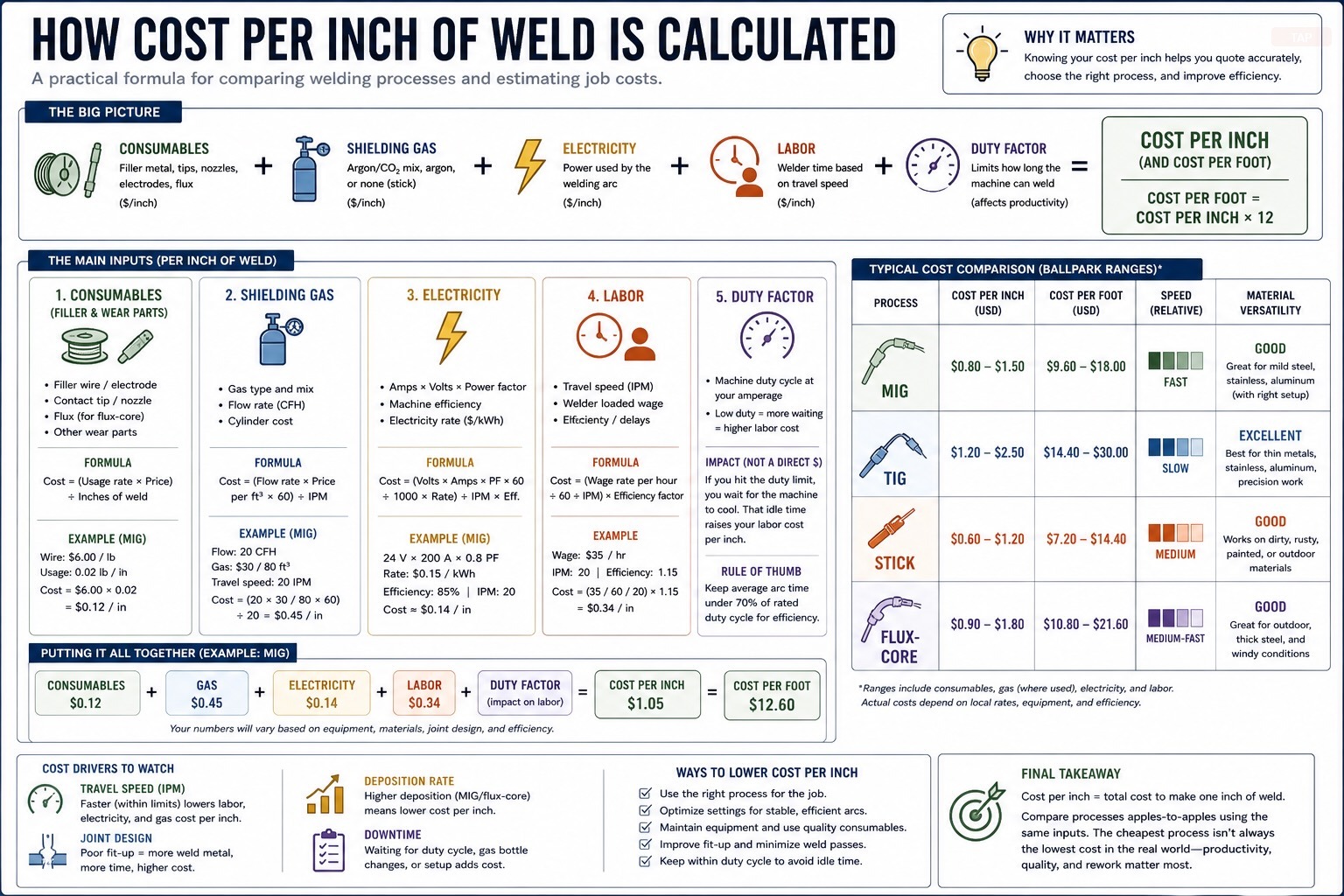
Calculate your actual cost per inch of weld. The Welding Cost Calculator breaks down wire, gas, electricity, and labor costs by process — useful for comparing MIG vs flux-core or quoting jobs.
Sources
- Lincoln Electric GMAW and FCAW process documentation and guidelines (lincolnelectric.com)
- Miller Electric welding process education and FAQs (millerwelds.com)
- American Welding Society AWS D1.1 — Structural Welding Code, Steel
- Hobart Brothers wire selection guide and product data sheets
- ESAB FCAW and GMAW process documentation