Corded vs Cordless Angle Grinders: Which Should You Buy in 2026?
Corded vs cordless angle grinder, in one pass: buy corded for a bench or fab shop, for sessions that run past about 15–20 minutes, for thick stock, and whenever no platform batteries exist yet. Buy cordless for scaffolds, roofs, finished rooms, and farm or gate work with no outlet — and only when M18, 20V MAX, or 18V LXT packs are already owned. Own both when the shop needs a corded workhorse and the truck needs a cordless tool for punch-list and remote cuts.
Affiliate disclosure: Tool Advisor Pro may earn a commission from qualifying purchases. Price bands below are planning ranges. Confirm the live price, switch type, and spec sheet before buying.
Budget corded picks: best angle grinders under $100. Platform cordless picks: best cordless angle grinders. Shared discs: best angle grinder discs.
Corded vs Cordless Angle Grinder Specs
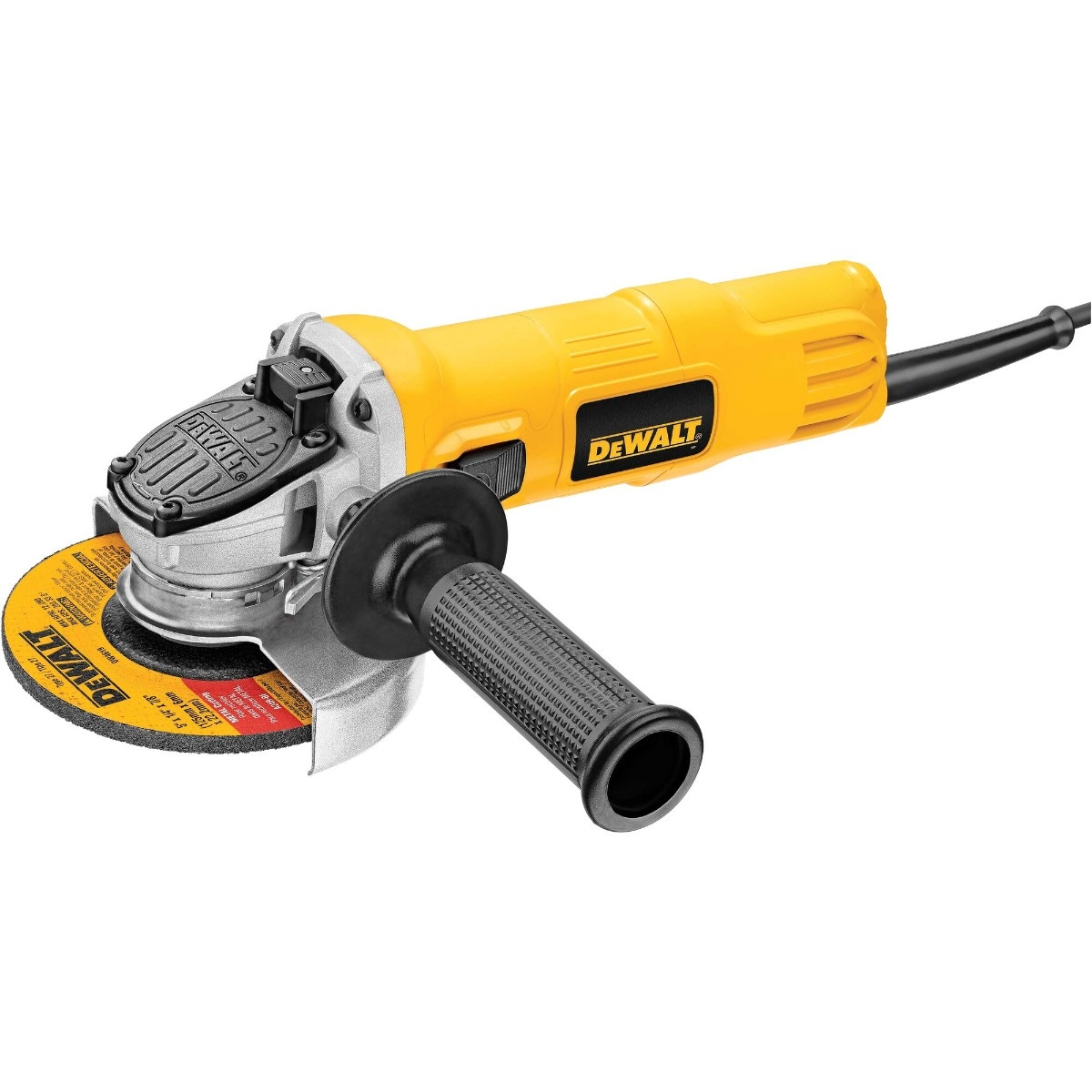
A corded 4.5-inch grinder in current catalogs spans about 7 A to 13 A at 120 V. DeWalt’s catalog lists the DWE4011 at 7.0 A AC/DC, 12,000 rpm, and 850 W max watts out. DeWalt’s DWE402 page lists 11 A and 11,000 RPM. Metabo HPT lists the G12SE3 at 10.5 A and 11,500 RPM. That nameplate current stays available for as long as the tool is plugged in.
Cordless tools in the same disc class are 18 V nominal. Milwaukee M18 and Makita 18V LXT are named at 18 V. DeWalt 20V MAX is a maximum initial voltage; DeWalt states the nominal voltage is 18 V. Higher-voltage packs exist on other tools. This page does not assign them a watt rating.
Brushless, on the cordless tools below, means the motor has no carbon brushes to replace and the tool’s electronics manage overload. It is a maintenance and thermal-control difference. It is not a promise that a cordless grinder outcuts a corded grinder of similar disc size.
| Factor | Corded | Cordless |
|---|---|---|
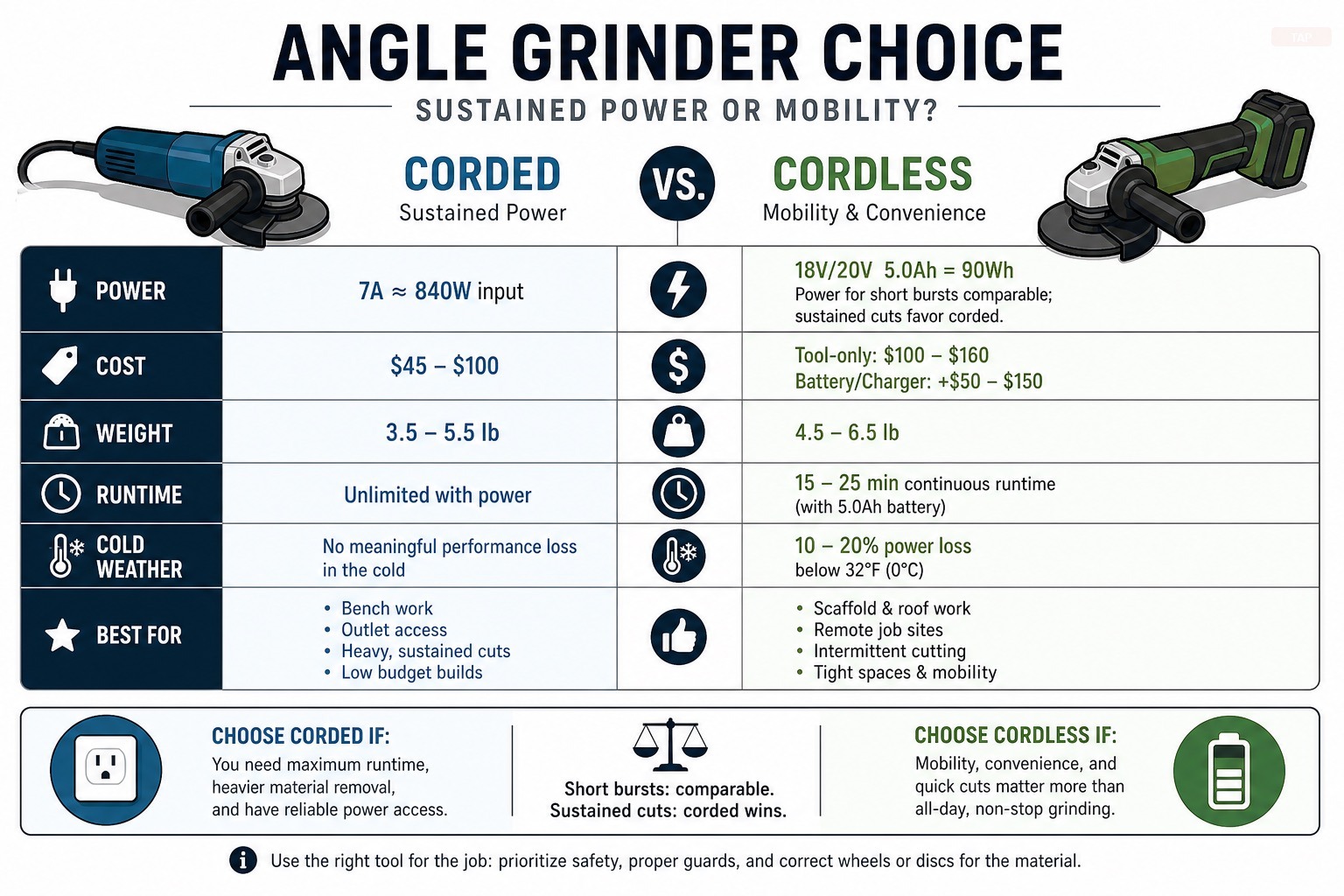
| Sustained power | 7–13 A at 120 V on common 4.5-inch tools. DWE4011 is 7.0 A; DWE402 is 11 A; G12SE3 is 10.5 A. Output continues while plugged in. | 18 V nominal (M18, LXT) or 20V MAX (18 V nominal). Milwaukee markets the 2880-20 as “11A corded power” at 8,500 RPM. That is a manufacturer claim for short work, and the electronics still throttle to protect the pack. |
| Duty cycle | Limited by the motor and the outlet, not by a battery. Suited to continuous weld grinding. | Pack heat and overload protection cut sustained heavy grinding. The workflow is cut, pause or swap packs, then cut again. |
| Disc size | 4.5-inch and 5-inch are the decision class. 6-inch, 7-inch, and larger wheels are widely sold as corded tools. | 4.5-inch, and 4.5/5-inch on the 2880-20, are the common class. Milwaukee also sells the M18 2785-20 for 7-inch and 9-inch accessories at 6,600 RPM. Match the cup or wheel RPM either way. |
| Weight | DWE4011 catalog weight is 3.9 lb. G12SE3 tool card lists 5.5 lb. | Add the pack. 2880-20 working weight is 3.1 lb bare and 5.5 lb with a battery: manual 58-14-0243 omits weight, the 2021 2880-22 press release lists 5.5 lb, and dealer sheets list 3.1 lb bare. DCG413B is 1.7 kg (about 3.7 lb) and 9,000 RPM on DeWalt’s Asia page. The US English DCG413B page does not publish either number. |
| Runtime / cord | Unlimited while plugged in. Factory cords are short relative to a jobsite. Use an extension cord rated for the nameplate amps. | Finite. An 18 V, 5.0 Ah pack stores about 90 watt-hours nominal. Milwaukee states up to 135 cuts per charge for the 2880-20 alongside the XC6.0 pack. Minutes under a grind depend on the load. |
| Sparks / safety | Same disc hazards on both formats. ANSI B7.1 and OSHA 1926.303 cover wheel speed, guards, and mounting. A slide switch with lock-on, which DeWalt’s catalog lists for the DWE4011, can keep spinning if the tool is dropped. | 2880-20: paddle, no lock, electronic clutch, RAPIDSTOP brake under 2 seconds. DCG413B: kickback brake and a brake that stops the wheel in 2 seconds or less, per DeWalt’s US page. |
| Cost of ownership | The tool price is most of the purchase. Discs are the ongoing cost. | Bare tool if the platform is owned. Battery and charger if it is not. Packs are a replaceable wear item. Discs are the same ecosystem. |
Street prices move. Treat $50–$90 as the planning band for a 7 A corded grinder such as the DWE4011, and $100–$165 as the planning band for a bare 2880-20 or DCG413B. Confirm both at purchase.
Use-Case Matrix
| Use case | Prefer | Why |
|---|---|---|
| Cutting rebar and other short jobsite cuts | Cordless if the platform is owned; otherwise corded plus a rated cord | The work moves. The cord’s cost advantage matters only when packs are not already paid for. |
| Rust, paint, and wire-brush cleanup | Either; cordless on a vehicle or in the field | The load is intermittent, so pack heat is less of the decision than where the work sits. |
| Concrete or masonry cup work | Often a larger corded grinder | Cups want sustained power and a wheel RPM at or under the cup’s rating. A cordless 7-inch/9-inch tool exists (Milwaukee 2785-20) and is a separate purchase from a 4.5-inch grinder. |
| Farm fence, remote gates, no outlet | Cordless | No cord is the job. See the farm notes below. |
| Fab-shop weld grinding in long sessions | Corded | Sustained duty cycle at a bench with an outlet. |
| Scaffold, roof, or finished interior | Cordless | A cord is a trip and drag hazard, and it snags on finished work. |
| First grinder, no batteries | Corded | Avoids paying for a pack and charger on top of the tool. If the ceiling is $100, start with the under-$100 guide. |
Battery Platform vs Cord Management
Platform lock-in. A bare cordless grinder is an incremental tool once the packs exist. Starting from zero means the tool, a battery, and a charger. That stack is the reason a first grinder should be corded unless the buyer has already chosen Milwaukee, DeWalt, or Makita for other tools. The DeWalt vs Milwaukee vs Makita battery platform comparison is the page for that commitment. This page does not rank cordless models. The cordless angle grinder roundup owns Milwaukee, DeWalt, Makita, and Bosch picks.
Cold weather. Milwaukee’s 2880-20 manual lists a recommended ambient range of 0°F to 125°F. Milwaukee service bulletin TIY477 describes cold packs that seem slow or buzz, more often below 30°F, and chargers that reduce current below 40°F. REDLITHIUM marketing also claims operation in climates below 0°F. None of those documents publish a single percentage of capacity loss for grinding. Expect shorter runtime in the cold, keep packs warmer than the air when you can, and warm a cold pack before charging. Do not plan a winter fence day on a room-temperature cut count.
Extension cords. A corded grinder used away from the wall needs a cord rated for the tool’s amps. An undersized cord drops voltage at the motor, which shows up as lost speed and extra heat. OSHA 1926.405(a)(2)(ii)(J) requires extension cord sets used with portable electric tools to be three-wire and designed for hard or extra-hard usage (types such as S, ST, SO, STO, SJ, SJO, SJT, SJTO). That rule is about cord construction, not a mandated gauge. For a 7–13 A grinder on a longer run, a 12 AWG outdoor cord is the heavy-gauge choice that holds voltage better than a light 16 AWG household cord. 12 AWG outdoor extension cord on Amazon. Confirm length, gauge, and the hard-service marking against the tool’s nameplate.
Why shops keep a corded grinder. Crews that are cordless everywhere else still park a corded grinder at the weld bench. Pack swaps and thermal throttling are tolerable for punch-list cuts. They are a poor fit for a Saturday of continuous bead cleanup. The corded tool stays; the cordless tool rides in the truck.
Illustrative Picks
Four tools show the format. They are not a ranking. Cordless model comparisons live on the cordless roundup. Sub-$100 corded scorecards live on the under-$100 guide.
DeWalt DWE4011 — corded value. DeWalt’s catalog lists 7.0 A AC/DC, 12,000 rpm, 850 W max watts out, a 4.5-inch wheel, a 5/8-11 spindle, a slide switch, and 3.9 lb. The power source is included in the tool price (about $50–$90; verify). A regional DeWalt page lists a 3-year limited warranty; the US product URL did not resolve in this refresh, so confirm the term and that the switch on the tool in hand is the catalog’s slide with lock-on. A lock-on slide keeps spinning if the grinder is dropped. Buyers who want a deadman paddle should look at DeWalt’s DWE402 (11 A, 11,000 RPM, paddle with lock-off) or the under-$100 scorecard, not treat the DWE4011 as a paddle tool.
Check DeWalt DWE4011 price on Amazon →
Metabo HPT G12SE3 — higher-amp corded. This is the current successor to the G12SE2. Metabo HPT says the G12SE3 is a full amp and 1,500 RPM above that predecessor. The G12SE3 tool card lists 10.5 A, 11,500 RPM, a locking paddle, a 4.5-inch wheel, 5/8-11, and 5.5 lb, with a 1-year warranty on the 2020 card. Confirm warranty and price. The card’s 1,900 max-watts-out figure is a peak rating, not 10.5 A × 120 V of continuous input. An older G12SE2 US manual lists 9.5 A, 11,000/min, and 4.2 lb for the main body, which does not line up with a 10,000 RPM reading of Metabo’s “1,500 RPM” sentence, so this page does not publish a settled G12SE2 spec. Do not assume the G12SE3 is under $100.
Check Metabo HPT G12SE3 price on Amazon →
Milwaukee 2880-20 — cordless, M18 already owned. The product page and manual list 18 V DC, 8,500 RPM, a 4.5-inch or 5-inch wheel (5 in × 1/4 in maximum, matching guard required), a paddle with no lock, an electronic clutch, and a RAPIDSTOP brake under 2 seconds. Milwaukee’s “11A corded power” line and “up to 135 cuts per charge” sit in copy that also names an XC6.0 pack. Working weight, shared with the cordless roundup, is 3.1 lb bare and 5.5 lb with a battery. Manual 58-14-0243 does not list weight. The 5.5 lb figure is the weight line on Milwaukee’s 2021 press release for the 2880-22 kit, and dealer spec sheets list 3.1 lb excluding the battery. Tool-only planning band about $130–$165. The cordless roundup compares this with DeWalt, Makita, and Bosch.
Check Milwaukee 2880-20 price on Amazon →
DeWalt DCG413B — cordless, 20V MAX already owned. DeWalt’s US page confirms a brushless motor, a paddle switch, a kickback brake, a brake that stops the wheel in 2 seconds or less on average, tool-only sale, and a 3-year limited warranty with 1 year of free service. It does not publish RPM or weight. Manual N505670 lists 9,000 rpm no-load and 800 W for the DCG413 in the Spanish specification block. The Asia specification page lists 9,000 RPM, 1.7 kg (about 3.7 lb), kickback brake, and E-clutch. Those RPM and weight figures match the cordless roundup. Tool-only planning band about $100–$140. Makita LXT buyers should use the cordless roundup for that platform’s grinder rather than a third review here.
Check DeWalt DCG413B price on Amazon →
Consumables and PPE, one line. Both formats share the 4.5-inch and 5-inch disc ecosystem when the guard and RPM match. Flap discs, cut-off wheels, Type 27 grinding discs, and wire cups are specified on the discs guide. Add a face shield, safety glasses, hearing protection, and gloves before the first cut. Angle grinder face shield and safety glasses on Amazon.
Buy Rules
Choose corded when:
- The work lives at a bench, a weld table, or within a short, properly rated cord of an outlet.
- Sessions run long — on the order of 15–20 minutes and up of actual grinding, not a few weld passes.
- The metal is thick enough that a thermal throttle would show up as a stalled cut. Treat “over 3/8 inch, sustained” as a shop rule of thumb, and verify it on your stock and wheel rather than as a lab number.
- No M18, 20V MAX, or LXT batteries exist yet, or the budget stops near the price of the tool alone.
- The ceiling is $100. Use the under-$100 guide for that scorecard.
Choose cordless when:
- The work is on a scaffold, roof, ladder, or in a finished space where a cord is a trip or snag.
- The job is a farm gate, a fence brace, or an implement in the field. The farm tools section covers the rest of that equipment; the grinder decision is the power source.
- Cuts and cleanup are intermittent, and a second pack is available when the first one heats up.
- The platform is already owned, so the purchase is the bare tool.
Choose both when the shop keeps a corded grinder at the bench and the truck carries a cordless grinder for remote and punch-list work. One of each is a duty split, not a second opinion on the same job.
Who This Is NOT For
Skip corded when the work is routinely far from power and a heavy, correctly rated extension cord is not part of the plan. Voltage drop from an undersized cord heats the motor and slows the wheel.
Skip cordless as the only grinder when there is no platform yet. Adding a battery and charger pushes the all-in cost into a band where a corded grinder already includes its power source. Also skip cordless as the only grinder for long, continuous removal. Overload protection exists to save the pack and the motor, and it will interrupt the cut.
Skip this page for a ranked cordless list, a sub-$100 scorecard, or a grit chart. Those are the three sibling guides linked above. Stationary sharpening belongs on a bench grinder, which is a different tool.
Frequently Asked Questions
Are cordless angle grinders as powerful as corded?
A current 18V-class brushless grinder can keep up with a mid-amp corded grinder on short cuts, and it does not match corded output across a long grinding session. Milwaukee’s 2880-20 page describes that M18 FUEL model as generating 11A corded power at 8,500 RPM. DeWalt’s DCG413 family manual lists 9,000 rpm no-load, and the Asia specification page lists the DCG413B at the same 9,000 RPM and 1.7 kg. Those figures describe no-load speed and a manufacturer power-class claim. A corded grinder keeps its nameplate current available from a 120 V outlet for the whole session. A cordless grinder draws on a finite pack — about 90 watt-hours nominal on an 18 V, 5.0 Ah battery — and its electronics cut output when the pack or motor overheats. Intermittent weld cleanup hides most of the gap. Continuous grinding on thick stock favors corded.
How long does a cordless angle grinder run on one battery?
Runtime is a function of pack size and load, and no single minute figure applies to every cut. Nominal stored energy is voltage times amp-hours, so an 18 V, 5.0 Ah pack is about 90 watt-hours and a larger pack stores more. Milwaukee’s 2880-20 product copy states up to 135 cuts per charge in the same description that names an M18 REDLITHIUM HIGH OUTPUT XC6.0 battery. That cut count is a manufacturer test claim, and it will move with material, wheel, and pressure. Time a pack on the actual job before planning a remote session around it.
Is a cordless angle grinder worth it if I don’t already own batteries?
A cordless angle grinder is usually a poor first purchase when no M18, 20V MAX, or 18V LXT packs are already on the shelf. Bare-tool street prices for the Milwaukee 2880-20 and DeWalt DCG413B sit in a planning band around $100–$165, and a battery plus charger is a separate purchase in a similar range. A corded 7 A grinder such as the DeWalt DWE4011 is a complete tool at a lower all-in cost. Cordless becomes the rational add-on once the platform battery and charger already exist, because the incremental cost is the bare tool. Platform choice belongs on the battery platform comparison, and model rankings belong on the cordless roundup.
Can I use the same discs on corded and cordless grinders?
The same disc fits a corded grinder and a cordless grinder when the diameter, arbor, guard, and maximum RPM all match. Most 4.5-inch and 5-inch metal discs in this class use a 7/8-inch arbor hole and mount on a 5/8-11 spindle. ANSI B7.1 requires the disc’s maximum RPM to equal or exceed the grinder’s no-load speed. Milwaukee’s 2880-20 manual says to use 4.5-inch wheels only with 4.5-inch guards and 5-inch wheels only with 5-inch guards. Disc type and grit are on the angle grinder discs guide.
What amp corded grinder do I need for shop metalwork?
For intermittent weld cleanup, deburring, and thin cut-off work, a 7 A to 7.5 A, 4.5-inch corded grinder is the usual starting class. DeWalt’s catalog lists the DWE4011 at 7.0 A AC/DC and 12,000 rpm. Longer sessions and heavier stock removal move into the 9 A to 13 A class. Metabo HPT lists the current G12SE3 at 10.5 A and 11,500 RPM, and DeWalt’s DWE402 product page lists 11 A AC/DC at 11,000 RPM with a paddle switch. Amperage is nameplate current. Match the wheel’s rated RPM to the tool’s no-load speed before treating a faster nameplate as a faster, safer cut.
Corded vs cordless for farm fence and gate repair — which wins?
Cordless wins for fence, gate, and implement repair away from an outlet. That work is intermittent cutting and grinding, which is the duty a battery pack is built for, and a cord dragged across a pasture is the slower hazard. Corded wins when the same repair happens at a shop bench, the session runs long, or no battery platform exists yet. In that case a corded grinder and a heavy outdoor extension cord rated for the tool’s amps is the lower-cost way to reach a barn outlet.
Related Guides
- Best Cordless Angle Grinders — M18, 20V MAX, LXT, and Bosch picks once the format decision is cordless
- Best Angle Grinders Under $100 — budget corded scorecard, including the DWE4011 class
- Best Angle Grinder Discs — flap discs, cut-off wheels, Type 27, and wire wheels
- DeWalt vs Milwaukee vs Makita Battery Platform — which ecosystem to commit to before a bare-tool grinder
- Best MIG Welders for Beginners — the welds this grinder will be cleaning up
- Shop tools and farm tools — the two hubs for the bench and the field
Sources
- DeWalt corded power-tools catalog specifications for the DWE4011 (7.0 A AC/DC, 12,000 rpm, slide switch, 3.9 lb, 850 W max watts out, 5/8-11) and the DWE4011 instruction manual (120 V, 7 A, 850 W, 12,000/min)
- DeWalt DWE402 product page, 11 A AC/DC, 11,000 RPM, paddle switch with lock-off (dewalt.com)
- DeWalt DCG413B US product page (brushless, kickback brake, brake in 2 seconds or less, 3-year limited warranty; RPM and weight not published on the US English page), instruction manual N505670 Spanish specification block (DCG413, 800 W, 9,000 rpm), and Asia specification page (9,000 RPM, 1.7 kg)
- Milwaukee 2880-20 product page and instruction manual 58-14-0243 (18 V DC, 8,500 RPM, paddle no-lock, 5-inch × 1/4-inch max, 0°F to 125°F ambient; weight not in the spec table). Working weight 3.1 lb bare / 5.5 lb with a battery comes from dealer spec sheets and the 5.5 lb line on Milwaukee’s 2021 2880-22 press release.
- Milwaukee 2785-20 product page (M18 FUEL 7-inch / 9-inch, 6,600 RPM)
- Metabo HPT G12SE3 product page and September 2020 tool card (10.5 A, 11,500 RPM, locking paddle, 5.5 lb, 1-year warranty on the card)
- Metabo HPT / Hitachi G12SE2 US instruction manual (9.5 A, 11,000/min, 4.2 lb main body), cited because it conflicts with later Metabo marketing on RPM
- Milwaukee service bulletin TIY477, cold-weather battery symptoms
- ANSI B7.1 — Safety Requirements for the Use, Care, and Protection of Abrasive Wheels
- OSHA 1926.303 — Abrasive Wheels and Tools
- OSHA 1926.405(a)(2)(ii)(J) — extension cord sets for portable tools: three-wire, hard or extra-hard usage