DeWalt vs Milwaukee vs Makita (2026): Which Battery Platform Should You Commit To?
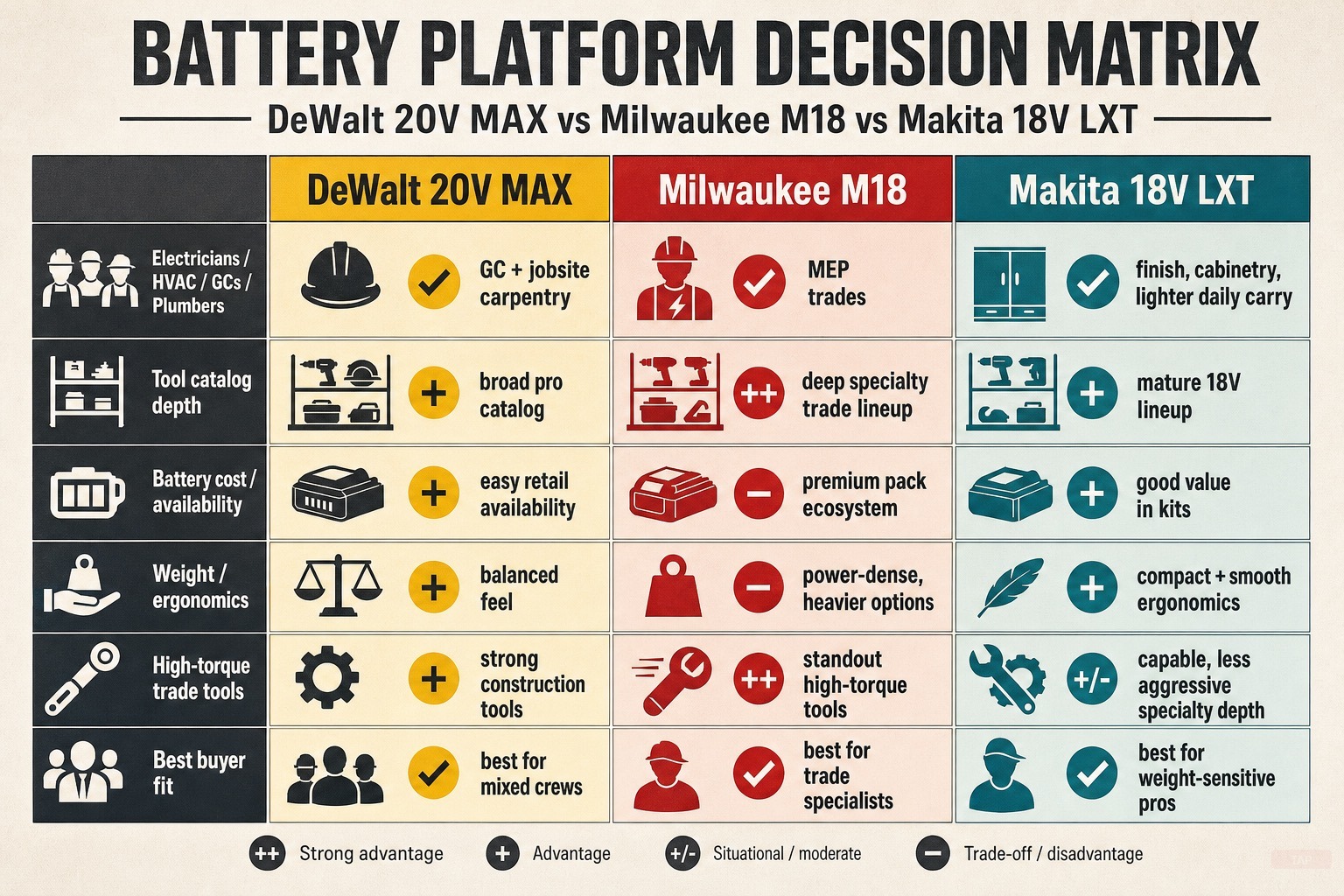
Answer first: Electrical → Milwaukee M18. Framing → DeWalt 20V MAX / FLEXVOLT. Finish carpentry or all-day handheld → Makita 18V LXT. All three platforms use 18V-nominal cells; DeWalt’s “20V MAX” is peak unloaded voltage, not extra power. Switch only before lock-in — five or more batteries usually makes switching cost more than any one-tool spec gain.
The battery platform decision is the most expensive cordless-tool choice a contractor makes outside of a truck. Once five or six batteries sit on the shelf, switching costs easily exceed $1,000 in stranded equipment. At ten or more tools deep, the number doubles. This is not a drill comparison or an impact driver shootout — it is a platform-level analysis designed to help buyers choose the right ecosystem before lock-in takes hold.
All three platforms covered here — DeWalt 20V MAX, Milwaukee M18, and Makita 18V LXT — produce professional-grade cordless tools. None of them are bad. The question is which one aligns best with a specific trade, workflow, and long-term tool needs.
Pick Your Trade (30-Second Router)
Find the row closest to the work that fills most of the week. The reasoning behind each call is detailed further down, but the short verdict is here:
| If your work is mostly… | Commit to | Why (one line) |
|---|---|---|
| Electrical | Milwaukee M18 | Deepest specialty catalog (ProPEX, knockouts) + ONE-KEY fleet tracking |
| Plumbing / HVAC / mechanical | Milwaukee M18 | Press tools, sewer machines, close-quarters drills no rival offers |
| Framing / structural carpentry | DeWalt 20V MAX | FLEXVOLT bridges 20V and 60V saws on one battery |
| Finish carpentry / trim | Makita 18V LXT | Lightest tools + best nailer line for all-day overhead work |
| Remodeling / cabinet install | Makita 18V LXT | Sub-compact tools under 2.6 lbs, fastest chargers |
| Concrete / demo / high-draw | DeWalt 20V MAX | 15.0 Ah FLEXVOLT cap sustains load longest |
| General contractor (mixed) | Any — buy on local stock | All three cover GC work; pick best regional support/pricing |
| Homeowner, under 3 tools total | Whatever is on sale | Lock-in is irrelevant below ~3 tools (see “Who This Is NOT For”) |
This is a starting point, not a verdict. The right answer depends on the full list of tools planned over the next 2–3 years, not the first drill. Read on for the trade-by-trade reasoning, the 2026 lineup notes, and the lock-in math that makes this decision expensive to reverse.
Quick Answer: Which Platform Should You Buy?
- Choose Milwaukee M18 if your work centers on electrical, plumbing, HVAC, or service trade tools. According to Milwaukee’s catalog, the specialty-tool depth is the reason crews stay on M18, not just the drill and impact driver.
- Choose DeWalt 20V MAX / FLEXVOLT if your work leans toward framing, carpentry, concrete accessories, or mixed general-contractor use. The FLEXVOLT bridge into 60V saws and larger jobsite tools is the main differentiator.
- Choose Makita 18V LXT if lower tool weight, faster charging, and all-day handheld use matter more than digital tracking or the deepest specialty catalog.
- Do not switch platforms casually if you already own 5+ batteries and multiple bare tools. The lock-in math later in this guide is usually more important than a small spec advantage on one new tool.
What the Voltage Numbers Actually Mean
DeWalt labels its platform “20V MAX.” Milwaukee uses “M18.” Makita labels theirs “18V LXT.” All three platforms use battery cells with a nominal voltage of 18V. The “20V MAX” figure that DeWalt uses refers to the peak unloaded voltage of a fully charged lithium-ion cell pack — a measurement standard permitted under ANSI guidelines, but one that overstates the voltage the tool actually receives under load.
Per the electrical specifications:
- DeWalt 20V MAX: 18V nominal, 20V peak unloaded
- Milwaukee M18: 18V nominal, 20V peak unloaded
- Makita 18V LXT: 18V nominal, 20V peak unloaded
The cells are the same voltage class. There is no performance advantage baked into DeWalt’s “20V” label — it is a marketing decision, not an engineering one. Milwaukee and Makita simply chose to label their platforms at the nominal voltage instead.
This distinction matters because some buyers assume DeWalt tools deliver more voltage. According to the electrical specifications from all three manufacturers, they do not. Performance differences between platforms come from motor design, electronics, and battery cell chemistry — not from the number on the label.
Platform Overview Comparison
| Feature | DeWalt 20V MAX | Milwaukee M18 | Makita 18V LXT |
|---|---|---|---|
| Nominal Voltage | 18V | 18V | 18V |
| Marketing Voltage | 20V MAX | M18 | 18V |
| Bare Tools Available | 300+ | 200+ | 300+ |
| Battery Range (Ah) | 1.5–15.0 Ah | 1.5–12.0 Ah | 2.0–6.0 Ah (LXT) |
| Flagship Battery Tech | FLEXVOLT (60V/20V auto-switching) | HIGH OUTPUT (HD cells) | LXT with BL motor optimization |
| Higher Voltage System | FLEXVOLT 60V MAX | MX FUEL (stand-alone system) | XGT 40V MAX |
| Backward Compatibility | FLEXVOLT 60V batteries work in 20V tools | M18 only (MX FUEL is separate) | XGT batteries require adapter for LXT tools |
| Fast Charger Speed | ~60 min (standard), ~30 min (rapid) | ~60 min (standard), ~45 min (rapid) | ~45 min (standard), ~25 min (rapid) |
| Digital Tool Tracking | Tool Connect (Bluetooth) | ONE-KEY (Bluetooth + cloud) | N/A (no integrated tracking) |
| Compact Companion Line | 12V MAX XTREME | M12 (200+ tools) | 12V MAX CXT (limited US) |
| Primary US Retail Partner | Home Depot | Home Depot | Home Depot / Amazon |
| Warranty (tool) | 3 years | 5 years (power tools) | 3 years |
Data sourced from manufacturer catalogs as of March 2026.
Heavy-Duty 18V Workload: A Fit Check Before You Commit
For heavy-duty 18V work, choose the battery ecosystem around the tools that must share batteries and chargers through a typical week—not around a single high-demand tool.
| If your workload looks like this | Decide on this battery-ecosystem question | Fit-based guidance |
|---|---|---|
| A drill, impact, saw, or grinder handles heavier work only occasionally | Will the same 18V-class battery family cover the everyday tools you plan to add? | Any of the three can fit when its documented tool family covers that list; local service, price, and existing batteries can break the tie. |
| Heavy cutting, drilling, grinding, or concrete work is a regular part of the week | Which tools need to work from the same packs, and which will need a separate higher-voltage investment? | Map the full heavy-duty kit before buying. The compatibility boundaries in the comparison table matter more than a claimed advantage from one tool or battery. |
| You expect to add larger jobsite tools later | Does the manufacturer document a battery bridge from the 18V-class tools to the larger tools you actually need? | Treat documented cross-tool compatibility as a planning benefit, not an assumption. If the needed tools sit in separate systems, budget their batteries and chargers as a second ecosystem. |
| You already own several 18V-class batteries and chargers | Does the current ecosystem cover the missing heavy-duty tool without forcing duplicate charging and battery inventory? | Keep the existing platform when it covers the planned workload; add a separate system only when the uncovered tool category is important enough to justify the extra battery ecosystem. |
This check is deliberately workload-specific: battery labels alone do not establish cross-tool compatibility, and no cross-brand battery sharing exists among these three platforms. Confirm the exact tool-and-battery pairing in the manufacturer’s catalog before purchasing.
DeWalt 20V MAX / 60V FLEXVOLT
Platform Strengths
According to DeWalt’s product catalog, the 20V MAX platform includes over 300 bare tools — the largest lineup tied with Makita globally. Where DeWalt separates itself is the FLEXVOLT system. FLEXVOLT batteries automatically switch between 20V and 60V configurations depending on the tool they are inserted into. This means a single FLEXVOLT 60V battery can power a 20V MAX drill and a 60V MAX table saw without carrying two separate battery systems.
Per DeWalt’s specifications, the FLEXVOLT system is the only platform that bridges the gap between handheld 18V-class tools and the higher-power demands of jobsite saws, planers, and dust extractors within a single battery architecture. Milwaukee’s MX FUEL addresses heavy equipment but uses entirely separate batteries. Makita’s XGT 40V system requires an adapter for backward compatibility.
DeWalt’s saw lineup is widely regarded as the deepest in the cordless space. The 60V MAX 8-1/4” table saw (DCS7485), the 60V MAX 12” sliding miter saw (DCS781), and the FLEXVOLT circular saws give framers and finish carpenters a full cordless saw kit on one battery system.
Platform Weaknesses
DeWalt’s battery cell technology has lagged slightly behind Milwaukee’s HIGH OUTPUT line in energy density per pound. The FLEXVOLT 9.0 Ah (60V) / 3.0 Ah equivalent batteries are heavy — 3.4 lbs per the spec sheet. For overhead and all-day handheld work, that weight penalty adds up.
The warranty is 3 years on power tools, compared to Milwaukee’s 5-year warranty. For contractors running tools daily, two fewer years of coverage is a meaningful difference.
Best Starter Kit
DeWalt 20V MAX XR Brushless 2-Tool Kit (DCK2100D1T1) — Includes hammer drill, impact driver, one 2.0 Ah battery, one 6.0 Ah battery, charger, and bag. Street price: $280-$350.
Milwaukee M18 / M18 FUEL
Platform Strengths
Milwaukee’s M18 platform has become the dominant choice in the electrical, plumbing, and HVAC trades. According to Milwaukee’s catalog, the M18 system includes over 200 tools, but the platform’s real advantage is in specialty tools that other brands do not offer at all: the M18 ProPEX expansion tool, the M18 short-throw press tool, the M18 FUEL sectional sewer machine, and a deep line of right-angle drills and close-quarters tools designed for mechanical trades.
The ONE-KEY system is Milwaukee’s Bluetooth tracking and tool customization platform. Per Milwaukee’s documentation, ONE-KEY allows contractors to set custom speed/torque profiles, lock tools remotely if stolen, and track tool inventory across a fleet. No other platform offers comparable digital tool management.
Milwaukee’s companion M12 system is the strongest compact tool line in the industry, with over 200 M12 tools per the manufacturer’s catalog. Many contractors run M18 for primary tools and M12 for inspection cameras, compact lights, heated gear, soldering irons, and small-profile impact drivers. The dual-system approach (M18 + M12) provides size and weight optimization that single-platform strategies cannot match.
Per Milwaukee’s battery data, the M18 HIGH OUTPUT batteries use optimized cell configurations that deliver more sustained power under load than standard M18 packs. The HIGH OUTPUT HD12.0 Ah battery provides the highest sustained output in the M18 system and is rated for concrete tools and high-draw applications.
Platform Weaknesses
Milwaukee tools tend to be heavier than equivalent Makita models. According to spec sheet comparisons, the M18 FUEL hammer drill weighs 4.1 lbs bare versus Makita’s equivalent at 3.6 lbs. Over a full day of overhead drilling, that half-pound adds up.
Milwaukee’s higher-voltage system (MX FUEL) uses completely separate batteries. There is no backward compatibility with M18 — the MX FUEL batteries are a standalone investment. This contrasts unfavorably with DeWalt’s FLEXVOLT approach, where 60V batteries work in 20V tools.
Best Starter Kit
Milwaukee M18 FUEL 2-Tool Combo Kit (3697-22) — Includes hammer drill, impact driver, two 5.0 Ah batteries, charger, and contractor bag. Street price: $300-$400.
Makita 18V LXT / 40V XGT
Platform Strengths
According to Makita’s global product catalog, the 18V LXT platform spans over 300 tools worldwide — making it the largest or tied-for-largest cordless tool system by sheer count. Makita’s engineering emphasis is on motor efficiency and weight reduction. Per Makita’s specifications, their brushless motors are tuned to extract more work per amp-hour of battery capacity, which translates to longer runtime on equivalent battery sizes.
Makita consistently produces the lightest tools in head-to-head comparisons. The 18V LXT brushless hammer drill (XPH14Z) weighs 3.6 lbs bare tool; the sub-compact drill (XFD15ZB) drops to 2.5 lbs. For finish carpenters, remodelers, and anyone working overhead for extended periods, the weight difference is not trivial.
Makita’s charger technology is the fastest of the three platforms. Per manufacturer specs, the DC18RD dual-port rapid charger can charge a 5.0 Ah battery in approximately 45 minutes, and the DC18RE can charge from automotive 12V, making it useful for jobsite trucks without AC power.
The XGT 40V MAX system provides a higher-voltage line for demanding applications. Makita offers an adapter (ADP10) that allows 40V XGT batteries to power 18V LXT tools, providing some forward compatibility — though the reverse is not possible.
Platform Weaknesses
Makita’s US retail presence is thinner than DeWalt or Milwaukee. While available at Home Depot and Amazon, Makita does not benefit from the same level of big-box exclusive kit deals and in-store promotional pricing that DeWalt and Milwaukee enjoy through their Home Depot relationship.
Makita does not offer a tool tracking or digital customization system comparable to Milwaukee ONE-KEY or DeWalt Tool Connect. For fleet managers tracking hundreds of tools, this is a gap.
The LXT battery range tops out at 6.0 Ah for 18V packs, compared to DeWalt’s 15.0 Ah FLEXVOLT and Milwaukee’s 12.0 Ah HIGH OUTPUT. For high-draw applications like rotary hammers and grinders, the lower maximum capacity means more frequent battery swaps.
Best Starter Kit
Makita XT288T 18V LXT Brushless 2-Tool Kit — Includes hammer drill, impact driver, two 5.0 Ah batteries, rapid charger, and tool bag. Street price: $280-$350.
Makita 18V LXT Platform: Deep Dive
The Makita LXT system is the platform most often underestimated in the US market — its advantages are in engineering efficiency and weight reduction rather than the marketing volume or retail shelf presence that DeWalt and Milwaukee enjoy.
LXT Battery Architecture
Per Makita’s technical specifications, the 18V LXT system uses a slide-style battery that connects via 10-contact terminals rather than the 3-contact design used by earlier generations. The additional contacts enable Makita’s Star Protection circuitry — real-time communication between the battery and tool that monitors temperature, current draw, and discharge depth to prevent overloading, overheating, and deep discharge that shorten cell life. Per Makita’s documentation, Star Protection activates automatically and requires no operator input.
LXT battery range tops out at 6.0 Ah (BL1860B), which is lower than DeWalt’s 15.0 Ah FLEXVOLT cap and Milwaukee’s 12.0 Ah HIGH OUTPUT cap. However, Makita’s brushless motor efficiency means the gap in practical runtime is smaller than the Ah numbers suggest — per Makita’s internal testing, their BL motor delivers approximately 50% more runtime per Ah than a brushed motor equivalent drawing the same load.
LXT vs XGT: When to Move Up
Makita launched the 40V MAX XGT platform in 2021 to address high-demand applications where 18V reaches its ceiling:
| Condition | Stay on LXT | Move to XGT |
|---|---|---|
| Primary tools | Drills, impact drivers, finish nailers | Circular saws (10”+), rotary hammers (1-1/8”+ SDS Max), concrete tools |
| Max battery needed | 6.0 Ah | 4.0 Ah XGT (higher cell voltage, equivalent runtime) |
| Compatibility | — | XGT battery powers LXT tools via ADP10 adapter |
| Price premium | — | XGT tools run $50–$150 more than LXT equivalents |
For most finish carpenters and remodelers, LXT covers the full tool list. The XGT system becomes relevant when the work includes large-format saw cuts, sustained heavy drilling into concrete, or high-draw grinder use where an LXT motor sustains load less effectively than a 40V motor drawing fewer amps for the same output power.
Who Makita LXT Is Best For
Finish carpenters: Makita’s flagship nailer line (XNB01Z 18-gauge brad, XNB02Z 16-gauge finish, XNB03Z 15-gauge angled finish) runs on LXT with the best weight-to-power ratio in the category. Per Makita’s specs, the XNB02Z at 7.5 lbs is lighter than equivalent Milwaukee M18 and DeWalt 20V finish nailers. For overhead crown installation and all-day trim work, that weight difference is cumulative.
Remodelers and cabinet installers: The LXT sub-compact line (XFD15ZB drill at 2.5 lbs, XDT16Z impact at 2.7 lbs) delivers full 18V performance in a compact package. No other platform offers a full-featured compact drill at under 2.6 lbs on an 18V battery.
Users who prioritize charger flexibility: Per Makita’s specifications, the DC18RD rapid charger handles two LXT batteries simultaneously (not sequentially), and the DC18SE charges from an automotive 12V outlet — useful for remote jobsite work where AC power requires a generator. No equivalent 12V charging option exists for DeWalt or Milwaukee.
Buyers outside the Home Depot ecosystem: Makita has strong distribution through Amazon, CPO Commerce, and regional tool dealers. Buyers who don’t want to optimize their purchases around Home Depot promotional events have more flexibility on the Makita platform.
Makita LXT Gaps
- Tracking and tool management: Makita has no tool tracking or Bluetooth customization system. Fleet managers running 50+ tools cannot lock or locate Makita tools the way ONE-KEY allows for Milwaukee.
- Specialty trade tools: Makita’s US catalog is thinner than Milwaukee’s in mechanical trade-specific tools. No Makita equivalent exists for the M18 ProPEX expansion tool or M18 cable stripper.
- High-Ah battery ceiling: The 6.0 Ah ceiling limits runtime on sustained high-draw applications (angle grinders, circular saws). Contractors running these tools all day will swap batteries more frequently than on M18 HIGH OUTPUT or DeWalt FLEXVOLT.
Best Platform by Trade
DeWalt dominates framing and carpentry through its FLEXVOLT system. Milwaukee dominates electrical, plumbing, and HVAC through trade-specific tool depth unavailable on other platforms. Makita leads finish carpentry and remodeling through lighter tools and higher battery efficiency.
Framing and Carpentry: DeWalt
DeWalt’s FLEXVOLT system provides the strongest cordless saw lineup. The ability to run a 60V table saw, miter saw, and circular saw on the same batteries as a 20V drill and nailer is a significant advantage for framers. According to DeWalt’s catalog, the 60V MAX line includes 8-1/4” table saw, 12” double-bevel sliding miter saw, 7-1/4” circular saw, and reciprocating saw — a complete framing saw set on one battery platform.
Electrical, Plumbing, and HVAC: Milwaukee
Milwaukee’s trade-specific tool depth is unmatched. Per the manufacturer’s catalog, M18 includes ProPEX expansion tools, copper press tools, PVC shears, threaded rod cutters, cable strippers, and knockout punch kits. Combined with the M12 line for close-quarters inspection cameras, stubby impact wrenches, and compact right-angle drills, Milwaukee covers mechanical and electrical trades more completely than either competitor.
Finish Carpentry and Remodeling: Makita
Makita’s weight advantage and motor efficiency make it the strongest choice for all-day handheld use. Finish carpenters, cabinet installers, and remodelers working overhead and in tight spaces benefit from lighter tools that run longer per charge. Per Makita’s specifications, the brushless motor optimization delivers approximately 50% more runtime than brushed equivalents on the same battery — a meaningful difference during long trim-out days.
General Contractor (Mixed Trades): Any Platform
A general contractor who subs out specialty work (electrical, plumbing) and directly handles framing, finish, and general construction can succeed on any of the three platforms. DeWalt and Milwaukee have a slight edge in US availability due to stronger big-box retail partnerships and more frequent promotional kit pricing.
Use-Case Matrix: How the Three Platforms Compare Head-to-Head
The table below collapses the trade-by-trade reasoning into a single decision grid. “Best” indicates the platform with a documented advantage for that use case per manufacturer specifications; “Capable” means the platform handles the task without a clear edge.
| Use Case | DeWalt 20V MAX | Milwaukee M18 | Makita 18V LXT |
|---|---|---|---|
| Framing saw kit (table/miter/circ on one battery) | Best (FLEXVOLT 60V) | Capable (separate MX FUEL) | Capable (XGT 40V, separate) |
| Electrical specialty tools | Capable | Best (ProPEX, knockouts) | Limited US catalog |
| Plumbing press / pipe tools | Capable | Best (press, ProPEX, sewer) | Limited |
| All-day overhead trim work | Capable | Heavier tools | Best (lightest, ~3.6 lb drill) |
| Sub-compact drill/impact | Capable | Capable (M12 companion) | Best (2.5 lb XFD15ZB) |
| Concrete / high-draw sustained | Best (15.0 Ah FLEXVOLT) | Strong (12.0 Ah HD) | Weaker (6.0 Ah ceiling) |
| Fleet tool tracking / theft lock | Tool Connect | Best (ONE-KEY cloud) | None |
| Companion 12V compact line | 12V XTREME (limited) | Best (M12, 200+ tools) | 12V CXT (limited US) |
| Charger speed / 12V truck charging | Standard | Standard | Best (DC18RD, 12V option) |
| Tool warranty length | 3 years | Best (5 years) | 3 years |
| US big-box availability | Best (Home Depot) | Best (Home Depot) | Capable (HD/Amazon) |
Where two platforms both read “Best” in a row, the difference is small enough that local pricing or existing battery inventory should decide. The point of the grid is not to crown a single winner — it is to show that the right platform is the one whose “Best” cells overlap most with the planned tool list.
2026 Lineup Notes
Per the manufacturers’ current catalogs as of mid-2026, the platform-level differentiators above are stable, but a few lineup developments are worth noting for buyers committing this year:
- DeWalt continues to expand the FLEXVOLT and POWERSTACK lines. POWERSTACK pouch-cell batteries (introduced on the 20V platform) trade maximum capacity for lower weight and higher sustained output in a compact pack — relevant for buyers who found earlier FLEXVOLT packs too heavy. The 60V MAX saw lineup carried over from prior years remains the framing-saw anchor.
- Milwaukee has continued growing the M18 FUEL specialty catalog and the ONE-KEY ecosystem. The MX FUEL standalone line addresses concrete and breaker-class equipment but, per Milwaukee’s documentation, remains a separate battery investment from M18 — a buyer cannot bridge M18 packs into MX FUEL tools.
- Makita continues to position the 40V XGT system as the move-up path for high-draw work while keeping the 18V LXT line as its volume platform. The ADP10 adapter (XGT battery into LXT tool) remains the only documented cross-line compatibility; the reverse is not supported.
State of uncertainty: pricing, promotional timing, and exact tool availability shift through the year and by region. Confirm current SKUs and prices with the retailer before purchasing — the platform-level reasoning here is durable, but specific model numbers and street prices are not.
Starter Kit Pricing Comparison
What a $300-$500 investment gets on each platform as of March 2026, based on typical retail pricing:
| Budget Tier | DeWalt 20V MAX | Milwaukee M18 FUEL | Makita 18V LXT |
|---|---|---|---|
| ~$300 | Hammer drill + impact driver, 1x 2.0Ah + 1x 6.0Ah, charger | Hammer drill + impact driver, 2x 5.0Ah, charger | Hammer drill + impact driver, 2x 5.0Ah, charger |
| ~$400 | Above + circular saw or recip saw bare tool | Above + M12 FUEL impact driver kit | Above + circular saw bare tool |
| ~$500 | 4-tool combo kit (drill, impact, circ saw, light) + 2 batteries | Above + additional M18 bare tool | 4-tool combo kit + 2 batteries |
Prices vary by retailer and promotional timing. Home Depot holiday sales (Memorial Day, Black Friday, Father’s Day) typically discount combo kits by 20-30%.
The Lock-In Math
Switching platforms at 5 tools and 4 batteries strands approximately $800–$1,200 in equipment. At 10 tools and 6 batteries, the stranded cost reaches $1,800–$2,500. The full breakdown by investment depth:
| Investment Depth | Approximate Stranded Cost |
|---|---|
| 3 tools, 2 batteries, 1 charger | $400-$600 |
| 5 tools, 4 batteries, 1 charger | $800-$1,200 |
| 10 tools, 6 batteries, 2 chargers | $1,800-$2,500 |
| 15 tools, 8 batteries, 2 chargers | $2,800-$4,000 |
These figures assume mid-range bare tool prices ($100-$250 each) and battery prices ($60-$150 each depending on capacity). Selling used tools recovers some value, but typically at 40-60% of retail per typical resale market pricing.
The implication is clear: choose the platform deliberately before buying the third or fourth tool. After that point, switching becomes a financial penalty rather than a preference change.
Cross-Platform Compatibility: It Does Not Exist
There is no cross-brand battery compatibility between DeWalt, Milwaukee, and Makita. Third-party battery adapters exist on the aftermarket, but per all three manufacturers’ documentation, using non-OEM batteries or adapters voids the tool warranty and introduces safety risks related to cell chemistry mismatches and overcharge protection.
The only meaningful cross-platform strategy is running two separate ecosystems — most commonly Milwaukee M18 + M12, or a primary 18V platform plus a secondary 12V line for compact tasks.
Who This Is NOT For
-
Homeowners buying one drill. If the total tool collection will stay under three cordless tools, platform lock-in is irrelevant. Buy whatever kit is on sale. A $99 brushless drill kit from any brand handles weekend projects. The platform decision only matters when buying five or more tools on the same battery system.
-
Anyone already 10+ tools deep in a platform. Switching at this point means writing off $2,000+ in batteries, chargers, and muscle memory. Unless the current platform is genuinely failing to cover needed tool categories, staying and supplementing with a second platform for gaps is more cost-effective than a full switch.
-
Buyers who prioritize a single tool’s specs over everything else. If the decision hinges on one drill having 50 more in-lbs of torque, the platform comparison is the wrong lens. Read a drill comparison instead — see the cordless drill buying guide for spec-level analysis.
-
Budget buyers looking for the cheapest option. All three platforms are premium-priced professional systems. Ryobi ONE+ (Home Depot) and Craftsman V20 (Lowe’s) offer significantly lower entry costs for lighter-duty use. Those platforms are not compared here because they target a different buyer segment.
The Decision Framework
Rather than declaring a single winner, the platform decision reduces to three questions:
-
What trade or primary work type defines 80% of tool use? Match the platform to the trade (see “Best Platform by Trade” above).
-
Which platform covers the most bare tools needed in the next 2-3 years? List every cordless tool likely to be purchased and check each manufacturer’s catalog for availability. Gaps matter more than flagships.
-
What do nearby suppliers stock? Tool service centers, local distributors, and big-box availability vary by region. A platform with better local support means faster warranty service and easier battery replacement.
For additional tool-specific comparisons, see the impact driver guide, circular saw comparison, and oscillating multi-tool guide. Once the platform is settled, the same battery drives the rest of the kit — see the platform-matched picks in the cordless angle grinder, cordless shop vacuum, and cordless work light guides, and the ranked top 10 cordless drills shortlist for the drill itself.
What You’ll Also Need
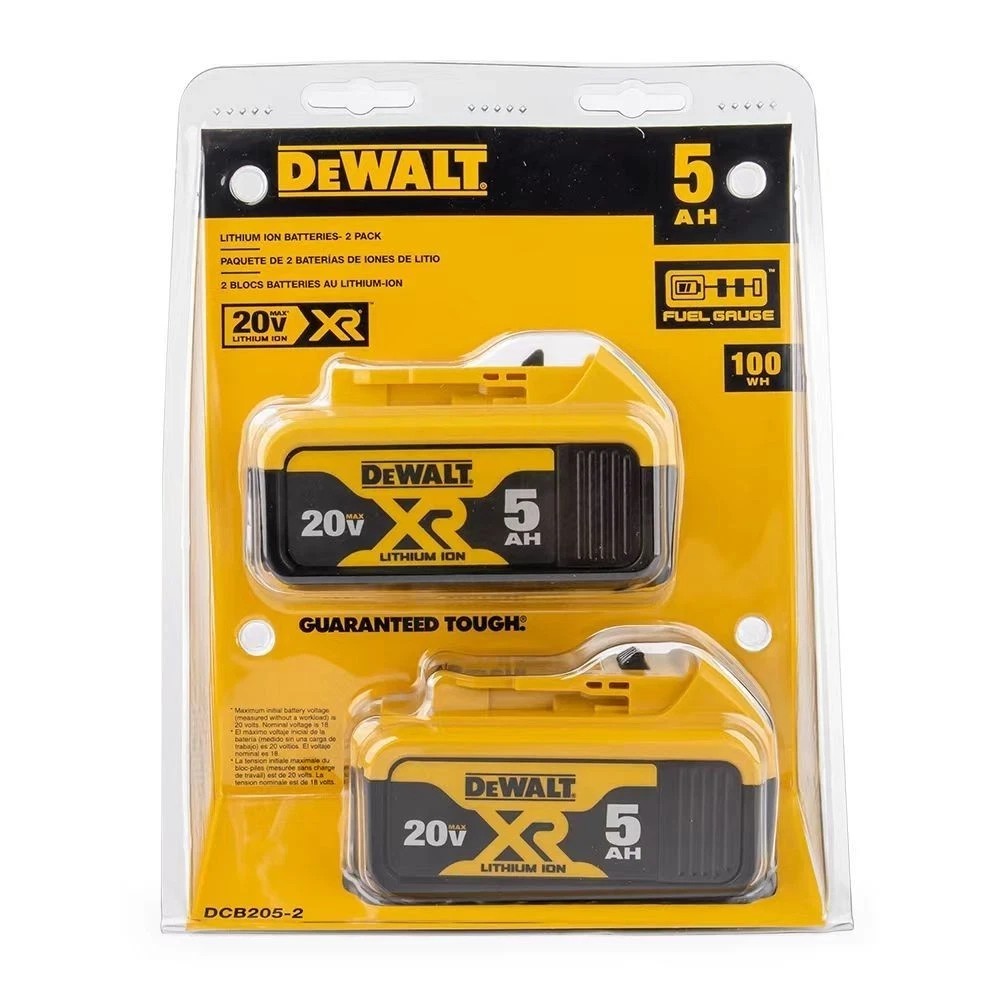
- DeWalt 20V MAX battery — 5.0 Ah — A 5.0 Ah battery doubles the runtime of the compact 2.0 Ah pack included in most DeWalt starter kits. For high-draw tools like circular saws and reciprocating saws, a 5.0 Ah pack is the practical minimum for extended jobsite use without mid-task battery swaps. Search: “DeWalt 20V battery 5Ah,” “DeWalt DCB205 20V MAX battery.” Check price on Amazon →
- Milwaukee M18 battery — 5.0 Ah HIGH OUTPUT — The HIGH OUTPUT 5.0 Ah pack uses optimized cell architecture for sustained power under load, outperforming standard M18 batteries in high-draw applications. Per Milwaukee’s specifications, the HIGH OUTPUT format is the recommended battery for M18 FUEL circular saws and reciprocating saws. Search: “Milwaukee M18 battery 5Ah HIGH OUTPUT,” “Milwaukee M18B5 battery 5Ah.” Check price on Amazon →
- Makita 18V LXT battery — 5.0 Ah — Makita’s BL1850B 5.0 Ah battery includes the Makita Star Protection circuitry that communicates with the tool to prevent overloading, overheating, and over-discharge. Building a second 5.0 Ah pack for each platform tool ensures continuous operation through a full work day. Search: “Makita 18V battery 5Ah BL1850B,” “Makita LXT battery 5Ah.” Check price on Amazon →
- DeWalt fast charger — dual port — A dual-port fast charger charges two 20V MAX batteries simultaneously, reducing downtime from 90+ minutes per battery to approximately 45 minutes. For crews with three or more tools running off the same platform, a second fast charger at the truck keeps batteries rotating through rather than waiting. Search: “battery charger fast charge DeWalt 20V dual port,” “DeWalt DCB102 dual port charger.” Check price on Amazon →
- Milwaukee M18 dual port simultaneous charger — Milwaukee’s dual-port charger charges two M18 batteries at the same time without reducing charging speed for either pack — a distinction from sequential dual chargers that prioritize one port. Per Milwaukee’s documentation, full charge on a 5.0 Ah HIGH OUTPUT pack takes approximately 60 minutes. Search: “dual port battery charger Milwaukee M18 simultaneous,” “Milwaukee M18 charger dual port.” Check price on Amazon →
- Cross-brand battery adapter — Third-party adapters allow Milwaukee M18 or Makita 18V batteries to power DeWalt 20V tools (and vice versa) for emergency backup use when the primary platform’s battery is depleted. Note: per manufacturer documentation, using non-OEM adapters voids the tool warranty — these are emergency supplements, not primary solutions. Search: “battery compatibility adapter M18 DeWalt,” “cross brand battery adapter 18V.” Check price on Amazon →
Frequently Asked Questions
Which battery platform should I buy first? Match the platform to the trade that fills most of the work week, using the “Pick Your Trade” router above. According to manufacturer catalogs, Milwaukee M18 leads for electrical, plumbing, and HVAC; DeWalt 20V MAX/FLEXVOLT leads for framing and high-draw saw work; Makita 18V LXT leads for finish carpentry and all-day handheld use. For mixed general-contractor work, all three are capable — buy on local stock and pricing.
Is DeWalt 20V actually more powerful than Milwaukee M18 or Makita 18V? No. Per the electrical specifications from all three manufacturers, every platform uses 18V nominal cells with a 20V peak unloaded reading. DeWalt labels its platform “20V MAX” using the peak figure; Milwaukee and Makita label at nominal. Real performance differences come from motor design, electronics, and cell chemistry — not the number on the label.
Can I mix batteries across brands? No. There is no OEM cross-compatibility between DeWalt, Milwaukee, and Makita. Third-party adapters exist on the aftermarket, but per all three manufacturers’ documentation they void the tool warranty and introduce cell-chemistry and overcharge-protection risks. Treat adapters as emergency backups only, not a primary strategy.
Is it ever worth switching platforms? Rarely, once 5 or more batteries are on the shelf. Switching costs typically run $800–$2,500 in stranded equipment depending on tool depth (see “The Lock-In Math”). The decision matters most before the third or fourth tool. If the current platform already covers the trade’s core tools, supplementing a gap with a second platform usually beats a full switch.
Which platform is best for a homeowner or weekend DIYer? For a collection that will stay under roughly three cordless tools, platform lock-in does not apply — buy whatever quality kit is on sale. Buyers who want the lowest entry cost should also look at Ryobi ONE+ or Craftsman V20, which target a lighter-duty segment and are not compared in this professional-platform analysis.
Do I need the higher-voltage system (FLEXVOLT, MX FUEL, XGT)? Only for sustained high-draw work — large-format saws, SDS-Max rotary hammers, concrete tools, and all-day grinder use. For drills, impacts, and finish tools, the standard 18V/20V platform is sufficient. DeWalt’s FLEXVOLT is the only system where the higher-voltage battery also powers the standard-voltage tools; Milwaukee’s MX FUEL and Makita’s XGT are largely separate battery investments (XGT can feed LXT tools via the ADP10 adapter, one direction only).
Sources
- DeWalt 20V MAX and FLEXVOLT product catalog and specifications (dewalt.com)
- Milwaukee Tool M18 and M12 product catalog and specifications (milwaukeetool.com)
- Makita 18V LXT and 40V XGT product catalog and specifications (makitatools.com)
- ANSI/CTA-2045 battery voltage measurement standards
- Manufacturer warranty documentation (DeWalt, Milwaukee, Makita)