Best CNC Plasma Tables for Small Shops in 2026: Langmuir vs Arclight vs Baileigh
A CNC plasma table automates what a handheld plasma cutter does manually — cutting metal along programmed toolpaths with repeatable accuracy. For small fabrication shops, sign makers, and custom metalwork businesses, a CNC plasma table can transform a single-person operation into a production-capable shop. According to industry data, CNC plasma tables offer cutting speeds 3-5x faster than manual cutting with significantly better edge quality and repeatability.
The market ranges from $2,000 hobby kits to $60,000+ industrial units. This guide focuses on tables suited for small shops — typically 2’x2’ to 5’x10’ cut areas, compatible with standard plasma power supplies, and priced under $20,000 for the table itself.
2026 Market Snapshot
Several pricing and product changes have hit the small-shop CNC plasma market in 2026. According to Langmuir Systems’ current product pricing, the CrossFire family now spans three tiers — base CrossFire at $1,995, CrossFire PRO at $3,195, and CrossFire XR (4’x8’ industrial frame) at $6,995. The XR has effectively replaced the older PRO 4’x8’ configuration as the top of the Langmuir lineup. Used-market pricing has tightened as well: search interest in “best cnc plasma tables” is currently running roughly 4x its 90-day average, which historically pulls used inventory off Facebook Marketplace and BangShift faster than usual.
Northern Tool’s affiliate program terminated mid-2026, so retailer linking has shifted to manufacturer direct, eBay, and Amazon for accessories.
Key Specifications That Matter
Before comparing tables, understand what separates a productive CNC plasma table from a frustrating one:
- Cut area: Determines your maximum part size. 4’x4’ is the minimum for most fabrication work; 4’x8’ handles full sheet steel.
- Motion system: Lead screws and ball screws offer precision over short travel; rack and pinion provides speed over longer distances. Most tables over 4’ use rack and pinion.
- Controller: The software/hardware that interprets G-code and drives the motors. THC (Torch Height Control) integration is critical for cut quality.
- Frame rigidity: A flex-prone frame produces wavy cuts. Look for welded steel tube construction with proper gusseting.
- Water table vs. downdraft: Water tables reduce warping and smoke; downdraft tables provide better visibility and easier cleanup.
Top CNC Plasma Tables by Category
Langmuir Systems CrossFire (Base) — Best Entry-Level Footprint
| Specification | Value |
|---|---|
| Cut Area | 25.3” x 23.3” (expandable to 25.3” x 33.3” with XL Kit) |
| Motion System | 3/8”-8 4-start ACME lead screws with anti-backlash nuts |
| Motors | NEMA 23 stepper motors |
| Controller | Langmuir FireControl |
| THC | Optional add-on |
| Table Type | Water tray (included) |
| Frame | Welded steel tube |
| Price (per Langmuir) | $1,995 (XL extension kit ~$150) |
The base CrossFire is Langmuir’s lowest-cost entry into CNC plasma cutting. According to Langmuir’s published specifications, the lead screw drive and anti-backlash nut design produces accurate cuts within the small cut envelope, but the table is not designed for full-sheet processing — the maximum cut area is roughly 25” square even with the XL extension.
Find Langmuir CrossFire on eBay (new and used) →
Best for: Hobbyists, artists, and small custom shops cutting parts under 24” square. The lowest-capital path to programmable plasma cutting in the Langmuir ecosystem.
Who this is NOT for: Anyone planning to process 4’x8’ sheet stock. Pre-cutting raw material to fit on a 25” table erodes the throughput advantage of CNC quickly.
Langmuir Systems CrossFire PRO — Best Small-Shop Value
| Specification | Value |
|---|---|
| Cut Area | 4-foot cutting width (full-sheet not supported in single setup) |
| Motion System | Lead screw / rack hybrid depending on configuration |
| Motors | NEMA 23 stepper motors |
| Controller | Langmuir FireControl |
| THC | Optional |
| Table Type | Water tray included |
| Frame | Welded steel tube |
| Price (per Langmuir) | $3,195 starting |
The CrossFire PRO is Langmuir’s middle tier and the best fit for small shops that want a 4-foot cutting width without stepping up to the industrial XR frame. Per Langmuir’s product page, the PRO is described as suitable for “the small business bringing small run parts in house or the garage warrior stepping up.” It accepts a 4-foot wide sheet and includes a water tray and Z-axis. THC is optional rather than bundled, so budget for the upgrade if cut quality on warped material matters.
Find Langmuir CrossFire PRO on eBay (new and used) →
Best for: Garage shops, ag fabricators, and sign makers cutting parts up to 4 feet wide. The pricing-vs-capability ratio is the strongest in the Langmuir lineup for buyers who do not need full 4’x8’ processing.
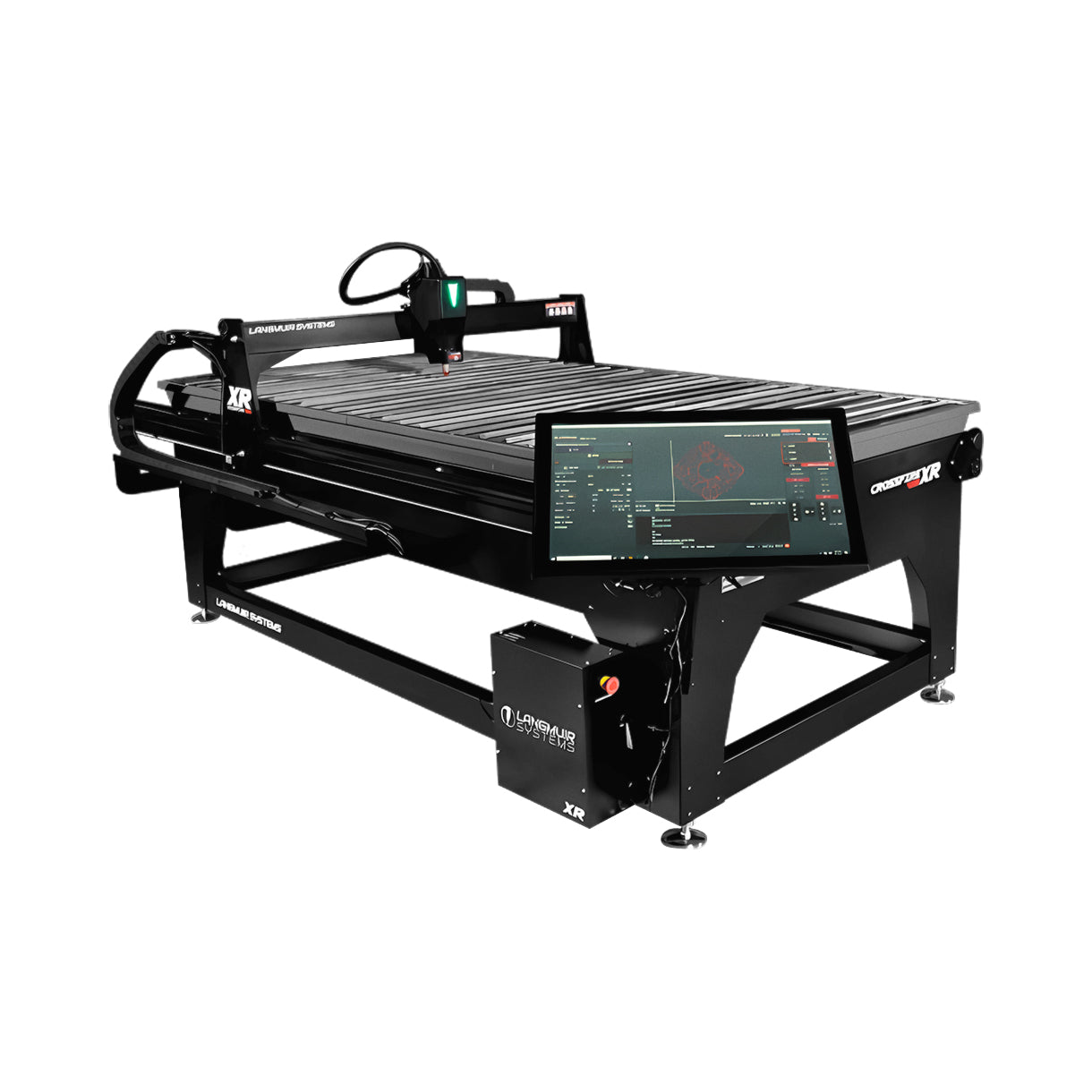
Langmuir Systems CrossFire XR — Best 4’x8’ Value (2026 Top Pick)
| Specification | Value |
|---|---|
| Cut Area | 4’ x 8’ (full-sheet) |
| Motion System | Rack and pinion (industrial gantry) |
| Motors | NEMA 23 stepper motors |
| Controller | Langmuir FireControl |
| THC | Integrated |
| Table Type | Heavy-duty water table |
| Frame | Heavy-duty industrial frame |
| Price (per Langmuir) | $6,995 starting |
According to Langmuir’s product positioning, the CrossFire XR is described as “a high performance industrial CNC Plasma table with 4x8’ cutting envelope, heavy-duty industrial frame and loaded with features that increase efficiency and cut quality.” This is the table that replaces the older CrossFire PRO 4’x8’ configuration as Langmuir’s top-line offering. At $6,995, the XR undercuts comparable 4’x8’ production tables (Arclight FullSheet, Lincoln Torchmate 4800) by 40–60%.
Find Langmuir CrossFire XR on eBay (new and used) →
Best for: Small fabrication shops processing full 4’x8’ sheet stock, sign shops, ag and trailer fabricators, and any operation that needs production capacity without writing a $15,000 check.
Who this is NOT for: Production shops running 30+ hours of cutting per week. The stepper motor drive is fine for intermittent use but does not match servo-driven systems for sustained throughput.
Arclight Dynamics FullSheet — Best for Production Fabrication
| Specification | Value |
|---|---|
| Cut Area | 4’ x 8’ / 5’ x 10’ |
| Motion System | Helical rack and pinion |
| Motors | Servo motors |
| Controller | Mach4 compatible |
| THC | Proma SD (or compatible) |
| Table Type | Water table (heavy duty) |
| Frame | Heavy wall steel tube, gusseted |
| Positional Accuracy | ±0.003” per manufacturer specs |
| Price Range | $12,000-$18,000 (table only, no plasma source) |
Arclight Dynamics builds heavier-duty tables designed for daily production use. According to their specifications, the helical rack and pinion system with servo motors provides faster traverse speeds and more precise positioning than stepper-driven alternatives. The frame uses heavier wall tubing with diagonal gusseting to maintain rigidity during high-speed cutting.
Best for: Job shops running 4+ hours of cutting daily. The servo motors and heavier construction handle sustained production better than stepper-driven tables.
Lincoln Electric Torchmate 4400/4800 — Best Brand Support
| Specification | Value |
|---|---|
| Cut Area | 4’ x 4’ / 4’ x 8’ |
| Motion System | Rack and pinion |
| Motors | Stepper motors |
| Controller | Torchmate CAD/CAM |
| THC | Included |
| Table Type | Water or downdraft options |
| Frame | Welded steel tube |
| Warranty | 1 year |
| Price Range | $8,000-$15,000 (table only) |
Lincoln Electric’s Torchmate line is backed by Lincoln’s dealer and service network. Per Lincoln’s product data, the included Torchmate CAD/CAM software handles design through cutting in a single workflow. Lincoln also offers bundled packages with their own plasma power supplies for simplified purchasing and support.
Best for: Shops that value manufacturer support and prefer a single vendor for table and plasma source.
Baileigh PT-22 — Hobby Tier with Industrial DNA
| Specification | Value |
|---|---|
| Cut Area | 22” x 22” |
| Motion System | Rack and pinion |
| Motors | Stepper motors |
| Controller | Baileigh CAD/CAM compatible |
| THC | Optional |
| Table Type | Water table |
| Frame | Welded steel tube (industrial-grade) |
| Price Range | $4,500-$5,500 (table only) |
According to Baileigh Industrial’s product positioning, the PT-22 is the smallest table in their plasma line and targets hobby and small-shop buyers who want Baileigh’s industrial machine support behind a compact footprint. Per Baileigh’s documentation, the PT-22 uses heavier frame stock than typical hobby kits at this price, which translates to better cut consistency on thin material when paired with a 30–45A plasma source. The tradeoff is the 22”x22” cut area — smaller than the Langmuir base CrossFire’s expanded envelope.
Find Baileigh CNC plasma tables on eBay →
Best for: Shops that want Baileigh’s dealer network and warranty backstop on a compact table, and don’t need full-sheet cutting.
Comparison Summary
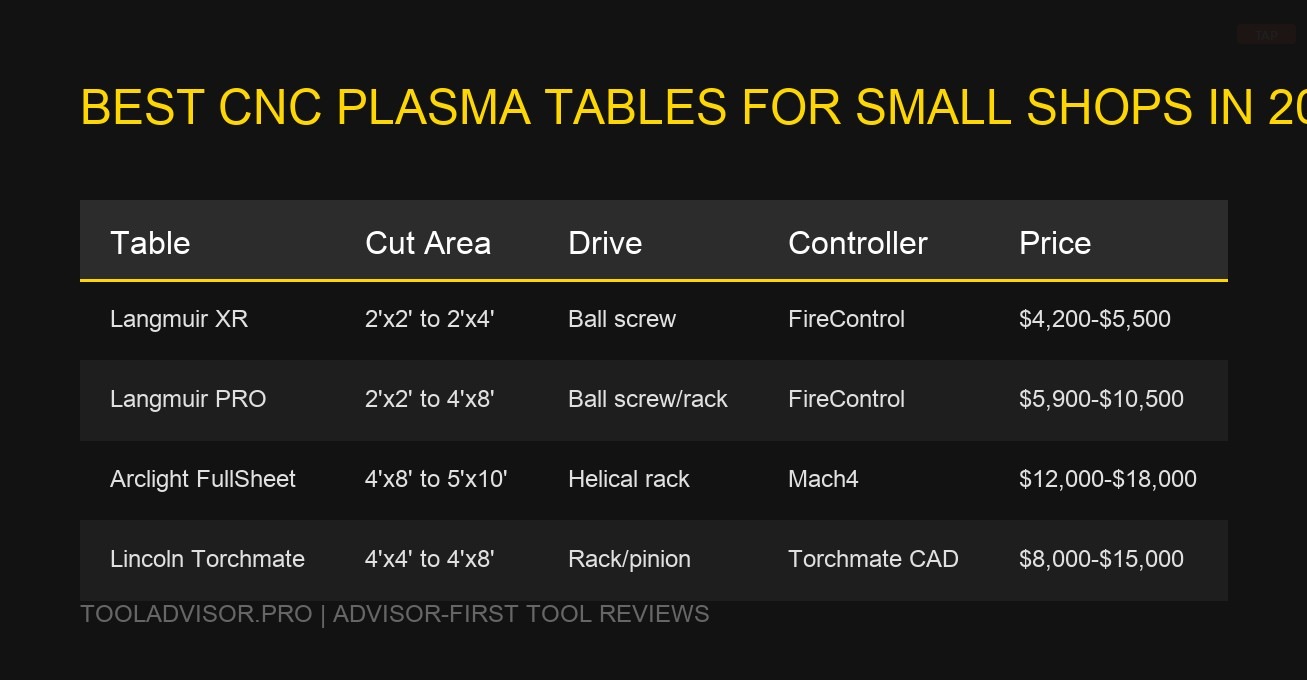
| Table | Cut Area | Drive | Controller | Price |
|---|---|---|---|---|
| Langmuir CrossFire (base) | ~25”x23” (exp 25”x33”) | Lead screw | FireControl | $1,995+ |
| Langmuir CrossFire PRO | 4-foot width | Lead screw / rack | FireControl | $3,195+ |
| Langmuir CrossFire XR | 4’x8’ | Rack and pinion | FireControl | $6,995+ |
| Baileigh PT-22 | 22”x22” | Rack and pinion | Baileigh CAD | $4,500-$5,500 |
| Arclight FullSheet | 4’x8’ to 5’x10’ | Helical rack | Mach4 | $12,000-$18,000 |
| Lincoln Torchmate | 4’x4’ to 4’x8’ | Rack/pinion | Torchmate CAD | $8,000-$15,000 |
Used vs New CNC Plasma Tables (2026 Market)
Used CNC plasma table inventory is moving faster than usual right now. Spring fabrication demand is overlapping with a 4x search-interest surge versus the 90-day average, which historically pulls used Langmuirs and Arclights off Facebook Marketplace and BangShift Forum within days of listing. Buyers looking to land used should be ready to act on the same day a listing appears.
What used pricing actually looks like
Per industry resale data and current marketplace listings:
- Langmuir CrossFire (base): $1,000–$1,400 used, depending on age and whether the THC and water table are included. Base model holds value well because it’s mechanically simple.
- Langmuir CrossFire PRO: $1,800–$2,400 used in good condition. The most common used Langmuir on the market because it’s the volume seller.
- Langmuir CrossFire XR (older PRO 4’x8’): $3,500–$5,500 for an older PRO 4’x8’ configuration; XR units have only been on the market briefly so used XR inventory is thin.
- Arclight Dynamics 4’x8’: $7,000–$12,000 used, depending on year, hours, and whether the original servo drives and Proma THC are intact.
- Lincoln Torchmate 4400: $4,000–$7,000 used. Torchmate CAD software licensing can be a complication on older units — verify the seller can transfer the license before purchasing.
What to look for in a used Langmuir or Arclight
According to industry maintenance documentation, the failure modes that matter most on used CNC plasma tables are:
- Stepper or servo motors that stall under load. Run a test cut through several inches of material before agreeing to purchase. Stalls or skipped steps indicate a worn driver or motor that will need replacement ($150–$600 per axis).
- Water table corrosion through the bottom. Water tables hold water with rust inhibitors. Older tables that ran without inhibitors or with stagnant water can pit through the floor pan. Replacement water tables on a Langmuir run $400–$700.
- Controller boot and software currency. Verify the controller boots cleanly and the seller can demonstrate it loading a current G-code file. Tables older than 5 years may run controller software that no longer receives updates from the manufacturer.
- Rack and pinion wear on long-axis tables. On 4’x8’ configurations, run the X-axis end-to-end at full speed and listen for chatter. Pitting or wear on the rack creates positioning errors that compound over long cuts.
- Torch lifter and THC functionality. Z-axis lifters and THC modules are common failure points. Watch the lifter cycle through its full range and verify the THC reads arc voltage during a test cut.
Where used CNC plasma tables actually appear
Used market inventory clusters in three places:
- Facebook Marketplace is the highest-volume source for used Langmuir tables. Most listings come from one-person shops upgrading or exiting the trade. Local pickup is the norm — the tables are too heavy and large to ship affordably.
- BangShift Forum classifieds and the Langmuir Owners Group on Facebook are where the better-maintained Langmuirs change hands. Sellers in these communities tend to know what they have and price accordingly, but the quality of the equipment is also higher on average.
- Dealer trade-ins (Lincoln Torchmate, Baileigh) show up periodically on dealer websites and on eBay through dealer accounts. These tables have been functional checked but the price premium reflects that.
Browse used CNC plasma tables on eBay →
Fair price ranges by year and condition
| Table | 1-2 Years Old | 3-4 Years Old | 5+ Years Old |
|---|---|---|---|
| Langmuir CrossFire | $1,400-$1,600 | $1,000-$1,300 | $700-$1,000 |
| Langmuir PRO | $2,200-$2,600 | $1,700-$2,100 | $1,200-$1,600 |
| Langmuir XR / PRO 4’x8’ | $5,000-$5,800 | $3,800-$4,800 | $2,800-$3,800 |
| Arclight 4’x8’ | $10,000-$13,000 | $8,000-$10,500 | $6,500-$8,500 |
| Lincoln Torchmate 4400 | $6,000-$7,500 | $4,500-$6,000 | $3,500-$4,500 |
Used pricing typically rises 10–15% during spring fabrication season as demand peaks. Buyers willing to wait until late summer or early fall often pick up the same equipment at the lower end of these ranges.
The Plasma Source Question
CNC plasma tables are often sold separately from the plasma power supply. The table is the motion system; you also need a mechanized plasma cutter. Not every handheld plasma cutter works well on a CNC table. (For handheld options and specs, see our plasma cutter buying guide.)
According to Hypertherm and other manufacturers, key requirements for CNC-compatible plasma sources include:
- Machine torch compatibility: Hand torches cause inconsistent cut quality on CNC systems
- Pilot arc: Non-contact arc starting prevents consumable damage during pierce
- CNC interface port: Allows the table controller to start/stop the arc automatically
- Sufficient duty cycle: CNC cutting runs longer continuous cycles than handheld cutting
Popular CNC-compatible plasma sources include the Hypertherm Powermax45 XP ($1,800-$2,200 — check price on Amazon), PrimeWeld CUT60 ($699-$799 per current PrimeWeld pricing — check price on Amazon), Eastwood Versa-Cut 40 ($600-$800 — check price on Amazon), and Razorweld 45 ($800-$1,000 — check price on Amazon). Total system cost (table + plasma source) typically ranges from $2,700 for entry-level to $20,000+ for production-grade setups.
Best CNC Plasma Table by Shop Type
The right table depends on what the shop produces, how many hours per week the machine runs, and whether parts need to go straight to assembly or require secondary processing. Here’s how the options map to real shop profiles:
Hobbyist and maker shop (under 10 hours/week, parts under 24” square): Langmuir CrossFire (base) or Baileigh PT-22. The base CrossFire’s 25”x23” cut area handles decorative metalwork, signs, brackets, and small structural parts. The included FireControl software handles CAM without an additional purchase. At $1,995 starting, it’s the lowest capital entry point in the Langmuir ecosystem. The Baileigh PT-22 is the same physical class with stronger dealer support but at roughly 2x the price.
Small fabrication shop (10–30 hours/week, 4-foot work): Langmuir CrossFire PRO. At $3,195 starting, the PRO accepts 4-foot wide stock and handles small-batch production of brackets, panels, gussets, and signage. Most owner-operator fab shops landing their first CNC plasma table fall into this profile.
Full-sheet shop (10–30 hours/week, 4’x8’ sheet stock): Langmuir CrossFire XR. The 2026 lineup positions the XR as the value leader in 4’x8’ production capacity at $6,995. This is the table that eliminates pre-cutting stock — raw 4’x8’ sheets go directly on the table. Trailer fabricators, sign shops, gate-and-fence custom work, and ag-equipment repair shops are the natural fit.
Sign shop and custom metalwork (intricate cuts, high detail): Langmuir CrossFire PRO or Lincoln Torchmate 4400. Decorative and signage work demands consistent cut quality on thin material (16–12 gauge). The Langmuir’s accuracy specs and integrated THC produce clean results on intricate profiles. Lincoln’s Torchmate is worth considering for shops that want single-vendor support and bundled plasma sourcing.
Job shop and production fabrication (30+ hours/week, structural steel): Arclight Dynamics FullSheet. Shops cutting 1/4” and thicker plate for structural applications — trailers, gates, agricultural equipment, industrial brackets — need the servo drive system and heavy-frame construction of the Arclight. Stepper-driven tables lose accuracy under thermal load from sustained production cutting; servo systems maintain positioning throughout a full shift.
Farm and ranch fabrication shop: Langmuir CrossFire PRO or XR depending on whether 4’x8’ sheets are part of the workflow. Custom gate panels, equipment brackets, mounting plates for implements, and repair parts for aging machinery are common farm shop outputs. The eBay used market often surfaces used Langmuir tables at 40–50% of new pricing — a strong fit for farm shops where the machine supplements other work rather than running continuously.
Spring Fabrication Season: When CNC Plasma Table Demand Peaks
CNC plasma table interest follows construction and outdoor fabrication seasonality. Search demand for plasma tables historically accelerates in March and April and peaks through early summer — the same pattern seen in structural steel, trailer fabrication, and agricultural equipment markets. Current 2026 search-interest data shows the surge is running roughly 4x its 90-day average right now.
The spring demand drivers:
Custom gate and fence fabrication. Decorative gate season opens with outdoor project weather. Shops that produce ornamental iron gates and fence panels are buying or upgrading CNC plasma capacity to handle spring order volume.
Agricultural equipment repair and custom parts. Spring field preparation uncovers worn and broken implement components — mounting brackets, drawbars, hitch plates, wear parts. Farm fabricators cutting replacement parts from plate steel drive a consistent spring demand cycle.
Trailer and utility body fabrication. Construction trailers, utility beds, and equipment haulers are ordered heavily in spring. Shops producing these are running CNC plasma at capacity from March through June.
Outdoor structure and landscape metalwork. Pergolas, arbors, decorative panels, and site furniture fabricated from flat plate are spring-season products for architectural metalwork shops.
For shops considering a first CNC plasma table purchase, spring is when the business case is clearest — order volume exists, lead times on outsourced cutting are stretching, and the machine pays for itself faster with a full season ahead. Used market inventory also moves fastest during this window, so buyers shopping the secondary market need to be ready to commit when a listing appears.
Who This Is NOT For
- Shops cutting primarily stainless steel or aluminum. Plasma cut quality degrades on these materials compared to mild steel. For production stainless/aluminum cutting, laser or waterjet is superior despite higher cost.
- Precision work requiring tolerances tighter than ±0.020”. CNC plasma is a near-net-shape process. Parts typically require secondary machining on a CNC mill for tight-tolerance features.
- Shops without adequate electrical infrastructure. A CNC plasma table with a 60A plasma source may draw 50+ amps at 240V. Combined with the compressor requirement (typically 5-7 CFM at 90 PSI), electrical capacity can be a limiting factor.
- Occasional users cutting fewer than 10 parts per month. The setup time, consumable costs, and learning curve favor outsourcing small quantities to a local metal service center.
Total Cost of Ownership
Beyond the table and plasma source, budget for:
- Compressed air: 5+ CFM at 90 PSI minimum. A dedicated compressor ($500-$1,500) is typical, or a rotary screw compressor for shops with higher air demands
- Consumables: Electrodes, nozzles, and shields. Budget $100-$300/month for active use
- Software: Some tables include CAM software; others require separate purchases ($200-$2,000)
- Ventilation: Plasma cutting produces significant fumes. A downdraft table or fume extraction system ($500-$3,000) is essential for enclosed shops
- Maintenance: Slat replacement, water treatment, and drive system lubrication are ongoing costs
What You’ll Also Need
Buyers of CNC plasma tables typically need the following accessories to get started. Per manufacturer setup guides, these are not optional for productive use:
- Hypertherm Powermax 45 XP Consumables Kit ($40-$80): Electrodes, nozzles, and shields are wear items that degrade with every cut — a spare consumable kit prevents downtime when parts wear out mid-job. Check price on Amazon →
- Lincoln Electric Viking 3350 Welding Helmet ($250-$350): Plasma cutting produces intense arc light and UV radiation — an auto-darkening helmet rated for plasma use protects eyes during operation and part handling. Check price on Amazon →
- DeWalt DWE4011 Angle Grinder ($50-$70): An angle grinder removes dross, deburrs edges, and cleans up plasma-cut parts — required post-processing for nearly every cut part. Check price on Amazon →
- Rustlick WS-11 Water-Soluble Cutting Fluid (1 gal) ($25-$45): Water table additive prevents rust on the table and cut parts while reducing odor and extending table life. Check price on Amazon →
Consider Buying Used
For CNC plasma tables in the $2,000-$18,000 range, used equipment can save 30-50% over new pricing. See the Used vs New CNC Plasma Tables (2026 Market) section above for fair price ranges by table, year, and condition, plus what to inspect before buying.
Find used CNC plasma tables on eBay →
For a head-to-head between Langmuir’s two most-bought tables, see Langmuir CrossFire PRO vs CrossFire XR.
Sources
- Langmuir Systems CrossFire, CrossFire PRO, and CrossFire XR product specifications and pricing (langmuirsystems.com, accessed 2026-05-09)
- Arclight Dynamics FullSheet product documentation (arclightdynamics.com)
- Lincoln Electric Torchmate 4400/4800 specifications (torchmate.com)
- Baileigh Industrial PT-22 product specifications (baileigh.com)
- PrimeWeld CUT60 product page and pricing (primeweld.com, accessed 2026-05-09)
- Eastwood Versa-Cut 40 plasma cutter specifications (eastwood.com)
- Hypertherm CNC cutting application notes and Powermax product data
- AWS D1.1 Structural Welding Code — cut quality standards reference