Best Random Orbital Sanders Under $100 in 2026
A random orbital sander is one of the most-used tools in any woodworking shop, and it is also one of the easiest to get wrong. Cheap sanders punish their owners in ways that do not show up until mid-project: excessive vibration that numbs hands after twenty minutes, dust collection systems that clog or leak fine particles into the air, hook-and-loop pads that shred sandpaper discs prematurely, and orbit patterns that leave visible swirl marks on finished surfaces. The difference between a $30 throwaway and a $70 contractor-grade sander is not incremental — it is the difference between sanding as a chore and sanding as a reliable step in the finishing process.
This guide compares four corded random orbital sanders under $100, all readily available on Amazon, evaluated strictly on manufacturer specifications and documented performance characteristics. No hype, no inflated claims — just the specs that determine whether a sander will perform on day one and day three hundred.
Key Specs That Matter
Before comparing specific models, it helps to understand which specifications actually predict real-world performance and which are marketing noise.
Orbit diameter refers to the size of the circular path the pad travels. Most consumer and contractor sanders use a 1/8-inch (3.2mm) orbit. A few models, like the Makita BO5041, use a larger orbit diameter for more aggressive material removal. Smaller orbit diameters tend to leave a finer finish but remove material more slowly.
Pad size is standardized at 5 inches for the vast majority of random orbital sanders. This matters because 5-inch sanding discs are the most widely available and least expensive. Six-inch models exist but are less common in this price range.
Variable speed control allows adjustment of orbits per minute (OPM), typically ranging from around 7,000 OPM at the low end to 12,000 OPM at the high end. Lower speeds suit finish sanding and soft woods; higher speeds handle stock removal and hardwoods. A sander without variable speed locks operators into a single compromise setting.
Dust collection varies significantly across models. The three common approaches are onboard dust bags, vacuum-port adapters, and integrated microfilter canisters. According to manufacturer documentation, vacuum-port systems paired with a shop vac consistently outperform onboard bags for fine particle capture. However, a good onboard system matters for job-site portability where a vacuum is impractical.
Amp draw in corded models typically ranges from 2.0 to 3.0 amps in this price bracket. Higher amperage does not automatically mean better performance — it indicates the motor’s maximum power draw, which correlates with sustained performance under load.
Weight ranges from about 2.5 to 4.0 pounds. Lighter is generally better for extended use, but too light can mean the operator must apply more downward pressure, increasing fatigue through a different mechanism.
Top Picks Under $100
DeWalt DWE6423 — Best Overall
| Spec | Value |
|---|---|
| Pad Size | 5 inches |
| Motor | 3.0 Amp |
| Speed Range | 8,000–12,000 OPM |
| Orbit Diameter | 1/8 inch |
| Weight | 2.9 lbs |
| Dust Collection | Dust bag + vacuum port |
| Speed Control | Variable speed dial |
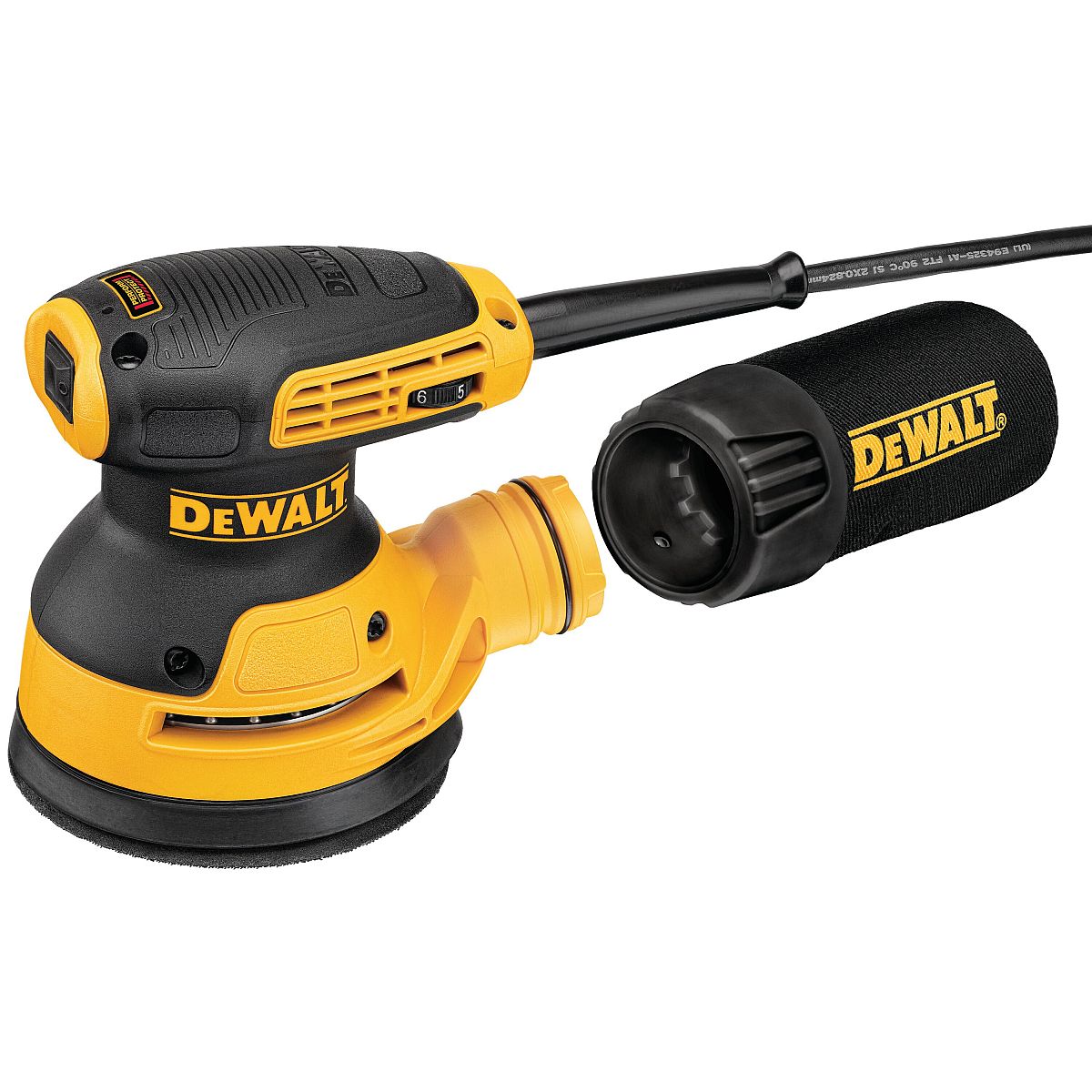
Per the DeWalt product data sheet, the DWE6423 features a rubber overmold grip designed to reduce vibration, a dust-sealed switch to prevent particle ingress, and a controlled finishing system with variable speed. At 2.9 pounds, it sits in the sweet spot for extended use without excessive operator fatigue. The separate counterweight design is engineered to reduce vibration, which third-party user feedback consistently confirms as a distinguishing trait of this model. For most contractors and serious DIYers, this is the sander to default to unless a specific use case demands something different.
Makita BO5041 — Best for Finish Work
| Spec | Value |
|---|---|
| Pad Size | 5 inches |
| Motor | 3.0 Amp |
| Speed Range | 4,000–12,000 OPM |
| Orbit Diameter | 1/8 inch |
| Weight | 3.1 lbs |
| Dust Collection | Dust bag + vacuum port |
| Speed Control | Variable speed dial |
According to Makita’s specifications, the BO5041 offers one of the widest speed ranges in this class, dropping as low as 4,000 OPM. That low-end capability is significant for finish sanding on veneers, lacquered surfaces, and softwoods where aggressive action causes burns or tear-out. The longer barrel grip design provides an alternative hold position that some operators prefer for detail work. The pad brake feature stops pad rotation when lifted from the surface, reducing the risk of swirl marks at the start and end of each pass.
Bosch ROS20VSC — Best Dust Collection
| Spec | Value |
|---|---|
| Pad Size | 5 inches |
| Motor | 2.5 Amp |
| Speed Range | 7,500–12,000 OPM |
| Orbit Diameter | Micro |
| Weight | 3.5 lbs |
| Dust Collection | Microfilter canister + vacuum port |
| Speed Control | Variable speed dial |
Per Bosch product documentation, the ROS20VSC integrates a microfilter dust canister system that captures particles down to 0.5 microns. This is a meaningful specification for operators who sand indoors or in enclosed shop spaces without dedicated dust extraction. The canister system outperforms cloth dust bags for fine particle capture according to Bosch’s published testing data. At 2.5 amps, the motor draws less power than the DeWalt or Makita, which may result in slightly less sustained performance under heavy load on hardwoods. For finish sanding and general-purpose work, the lower amperage is not a practical limitation.
Milwaukee 6034-21 — Best Value
| Spec | Value |
|---|---|
| Pad Size | 5 inches |
| Motor | 3.0 Amp |
| Speed Range | 7,000–12,000 OPM |
| Orbit Diameter | 1/8 inch |
| Weight | 3.25 lbs |
| Dust Collection | Dust bag |
| Speed Control | Variable speed dial |
According to manufacturer specs, the Milwaukee 6034-21 delivers 3.0-amp performance at a price point that consistently lands below the DeWalt and Makita. The trade-off is a simpler dust collection system — a basic dust bag without the microfilter technology found on the Bosch — and slightly heavier weight at 3.25 pounds. For operators who always connect to a shop vacuum anyway, the onboard dust collection quality is irrelevant, making this a strong value proposition. The 3.0-amp motor matches the DeWalt and Makita on paper, and the variable speed range covers the essential spectrum from finish work to moderate stock removal.
5-Inch vs 6-Inch Pads
The 5-inch pad is the industry standard for random orbital sanders, and every model in this guide uses it. Five-inch sanding discs are available from dozens of manufacturers in every grit from 40 to 3000, and bulk pricing is significantly cheaper than 6-inch equivalents.
Six-inch random orbital sanders do exist and cover roughly 44% more surface area per pass. According to manufacturer data, this translates to faster stock removal on large flat surfaces like tabletops, doors, and panel goods. However, 6-inch models are heavier, more expensive (most exceed $100), and the larger pad is harder to control on edges, profiles, and smaller workpieces.
For most contractors and woodworkers operating under a $100 budget, the 5-inch format is the correct choice. The consumable cost savings alone justify it — a box of 50 premium 5-inch discs typically costs 30-40% less than the same quantity in 6-inch.
Who This Is NOT For
Production cabinet shops running sanders for 6+ hours daily should bypass corded electric random orbital sanders entirely. Pneumatic random orbital sanders connected to a compressor system deliver lower vibration, lighter weight, and effectively unlimited runtime. The upfront cost is higher (compressor + sander + plumbing), but the per-hour operating cost and operator fatigue reduction justify it at production volumes.
Auto body and paint prep work requires a dual-action (DA) sander, not a standard random orbital. DA sanders allow both random orbital and rotary motion, which is necessary for compound application and paint correction. Using a standard random orbital sander for auto body work will produce acceptable results on primer sanding but falls short for finish stages.
Aggressive stock removal tasks — stripping paint, leveling rough lumber, removing heavy coats of finish — demand a belt sander, not a random orbital. A random orbital sander removes material slowly by design; that is its advantage for finish work and its limitation for demolition-speed removal. Attempting heavy stock removal with a random orbital sander leads to premature disc wear, excessive heat, and frustration.
Fine furniture makers working with veneers thinner than 1/32 inch should consider hand sanding or specialty detail sanders. A full-size 5-inch random orbital sander can sand through thin veneer in seconds, especially at higher OPM settings, with no practical way to recover from the mistake.
Building Your Sanding Setup
A random orbital sander pairs naturally with other core power tools. If the shop still needs a cordless drill or impact driver, those are typically higher-priority purchases. For edge profiling and joinery work that complements sanding, a wood router kit is the next logical addition. For detail sanding in corners and tight spaces a random orbital sander cannot reach, an oscillating multi-tool with a sanding pad attachment fills the gap — but a quality sander under $100 is one of the best returns on investment in any tool collection. The consumable cost (sanding discs) will eventually exceed the tool cost, so choosing a sander that uses standard 5-inch 8-hole discs keeps long-term operating costs predictable.
Frequently Asked Questions
What speed should I set my random orbital sander to?
For finish sanding on softwoods and between coats of finish, 7,000-8,000 OPM provides a smooth result with minimal risk of burn-through. For stock removal on hardwoods or bare wood preparation, 10,000-12,000 OPM is more efficient. According to manufacturer guidelines, starting at a medium speed and adjusting based on the material response is the safest approach.
Do I need a 5-inch or 6-inch orbital sander?
A 5-inch random orbital sander is the correct choice for the vast majority of users. Five-inch sanding discs are the most widely available, least expensive, and compatible with every model in the sub-$100 category. Six-inch models cover about 44% more surface area per pass but cost more, weigh more, and have higher consumable costs — they are best reserved for production shops sanding large flat panels.
What grit sandpaper should I start with on a random orbital sander?
Start with 80-grit for bare wood with mill marks or rough surfaces, 120-grit for wood that is already reasonably smooth, and 150-grit or higher for sanding between finish coats. According to abrasive manufacturer recommendations, skipping more than one grit step (e.g., jumping from 80 to 220) leaves scratches from the coarser grit that the finer disc cannot remove efficiently.
What You’ll Also Need
- 5-inch sanding discs — 40 grit, hook and loop, 50-pack — Aggressive stock removal on bare wood and rough surfaces starts with 40 grit. A bulk pack of 50 keeps the sander running without mid-project supply runs, and 40 grit discs wear faster than finer grits due to the material removed per pass. Search: “5 inch sanding discs hook and loop 40 grit,” “5 inch random orbital sander discs 40 grit bulk.” Check price on Amazon →
- 5-inch sanding disc assortment — 40, 80, 120, 220 grit — A mixed-grit assortment covering coarse through fine covers the full sanding progression from bare wood prep through final finish sanding. Per abrasive manufacturer guidelines, skipping grits leaves scratches from coarser discs that finer discs cannot remove efficiently. Search: “5 inch sanding disc assortment 40 80 120 220,” “orbital sander disc assortment multi grit.” Check price on Amazon →
- 5-inch replacement pad — hook and loop backing — The hook-and-loop backing pad wears out before the sander motor does, especially with heavy use. Replacement pads are available for all major sander brands and restore full disc adhesion at a fraction of the cost of replacing the tool. Search: “orbital sander pad replacement 5 inch hook loop,” “hook loop backing pad 5 inch sander.” Check price on Amazon →
- 5-inch sanding discs — 220 grit, 50-pack — Final finish sanding between coats of paint, stain, or varnish requires 220 grit for a smooth base without visible scratch patterns. A dedicated 220-grit bulk pack is the most-consumed fine grit in any finishing workflow. Search: “sanding disc 220 grit 5 inch hook loop,” “5 inch finish sanding discs 220 grit.” Check price on Amazon →
- Sander dust bag replacement — The factory dust bag fills quickly and loses suction as it approaches capacity. A replacement bag or adapter to a shop vac port maintains dust capture effectiveness through extended sanding sessions. Search: “sander dust bag replacement 5 inch orbital,” “orbital sander dust collection bag.” Check price on Amazon →
- Interface pad — 5 inch foam cushion — An interface pad mounts between the sander backing pad and the sanding disc to conform the abrasive surface to curved profiles, routed edges, and contoured workpieces. Without an interface pad, the rigid backing pad cannot follow curves, leaving uneven material removal on shaped surfaces. Search: “interface pad 5 inch orbital sander foam,” “sanding interface pad cushion 5 inch.” Check price on Amazon →
Sources
- DeWalt DWE6423 product specifications and data sheets — dewalt.com
- Makita BO5041 product specifications — makitatools.com
- Bosch ROS20VSC product documentation — boschtools.com
- Milwaukee 6034-21 product specifications — milwaukeetool.com
- Manufacturer-published orbit diameter, OPM range, amperage, and weight data for all listed models