Used Mini Round Baler Buying Guide: Inspection Checklist, Chamber Size, and When Custom Hire Wins
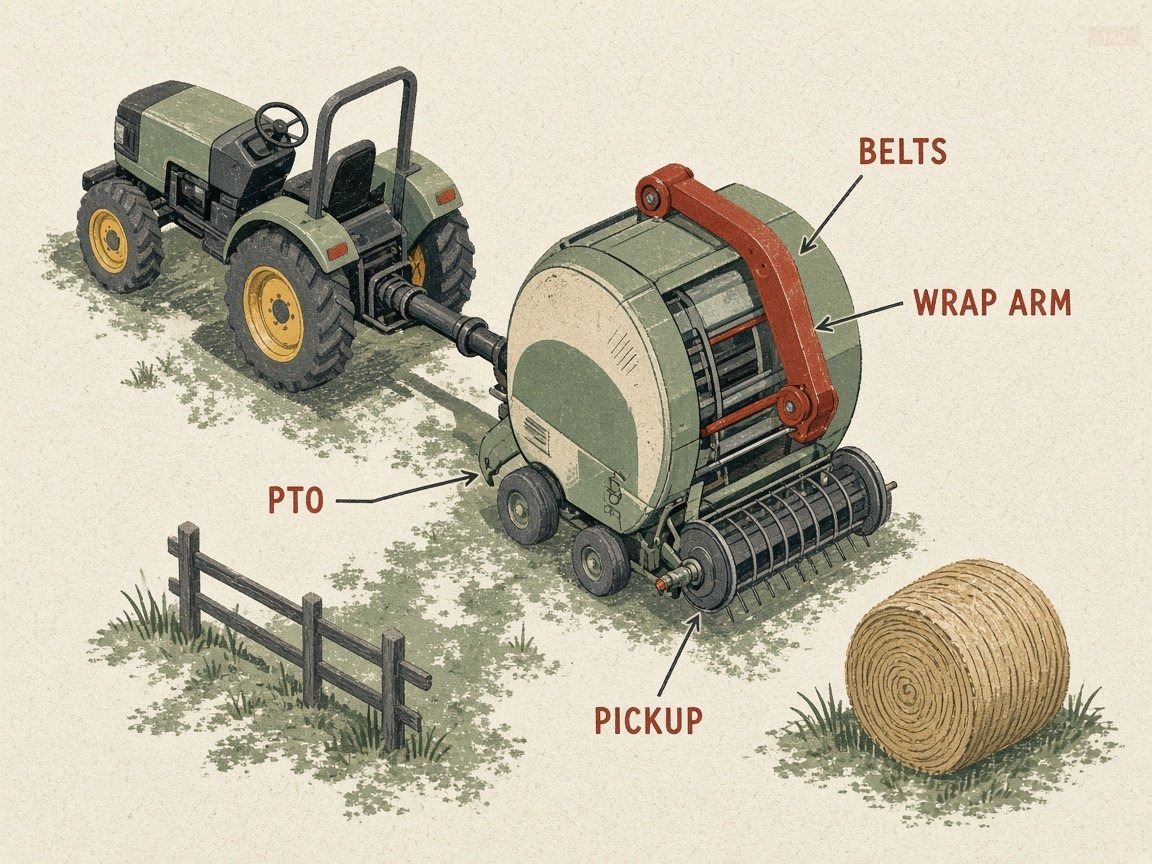
A used mini round baler is a different purchase than a new 4×5 listed in a model roundup. The machine that looks clean from the road can hide cracked belts, a pickup missing a third of its teeth, a wrap cycle that will not complete, and a wrapping arm seized at the pivot. Those four failures — plus an undersized PTO match — are what turn a $6,000 asking price into a winter of parts hunting.
This is the inspection path: belts, pickup, wrap or twine cycle, PTO horsepower, chamber size (mini vs 4×5 vs 5×6), wrapping-arm rust, and used versus custom hire. New-model comparison lives in the best small round balers guide. Used iron is not an Amazon SKU.
Mini Round Baler vs 4×5 vs 5×6: Match Chamber to PTO
Buyers searching mini round baler are usually matching a 15–25 HP subcompact tractor (Kubota BX / John Deere 1025R class), not downsizing a utility-tractor chamber. Per ASABE S351.3 dimensional conventions and manufacturer PTO minimums:
| Chamber class | Typical bale | Min PTO (540 RPM) | Tractor that can pull it | Used-market role |
|---|---|---|---|---|
| Mini (~3’ × 3’ to 3’3”) | 200–400 lbs | 15–20 HP | Subcompact 15–25 HP | One-person handling; usually twine only |
| 4’ × 4’ / 4’ × 5’ | 600–1,000 lbs | 35–50 HP | Compact/utility 50–75 HP engine | The small-farm workhorse |
| 5’ × 6’ (full) | 800–1,500+ lbs | 50–80 HP | Utility 75–100+ HP | Commercial hay; skip for most 5–50 acre places |
Per Abbriata’s M60 data, the mini class lists 15 HP PTO. Per Vermeer and John Deere sheets, a 4×5 such as the 504R Classic lists 40 HP PTO and the 450M lists 35 HP PTO. A used 5×6 behind a compact tractor is not a bargain — the tractor bogs and density falls. Most pull-type small balers also need 1–2 rear remotes; mounted minis need lift and ballast for 1,200–2,000 lbs. If the tractor match is still open, matching implements to a compact tractor covers lift and PTO before the bid.
Used vs Custom Hire Before You Bid
Custom baling commonly runs $12–$20 per bale for twine and $14–$22 for net wrap, per University of Nebraska-Lincoln farm custom-rate surveys. Ownership only wins when volume absorbs depreciation, belts, chain, and pickup teeth. At 300 bales per year, a $20,000 new 4×5 lands roughly $6.50–$8.20 per bale in the small-farm round baler cost table; a used 4×5 at $10,000 cuts that depreciation line roughly in half. Below about 50 bales per year, custom hire is almost always cheaper when full depreciation is counted. Used does not erase the ~150-bale rule of thumb — it only lowers breakeven. If the place does not already cut and rake on a schedule — see hay rakes for small farms — a baler bought to “maybe bale someday” is inventory, not a hay system.
Inspection Spine: Belts, Pickup, Wrap Cycle, Wrapping-Arm Rust
Walk this sequence on every used mini round baler and every used 4×5. Cosmetic paint is last.
Belts. Open the shields and inspect every chamber belt across the full width. Per manufacturer service guidelines, cracks, delamination, glazed faces, and frayed edges are replacement items. A 4-belt fixed-chamber set runs $1,500–$3,000 in parts plus labor. Uneven wear on one edge usually means a misaligned idler — budget both. Mini chambers use fewer belts; one failed belt still parks the machine.
Pickup. Walk the full width and count bent, broken, and missing teeth. Individual teeth are $2–$6 on common 4×5 pickups; 20–30 damaged teeth plus worn strippers is a labor bill. Mini pickups are narrower (about 40” on the M60 class versus 51–53” on 4×5 machines). A bent mini pickup frame is harder to square than replaceable tooth bars.
Wrap / twine cycle. Load twine or net, engage the PTO at 540 RPM, and watch one complete cycle: start, wrap or twine feed, cut, reset. The wrapping arm must travel its full arc without binding; knives must shear; trip cams must reset. A seller who will not run the cycle is signaling a problem they prefer discovered after the check clears. Price the repair before bidding.
Rust in the wrapping arm. Surface rust on shields is cosmetic. Scale in the pivot, a frozen grease fitting, or rust-jacked bushings that let the arm wobble are structural. With the PTO off, the arm should move through the arc with even resistance. Binding at one point is rust or a bent tube. Arms left loaded with net or twine often corrode around the knife; kits are model-specific and slow on older mini imports.
PTO, gearbox, chains. Check driveline U-joints, shielding (per ASABE S210.3, missing shields are not optional), and gearbox oil for metal flake. Per ASME B29.1, roller chain past about 3% elongation should be replaced. Spin rollers by hand; grinding bearings are a used-market tell.
The test bale. Do not close without watching the machine form and wrap at least one bale. Density, shape, and a clean wrap matter more than hour-meter stories. Many older balers have no hour meter.
Inspect used round balers on eBay →
Fair Price Bands (Working Condition)
Based on dealer reference pricing and 2025–2026 auction / classified patterns for machines that pass the inspection spine:
| Configuration | Typical used range | Walk-away if |
|---|---|---|
| Mini round baler (3’ class, twine) | $4,000–$8,000 | Seller will not run wrap/twine cycle; pickup frame bent; belts cracked |
| 4×4 / 4×5 fixed-chamber, twine | $8,000–$12,000 | Multiple failed idler bearings plus belt set due |
| 4×5 with working net wrap | $10,000–$16,000 | Net system incomplete; wrapping-arm pivot seized |
| 5×6 commercial chamber | $12,000–$25,000+ | Tractor under ~75 HP engine / 50 HP PTO — wrong class |
Deduct $1,500–$3,000 for a due 4-belt set, $200–$600 for a wrecked pickup, and $400–$1,200 for wrapping-arm / knife work. Stacked repairs plus transport rarely leave a deal. Mini import parts can add weeks of downtime even when the bid looks low.
Consumables After the Purchase
The baler is used iron. The season still consumes wrap and a way to move bales.
- 64-inch net wrap — the consumable a net-capable 4×5 actually uses. Mini chambers in the M60 class are typically twine-only; do not assume a used mini can take net. 64” net wrap →
- Bale spear, 3-point — required for 4×5 and 5×6 bales (600–1,500+ lbs). Mini 200–400 lb bales are often moved by hand; a spear is still the safer plan once volume rises. Check bale spears on Amazon →
Who This Is NOT For
- Commercial hay crews. A used mini or small-farm 4×5 is the wrong throughput and the wrong bale for custom routes and commercial 5×6 density. This inspection path will not turn a compact-tractor chamber into a commercial tool.
- “Maybe I’ll bale someday.” A used baler still needs a tractor at the PTO floor, a mower and rake upstream, a moisture window, and either roof storage or a wrap system that matches outdoor exposure. Per University of Missouri Extension forage storage research, twine-tied bales stored outdoors in humid climates can lose 10–25% of dry matter; net wrap reduces that outdoor loss to roughly 5–8%. Buying the chamber first is how used balers sit in the weeds until the wrapping arm rusts. Under ~50 bales a year, hire custom. If the crop must stay in small packages for sale, small square balers are the other path.
Related Guides
- Best Small Round Balers for Small Farms — new mini vs 4×5 comparison, net wrap vs twine, ownership math
- Best Subcompact Tractors — 15–25 HP class that actually pulls a mini chamber
- Best Hay Rakes for Small Farms — windrow width has to match pickup width
- Used Subcompact Tractor Buying Guide — same inspection discipline on the tractor that will turn the PTO
Sources
- Vermeer 504R Classic specifications (vermeer.com)
- John Deere 450M product documentation (deere.com)
- Massey Ferguson RB3130F specifications (masseyferguson.com)
- Abbriata M60 product data (abbriata.com)
- ASABE Standard S351.3 for round bale dimensions and density
- ASABE Standard S210.3 — Operator protection and PTO driveline shielding requirements
- University of Missouri Extension — Round Bale Storage Losses guide
- University of Nebraska-Lincoln Farm Custom Rates survey (2024–2025 edition)
- ASME B29.1 — Roller chain elongation and replacement criteria