Used Subcompact Tractor Buying Guide: Price Benchmarks, Inspection Checklist, and Years to Avoid
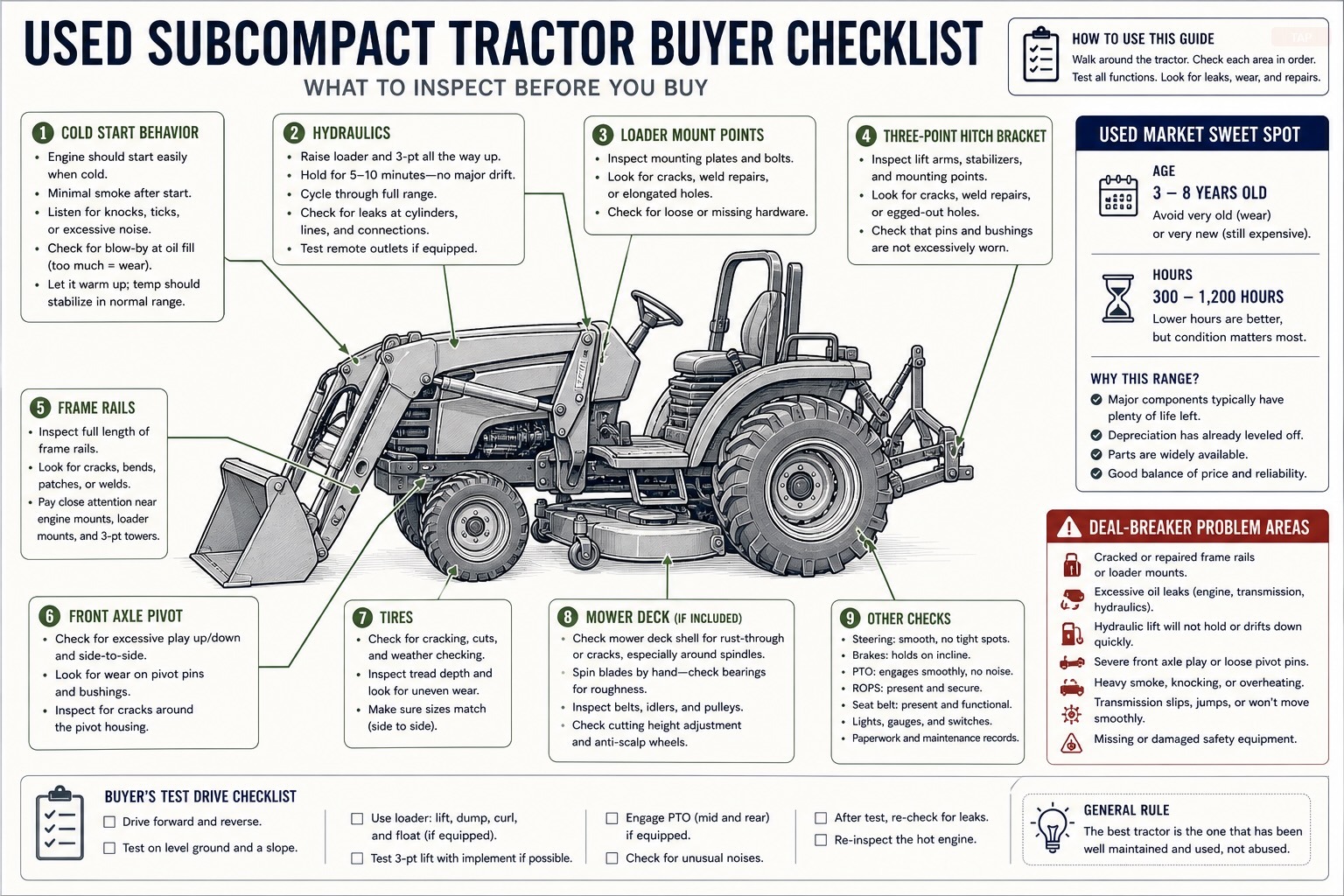
Used subcompact tractors represent one of the better values in the used equipment market. A 2–4 year old Kubota BX or John Deere 1 Series with a loader, mid-mount mower deck, and under 400 hours sells for 60–75% of new retail — absorbing the steepest part of the depreciation curve while retaining most of the useful service life. For a property owner running 50–100 hours per year, that machine has 30–50 years of economic life remaining.
The risks are real but manageable: a deferred maintenance machine with worn hydrostatic transmission, leaking hydraulics, or a cracked loader frame can turn a good deal into an expensive repair. This guide covers where to find used subcompact tractors, how to evaluate them before purchase, what prices to expect, and which years and configurations to avoid.
Depreciation Benchmarks
Per Iron Solutions agricultural equipment market data, subcompact tractor depreciation follows a consistent curve regardless of brand:
| Age | Typical Resale (% of new retail) |
|---|---|
| 1 year | 75–85% |
| 2–3 years | 65–75% |
| 4–5 years | 55–65% |
| 6–10 years | 45–55% |
| 10+ years | 35–45% (condition-dependent) |
Brand affects the floor, not the curve. Kubota BX and John Deere 1 Series hold their value 5–10 percentage points better than comparable machines from Mahindra, LS, or Kioti because of parts availability, dealer network density, and recognized resale demand. A 5-year-old Kubota BX2380 with loader is easier to resell than an equivalent Mahindra eMax — which matters if the machine is eventually replaced.
What drives used price more than age:
- Loader included (adds $2,000–$4,000 to value, even used)
- Mid-mount mower deck included (adds $1,500–$2,500)
- Hours (under 500 is the sweet spot; over 1,000 requires negotiation leverage)
- Condition of hydrostatic transmission (the single most expensive repair)
- Presence of service records
Where to Find Inventory
Dealer used lots — Kubota, John Deere, AGCO, and Kioti dealers take in trade-ins regularly. These machines are typically inspected, serviced, and offered with 30–90 day powertrain warranties. Prices run 10–15% above auction or private sale but include the lowest risk. Ask specifically: “What was done at trade-in inspection and do you have service records?”
Equipment auctions — Purple Wave, Ritchie Bros., and IronPlanet list subcompact tractors regularly. Online auctions allow inspection of photos and listed hours but not in-person evaluation before bidding. Reserve pricing often starts low. Best for buyers who know exactly what to look for and can accept a no-warranty transaction. Budget $200–$400 to transport from a remote auction lot.
Private sales — Craigslist, Facebook Marketplace, and local farm classified publications. The widest price range (great deals and overpriced machines exist side by side), full inspection opportunity, and maximum negotiation flexibility. Estate sales often surface well-maintained low-hour machines at below-market prices from sellers who need to liquidate rather than maximize value.
NADA and market reference — NADA Guides (Outdoor Power Equipment section) and Iron Solutions provide regional resale value benchmarks. Cross-reference any asking price against the NADA “Average Retail” value for the specific year, model, and configuration before negotiating.
eBay completed listings are the most useful free pricing tool available. Set the search filter to “Sold Items” to see actual transaction prices, not asking prices. The gap between asking and selling price on eBay often reveals whether a local seller is priced fairly.
Search eBay — used Kubota BX subcompact tractors → Search eBay — used John Deere 1025R →
Current Market Prices by Model (2026)
Based on eBay completed listings and TractorHouse auction data:
| Model | New Price | Used (3–5 yr, ~400 hrs) |
|---|---|---|
| Kubota BX2380 | $16,000–$20,000 | $10,000–$13,500 |
| Kubota BX23S (with backhoe) | $21,000–$26,000 | $14,000–$19,000 |
| John Deere 1025R | $16,000–$20,000 | $10,500–$14,000 |
| John Deere 1023E | $14,000–$17,000 | $8,500–$12,000 |
| Mahindra eMax 22S | $12,000–$15,000 | $7,000–$10,000 |
Pre-Purchase Inspection Checklist
Walk through this sequence before committing to any used subcompact tractor purchase. Items flagged as “walk away” indicate conditions where repair cost likely exceeds the discount.
Engine
- Cold start: Start the engine cold. Excessive smoke (blue = oil burning, white = coolant, black = rich mixture) on a cold start that clears after warmup is acceptable. Smoke that persists after 5 minutes warrants investigation.
- Oil: Pull the dipstick. Milky or gray oil indicates coolant contamination — likely head gasket failure. Walk away.
- Coolant: Check the overflow reservoir. Brown or rusty coolant indicates a neglected cooling system. Pressure test the cooling system if the machine has over 800 hours.
- Air filter: A heavily loaded or torn air filter indicates deferred maintenance throughout the machine.
Hydrostatic Transmission
The HST is the most expensive repair on a subcompact tractor. Per manufacturer service data, a hydrostatic rebuild on a Kubota BX or John Deere 1 Series runs $1,500–$3,000 in parts and labor.
- Engage the HST in forward, then neutral, then reverse. Transitions should be smooth with no hesitation, jerking, or grinding.
- Drive uphill in high range. The machine should maintain constant speed without hunting or surging. Hunting at load indicates a worn HST charge pump.
- Check HST fluid (separate reservoir from engine oil on most models). Dark brown or black fluid indicates high heat cycles and potential wear. Fresh fluid should be amber-to-red.
- Walk away if: The machine bucks, surges, or loses forward drive when the HST is warm.
Hydraulics
- Raise the loader to full height and hold it there for 5 minutes with the engine off. Any visible drop in loader height indicates internal hydraulic cylinder seal leakage.
- Check under the machine for hydraulic fluid on the frame rails, 3-point hitch arms, and rear axle housing. Minor seeping at hose fittings is acceptable; active dripping is not.
- Operate all hydraulic functions (loader curl, loader lift, 3-point up/down) at full cycle. Functions should be smooth and full-speed. Slow or jerky operation indicates low fluid, air in the system, or pump wear.
Loader
- Inspect all pivot pins and bushings. Grab the loader bucket and push/pull laterally — more than 1/4 inch of play at any pivot indicates worn pins that need replacement ($50–$200 per pin set, but requires shop time).
- Check loader frame welds for cracks, especially at the A-frame mounting points where the loader attaches to the tractor frame. Cracks indicate overloading or collision damage. Walk away from cracked loader frames — weld repair on structural loader components is unreliable.
- Verify the quick-attach coupler (if equipped) locks and unlocks cleanly. Bent or binding couplers indicate bucket overloading.
Tires and Rims
- Rear tires on a subcompact tractor are typically R1 (ag lug), R3 (turf), or R4 (industrial). Verify the tire type matches your intended use — switching from R1 to R3 or vice versa costs $400–$800 for a set.
- Check sidewall cracking. Ozone-cracked sidewalls on tires that otherwise have tread remaining indicate UV and age degradation. A tire with good tread depth but cracked sidewalls may fail under load. Budget $150–$250 per rear tire for replacement.
- Inspect rims for rust-through or weld repairs at the rim bead seat.
PTO
- Engage the rear PTO (and mid-mount PTO if equipped). It should engage smoothly within 1–2 seconds with no chattering or grinding. A chattering PTO clutch is a $300–$800 repair.
- Check for oil weeping around the PTO seal at the rear of the transmission housing.
Hours vs. Condition Mismatch
Low-hour machines in poor condition indicate either infrequent use with deferred maintenance (storage damage, degraded fluids, dried seals) or an odometer discrepancy. High-hour machines in excellent condition indicate regular use with attentive maintenance — often the better buy. Trust condition over hours when the two tell different stories.
Negotiating on Price
Deduct for documented needed work at 1.25–1.5x repair cost. If the machine needs tires ($600–$1,200 for a set), a deck rebuild ($400–$800), or a hydraulic service ($200–$400), price that into your offer with a buffer. You’re buying the repair risk, not just the repair cost.
Use eBay sold listings as a factual anchor. “This model in similar condition sold for $X on eBay last month” is harder for a seller to dismiss than a general negotiation. Screenshot the comparable listing before the conversation.
Attachments add value above their individual cost. A BX23S with the factory backhoe is worth more than tractor value plus backhoe value separately — because factory mounting brackets are model-specific and difficult to source used. Pay a modest premium for factory-matched attachment sets rather than patched-together combinations.
Hours matter less than condition on low-hour machines. A 200-hour machine stored outside for 3 years with degraded fluids and cracked tires may be a worse buy than an 800-hour machine with current service records and a freshly rebuilt deck. If hours and condition tell different stories, trust condition.
Which Years and Configurations to Prioritize
Kubota BX Series (2014–present): The BX80 series (BX1880, BX2380, BX2680) introduced in 2014 is the benchmark for reliability in the category. Parts are interchangeable across the series and widely stocked. Avoid BX25D machines (2011–2014) — the diesel particulate filter added in that generation created maintenance problems that were resolved in the BX80 refresh.
John Deere 1 Series (2013–present): The 1023E and 1025R are the most common used examples. The 1025R added a mid-mount mower connection and slightly more hydraulic capacity. Both are solid machines. Avoid 1 Series machines with over 800 hours that lack service records — John Deere hydrostatic transmissions require fluid changes at specified intervals, and skipped service reduces transmission life.
Avoid: Any machine that has been used commercially (landscaping companies, golf courses, rental fleets). Commercial-use machines accumulate hours faster and are operated by non-owner operators who may not report damage or maintenance issues. Ask specifically: “Was this used commercially or on a private property?”
Who This Is NOT For
- Anyone expecting to run heavy implements. Subcompact tractors (15–25 HP) are property maintenance machines, not production agriculture equipment. A used subcompact tractor cannot power a 5-foot finishing mower reliably, pull a full-size disc, or operate a large hay rake. See the compact tractor guide for 25–50 HP options suited to implement work, and how to match implements to your compact tractor for sizing any implement to a machine’s actual PTO and lift capacity.
- Buyers who need immediate productivity. A used machine purchase can take 2–6 weeks from inspection to closing (especially at auction). If the machine is needed for a specific season’s work starting in 30 days, a dealer new purchase with immediate delivery may be more practical than the used market.
- Buyers without mechanical aptitude or a local shop. Used equipment requires an owner who can perform basic maintenance (oil changes, filter replacement, fluid checks) and recognize when professional service is needed. An owner who cannot inspect a dipstick or identify a hydraulic leak will struggle with used equipment ownership.
Related Guides
- Best Subcompact Tractors for Small Acreage — new model comparison for the Kubota BX, John Deere 1 Series, and alternatives
- Best Compact Tractors for Small Farms — 25–50 HP range for more serious implement work
- Best Bobcat Subcompact Tractors — CT series models and dealer-network trade-offs to weigh when shopping used
- Best Box Blades — the first implement most subcompact tractor owners add
- Best Post Hole Diggers for Small Farms — PTO-driven post hole diggers compatible with subcompact tractors
Sources
- Kubota BX Series service manuals and technical service bulletins (kubotausa.com)
- John Deere 1 Series technical service information (deere.com)
- NADA Guides — Outdoor Power Equipment valuations (nadaguides.com)
- Iron Solutions — Agricultural equipment market data and residual value analysis
- USDA NASS — Farm equipment ownership and capital expenditure data