Used Cattle Chutes for Sale: What to Inspect, What to Pay, and Which Brands Hold Value
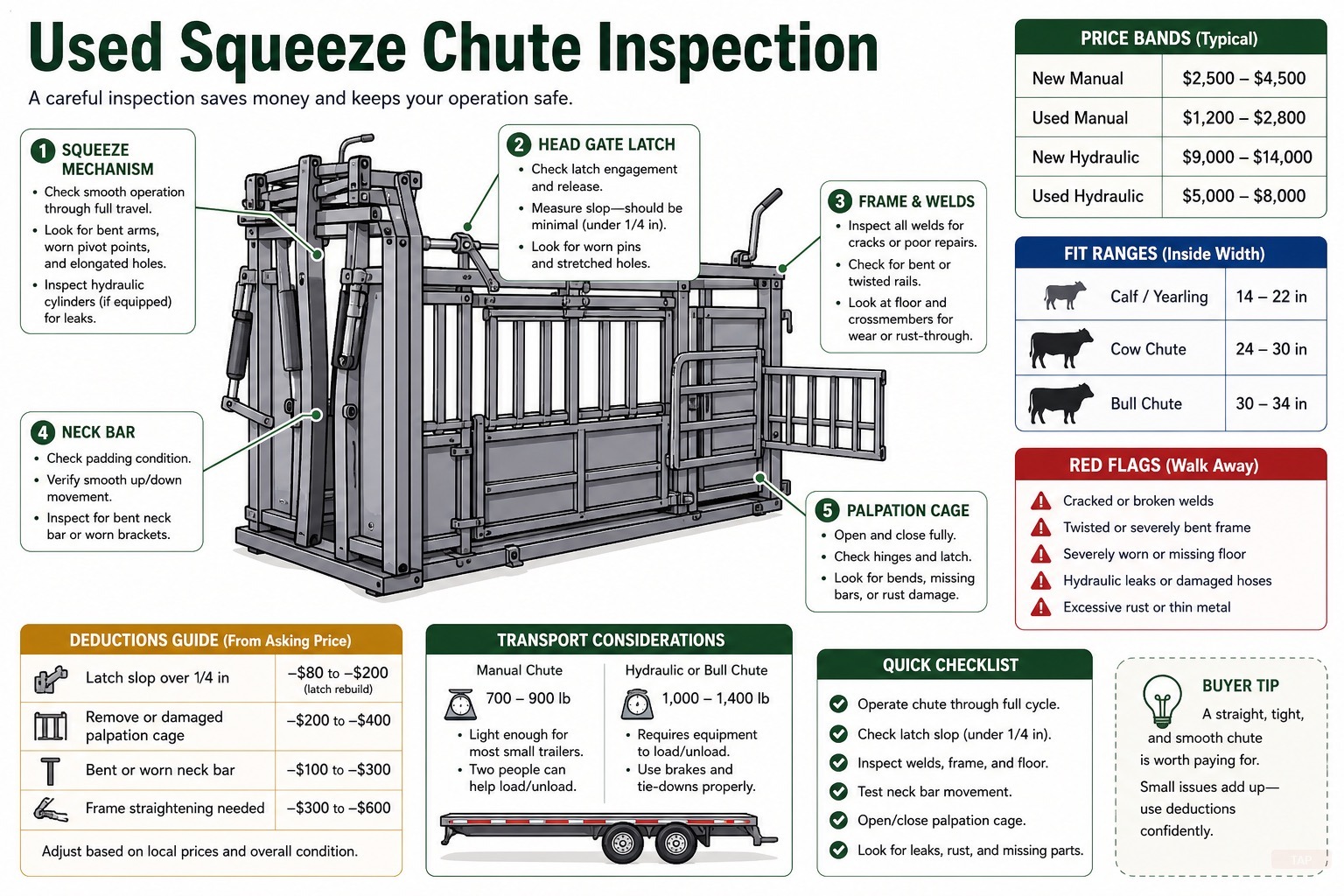
A used squeeze chute is one of the better capital purchases on a small-to-mid cow-calf operation. Steel chutes from Powder River, Priefert, WW Livestock Systems, and For-Most are mechanically simple, visually inspectable, and built from materials that hold up for decades when the head gate latch and squeeze pivots are maintained. A new manual squeeze chute runs $2,500-$4,500; the same chute used and in working condition typically trades at $1,200-$2,800. A new hydraulic chute that retails at $9,000-$14,000 is often available used for $5,000-$8,000.
This guide covers capacity tiers, manual vs. hydraulic squeeze tradeoffs, brand-by-brand resale value retention, what to inspect before buying, fair price ranges, where inventory turns up, and what it costs to move a chute home. For new chute comparisons and full specs, see our best cattle chutes guide.
Capacity Tiers: Match the Chute to the Animal
Not every used chute fits every herd. Per manufacturer specifications, squeeze chutes are built around three working width ranges:
Calf and yearling chutes (14-22 inch working width). Designed for animals under approximately 800 lbs. These show up in dairy and seedstock operations and are too narrow for mature cows. Powder River and For-Most both build dedicated calf chutes; Priefert offers calf-specific cradles. Useful only if calf-specific work (dehorning, banding, vaccination) is a frequent task.
Cow-capacity chutes (24-30 inch working width). The most common configuration. Per Powder River’s product data, the 2000 Series and similar mid-line chutes from Priefert (Model 91 series) and WW Livestock Systems open to roughly 28 inches and squeeze down to 14-16 inches. This range covers commercial cows, most heifers, and moderate-frame bulls. The vast majority of used inventory falls into this tier.
Bull and large-frame chutes (30-34 inch working width). Per Priefert and Powder River documentation, heavy bull chutes feature reinforced frames, larger pivot pins, and wider working widths to accommodate mature beef bulls (1,800-2,400 lbs). Frame steel is typically heavier-gauge rectangular tubing. Used examples carry a premium because the supply is thinner.
Buyers running a mixed herd of cows and a single mature bull are usually better served by a cow-capacity chute with adequate maximum width than by a bull chute that is overbuilt for routine cow work.
Manual Squeeze vs. Hydraulic Squeeze on the Used Market
Manual squeeze chutes use lever, ratchet, or rope-and-pulley mechanisms to close the side panels. Per manufacturer documentation, manual chutes from Powder River, Priefert, and WW Livestock are designed to be operated by a single person with reasonable physical strength. The mechanical simplicity is the durability advantage: there is no hydraulic pump, hose, cylinder, or electrical control to fail. Used manual chutes 15-25 years old often work as well as the day they were built provided the pivot pins and latches have been maintained. Fair used pricing: $1,200-$2,800 for cow-capacity, $2,500-$4,500 for bull-capacity.
Hydraulic squeeze chutes use a 12V or PTO-driven hydraulic pump to operate the squeeze, head gate, neck extender, and side exit. Per Powder River and Priefert specifications, hydraulic operation reduces the physical effort of working 50+ head per session and allows finer pressure control on flighty animals. The tradeoff on the used market is mechanical complexity: hydraulic pumps fail, hoses leak, cylinders develop seal wear, and 12V systems suffer wiring corrosion in outdoor installations. Fair used pricing: $5,000-$8,000 for a working hydraulic cow-capacity chute; deduct $800-$2,000 for any chute with documented hydraulic issues, because parts and labor for a full hydraulic refresh typically run in that range.
For operations under 50 head, a clean used manual chute is usually the better value. For commercial operations working 100+ head per session multiple times per year, a hydraulic chute earns its complexity back in reduced labor and faster throughput.
Resale Value Retention by Brand
Per dealer reference pricing and active auction data, brand affects used pricing significantly more than age once a chute is past 5 years old. The pattern observed across regional sales:
Powder River (USA, Provo, UT) — best resale value retention. A 10-year-old Powder River 2000 Series in working condition typically sells at 55-70% of current new retail. Per Powder River’s parts documentation, virtually every wear part (head gate latch, squeeze pivot bushing, palpation cage hinge, neck extender bar) is available as a service part directly from the factory. The brand recognition and parts availability create a deep buyer pool on the resale market.
Priefert (USA, Mt. Pleasant, TX) — strong resale, second to Powder River. Priefert’s Model 91, 75, and S0191 chutes are common in cow-calf country, and parts are stocked at most Priefert dealers and through Tractor Supply. Used pricing typically runs 50-65% of new retail. Priefert’s heavier hinged head gate designs hold up well under daily commercial use.
WW Livestock Systems (USA, Thomas, OK) — solid resale, often slightly below Priefert. The Beefmaster squeeze chute is the most common WW found used. Per WW’s product documentation, the brand shares many design features with Priefert but with somewhat lighter frame construction on entry-level models. Used pricing runs 45-60% of new retail.
For-Most (USA, Hawarden, IA) — strong build quality, narrower distribution. For-Most chutes (Model 25, 30, 450) are well-regarded on Plains-state ranches but sell into a smaller market than Powder River or Priefert. Used pricing runs 50-60% of new retail; freight costs from Iowa-area sellers can be material for buyers in the Southeast or West Coast.
Tarter (USA, Dunnville, KY) — lower resale retention. Per Tarter product documentation, the brand uses lighter-gauge frame steel than Powder River, Priefert, or For-Most, and the lower entry-price means used chutes face price competition from new units at Tractor Supply. Used pricing typically runs 40-55% of new retail.
Off-brand and unbranded chutes — heavily discounted on the used market. Steel quality, pivot tolerances, and parts availability are inconsistent. A chute without a manufacturer plate is worth what the steel weighs plus a small premium for working condition; assume parts are not available.
Pre-Purchase Inspection: What to Check
The five components that determine whether a used chute is worth buying are the squeeze mechanism, head gate latch, frame, neck bar, and palpation cage. Everything else is cosmetic.
Squeeze mechanism. Operate the squeeze through its full range. Both side panels should move evenly toward the centerline; uneven travel indicates a worn or bent pivot. Listen for grinding or binding at the pivot points. With the chute empty, the squeeze should hold position when the lever or ratchet is locked. A squeeze that drifts open under no load will not hold an animal under load.
Head gate latch wear. Per Powder River’s parts documentation, the head gate latch is the highest-wear component on a squeeze chute. Inspect the latch pin, the catch dog, and the spring or weight that holds the latch closed. Excessive play (more than 1/4 inch of slop at the latch pin) indicates the latch should be rebuilt before the chute sees animals — a worn latch can release under animal pressure. Replacement latch kits run $80-$200 from the manufacturer.
Frame straightness and weld integrity. Sight down the top rails and bottom rails of the chute from the entrance end. Bowing, twisting, or crab-walking of the frame indicates the chute has been hit by a tractor, dropped during transport, or worked with cattle far above its rated capacity. Inspect every weld at the corner gussets and at the head gate mounting plate. Cracked welds at the head gate mount are a deal-breaker — head gate forces concentrate at this point and a failure here is dangerous.
Neck-bar wear. The neck bar (or scissor bars on V-bar designs) takes constant friction from animals as they enter and exit. Per manufacturer documentation, neck bars are designed to be replaceable. Heavy grooving or gouging is acceptable as long as the bar is straight; a bent neck bar should be replaced before use ($60-$180 from the manufacturer).
Palpation cage hinges and rear access. Open the palpation cage and check hinge play. The cage should swing cleanly without dragging on the ground or binding at the hinge. Bent hinges typically result from the cage being left open during transport. Side exit doors should latch cleanly and swing without sagging.
Alley and loading chute connection. If the seller offers an alley or sweep tub with the chute, inspect the connection bolts and verify the mating dimensions match. Many used chutes are sold as part of a working facility liquidation; the alley and tub may be worth as much as the chute itself.
Fair Price Ranges by Capacity and Condition
Based on dealer reference pricing and 2026 regional auction data:
| Configuration | Condition | Price Range |
|---|---|---|
| Manual cow chute (Tarter, off-brand) | Working, used | $700-$1,400 |
| Manual cow chute (WW Livestock) | Working, used | $1,200-$2,200 |
| Manual cow chute (Priefert, For-Most) | Working, used | $1,500-$2,500 |
| Manual cow chute (Powder River 2000 series) | Working, used | $1,800-$2,800 |
| Manual bull chute (Powder River, Priefert) | Working, used | $2,500-$4,500 |
| Hydraulic chute (any major brand) | Working, hydraulics verified | $5,000-$8,000 |
| Hydraulic chute (any major brand) | Hydraulic issues | $3,000-$5,000 |
Deduct $200-$400 for a missing palpation cage, $100-$300 for a missing or bent neck bar, $150-$400 for a head gate latch rebuild, and $300-$600 for any frame straightening. A chute requiring multiple repairs is rarely a deal once total cost is calculated.
Search used cattle chutes on eBay →
Where Used Cattle Chutes Show Up
Farm and ranch auctions — the largest source of used chutes, especially in the spring and fall when retiring operators disperse equipment. Auction services like Purple Wave, BigIron, and regional auction houses list squeeze chutes in their farm equipment sales. Prices are competitive but inspection windows are short; arrive early.
Livestock equipment dealers — many regional dealers take used chutes on trade or consign them. Prices are higher than auction (10-20% premium) but the chute has typically been inspected, and dealers often offer a short-term parts warranty. Best for first-time buyers without inspection experience.
Craigslist and Facebook Marketplace — wide price range. The best deals come from estate sales and downsizing operators who price by what the chute owes them rather than current market. Worst deals come from sellers who have priced their used chute at near-new retail. Always verify the asking price against the table above before driving to inspect.
Ranch dispersals — when a multi-generation ranch is sold or liquidated, the entire handling facility (chute, alley, sweep tub, loading chute) often sells as a package. These sales offer the best opportunity to buy a complete working system rather than assembling components piece by piece.
Transport Considerations
A manual cow-capacity squeeze chute weighs 700-900 lbs; a hydraulic or bull-capacity chute weighs 1,000-1,400 lbs. Transport options:
Gooseneck or bumper-pull stock trailer — the simplest option for chutes under 1,000 lbs if the chute will fit through the trailer’s swing or slider gate. Verify dimensions before driving to pick it up; some chutes do not fit standard 6-foot-wide trailer gates without removing the palpation cage.
Flatbed trailer with ramps — necessary for chutes over 1,000 lbs or chutes that exceed stock trailer gate dimensions. Budget for tie-down straps rated for the chute’s weight; a chute that shifts in transit can damage the trailer or the chute.
Hot-shot or freight delivery — for cross-state moves, an LTL freight quote typically runs $300-$700 depending on distance and chute weight. Get the chute palletized and strapped before pickup; LTL carriers will not handle a loose chute.
For comparison shopping, see our used subcompact tractor buying guide — the inspection logic for pivots, frames, and hydraulics translates directly.
Who This Is NOT For
- Operators with fewer than 5 head. A used squeeze chute represents a minimum $1,500-$2,000 commitment when transport, accessories, and a head-gate latch rebuild are included. Hobby operators with very small herds typically get better value from a head gate mounted to a sturdy panel arrangement and halter-trained animals. See the best cattle chutes guide if a full chute is genuinely required.
- Buyers without an existing handling facility. A squeeze chute is one component of a working system that requires an alley, sweep tub or Bud Box, and adequate fencing. Used chutes purchased without a place to install them often sit unused for months while the facility is built; in the meantime, exposure to rain accelerates wear on pivots and latches.
- Anyone planning to work cattle alone for the first time. Operating a squeeze chute safely with live animals requires familiarity with low-stress handling and chute mechanics. New operators should work cattle alongside an experienced handler before committing capital to a chute.
Related Guides
- Best Cattle Chutes for Small Farm Operations — new chute comparison across WW, Tarter, Hi-Qual, and Powder River
- Best Livestock Scales — pairing a scale with the chute for full-cycle weighing and treatment dosing
- Best Electric Fence Chargers — perimeter and rotational fencing supporting a working facility
- Best Side-by-Sides for Farm Use — UTV options for moving equipment around the working alley
- Used Subcompact Tractor Buying Guide — same inspection discipline applied to small tractors
Sources
- Powder River Incorporated product specifications and parts documentation (powderriver.com)
- Priefert Manufacturing squeeze chute product data (priefert.com)
- WW Livestock Systems product documentation (wwlivestocksystems.com)
- For-Most Manufacturing chute specifications (for-most.net)
- Tarter Farm & Ranch product documentation (tarterusa.com)
- USDA APHIS — Cattle Handling and Facilities Guidelines
- Purple Wave and BigIron auction sale records — farm equipment results, 2025-2026