Best Electric Fence Charger 2026: Gallagher M1200i (12 Joules, 150 Miles) + AC, Solar, Battery Picks
Electric fence chargers (also called energizers) deliver pulsed voltage through fence wire to deter livestock from pushing through. The charger is the single most important component in any electric fence system — an undersized energizer produces a weak pulse that animals learn to ignore, while an oversized one wastes electricity and money. Selecting the right charger means matching joule output, power source, and pulse characteristics to your fence length, vegetation load, and livestock type.
Understanding Electric Fence Charger Specifications
Before comparing specific models, it helps to understand what the key specifications actually mean and which ones matter most.
Joules: Stored vs. Delivered
Joule ratings measure the energy in each pulse. Manufacturers report two figures:
- Stored joules: Total energy the capacitor stores before each pulse. This is the larger number and what most marketing materials emphasize.
- Delivered joules (also called output joules): Energy actually delivered to the fence wire. This is the number that determines animal deterrence. According to manufacturer data, delivered joules are typically 30-60% of stored joules depending on charger efficiency.
When comparing chargers, prioritize delivered joules over stored joules. A charger rated at 6 stored joules and 3.5 delivered joules is more effective than one rated at 8 stored joules but only 2.5 delivered.
Miles of Fence Rating
Manufacturers rate chargers for a maximum fence distance, but these ratings assume ideal conditions — clean wire, no vegetation contact, and low-resistance connections. According to industry guidance, real-world fence capacity is typically 50-70% of the manufacturer’s clean-fence rating once you account for:
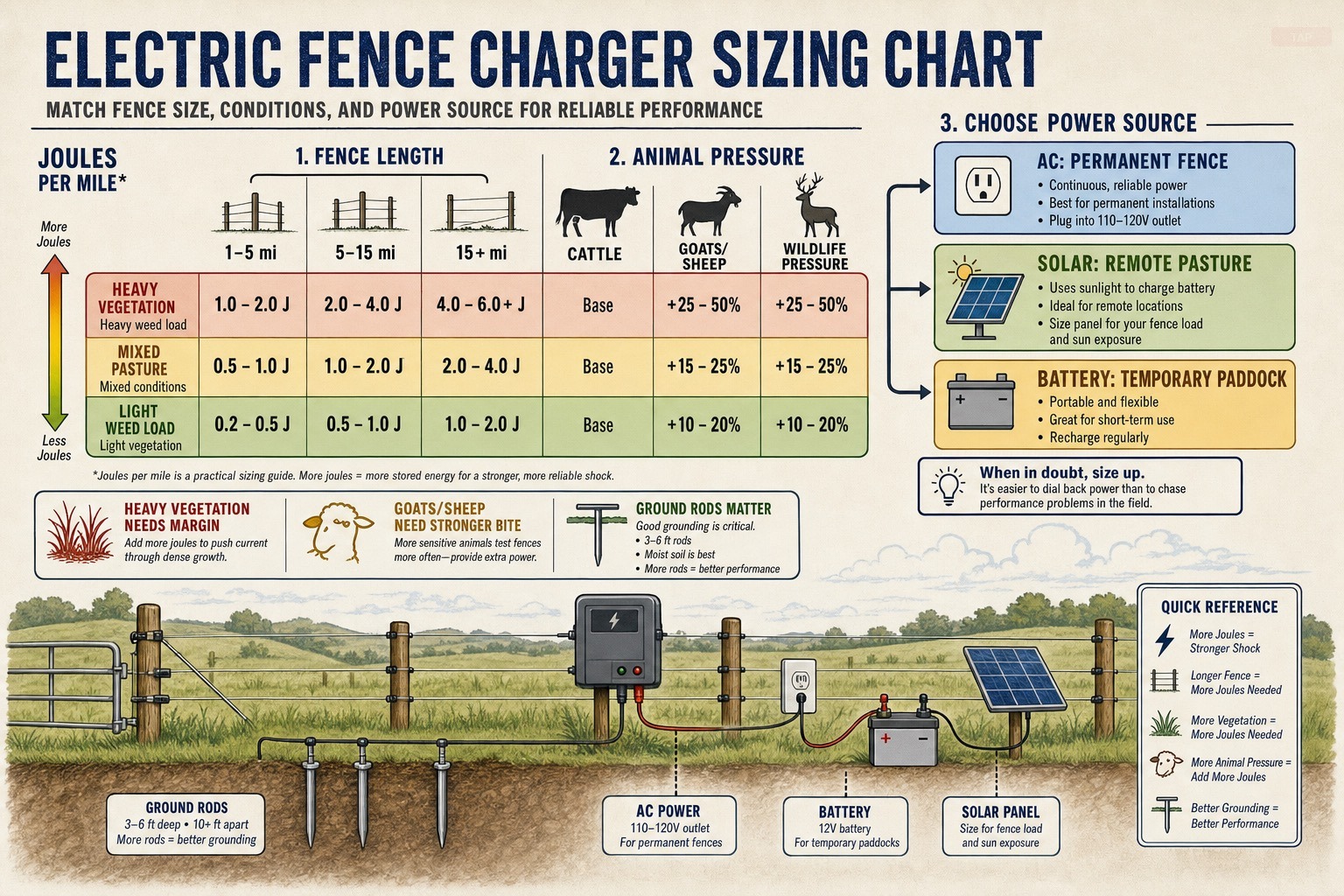
- Vegetation load: Grass, weeds, and vines touching the wire drain energy from every pulse. Heavy vegetation can reduce effective range by 50% or more.
- Wire type: High-tensile steel wire carries current farther than polywire or polytape. Aluminum wire falls in between.
- Number of strands: Multi-strand fences divide the charger’s output across each electrified wire.
- Soil conditions: Dry, sandy, or frozen soil increases grounding resistance, reducing shock effectiveness regardless of charger power.
A practical rule: size your charger for twice the fence distance you actually need. This provides headroom for vegetation growth and degraded connections.
Livestock Requirements
Different animals require different pulse intensities. Per manufacturer guidelines across the category:
| Livestock | Minimum Delivered Joules | Notes |
|---|---|---|
| Cattle | 1.0+ joules | Thick hide requires strong pulse; calves are more responsive |
| Horses | 0.5+ joules | Sensitive to shock; lower joule chargers are effective |
| Goats / Sheep | 1.0+ joules | Wool and hair insulate; need stronger pulse than size suggests |
| Hogs | 1.0+ joules | Tough hide, strong motivation to root; need reliable deterrence |
| Poultry | 0.25+ joules | Netting systems with dedicated low-impedance chargers preferred |
| Predator control | 1.0+ joules | Coyotes, dogs, bears require strong, consistent pulse |
Joule Output Tiers: Matching Charger Class to Fence Load
Most charger marketing collapses joule output into a single “miles of fence” figure, but the reality is that charger class — not just raw joules — determines whether a fence holds livestock. Per Gallagher, Stafix, and Premier 1 technical literature, electric fence energizers fall into four practical tiers.
Tier 1: Sub-1 Joule Solid-State (0.25-0.75J Delivered)
Solid-state chargers in this range use a transformer-and-capacitor design without a thyristor (SCR) switching circuit. According to manufacturer documentation, solid-state units produce a longer-duration but lower-amperage pulse than low-impedance designs. They short out quickly under vegetation contact.
- Use case: Small permanent paddocks under 5 acres, poultry netting, garden perimeter, training pens with clean wire
- Livestock: Horses, sheep, goats on short, well-maintained runs
- Examples: Patriot PE2, Zareba 5-mile solid-state, small Premier 1 IntelliShock
- Avoid for: Cattle, hogs, predator control, weedy fence lines
Tier 2: 1-3 Joule Low-Impedance (0.5-1.5J Delivered)
True low-impedance chargers use SCR switching to deliver a high-amperage, short-duration pulse that punches through moderate vegetation. According to Parmak and Gallagher data, this is the entry point for serious livestock containment.
- Use case: 5-25 acre operations, single-strand polywire perimeter, mixed livestock on managed pasture
- Livestock: Cattle on clean wire, horses, goats, sheep, mixed small livestock
- Examples: Parmak Magnum 12 (1.95J stored / 0.7J delivered), Gallagher S100, Patriot P10
- Avoid for: Heavy brush, predator-class loads, multi-strand high-tensile over 20 miles
Tier 3: 3-8 Joule Low-Impedance (1.5-4J Delivered)
Mid-power low-impedance chargers deliver enough energy to maintain effective voltage on weedy fences and multi-strand systems. Per Gallagher M-series and Stafix X-series specs, this tier is the workhorse of commercial livestock operations.
- Use case: 25-100 acre rotational grazing, multi-paddock systems, heavy vegetation regions, predator deterrence
- Livestock: Cattle herds, hogs, goats on brush, predator-class fencing for sheep
- Examples: Zareba EAC200M-Z (20J stored / 6.4J delivered), Gallagher M1200i (12J/7.2J), Stafix X6
- Avoid for: Operations under 10 acres (overpowered, wastes capital)
Tier 4: 15J+ Stored (6J+ Delivered, Commercial-Class)
Commercial-class energizers like the Gallagher MB1800i, Stafix X18, and Speedrite 18000i deliver enough energy for industrial-scale operations. Per manufacturer guidance, these are sized for 100+ miles of multi-strand high-tensile across hundreds of acres.
- Use case: 100+ acre ranches, predator-class sheep operations, regional cattle ranches with brushy sections
- Livestock: Large cattle herds, predator exclusion (bears, big cats), bull paddocks
- Examples: Gallagher MB1800i (18J stored), Stafix X18, Speedrite 18000i
- Avoid for: Anything under 50 acres — gross overkill and a lightning magnet
Distance and Acreage Matrix
The “miles of fence” rating on a charger box is calculated for clean single-strand wire with zero vegetation. Real-world capacity collapses fast under multi-strand and brush load. Per Premier 1 and Gallagher field guides, here is what each tier actually handles in real conditions.
| Property Size | Single-Strand Clean | Single-Strand Brushy | Multi-Strand (3-5 wire) | Predator-Class (5-7 wire) |
|---|---|---|---|---|
| 5 acres | Tier 1 (0.5J) | Tier 2 (1J) | Tier 2 (1-2J) | Tier 3 (3J) |
| 20 acres | Tier 2 (1J) | Tier 2-3 (2-3J) | Tier 3 (3-5J) | Tier 3 (5-6J) |
| 50 acres | Tier 2-3 (2-3J) | Tier 3 (4-6J) | Tier 3 (6J) | Tier 3-4 (6-10J) |
| 100 acres | Tier 3 (5-6J) | Tier 3 (6-8J) | Tier 3-4 (8-12J) | Tier 4 (12J+) |
| 200+ acres | Tier 3 (6-8J) | Tier 4 (10-15J) | Tier 4 (15J+) | Tier 4 (18J+) |
The joule-per-mile rule of thumb: For multi-strand high-tensile in moderate vegetation, plan on roughly 0.1-0.15 delivered joules per mile of total wire (miles of fence × number of strands). A 40-acre square pasture with a five-strand perimeter is roughly 1 mile of fence × 5 strands = 5 wire-miles, requiring 0.5-0.75 delivered joules minimum — and double that for headroom.
AC vs Solar vs Battery: Decision Framework
Power source selection is usually constrained by site logistics, not preference. Per manufacturer installation guides, the decision tree runs as follows.
Choose AC (120V plug-in) when:
- An outlet exists within 100 feet of a sheltered mounting location
- The fence is permanent and the charger location is not changing seasonally
- You need Tier 3 or Tier 4 output (battery and integrated-solar units rarely exceed 2J delivered)
- Lightning protection infrastructure (diverter, dedicated ground field) is feasible
AC chargers deliver 5-10x the joules per dollar of comparable battery units. According to Zareba and Gallagher specs, an AC unit at $200 typically delivers 4-7J, while a $200 solar-integrated unit delivers 0.5-1J.
Choose 12V battery + separate solar panel when:
- The fence is over 200 feet from any AC outlet
- You need Tier 2 output (1-2J delivered) on remote pasture
- You are willing to maintain a deep-cycle battery and solar charge controller
- Operating temperature swings are moderate (battery capacity drops below 20 F)
Per Parmak documentation, a 12V deep-cycle setup with a 20-25W solar panel runs a Magnum-class charger indefinitely with no battery swaps in most climates.
Choose integrated solar (all-in-one unit) when:
- The fence is short (under 10 effective miles), remote, and rarely visited
- Self-contained operation outweighs raw output
- Theft and vandalism risk is low (integrated units are easy to walk off with)
- You accept Tier 1 output (0.25-0.75J delivered)
Choose battery-only (no solar) when:
- The fence is strictly temporary (strip grazing within a permanent perimeter, weeks not months)
- You can rotate batteries to a charging station weekly
- A dedicated 12V deep-cycle is already in service for other equipment
Top Electric Fence Chargers
Gallagher M1200i — Best Overall for Serious Livestock Operations
| Specification | Value |
|---|---|
| Power Source | AC (120V plug-in) |
| Stored Joules | 12.0 |
| Delivered Joules | 7.2 |
| Miles of Fence | Up to 150 miles (clean wire) |
| Suitable Livestock | Cattle, horses, goats, hogs, predator control |
| Low-Impedance | Yes |
| Lightning Protection | Built-in (Gallagher claims 1,000+ joule surge rating) |
| Warranty | 3-year full replacement |
| Price Range | $300-$400 |
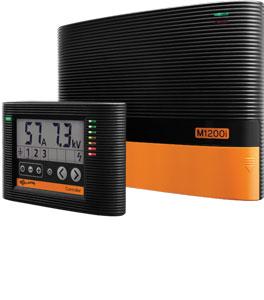
According to Gallagher’s specifications, the M1200i is their mid-range professional energizer designed for multi-paddock rotational grazing systems. The i-Series features Gallagher’s patented pulse technology that adjusts energy output based on fence load — reducing power consumption when the fence is clean and increasing output when vegetation contact is detected. Per Gallagher’s product data, the unit draws approximately 35 watts under normal load.
The M1200i includes a built-in lightning diverter and a digital display showing fence voltage, current draw, and fault indicators. The voltage indicator is particularly useful for diagnosing shorts and grounding problems without a separate fault finder.
Best for: Operations running 10+ miles of fence or managing rotational grazing across multiple paddocks. The adaptive pulse technology and diagnostic display justify the premium for operators who depend on fence reliability. If you are running livestock across larger acreage accessible by side-by-side or UTV, the M1200i provides enough power to fence entire properties from a single unit.
Zareba EAC200M-Z — Best Mid-Range AC Charger
| Specification | Value |
|---|---|
| Power Source | AC (120V plug-in) |
| Stored Joules | 20.0 |
| Delivered Joules | 6.4 |
| Miles of Fence | Up to 200 miles (clean wire) |
| Suitable Livestock | Cattle, horses, goats, hogs |
| Low-Impedance | Yes |
| Lightning Protection | Built-in MOV protection |
| Warranty | 2-year limited |
| Price Range | $150-$200 |
Per Zareba’s product documentation, the EAC200M-Z is a low-impedance AC energizer with 20 stored joules and 6.4 delivered joules. The high stored-to-delivered ratio (32%) is worth noting — while the stored joule figure looks impressive at 20J, the delivered output of 6.4J is what the fence wire actually receives. That said, 6.4 delivered joules is still substantial and sufficient for most livestock operations.
According to manufacturer specs, the unit features a weather-resistant case rated for outdoor installation, though Zareba recommends sheltered mounting when possible to extend electronics life. The charger includes a fence status indicator light and an audible pulse click.
Best for: Operators wanting strong output at a moderate price point. The Zareba delivers solid performance for cattle and mixed livestock operations without the premium pricing of the Gallagher i-Series. A strong choice for permanent fence installations up to 50-75 miles of actual fenced distance (accounting for vegetation load).
Parmak Magnum 12 MAG12-UO — Best Battery/Solar-Capable Charger
| Specification | Value |
|---|---|
| Power Source | 12V DC battery (solar panel compatible) |
| Stored Joules | 1.95 |
| Delivered Joules | 0.7 |
| Miles of Fence | Up to 30 miles (clean wire) |
| Suitable Livestock | Cattle, horses, goats |
| Low-Impedance | Yes |
| Lightning Protection | Built-in spark gap protector |
| Warranty | 3-year full replacement (Made in USA) |
| Price Range | $100-$150 |
According to Parmak’s specifications, the Magnum 12 runs on a standard 12V deep-cycle battery and can be paired with a 10-25 watt solar panel to maintain battery charge indefinitely. Per the product data sheet, the unit draws approximately 120 milliamps, meaning a fully charged 100Ah deep-cycle battery can power the charger for roughly 30+ days without solar replenishment.
Parmak manufactures all their chargers in the United States and backs them with a 3-year full replacement warranty — among the strongest in the category. The MAG12-UO is designed for remote fence lines where AC power is unavailable. The low-impedance design maintains pulse strength even with moderate vegetation contact.
Best for: Remote pastures and fence lines without access to AC power. The solar compatibility makes this charger effectively grid-independent. Operators fencing remote sections of property — particularly those who use compact tractors to maintain fence lines across larger acreage — benefit from not needing to run extension cords or install electrical service.
Patriot PE10B — Best Budget Battery-Powered Charger
| Specification | Value |
|---|---|
| Power Source | 12V DC battery |
| Stored Joules | 1.0 |
| Delivered Joules | 0.35 |
| Miles of Fence | Up to 10 miles (clean wire) |
| Suitable Livestock | Cattle, horses, goats (short runs) |
| Low-Impedance | Yes |
| Lightning Protection | Basic internal protection |
| Warranty | 2-year limited |
| Price Range | $50-$80 |
Per Patriot’s product specifications, the PE10B is an entry-level battery-powered energizer designed for small fence systems. The 0.35 delivered joules is adequate for short fence runs with minimal vegetation, but this charger reaches its limits quickly on longer runs or in weedy conditions.
According to manufacturer data, the PE10B draws approximately 60 milliamps, allowing extended battery life on a single charge. The unit is compact and lightweight, making it easy to relocate for temporary fencing applications such as rotational grazing within a permanently fenced perimeter.
Best for: Small temporary fence setups, strip grazing within existing perimeters, or operators testing electric fencing before committing to a larger charger. At this price point, the PE10B is an effective way to learn how electric fencing works without a significant investment.
Gallagher S100 — Best Solar-Powered Charger
| Specification | Value |
|---|---|
| Power Source | Integrated solar panel + internal battery |
| Stored Joules | 1.0 |
| Delivered Joules | 0.5 |
| Miles of Fence | Up to 15 miles (clean wire) |
| Suitable Livestock | Cattle, horses, goats, poultry netting |
| Low-Impedance | Yes |
| Lightning Protection | Built-in lightning protection |
| Warranty | 3-year full replacement |
| Price Range | $120-$170 |
According to Gallagher’s specifications, the S100 is a self-contained solar energizer with an integrated solar panel and internal rechargeable battery. Per the product data sheet, the built-in battery stores enough energy for up to 21 days of operation without direct sunlight — providing reliable operation through extended cloudy periods.
The S100 includes Gallagher’s 360-degree mounting system that allows the unit to be angled toward the sun regardless of fence post orientation. The integrated design eliminates the need for separate solar panels, charge controllers, and battery boxes that battery-plus-solar setups require.
Best for: Small to mid-size pastures in remote locations where a fully self-contained, zero-maintenance power source is the priority. The integrated design trades raw power for convenience — operators who need more than 10 miles of effective fence distance in real-world conditions should consider the Parmak Magnum 12 with a separate solar panel instead.
Comparison Summary
| Model | Power Source | Stored J | Delivered J | Miles (Clean) | Price Range | Best For |
|---|---|---|---|---|---|---|
| Gallagher M1200i | AC 120V | 12.0 | 7.2 | 150 | $300-$400 | Multi-paddock, rotational grazing |
| Zareba EAC200M-Z | AC 120V | 20.0 | 6.4 | 200 | $150-$200 | Mid-range permanent fence |
| Parmak MAG12-UO | 12V DC/Solar | 1.95 | 0.7 | 30 | $100-$150 | Remote pastures, off-grid |
| Patriot PE10B | 12V DC | 1.0 | 0.35 | 10 | $50-$80 | Temporary/small fence |
| Gallagher S100 | Solar + Battery | 1.0 | 0.5 | 15 | $120-$170 | Self-contained remote fence |
Grounding: The Most Overlooked Factor
Even the most powerful charger produces a weak shock with poor grounding. The electrical circuit in an electric fence is only complete when an animal touches the wire and the current returns through the soil to the ground rod system. According to manufacturer installation guides across all brands reviewed:
- Install a minimum of three ground rods, each at least 6 feet long, spaced 10 feet apart
- Use galvanized steel rods — copper rods cause electrolysis when connected to galvanized fence wire
- Connect ground rods with continuous insulated lead-out wire (not fence wire) clamped to each rod
- In dry, sandy, or rocky soil, add additional ground rods — up to one rod per joule of output is a common guideline
- Test grounding by shorting the fence to ground with a metal stake 300+ feet from the charger. Voltage at the ground rods should read below 400V on a digital fence tester; above 400V indicates insufficient grounding
Poor grounding is the number one cause of electric fence failure, per manufacturer troubleshooting data. Before blaming the charger, test the ground system.
Who This Is NOT For
- Dry climates with sandy or rocky soil and no irrigation. Electric fence effectiveness drops dramatically when soil resistance is high. In arid regions, consider physical barrier fencing (pipe, woven wire) as the primary containment with electric as a psychological supplement only
- Operations containing livestock known to challenge fences aggressively. Certain individual animals — particularly bulls, boars, and bottle-raised livestock with low fear response — may push through electric fencing regardless of charger power. Physical barriers are the appropriate solution for these animals
- Poultry-only operations using standard wire. Poultry electric fencing works best with specialized electrified netting systems (like Premier 1 PoultryNet), not standard wire-and-post configurations. The chargers listed here can power netting, but the netting itself is the critical component for poultry containment
- Temporary cross-fencing without a perimeter fence. Electric fencing is a psychological barrier, not a physical one. It requires animals to learn respect for the fence before relying on it as sole containment. Always have a physical perimeter fence before introducing interior electric divisions
Installation Considerations
When choosing a charger power source, consider proximity to AC outlets. AC-powered chargers (the Gallagher M1200i and Zareba EAC200M-Z) deliver significantly more joules per dollar but require a 120V outlet within cord reach. Running dedicated electrical service to a fence charger location typically costs $500-$2,000 depending on distance and local electrical codes.
Battery and solar chargers sacrifice raw power for location flexibility. For operators managing remote fence lines from a central barn — especially those using compact tractors or side-by-sides to check fence — a battery charger with solar maintenance can run indefinitely without service visits.
Regardless of power source, always install a lightning diverter (also called a lightning arrestor) where the lead-out wire connects to the fence. Lightning strikes on fence wire are common in rural areas and will destroy unprotected chargers instantly. Most chargers listed here include basic internal protection, but an external diverter ($15-$30) provides additional insurance.
What You’ll Also Need
Electric fence chargers require a complete system of fence wire, posts, insulators, and testing equipment — all bought independently of the charger itself and replaced regularly.
- Electric fence wire — 17-gauge galvanized, 1/4-mile spool — the most-searched fence wire for livestock containment. 17-gauge galvanized is the standard for permanent pasture fencing; 14-gauge for high-tensile. Search: “electric fence wire 17 gauge galvanized,” “galvanized fence wire 1/4 mile spool.” Check price on Amazon →
- Electric fence poly wire / polytape — used for temporary rotational grazing divisions; highly visible to livestock, easy to move and reconfigure. Search: “electric fence polytape,” “poly wire electric fence temporary.” Check price on Amazon →
- T-post insulators — clip-on, 25-pack — plastic clip insulators attach fence wire to T-posts and prevent grounding. Search: “T-post electric fence insulator clip,” “T post insulator 25 pack.” Check price on Amazon →
- Electric fence tester / voltmeter — essential for diagnosing faults; a digital fence voltmeter reads voltage at any point on the line to locate shorts and grounds. Search: “electric fence tester digital,” “fence voltmeter Gallagher.” Check price on Amazon →
- Ground rod kit — 6 ft galvanized, 3-rod set — proper grounding is the most common reason electric fences underperform; the Gallagher rule is 3 feet of ground rod per joule of charger output. Search: “electric fence ground rod kit,” “grounding rod set electric fence 6 ft.” Check price on Amazon →
- Lightning diverter / lightning arrestor for electric fence — a $15–$30 external arrestor on the lead-out wire protects the charger from lightning strikes. Search: “electric fence lightning diverter,” “fence lightning arrestor.” Check price on Amazon →
- Premier 1 PoultryNet electrified netting — for poultry, sheep, and goat containment, electrified netting is a more effective system than wire-and-post. Premier 1’s PoultryNet pairs with any low-impedance charger above 0.25J delivered. Search: “Premier 1 PoultryNet electrified netting,” “electric fence netting sheep goat.” Check price on Amazon →
Sources
- Gallagher M1200i, S100, and MB1800i product specifications (gallagher.com)
- Zareba EAC200M-Z product documentation (zarebasystems.com)
- Parmak Magnum 12 MAG12-UO product data sheet (parmakusa.com)
- Patriot PE10B and PE2 product specifications (patriotchargers.com)
- Premier 1 Supplies IntelliShock and PoultryNet technical guides (premier1supplies.com)
- Stafix X-series energizer product literature (stafix.com)
- University of Missouri Extension — Electric Fencing for Livestock
- Penn State Extension — Pasture Fencing for Livestock
- USDA NRCS Conservation Practice Standard 382 — Fence