Used Surface Grinders: What to Inspect Before You Buy
A used surface grinder is a strong buy only when the spindle and the ways still are. The machines that show up in American toolrooms — Harig 612 and 618, Brown & Sharpe Micromaster, Okamoto ACC-series, Boyar-Schultz — were built to be rebuilt. A quiet spindle and straight ways can outlast the paint. A crashed spindle or galled ways cannot be dressed back into accuracy.
The decision against a new machine is capital and inspection, not nostalgia. A new 6×12 on 115 V, or a new 6×18 with a warranty and a known chuck, is the other path. Those current models, including the correction that Grizzly G0612 is a jointer and that JET does not currently list a JSG-6-9 surface grinder, are on the best surface grinders page.
This guide is the inspection: spindle, ways, crash history, which brands are worth the truck, what to budget, and where the machines actually are. Price bands below are planning ranges. They are not a completed-sale audit and not a guarantee of the next auction.
Why Used Works
The mechanism is simple. A manual surface grinder has a spindle, a table that traverses, and a cross-feed. Older Harig and Brown & Sharpe machines do not depend on a proprietary control. What fails is bearings, ways, and crash damage. Those are visible if you are allowed to run the spindle and move the table.
Service life sits in the spindle and the ways. A bearing set that was oiled and not crashed still has work left in it. Ways that were run dry or hit with a wheel do not. Paint, a new cord, and a wiped-down chuck are cheap. They are also how a tired spindle gets photographed.
Rebuilders still exist for the common brands. Harig, Brown & Sharpe, and Okamoto spindles are a known job at independent shops. That turns “unknown spindle” into a number you can subtract, instead of a surprise after the machine is on your floor. Get the quote before you bid. A planning figure you heard secondhand is not that quote.
A used grinder is still the wrong tool if the job is weld cleanup or bit sharpening. That work belongs on an angle grinder or a bench grinder.
Brands Worth Buying
Harig (USA). The default. The 612 (6×12 table) and 618 (6×18) are the machines most rebuilders have already seen. Manual cross-feed is the common configuration; power cross-feed costs more because it is less common, not because the iron is magically better. A Harig hand-feed specification sheet lists a 1-1/2 HP spindle at 3,450 RPM and an elevating handwheel graduation of 0.0001 in. That graduation is a handwheel mark, not a claim about the used machine in front of you.
Brown & Sharpe (USA). The Micromaster 618 is the heavier American toolroom grinder. Castings are stiffer than a typical Harig, and a clean one is worth a premium. Parts are less common. Pay for condition, not for the name on a crashed base.
Okamoto (Japan). ACC-618 class machines are the import equivalent of a Harig 618: capable when the ways are intact, slower to support because parts usually route through Japanese-source suppliers. A good Okamoto with a documented spindle is a buy. An Okamoto with no paperwork and scored ways is a parts project.
Boyar-Schultz (USA). Common, lighter-duty than Harig or Brown & Sharpe, and usually cheaper. Fine for small toolroom work when the spindle is quiet. Do not pay Harig money for one.
Approach carefully.
- No-name imports from the 1990s and 2000s with no rebuilder who will quote the spindle.
- Any machine with an unknown history plus visible way scoring or a bent wheel guard.
- A “refurbish” ad that means new paint. Refurbish, for this purchase, means the spindle bearings and the way geometry, not the color.
Inspection Checklist
Condition collapses to three checks. Everything else is cosmetic or a small parts bill. Do these in order, with the seller’s permission, before money moves.
Spindle
The spindle is the accuracy. Worn bearings show up as chatter, a taper the wheel will not dress out, and burned work. Dressing does not fix a bearing.
Cold start. Start the spindle from cold, at the speed the motor is built for (often 3,450 RPM on these 60 Hz machines — read the nameplate). A healthy set is a light hum. Rumble, a scrape, or a tick that is worse cold and fades as it warms is contamination or wear. The fade is not a pass. Write down that it was noisy cold.
End play. Stop the spindle. With the wheel off and the machine locked out if you are going near the arbor, apply light axial pressure by hand. Movement you can feel is lost preload. That is a rebuild, not a dresser problem.
Indicator check, without an invented limit. Mount a test indicator on the wheel flange or on a test bar in the taper, and read it while the spindle is turned by hand and, if the seller agrees, while it is running. Also sweep spindle-to-table parallelism across the travel. Harig’s 612/618 final inspection report, in hand-feed manual No. 17799100 (1985), states allowable deviation in inches per foot:
| Check | Allowable deviation |
|---|---|
| Work table flatness | 0.0002 in/ft |
| Squareness of longitudinal and cross-feed travel | 0.0006 in/ft |
| Spindle parallel to the work table | 0.0004 in/ft |
Those figures are factory geometry limits from that report. They are not a published spindle-nose runout cutoff, and they are not a number Tool Advisor Pro measured on a used machine. A forum rule such as “0.0001 in is good, 0.0003 in needs a rebuild” should not be treated as Harig documentation. If the reading changes as the spindle warms, or the cold start was noisy, price a rebuild before you bid.
Ways
Table travel. Crank the full longitudinal stroke. Bind, a tight spot at one end, or a ridge you can feel with a clean finger means the ways were run low on oil or were crashed. A regrind of a worn table is a real second invoice. Ask a grinding service what they charge for that casting before you assume it is minor.
Cross-feed and saddle. The same pass on the cross-feed. Shine, scoring, or grit in the way oil is wear. Lateral slop in the cross-feed handwheel is backlash from a worn screw or nut. There is no single Harig number in the inspection sheet above that turns “some backlash” into a pass or a fail. Compare it with the seller’s claim and with a rebuilder if the screw feels loose through the whole travel.
Chuck face. A magnetic chuck is a wear item and a clue. A dished or scored face means the machine was used with a dull wheel or after a crash. Regrinding a chuck is cheaper than a spindle, and a chuck that is out by several thousandths will eat the tolerance you bought the machine to hold. If the chuck is included, indicate it. If it is not included, it is a separate line in the budget below.
Crash history
Wheel guard. A bent, welded, or freshly painted guard over a dent is evidence of a wheel crash. Crashes load the spindle bearings and can nick the wheel flange and the ways. One crash is enough to take a machine out of the “good spindle” column.
Travel that is smooth only in the middle. Heavy use in one zone wears the center of the stroke. It is not an automatic reject. It is a reason to indicate a part at both ends of travel, not only in the middle where the seller likes to demonstrate.
Table dents. A light ding from a dropped parallel is cosmetic. A gouge that crosses the travel direction changes how a chuck or a vise sits. Reject the romantic story; look at the iron.
Per OSHA 1910.215, any wheel you mount later has to be rated for the spindle speed on the nameplate. A crash is also a reason to retire the wheel that was on the machine. Do not “try it.”
What to Pay
These bands are planning ranges for a conversation, carried forward so a first bid has a shape. They are not eBay completed-sale statistics, not a 2026 auction study, and not a promise that a clean Harig 618 will sell inside the band. Check completed listings and a local dealer before you bid. Prices move, and a machine 200 miles away has a truck bill that belongs in the total.
| Machine | Condition you are assuming | Planning range (verify) |
|---|---|---|
| Harig 612 (6×12) | Runs, spindle not verified | $800–$1,800 |
| Harig 618 (6×18) | Runs, spindle not verified | $1,200–$2,800 |
| Harig 618 | Spindle checked, power feed | $2,500–$4,500 |
| Brown & Sharpe Micromaster 618 | Good, running | $1,500–$3,500 |
| Okamoto ACC-618 class | Good, running | $2,000–$5,000 |
| Boyar-Schultz 6×18 | Average, running | $600–$1,500 |
Spindle rebuild. Independent shops still quote Harig, Brown & Sharpe, and Okamoto spindles. A figure often repeated in shop conversations is a few hundred to around a thousand dollars. That is a planning band, not a quote. Call a rebuilder with the model and the symptom (cold rumble, end play, indicator reading) and subtract their number from the asking price. An $800 machine plus a rebuild you have not priced is not an $800 machine.
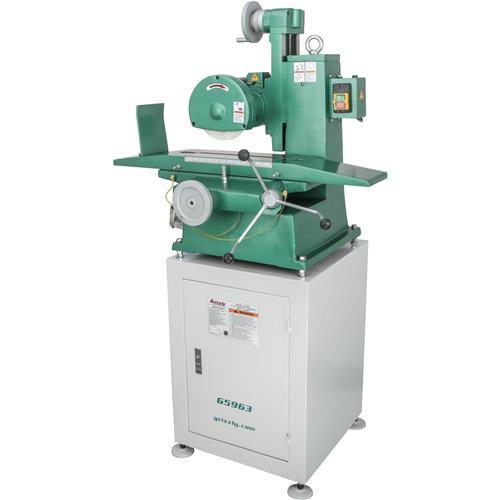
A new Grizzly G5963 was listed at $3,995 on 5 October 2026, without a chuck. A new G3104 was listed at $5,950 with a chuck and coolant. Those are the new-machine anchors on the best surface grinders page. A used Harig has to beat that total after trucking, a chuck, and any rebuild.
Search used surface grinders on eBay →
Harig surface grinders on eBay →
Brown & Sharpe surface grinders on eBay →
Accessories to Budget
A used grinder rarely arrives ready to grind. Put these on the same sheet as the purchase price. Dollar figures are planning ranges to verify at checkout, not current Amazon prices. The links are category searches. They are not specific ASINs.
| Item | Why it is on the list | Planning range (verify) |
|---|---|---|
| Magnetic chuck, 6×12 or 6×18 | Many ads are a bare table | $150–$600 used; confirm new |
| Single-point diamond dresser | A loaded wheel burns the work | Low relative to the machine |
| 46–60 grit aluminum oxide wheel | First wheel, matched to bore and width | Confirm at checkout |
| Wheel balancing arbor | Balance before the wheel goes on the spindle | Confirm at checkout |
| Dial indicator, 0.001 in | The only way to audit the pass | Confirm at checkout |
| Chuck cleaner | Swarf on the chuck is a height error | Confirm at checkout |
| Coolant system, if you will grind wet | Not on most manual Harigs as sold | $200–$500 planning |
Aluminum oxide surface-grinding wheel on Amazon →
Wheel balancing arbor on Amazon →
Magnetic chuck cleaner on Amazon →
6×12 permanent magnetic chuck on Amazon →
Per Norton’s guidance, aluminum oxide is the usual wheel for steel. Match diameter, thickness, and bore to the flange on the machine you bought, and match the wheel’s maximum RPM to the spindle (OSHA 1910.215). If the machine includes a chuck, indicate it. A dished chuck can be out by more than the tolerance you are trying to hold.
The same accessory list, tied to current new models, is on the best surface grinders page.
Where to Find Inventory
eBay. The widest net. Filter to used, then open completed listings for the same model before you bid. A “for sale” title is not a price. National shipping on a 1,000 lb machine can erase the bargain; get the freight quote while the listing is still up.
Used-machinery dealers. Higher asking prices, and sometimes a short warranty, because someone else did the spindle check. Ask what “reconditioned” includes. Spindle bearings and a scraped table are a different product from a paint job.
Plant auctions. Bidspotter and similar aggregators list shop liquidations. The terms are as-is. If you cannot attend or hire an inspector, you are buying a photograph.
Private party. A retiring toolmaker on a local classifieds site is often the complete package: chuck, wheels, dresser, and a story you can test by running the spindle. The story is not the inspection.
Who This Is NOT For
- Buyers who need a warranty and a 115 V small-table package. That is a new Grizzly G5963-class decision on the best surface grinders page, not a 40-year-old Harig with unknown bearings.
- CNC or unattended production grinding. A manual Harig or Micromaster does not become a CNC grinder because the ways are good.
- Work that is actually fabrication or sharpening. Angle grinders and bench grinders are the right tools, and they are the wrong search if you are here.
- Sub-tenth production you cannot inspect. Holding a tenth in a temperature-stable toolroom is a spindle, a chuck, and a process. A general-purpose used purchase does not guarantee that environment.
- First-time buyers who have never mounted a grinding wheel. Wheel mounting, speed rating, and what a crash does to a spindle are the safety content of the purchase. OSHA 1910.215 is the regulation. A supervised introduction beats discovering a burst wheel from a listing photo.
FAQ
What should I inspect on a used surface grinder?
Spindle, ways, crash history, in that order. Cold-start noise, axial end play, and an indicator on the flange or on spindle-to-table parallelism. Harig’s published geometry limits are in the table above. A bent wheel guard is a crash until proven otherwise.
What is a fair price for a used Harig 618?
A planning band, not a guarantee: roughly $1,200–$2,800 for a runner with an unknown spindle, and roughly $2,500–$4,500 when the spindle has been checked and the machine has power feed. Verify against current completed sales, then subtract trucking and any rebuild quote.
Is a spindle rebuild worth it?
Yes, when the ways and the guard say the machine was not crashed, and a rebuilder has quoted that model. No, when you are hoping new bearings will hide galled ways. Price the rebuild before the bid.
Which brands hold up?
Harig 612/618 first. Brown & Sharpe Micromaster when the premium is for condition. Okamoto when you accept the parts path. Boyar-Schultz when the price matches a lighter machine. Skip unknown imports with scored ways.
Used surface grinders for sale — where do I look?
eBay completed listings, a local machinery dealer, a liquidation auction you can inspect, and private-party toolrooms. The links above start the eBay search. They do not replace the checklist.
When should I buy new instead?
When you cannot inspect, when you want a warranty, or when a 115 V 6×12 (Grizzly G5963 class) or a new 6×18 (G3104 or Sharp SG-618) is the simpler install. Model-by-model specs are on the best surface grinders page.