Best Surface Grinders for Small Shops: Benchtop vs 6x18 Floor Models
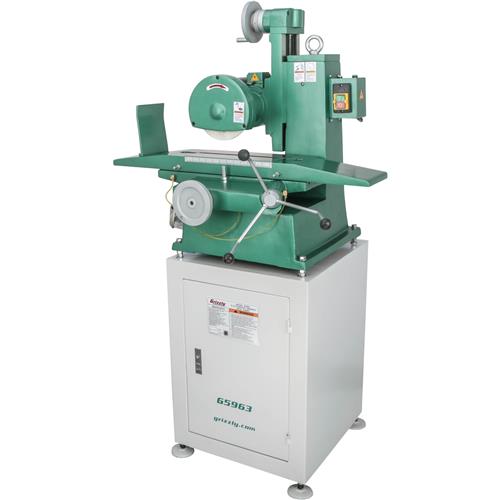
A small shop does not need a 1,500 lb toolroom grinder on day one, and it also cannot flatten a die shoe with an angle grinder. The new-machine split is electrical and table size. For small parts on ordinary 115 V service, the current class is the Grizzly G5963: 6×12 in table, 3/4 HP, prewired 115 V at 7.4 A, listed at $3,995 on Grizzly’s product page retrieved 5 October 2026. It is a floor machine on a cabinet stand (about 591 lb shipping, 64 in tall), not a countertop tool, and the magnetic chuck is not in the included-feature list. Step up to a 6×18 floor machine — Grizzly G3104 or Sharp SG-618 — when toolroom work is regular and the parts are longer. Buy used Harig-class iron when the capital and the accuracy target favor a machine you can inspect. That inspection lives in the used surface grinders buyers guide.
Two model numbers that show up in older roundups are the wrong machines today. Grizzly G0612 is a 6 in benchtop jointer, per Grizzly’s G0612 owner’s manual, not a surface grinder. JET does not currently list a JSG-6-9 surface grinder. On jettools.com the live JSG prefix is belt and disc sanders (JSG-6DC, JSG-96). Older JET surface grinders (JSG-612, JSG-618, and the three-phase JPSG-618M1) are used floor machines, covered on the used guide.
All figures below are manufacturer product-page figures as retrieved 5 October 2026. Confirm the live price, the chuck, and the nameplate before ordering. This page does not report a measured surface finish.
Check Grizzly G5963 on Amazon →
Grizzly sells the G5963 direct. An Amazon search is how to see whether a current offer exists. It is not a promise that the machine is in stock, freight-free, or cheaper than grizzly.com.
Specs That Matter
Per the manufacturer sheets, these are the numbers that change the purchase:
- Table size and travel. A 6×12 table (G5963 longitudinal travel 13-1/4 in) covers small toolroom parts. A 6×18 table (G3104 travel 20-1/2 in; Sharp SG-618 table 6 × 18.3 in, longitudinal travel 18.9 in) is the step when work regularly exceeds 12 in.
- Spindle horsepower. 3/4 HP on the small-table class is a finishing and light-removal motor. The G3104 manual lists 2 HP. The Sharp product page also prints 2 HP; the August 2024 manual lists 1 HP/1.5 HP and a 1.13 kW wheel motor. Confirm the Sharp nameplate. An underpowered spindle glazes a wheel and burns work; it does not become a larger spindle with a sharper dresser.
- Voltage and amps, not the marketing word “110 V.” Prewired 115 V at 7.4 A (G5963) can live on a dedicated 15 A circuit. The G3104 manual lists 19.1 A at 110 V and a 20 A minimum circuit. The product page still prints 18.8 A. Either figure will not share a typical 15 A receptacle. Sharp is 220 V or 440 V.
- Downfeed graduation. How fine the handwheel is marked. G5963 lists a column dial at 0.001 in resolution (0.05 in per revolution). Palmgren’s 6×12 bench page lists 0.0005 in vertical graduation. The G3104 manual lists 0.0002 in vertical graduation; the product page does not state it. Sharp’s August 2024 manual lists 0.0002 in. The current SG-618 product page lists 0.0001 in.
- Magnetic chuck. Ferrous workholding. Included on the G3104 (5-7/8 × 15-3/4 in). Not listed as included on the G5963. Optional on Palmgren and on the Sharp SG-618. Aluminum and brass need a fixture or a screwless vise either way.
- Coolant. Flood coolant is included on the G3104 and optional (12 gal with splash guard) on the Sharp. The small-table pages do not list a coolant system. Light work can be dry if the wheel is dressed and the downfeed stays small. Production grinding wants coolant so the part does not heat and the wheel does not load.
- Weight and how it arrives. About 591 lb shipping (G5963), 710 lb (Palmgren), 1,362 lb shipping on the G3104 manual (the product page prints about 1,429 lb), and about 1,507 lb on the Sharp manual (the product page prints about 1,540 lb) are freight problems: a pallet jack, a path to the floor, and a circuit that already exists. None of these is a bench-grinder-sized box.
Benchtop and 115 V Path
This is the Amazon-adjacent path, with the limit stated up front. The machine itself is a freight purchase from the manufacturer or a dealer. The dresser, wheel, indicator, and vise are what actually check out on Amazon.
Grizzly G5963 — current small-table, prewired 115 V
| Spec | Value (Grizzly product page) |
|---|---|
| Table | 6 × 12 in |
| Longitudinal / cross travel | 13-1/4 in / 7-1/8 in |
| Motor | 3/4 HP, 115/230 V, prewired 115 V, 7.4 A / 3.7 A |
| Spindle speed | 3,450 RPM |
| Column dial | 0.001 in resolution, 0.05 in per revolution |
| Wheel | 7 in diameter × 1/2 in wide × 1-1/4 in bore (owner’s manual data sheet; product-page bullets omit the bore) |
| Chuck | Not in the included-feature list; table has T-slots |
| Included | Diamond dresser with holder, wheel balancing kit, swarf guard, one-shot lube, cabinet stand |
| Size / shipping weight | 36-1/2 × 33 × 64 in / about 591 lb |
| Warranty | 1 year (consumables excluded, per Grizzly) |
| List price | $3,995 (Grizzly product page, rechecked 2026-10-05) |
Per Grizzly’s page, the G5963 is aimed at a small toolroom. The 3/4 HP spindle and the missing chuck are the constraints. Budget a permanent magnetic chuck before the first job, and do not plan on heavy stock removal. Grizzly’s manual for this model describes it as a floor machine. “Small” here means 6×12 and 115 V, not a machine you set on a wooden bench.
Palmgren 6×12 manual bench — 3,600 RPM
Palmgren still lists a 6 × 12 in manual bench surface grinder (model 9682122, the manual linked from that page). Retrieved 5 October 2026, palmgren.com shows it in stock at $8,333. The specification table lists 3/4 HP, 115 V, vertical feed graduation 0.0005 in, max grinding length 12-1/2 in, max width 6-11/16 in, wheel 7 × 1/2 × 1-1/4 in, and product weight 710 lb. A steel floor stand is included. The permanent magnetic chuck is optional (Palmgren item 9682130).
The specification table lists 3,600 RPM, and the specifications block in Palmgren’s model 9682122 manual lists the same 3,600 RPM. The product-page title still says 3,450 RPM. This page uses 3,600. At more than double the G5963 list price, and with the chuck extra, this is a named bench-category alternative, not the default small-shop buy. It is a dealer listing, not an assumed Amazon SKU.
Palmgren 6×12 bench surface grinder, 3,600 RPM →
What happened to the JET JSG-6-9
JET’s current public catalog does not list a JSG-6-9 surface grinder. The JSG models on jettools.com are belt and disc sanders. Buying a JSG-6DC or JSG-96 expecting a reciprocating table and a magnetic chuck buys the wrong tool. Historical JET surface grinders are a used-market question: inspect spindle, ways, and crash history on the used buyers guide rather than hunting a discontinued new SKU.
Floor 6×18: Grizzly G3104 and Sharp SG-618
Grizzly G3104 — 6×18 with chuck and coolant
| Spec | Value |
|---|---|
| Table | 6 × 18 in |
| Longitudinal / cross travel | 20-1/2 in / 6-7/8 in |
| Motor | 2 HP, 110/220 V, prewired 110 V. Manual data sheet: 19.1 A at 110 V, 9.5 A at 220 V, 20 A minimum circuit at 110 V. Product page still prints 18.8 A / 9.4 A |
| Spindle speed | 3,400 RPM on the manual data sheet. The product page still prints 3,450 RPM |
| Wheel | 7 in diameter × 1-1/4 in bore × 3/4 in wide (data sheet and product page). The same manual’s mounting checklist names a 1/2 in wheel. Measure the wheel on the spindle |
| Chuck | 5-7/8 × 15-3/4 in magnetic chuck included |
| Coolant | Flood coolant included |
| Shipping weight | 1,362 lb on the manual data sheet (machine weight 1,330 lb). Product page prints about 1,429 lb |
| 220 V conversion | Overload relay P3104115X, per Grizzly |
| Warranty | 1 year |
| List price | $5,950 (Grizzly product page, rechecked 2026-10-05) |
Per Grizzly, the G3104 is for precision parts in hardened or annealed ferrous metals. The included chuck and coolant are why it costs more than the G5963, not a vague “pro” label. The electrical catch is the current. The manual data sheet lists 19.1 A at 110 V and a 20 A minimum circuit. The product page still prints 18.8 A. A shared 15 A shop circuit is the wrong plan on either figure. Either a dedicated 110 V circuit sized for that load, or the 220 V relay conversion, has to exist before the truck arrives. The manual lists vertical handwheel graduation at 0.0002 in (0.05 in per revolution). The product page does not state a graduation.
Sharp SG-618 — finer downfeed, dealer, chuck extra
| Spec | Value |
|---|---|
| Table | 6 × 18.3 in |
| Max grind | 6.3 × 18.5 in |
| Longitudinal / cross travel | 18.9 in / 7 in |
| Spindle | August 2024 manual: 1 HP/1.5 HP, wheel motor 1.13 kW, 2,850/3,420 RPM. Product page prints 2 HP. Hydraulic table motor listed N/A (manual machine) |
| Vertical handwheel | 0.05 in per revolution on both sheets. Graduation 0.0002 in in the manual; 0.0001 in on the current product page |
| Wheel (standard) | WA46, 7.1 × 0.5 × 1.25 in (about 7 × 1/2 × 1-1/4 in), per the August 2024 manual |
| Wheel capacity | Manual: standard diameter 7.1 in, optional diameter up to 8 in, width 0.25–0.63 in, bore 1.25 in. The product page lists 8 in OD × 0.63 in wide × 1.25 in bore |
| Power | Wired 220 V or 440 V. Confirm the nameplate with Sharp. The product page’s 1.5 kVA / 4 A line is not used |
| Weight | Manual: about 1,507 lb. The metric figure on that same row is 550 kg, which is not 1,507 lb. Product page prints about 1,540 lb |
| Standard | Manual: WA46 wheel above, plus a 1/4 carat diamond tool with a base. Product page also lists auto-lube, flange, balancing arbor, work light, and a tool kit |
| Optional | Permanent or electromagnetic chuck; 12 gal coolant with splash guard |
| Price | Not published on the product page; dealer quote |
The standard wheel on this page is the one in the August 2024 manual, not the 8 × 0.63 in figure on the current product page. That product-page size sits at the manual’s optional diameter (up to 8 in) and maximum width (0.63 in). It is not the WA46 wheel the manual lists as a standard accessory. Read the manual that ships with the machine before ordering a spare.
The current product page prints power consumption at 220 V as 1.5 kVA / 4 amps. At 220 V those two figures are not the same load. The manual does not publish kVA or line amps. Its spindle line says 1 HP/1.5 HP, and the wiring section lists a 1.13 kW grinding-wheel motor, which does not match the product page’s 2 HP. Confirm the nameplate with Sharp before specifying a breaker. This page does not print an amp figure for the SG-618.
The chuck and coolant are optional. A quote that looks cheaper than the G3104 may be a bare machine. The SG-618 is a dealer purchase. Do not plan on adding a machine the manual lists at about 1,507 lb to an Amazon cart.
Search Sharp SG-618 on eBay (new and used) →
Comparison
| Spec | Grizzly G5963 | Palmgren 6×12 bench | Grizzly G3104 | Sharp SG-618 |
|---|---|---|---|---|
| Table | 6 × 12 in | 6 × 12 in | 6 × 18 in | 6 × 18.3 in |
| Spindle | 3/4 HP | 3/4 HP | 2 HP | Manual 1 HP/1.5 HP; product page 2 HP |
| Power | 115 V prewired, 7.4 A | 115 V | 110 V prewired; manual 19.1 A (page prints 18.8 A) | 220/440 V; confirm nameplate |
| Downfeed mark | 0.001 in | 0.0005 in | 0.0002 in (manual) | 0.0002 in (manual); 0.0001 in (product page) |
| Wheel | 7 × 1/2 × 1-1/4 in | 7 × 1/2 × 1-1/4 in | 7 × 3/4 × 1-1/4 in; manual also lists 1/2 in | WA46, 7.1 × 0.5 × 1.25 in (manual standard) |
| Chuck | Not included | Optional | Included | Optional |
| Coolant | Not listed | Not listed | Flood included | Optional 12 gal |
| Weight | ~591 lb ship | 710 lb listed | 1,362 lb ship (manual) | ~1,507 lb (manual); page ~1,540 lb |
| Where to buy | Grizzly; confirm Amazon | Palmgren / dealers | Grizzly | Sharp dealers |
| List price | $3,995 | $8,333 | $5,950 | Quote |
Prices are maker list prices retrieved 5 October 2026, except Sharp, which does not publish one. They are not street prices and not a promise of freight.
Surface Grinder vs Bench Grinder vs Angle Grinder
These are three different tools that share the word “grinder.”
- Surface grinder. Horizontal spindle, reciprocating table, wheel dressed true, work held on a chuck or fixture. The job is flatness and parallelism in thousandths and tenths on ferrous parts, including hardened tool steel that a mill should not be cutting.
- Bench grinder. A fixed machine with one or two wheels for sharpening and deburring. That decision is the bench grinder guide. It will not hold a die block parallel.
- Angle grinder. A handheld fabrication tool for weld cleanup, cutting, and rough stock removal. Corded versus cordless is a separate decision on the angle grinder comparison. An angle grinder does not produce a toolroom surface.
If the job is “make this plate flat and parallel,” it is a surface grinder. If the job is “clean this weld” or “touch up a chisel,” it is not.
Who This Is NOT For
- Fabrication-only buyers. Weld cleanup, cutoff, and flap-disc work belong on an angle grinder. A surface grinder is the wrong tool and the wrong budget.
- Everyday sharpening and deburring. That is a bench grinder. A surface grinder is a poor sharpening station and a slow way to remove an eighth of an inch.
- CNC or production grinding cells. None of the machines here is a CNC grinder with in-process gauging. If the work is unattended cycles, this shortlist is the wrong class.
- Buyers who picture a benchtop tool the size of a bench grinder. The lightest current machine in this comparison still ships around 600 lb and stands on the order of 64 in tall. A wooden bench and a 15 A circuit shared with the compressor is not an installation plan.
- Non-ferrous work with no fixture budget. Magnetic chucks hold steel. Aluminum and brass need a screwless vise or a dedicated fixture, and the setup time is part of the job.
- Anyone ordering “G0612” or “JSG-6-9” from an old list. Those numbers are not current surface grinders. G0612 is a jointer. JSG-6-9 is not on JET’s current surface-grinder catalog.
Grinding Wheels and Dressers
The wheel has to be a Type 1 straight toolroom wheel in the machine’s diameter, width, and arbor. The speed marked on the blotter has to cover the spindle speed on the nameplate. Per OSHA 1910.215, the wheel is not to be run faster than that marked speed. A bench-grinder wheel, a cutoff wheel, or a wheel that only fits with reducing bushings is the wrong part. Amazon’s “compatible devices” line on the listings below is not a mounting instruction.
Sizes are manufacturer figures retrieved 5 October 2026. Read the blotter on the wheel that shipped before ordering a spare.
| Machine | Wheel, diameter × width × arbor | Source retrieved 2026-10-05 |
|---|---|---|
| Grizzly G5963 | 7 × 1/2 × 1-1/4 in | G5963 owner’s manual machine data sheet (models manufactured since 8/13). Product-page bullets list diameter and width only. Spindle speed in that sheet: 3,450 RPM. |
| Palmgren 9682122 | 7 × 1/2 × 1-1/4 in | Palmgren 9682122 instructions, specifications block. Spindle speed in that block: 3,600 RPM. |
| Grizzly G3104 | 7 × 3/4 × 1-1/4 in | G3104/G3155 owner’s manual G3104 data sheet (V1.08.25; sheet dated accurate as of 8/4/2025) and the current product page. Manual spindle speed: 3,400 RPM. The product page still prints 3,450 RPM. |
| Sharp SG-618 | WA46, 7.1 × 0.5 × 1.25 in (about 7 × 1/2 × 1-1/4 in) | August 2024 manual standard accessories: WA46, 7.1 in diameter × 0.5 in wide × 1.25 in bore. Spec table: standard diameter 7.1 in, optional diameter up to 8 in, width 0.25–0.63 in, bore 1.25 in, spindle 2,850/3,420 RPM. The product page lists 8 × 0.63 × 1.25 in. |
The G3104 manual does not agree with itself. The data sheet and the machine ID label print 7 in × 1-1/4 in bore × 3/4 in wide. The accessory section of the same PDF lists Grizzly G7433 and G7434 as 7 × 1/2 × 1-1/4 in, and the wheel-mounting checklist names a 1/2 in wide wheel. Measure the wheel on the spindle before buying a spare. A 1/2 in wheel is the G5963, Palmgren, and Sharp standard-wheel width. It is not the G3104 data-sheet width.
7 × 1/2 × 1-1/4 in — G5963, Palmgren 9682122, and Sharp SG-618
Two Norton Type 01 wheels in this size were in stock on Amazon on 5 October 2026. Each listing states 7 in diameter, 1/2 in thickness, and a 1-1/4 in hole, one wheel per pack. Norton’s Type 01 spec tables list both part numbers at 3,600 RPM maximum. The Sharp manual’s standard wheel is this width and bore. Its printed diameter is 7.1 in.
- Norton 38A60-IVBE, part 66252941036. Norton’s 38A Type 01 page describes this grain as friable aluminum oxide for light to moderate feeds on heat-sensitive tool steels, including surface grinding. The Amazon listing calls it a white 38A wheel for light grinding of tool steels: 60 grit, medium grade I, vitrified bond, 3,600 RPM. Norton 38A60-IVBE, 7 × 1/2 × 1-1/4 in →
- Norton 32A60-KVBE, part 66253288782. Norton’s 32A Type 01 page describes monocrystalline aluminum oxide for medium to heavy stock removal on tool steels, including vanadium alloys, on a surface grinder. The Amazon listing is 60 grit, grade K, purple, and the description measures 7 in diameter by 1/2 in width by a 1-1/4 in arbor. Norton 32A60-KVBE, 7 × 1/2 × 1-1/4 in →
Per Norton’s wheel-selection note, aluminum oxide is the abrasive for high-tensile steels, including tool steel, and a coarser grit removes stock faster than a finer one. 60 grit is the finer end of the 46–60 range already used on this page. 32A is the heavier-removal grain. 38A is the cooler, lighter-feed grain. Neither wheel is a bench-grinder wheel.
The Sharp manual’s standard wheel is WA46 at 7.1 × 0.5 × 1.25 in. Width 0.5 in is 1/2 in, and bore 1.25 in is 1-1/4 in, so those two dimensions match the Norton wheels above. The Norton diameter is 7 in, which is 0.1 in under the manual’s stated standard of 7.1 in and under the optional maximum of 8 in. The manual does not publish a minimum diameter. On the width, bore, and maximum diameter it does publish, these two wheels fit the SG-618 the same way they fit the G5963 and the Palmgren.
A blotter marked 3,600 RPM covers the G5963 manual’s 3,450 RPM spindle and the Sharp manual’s 3,420 RPM (60 Hz) spindle. It meets the Palmgren manual’s 3,600 RPM spindle with nothing above that published figure. If the nameplate is higher than the blotter, the wheel does not belong on the spindle.
7 × 3/4 × 1-1/4 in — Grizzly G3104
One Norton listing matched the data-sheet size on Amazon on 5 October 2026.
- Norton 32A46-HVBE, part 66252941930. The Amazon title is a Type 1 wheel, 7 × 3/4 × 1-1/4, 46 grit aluminum oxide. The description reads “7 x 3/4 x 1-1/4 In. Toolroom Wheel 32A 46 H VBE T01.” Norton’s 32A spec table lists that part number as 7 in diameter, 3/4 in thick, 1-1/4 in arbor, 46 grit, 3,600 RPM. The use note is the same 32A tool-steel note as the wheel above. 46 grit is the coarser end of the 46–60 range. Norton 32A46-HVBE, 7 × 3/4 × 1-1/4 in →
That listing is a five-pack. The page’s item count is 5, and the title says PK5. The price in the cart is the pack. A single wheel in this spec was not a second ASIN this page could verify. A blotter marked 3,600 RPM covers both the manual’s 3,400 RPM and the product page’s 3,450 RPM.
Sharp product-page size — 8 × 0.63 × 1.25 in
The current product page lists an 8 in wheel, 0.63 in wide, with a 1.25 in bore, and its standard-accessories line prints a grinding wheel at that size. The August 2024 manual treats 8 in as the optional diameter cap and 0.63 in as the top of the width range (0.25–0.63 in), not as the wheel that ships. The wheel that ships in that manual is the WA46 above. No Amazon listing opened on 5 October 2026 was an 8 in wheel at 0.63 in thick, or at a 5/8 in thickness whose listing dimensions matched 0.63 in, with a 1-1/4 in arbor. This page does not link one. A 7 × 1/2 × 1-1/4 in wheel is the standard-wheel class. An 8 × 1/2 wheel is a different thickness from 0.63 in and is not a substitute for that product-page size.
Dressers
The G5963 manual includes a dressing diamond with mount. Sharp’s standard list includes a diamond dresser. A spare is still worth having. A glazed wheel burns work. No spare on Amazon survived a size check on 5 October 2026.
- TTC single-point listings with a 1/2 in shank (ASIN B005LH04P8) and with a 7/16 in shank (B005LH01VK, B005LH01M4) returned Amazon’s not-found page.
- The Norton BC5M7 that was in stock (ASIN B07H9JWXYZ) is a 7/16 × 2 in, 1/2 carat tool. Its own description limits that tool to 11 to 14 in wheels. That is the wrong diameter range for a 7 or 8 in surface-grinder wheel.
- No Norton or Desmond cluster dresser was verified live with a shank these manuals publish. The manuals do not state the included shank.
Measure the holder, then search. Do not assume 7/16 in or 1/2 in. Single-point diamond dresser on Amazon →
What You’ll Also Need
The machine does not grind until the wheel is dressed, the part is held, and the result can be measured. Wheel sizes and the three verified wheels are in the section above. The chuck, vise, indicator, and chuck cleaner below are still category searches. They are not specific ASINs. Confirm the price at checkout.
- Diamond dresser. Covered above. The G5963 and the Sharp include one. A spare still belongs in the drawer after the holder shank is measured. Single-point diamond dresser on Amazon →
- Permanent magnetic chuck, if the machine does not include one. The G5963 and the Palmgren 6×12 need this before they hold a part. 6×12 magnetic chuck on Amazon →
- Screwless toolmaker vise. For small parts and for non-ferrous work the chuck cannot hold. Screwless vise on Amazon →
- Dial indicator, 0.001 in. The check on flatness and parallelism after the pass. A surface grinder without an indicator is a machine you cannot audit. Dial indicator on Amazon →
- Magnetic chuck cleaner. Swarf left on the chuck becomes a height error on the next part. Chuck cleaner on Amazon →
Per OSHA 1910.215, the wheel’s rated speed has to cover the spindle speed. The G5963 manual lists 3,450 RPM. The G3104 manual lists 3,400 RPM; the product page still prints 3,450 RPM. Palmgren’s specification table and the 9682122 manual list 3,600 RPM. The Sharp manual lists 2,850/3,420 RPM. A cutoff wheel or a bench-grinder wheel with the wrong bore is not a substitute.
Consider Used
New wins when the 115 V small-table package, a warranty, and a known chuck-or-coolant list are worth more than older iron. Used wins when a Harig 612 or 618, a Brown & Sharpe Micromaster 618, or an Okamoto of similar size has a quiet spindle and straight ways, at a price that still works after a rebuild quote.
Do not treat a low asking price as a bargain until the spindle, the ways, and the crash history are checked. The checklist, the brand tiers, and the planning price bands are in the used surface grinders buyers guide.
Used surface grinders on eBay →
FAQ
What is the best surface grinder for a small shop?
The current new answer for small parts on 115 V is the Grizzly G5963 class: 6×12 in, 3/4 HP, 7.4 A, listed at $3,995, chuck extra, about 591 lb. Regular toolroom work on longer parts points to the G3104 or the Sharp SG-618. Inspected Harig-class used iron points to the used guide.
Do I need 220 V?
The G5963 does not. The G3104 is prewired 110 V. The manual data sheet lists 19.1 A and a 20 A minimum circuit; the product page still prints 18.8 A. The circuit still has to be built for that load or converted with Grizzly relay P3104115X. The Sharp SG-618 is 220 V or 440 V.
6×12 or 6×18?
Match the table to the longest part you grind on a normal week. Travel is about 13 in on the G5963 and about 19–20 in on the 6×18 machines. The G3104 manual lists 1,362 lb shipping. The Sharp manual lists about 1,507 lb; the product page prints about 1,540 lb.
Surface grinder vs bench grinder?
A surface grinder finishes flat, parallel surfaces. A bench grinder sharpens and deburrs. An angle grinder is a handheld fabrication tool. See the bench grinder guide and the angle grinder comparison.
What accessories do I need to start?
A diamond dresser, and a 46–60 grit aluminum oxide Type 1 wheel in the diameter, width, and arbor in the grinding-wheels section. For the Sharp SG-618 that standard wheel is the manual’s WA46, 7.1 × 0.5 × 1.25 in (about 7 × 1/2 × 1-1/4 in), the same width and bore as the Norton wheels linked for the G5963 and the Palmgren. Also a chuck if the machine did not include one, a screwless vise for small or non-ferrous parts, a 0.001 in dial indicator, and a chuck cleaner.
Should I buy used instead?
Yes, when you can inspect the spindle and the ways, or you are paying a rebuilder who will. No, when you need a warranty and a 115 V small-table package and you cannot stand in front of the machine. Start with the used buyers guide.