Best Cordless Work Lights Under $50 (2026): Bright Enough for the Job Site?
Cordless work lights sit in a unique category: they cost less than a decent lunch for two, but a bad pick means fumbling in the dark on every job. At under $50 for a bare tool, these are impulse-priced — but the real cost is the battery platform commitment behind them. Choosing a work light that matches existing batteries turns a $30 purchase into a zero-additional-cost addition to the kit. Choosing wrong means buying a $60-$100 battery just to power a $30 light.
This guide compares five cordless work lights under $50, all sold as tool-only (no battery included), evaluated strictly on manufacturer specifications, beam characteristics, and platform compatibility.
What to Look For in a Cordless Work Light Under $50
Before diving into specific models, four criteria determine whether a work light will actually do the job:
1. Lumen Output — Match Output to Task Scale
Lumens measure total light output. Getting this wrong in either direction is a real problem: too low and the light is useless; overkill lumens on a compact task light usually means reduced runtime.
- 100–250 lumens — Adequate for close work: inside electrical panels, under dashboards, inside cabinet boxes, behind appliances. Spot beam lights in this range are precision tools, not room lights.
- 500–1,000 lumens — General-purpose work in confined areas: attics, crawl spaces, mechanical rooms. Useful with a flood beam to cover a wider zone without repositioning.
- 1,500–2,200+ lumens — Area replacement lighting. At this output, a single light can substitute for a temporary string light in an unfinished room. These draw more battery capacity per hour and are heavier.
Rule of thumb from lighting industry specs: task lighting is 50 lumens per square foot; ambient work area lighting is 30–50 lumens per square foot.
2. Battery Platform Compatibility — The Real Cost Driver
The battery is almost always more expensive than the bare-tool light. Buying a work light on a platform you do not already own means paying $60–$120 for a compatible battery — effectively tripling the purchase price.
Existing platform users should default to buying within their ecosystem unless there is a specific technical reason not to. The right light for the platform beats the best light on the wrong platform.
Platform battery costs as of 2026 (1.5–2.0Ah starter packs):
- DeWalt 20V MAX — $40–$55 for a compact 2.0Ah
- Milwaukee M18 — $45–$60 for M18 REDLITHIUM CP2.0
- Makita 18V LXT — $35–$50 for BL1820B 2.0Ah
- Ryobi ONE+ 18V — $25–$40 for PCL100B 2.0Ah (lowest entry cost)
3. Flood vs. Spot Beam Pattern
Beam pattern determines where light goes, not just how much there is. At sub-$50 prices, this is rarely adjustable — the pattern is fixed by the optic design.
- Spot beams are narrow, directional, and suited for illuminating a specific object or surface up close. They create shadows outside the beam cone.
- Flood beams spread light across a wide horizontal angle. Better for illuminating a work area rather than a single point. Less punch at distance.
- 360-degree / omni-directional lights throw light in all directions, functioning like a lantern. Best for area illumination where you need ambient light throughout a space.
Spot and flood are not interchangeable. A 110-lumen spot can be more useful inside a junction box than a 900-lumen flood aimed at the same space.
4. Runtime at Typical Brightness Settings
Manufacturer-published runtime figures are almost always measured at the lowest brightness setting with the largest battery in the platform. Real-world runtime on a typical 2.0Ah battery at full brightness is often 30–60% of the rated figure.
When evaluating runtime:
- Identify which battery the manufacturer used for the spec (usually the largest available — 5.0Ah or 6.0Ah)
- Identify whether the runtime is for high or low mode
- For compact 2.0Ah batteries, expect roughly 40% of a 5.0Ah runtime figure
For all-day use without swapping batteries, the Makita DML186’s 15-hour spec (rated on 3.0Ah) points toward exceptional efficiency even at reduced battery capacity.
Quick Answer: Which Cordless Work Light Under $50 Is Best?
- Best overall for most buyers: DeWalt DCL040
- Best for Milwaukee M18 users: Milwaukee 2144-20
- Best budget value: Ryobi PCL660B
- Best compact carry light: Makita DML186
- Best overhead flood option: DeWalt DCL050
If you already own DeWalt batteries, the DCL040 is still the easiest answer because it is cheap, light, and good enough for cabinet work, attic work, and service calls. If you need to light an entire room instead of a panel or work surface, the Milwaukee 2144-20 is the stronger answer.
Why Battery Platform Matters More Than the Light Itself
At this price point, the light is almost secondary to the battery ecosystem. A contractor already running DeWalt 20V MAX tools has a drawer full of compatible batteries. That makes the DeWalt DCL040 effectively free to operate. Buying a Milwaukee light into a DeWalt shop means an additional $60-$100 for an M18 battery — tripling the real cost.
Before comparing lumens and beam angles, determine which battery platform already dominates the toolbox. For a deeper breakdown of what each platform offers, see the DeWalt vs Milwaukee vs Makita battery platform comparison.
The four major platforms represented here:
- DeWalt 20V MAX — Largest cordless tool selection, backward-compatible with all 20V MAX batteries
- Milwaukee M18 — Strong in electrical and plumbing trades, REDLITHIUM battery line
- Makita 18V LXT — Widest 18V tool range globally, Star Protection battery communication
- Ryobi ONE+ 18V — Over 300 tools on the platform, lowest battery cost, consumer-oriented
Quick Specs Comparison
| Model | Lumens | Battery Platform | Beam Type | Weight (bare) | Street Price (tool only) |
|---|---|---|---|---|---|
| DeWalt DCL040 | 110 | 20V MAX | Spot | 0.65 lb | $30-$40 |
| Milwaukee 2144-20 | 2,200 | M18 | 360° Area | 3.0 lb | $35-$45 |
| Ryobi PCL660B | 900 | ONE+ 18V | Flood | 1.1 lb | $20-$30 |
| Makita DML186 | 160 | 18V LXT | Spot | 0.38 lb | $25-$35 |
| DeWalt DCL050 | 250 | 20V MAX | Flood | 1.5 lb | $40-$50 |
Lumen-per-Dollar and Runtime Efficiency
Raw lumens and street price tell only part of the story. The table below calculates lumens per dollar (using the street price midpoint) and estimates real-world runtime on a commonly available 2.0Ah battery at full brightness — a more honest comparison than manufacturer-stated figures, which are typically measured at the lowest setting on the largest battery in the platform.
| Model | Street Price (tool only) | Lumens | Lumens per Dollar | Runtime on 2.0Ah (est.) | Best Use Case |
|---|---|---|---|---|---|
| DeWalt DCL040 | $30–$40 ($35 mid) | 110 | 3.1 lm/$ | ~11 hr | Close-quarters task lighting |
| Milwaukee 2144-20 | $35–$45 ($40 mid) | 2,200 | 55.0 lm/$ | ~0.6 hr | Room-filling area light |
| Ryobi PCL660B | $20–$30 ($25 mid) | 900 | 36.0 lm/$ | ~2.75 hr | Shop bench or floor flood |
| Makita DML186 | $25–$35 ($30 mid) | 160 | 5.3 lm/$ | ~10 hr | All-day portable task light |
| DeWalt DCL050 | $40–$50 ($45 mid) | 250 | 5.6 lm/$ | ~8 hr | Overhead articulating flood |
Runtime estimates at full brightness on a 2.0Ah battery; manufacturer figures typically measured at lowest setting on largest battery. Actual runtime varies by brightness level and battery condition.
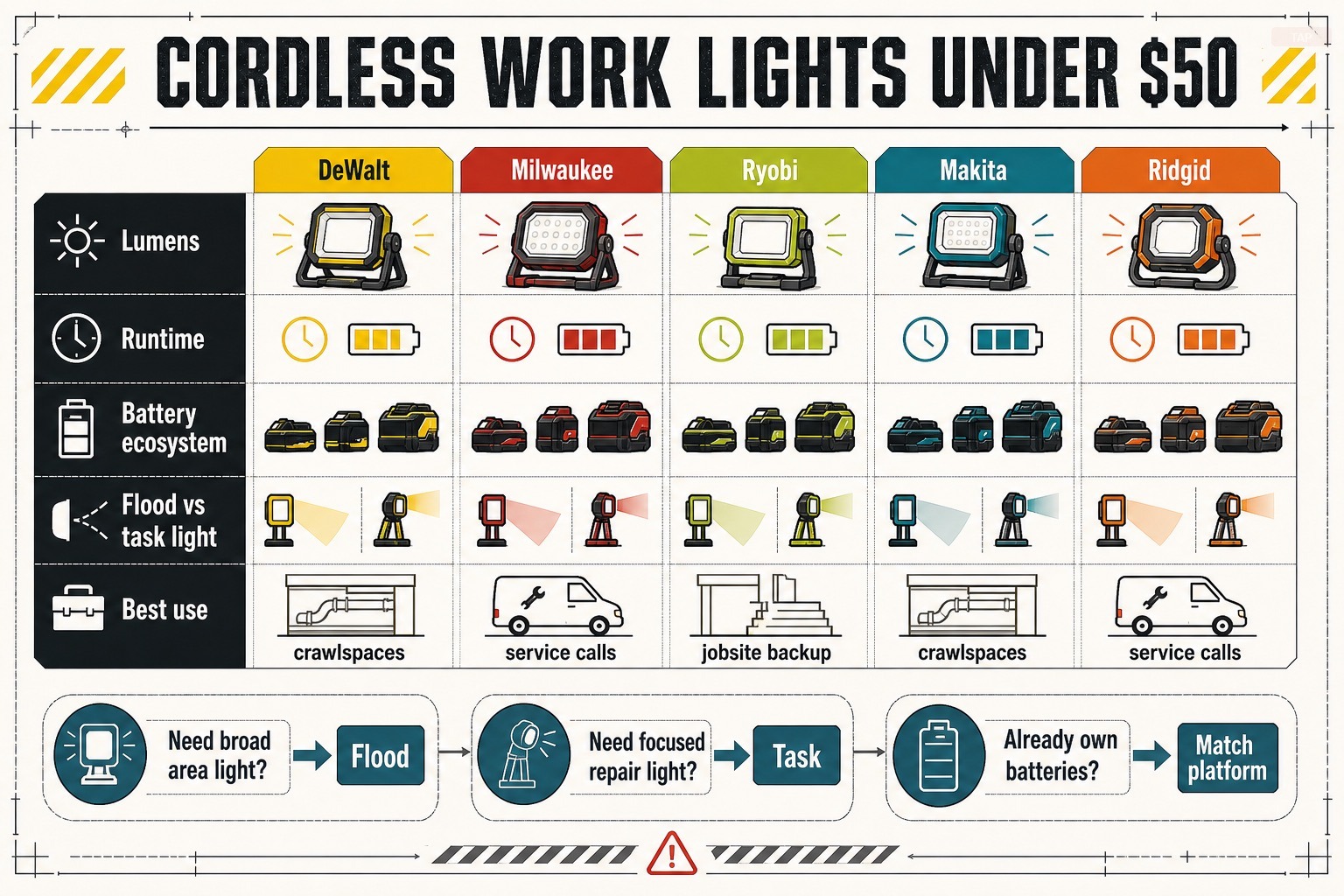
Reading this table: The Milwaukee 2144-20 dominates lumens-per-dollar (55 lm/$) but drains a 2.0Ah battery in under an hour at full output — it is a high-capacity-battery light, not a compact-pack light. The DCL040 and DML186 invert the ratio: modest lumen counts but exceptional runtime that covers a full shift without a battery swap. The Ryobi PCL660B balances output and efficiency best for the general-purpose buyer.
Battery Platform Compatibility Table
Matching the work light to an existing battery ecosystem is the single most important purchase decision in this category. The table below shows which models are compatible with which cordless platforms, along with manufacturer-stated lumens, runtime, and current street pricing for the tool-only SKU.
| Brand / Model | Compatible Platform | Lumens | Runtime (stated) | Price Range (tool only) |
|---|---|---|---|---|
| DeWalt DCL040 | 20V MAX (all capacities) | 110 | 11 hr (2.0Ah) | $30–$40 |
| DeWalt DCL050 | 20V MAX (all capacities) | 250 | 8 hr (2.0Ah) | $40–$50 |
| Milwaukee 2144-20 | M18 (all REDLITHIUM packs) | 2,200 | 6 hr low / ~1.5 hr high (5.0Ah) | $35–$45 |
| Ryobi PCL660B | ONE+ 18V (all ONE+ packs) | 900 | 5.5 hr (4.0Ah) | $20–$30 |
| Makita DML186 | 18V LXT (all LXT packs) | 160 | 15 hr (3.0Ah) | $25–$35 |
Per manufacturer specifications. Runtime figures reflect the battery capacity noted; smaller batteries reduce runtime proportionally. Milwaukee M18 runtime shown on high mode is estimated from high-draw consumption data in Milwaukee’s published documentation.
Cross-platform notes: DeWalt’s FLEXVOLT 60V MAX batteries are backward-compatible with all 20V MAX tools, so any DeWalt FLEXVOLT pack will also power the DCL040 and DCL050. Milwaukee M18 FUEL and M18 HIGH DEMAND packs are all compatible with the 2144-20. Makita XGT 40V MAX batteries are NOT compatible with 18V LXT tools — confirm the battery platform before purchasing.
Job Site vs. Shop Use: Which Scenario Are You In?
Cordless work lights under $50 serve two distinct environments with different requirements. Buying the wrong light for the context is a common and avoidable mistake.
Job Site (Portable, Mobile Work)
Requirements: Drop resistance, lightweight, hook or magnetic mount, battery endurance across a full shift.
The job site environment is hostile to equipment. Lights get knocked off ladders, tossed in vans, set on concrete slabs. Portability and durability matter more than raw lumen output for most trades.
Recommended for job site use:
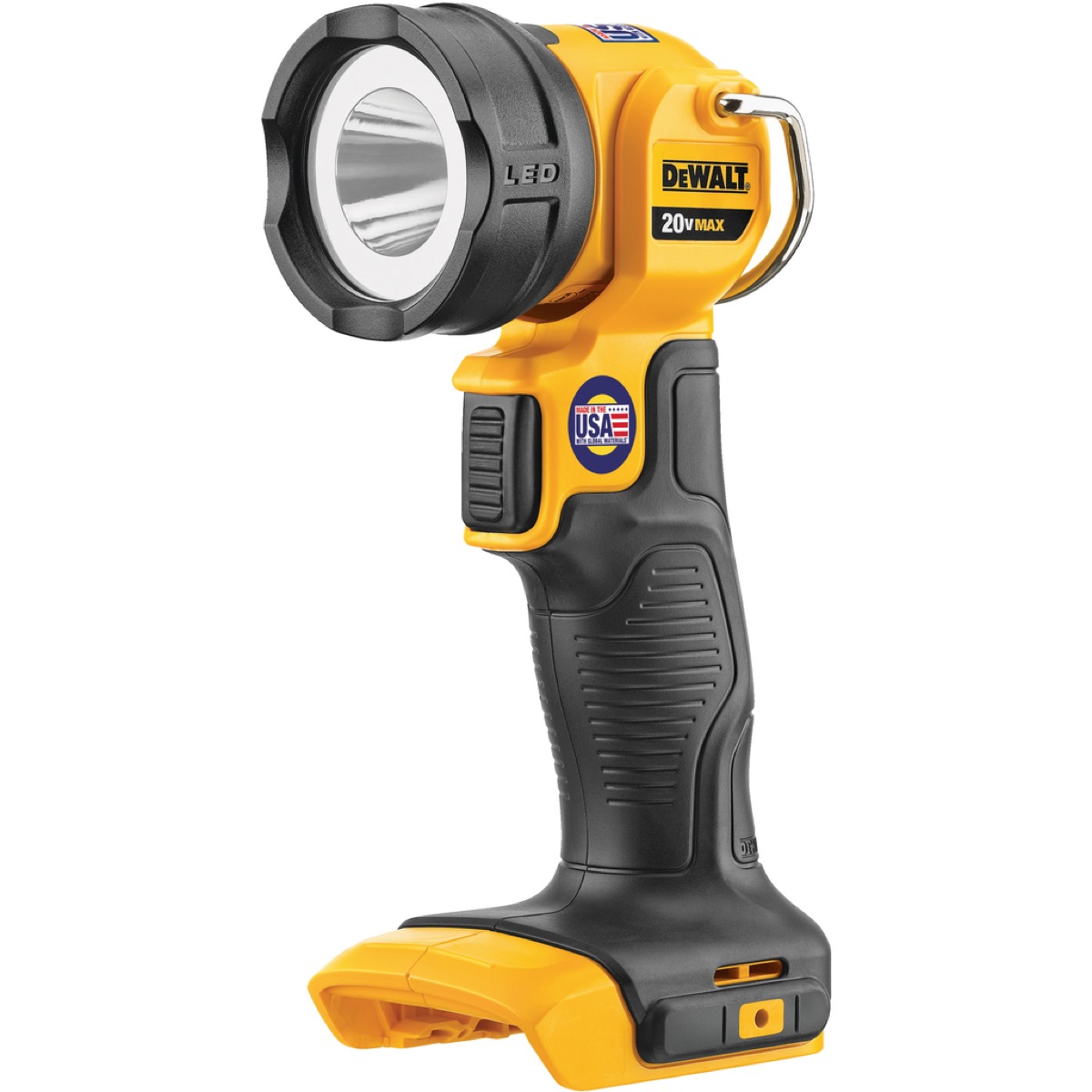
- DeWalt DCL040 — At 0.65 lb, this is a pocket-weight task light. The pivoting spot beam and 20V MAX compatibility make it a natural addition to any DeWalt-based site kit. View on Amazon →
- Makita DML186 — The lightest option on this list at 0.38 lb with the best all-day runtime (up to 15 hours per manufacturer specs). Fits a tool bag without bulk. View on Amazon →
Not ideal for job sites: The Milwaukee 2144-20 weighs 3.0 lb bare and is designed for stationary overhead placement, not toolbox carry. It earns its weight in a fixed position but is not a grab-and-go task light.
Shop Use (Fixed Location, Sustained Operation)
Requirements: High lumen output, stable placement, consistent coverage of a defined work area, longer duty cycles.
The shop environment is controlled. Lights live in one place, get hung once, and run for hours. Runtime and lumen output take priority over portability. A shop light that has to be repositioned every 20 minutes is a problem; a job site light that consumes a full battery in 90 minutes is also a problem.
Recommended for shop use:
- Milwaukee 2144-20 — 2,200 lumens in a 360-degree pattern is the strongest area illumination on this list. Per Milwaukee’s product documentation, it is designed to replace temporary string lights. Hung from a joist or ceiling hook, it covers an entire bay. View on Amazon →
- Ryobi PCL660B — At 900 lumens flood with an adjustable head, this is a capable bench or floor light for a home shop or garage. The ONE+ platform’s low battery cost makes it easy to keep a spare charged. View on Amazon →
- DeWalt DCL050 — The articulating flood head and hang hook make it the better DeWalt choice for a fixed overhead position. 250 lumens won’t light an entire bay, but for illuminating a specific machine or workbench zone, the adjustable positioning beats the DCL040’s spot beam.
Not ideal for fixed shop use: The DCL040 and DML186 are spot lights designed for task illumination. Running either as permanent shop area lights means under-illuminating the space and running batteries through cycles faster than the lumen output warrants.
Understanding Lumens vs. CRI: What Actually Matters for Work Lighting
Lumens measure total light output — how much light leaves the source. A 2,200-lumen area light fills a room. A 110-lumen spot light illuminates a junction box. Higher lumens are not inherently better; they serve different tasks.
Color Rendering Index (CRI) measures how accurately colors appear under a light source compared to natural daylight. A CRI of 80+ is considered acceptable for general work. A CRI of 90+ matters for tasks like color-matching paint, identifying wire colors in dim electrical panels, or inspecting weld quality. Most manufacturers in this price range do not publish CRI ratings, which typically indicates a CRI in the 70-80 range. According to manufacturer specs, none of the five lights reviewed here advertise CRI ratings above 80.
For most job site work — framing, rough electrical, plumbing — lumens matter more than CRI. For finish work and inspection tasks, CRI becomes relevant, and stepping up to a higher-priced light with published CRI data may be warranted.
Flood vs. Spot: Matching the Beam to the Task
Spot beams (DCL040, DML186) concentrate light into a narrow cone. These excel at illuminating specific work areas: inside cabinets, behind panels, under dashboards. They are poor choices for lighting an entire room.
Flood beams (Ryobi PCL660B, DeWalt DCL050) spread light across a wide angle. These work well for general area illumination in crawl spaces, attics, or unfinished rooms. They wash out detail at distance.
360-degree area lights (Milwaukee 2144-20) throw light in all directions. According to Milwaukee’s product documentation, the 2144-20 is designed to replace temporary string lights on job sites, illuminating an entire room from a central position.
The Five Best Cordless Work Lights Under $50
DeWalt DCL040 — Best Overall Value
| Spec | Detail |
|---|---|
| Lumens | 110 |
| Battery | 20V MAX (tool only) |
| Beam | Spot, pivoting head |
| Runtime | Up to 11 hours (20V MAX 2.0Ah) |
| Weight | 0.65 lb (bare) |
| Price | $30-$40 |
Per the product data sheet, the DCL040 delivers 110 lumens through a focused LED spot beam with a pivoting head that locks at multiple angles. The 20V MAX compatibility means any DeWalt battery from the compact 1.5Ah to the 12.0Ah FLEXVOLT will power it. Runtime with a standard 2.0Ah battery reaches approximately 11 hours according to DeWalt’s specifications.
At under $40, this is the lowest-risk entry point for anyone already invested in DeWalt’s 20V MAX ecosystem. The 110-lumen output is modest, but the combination of light weight, long runtime, and flexible head positioning makes it practical for task lighting in tight spaces.
Milwaukee 2144-20 — Best Area Light
| Spec | Detail |
|---|---|
| Lumens | 2,200 |
| Battery | M18 (tool only) |
| Beam | 360° area, TRUEVIEW |
| Runtime | Up to 6 hours (M18 5.0Ah, low mode) |
| Weight | 3.0 lb (bare) |
| Price | $35-$45 |
The 2,200-lumen output from the 2144-20 is in a different class from the other lights on this list. According to Milwaukee’s specifications, the TRUEVIEW LED technology is designed to deliver consistent color temperature and reduced eye fatigue. The 360-degree beam pattern throws light in all directions, effectively replacing a temporary construction light.
2026 note: Milwaukee has added the 2145-20 ROVER Compact Site Light to their lineup (2,000 lumens, similar price), which includes a telescoping design for floor standing. Both models remain available; the 2144-20 persists at the $35–$45 street price and remains the better value when the goal is overhead or hook-mounted area lighting rather than floor-stand use.
The trade-off is weight and runtime. At 3.0 pounds bare (before a battery), this is not a pocket light. Runtime on high mode drops significantly compared to low mode. For M18 platform users who need to light an entire room or work area, this is the strongest option under $50 — but it draws batteries down faster than the task lights on this list.
View Milwaukee 2144-20 on Amazon
Ryobi PCL660B — Best Budget Option
| Spec | Detail |
|---|---|
| Lumens | 900 |
| Battery | ONE+ 18V (tool only) |
| Beam | Flood, adjustable head |
| Runtime | Up to 5.5 hours (4.0Ah) |
| Weight | 1.1 lb (bare) |
| Price | $20-$30 |
At $20-$30 for 900 lumens, the PCL660B offers the best lumen-per-dollar ratio on this list. Per Ryobi’s product documentation, the light features an adjustable head and a hang hook for overhead positioning. The ONE+ battery platform is the most affordable to buy into, with 1.5Ah batteries frequently available under $40.
The PCL660B is a strong choice for homeowners and DIYers already on the Ryobi ONE+ platform, or for anyone looking to add a work light to an existing cordless drill setup without a significant cost commitment. Build quality is a step below the trade-focused brands, but for intermittent use the value proposition is hard to argue against.
Makita DML186 — Best Compact Light
| Spec | Detail |
|---|---|
| Lumens | 160 |
| Battery | 18V LXT (tool only) |
| Beam | Spot, fixed head |
| Runtime | Up to 15 hours (18V LXT 3.0Ah) |
| Weight | 0.38 lb (bare) |
| Price | $25-$35 |
According to Makita’s specifications, the DML186 is the lightest cordless work light in their lineup at just 0.38 pounds. The 160-lumen output sits between the DCL040 and DCL050 in brightness, with a spot beam pattern suited for directed task lighting. The standout specification is runtime: up to 15 hours on a 3.0Ah battery, making it practical for full-day use without swapping packs.
For Makita 18V LXT users who want a compact light that disappears into a tool bag and runs all day, the DML186 fills the role effectively. It is not bright enough to light a room, but that is not its purpose.
DeWalt DCL050 — Best for Overhead and Articulating Work
| Spec | Detail |
|---|---|
| Lumens | 250 |
| Battery | 20V MAX (tool only) |
| Beam | Flood, articulating head |
| Runtime | Up to 8 hours (20V MAX 2.0Ah) |
| Weight | 1.5 lb (bare) |
| Price | $40-$50 |
Per DeWalt’s product data sheet, the DCL050 features a multi-position articulating head and an integrated hang hook designed for overhead mounting in drop ceilings, floor joists, and mechanical spaces. The 250-lumen flood beam covers a wider area than the DCL040’s spot pattern, making it more versatile for general illumination.
At the top of the under-$50 range, the DCL050 competes with the Milwaukee 2144-20 for different use cases. Where the Milwaukee excels at room-filling 360-degree light, the DCL050 focuses on directional overhead flood lighting with better hang-and-aim flexibility. For electricians and HVAC technicians working above their heads, the articulating mount and flood beam pattern are practical advantages.
Who This Is NOT For
This guide is not appropriate for every lighting need. Specifically:
- Permanent shop lighting. If the goal is to illuminate a garage or workshop permanently, hardwired LED shop lights at $20-$40 each will deliver 4,000-5,000 lumens continuously without consuming tool batteries. Cordless work lights are designed for portability, not permanent installation.
- Outdoor construction lighting towers. For site-wide illumination on exterior job sites, portable light towers or corded flood lights rated at 10,000+ lumens are the correct tool. Nothing on this list is designed to illuminate an exterior work zone.
- High-CRI inspection and finish work. If accurate color rendering is critical — paint matching, finish inspection, photography — these sub-$50 lights lack published CRI data and likely fall below the 90+ CRI threshold required for color-critical work. Purpose-built inspection lights exist for this role.
- Users without an existing battery platform. Buying a bare tool work light requires owning a compatible battery. If no cordless tools are currently in the kit, a plug-in or battery-included work light will be more cost-effective than buying into a platform for a single light.
The Bottom Line
At under $50, the real decision is not which light has the best specifications — it is which light runs on batteries already sitting in the charger. The DeWalt DCL040 earns the top spot for 20V MAX users on value and versatility. The Milwaukee 2144-20 is the clear choice for M18 users who need area lighting. The Ryobi PCL660B delivers the best value for ONE+ users or anyone cost-conscious. The Makita DML186 wins on compactness and all-day runtime for LXT users.
Buy the light that fits the platform. The batteries cost more than the light.
Frequently Asked Questions
How many lumens do I need for a job site work light?
For task lighting in a specific area (inside a cabinet, behind a panel), 100-250 lumens from a focused spot beam is sufficient. For illuminating an entire room or work area, 900-2,200 lumens with a flood or 360-degree beam pattern is more appropriate. According to manufacturer specifications, matching the beam type to the task matters more than raw lumen count.
Can I use my drill battery in a work light?
Yes, as long as the work light and drill share the same battery platform. All five lights in this guide are sold as bare tools designed to run on their respective platform batteries — DeWalt 20V MAX, Milwaukee M18, Makita 18V LXT, or Ryobi ONE+ 18V. Any battery from the matching platform will power the light.
What is CRI and does it matter for work lights?
CRI (Color Rendering Index) measures how accurately colors appear under a light source compared to natural daylight, on a scale of 0-100. For general construction tasks like framing and rough electrical, CRI is not a significant factor. According to lighting industry standards, a CRI of 90+ matters for color-critical tasks such as paint matching, wire color identification, and weld inspection — but most sub-$50 work lights do not publish CRI ratings and likely fall in the 70-80 range.
What You’ll Also Need
- Work light hook and mounting bracket — Most bare work lights include a basic stand or hook, but a dedicated mounting bracket expands placement options to conduit, shelving, and overhead structures. Magnetic base options provide instant attachment to any steel surface without drilling or clamping. Search: “work light hook mounting bracket,” “magnetic work light base attachment.” Check price on Amazon →
- USB-C charger cable — right-angle — Some cordless work lights include USB-C charging alongside their battery port. A quality right-angle USB-C cable allows charging from a power bank or truck USB port when the main battery charger is not available. Search: “USB-C charger cable right angle fast charge,” “USB-C cable heavy duty right angle.” Check price on Amazon →
- Portable work light stand — adjustable height — A telescoping tripod stand raises a work light to head height or above, eliminating shadow below knee level and allowing area illumination from a central position. Tripod stands fold compact for transport in a tool bag. Search: “portable work light stand adjustable,” “job site light tripod stand.” Check price on Amazon →
- Magnetic work light base — universal — A strong neodymium magnetic base attaches most flashlight and compact work light formats to metal studs, HVAC ductwork, and vehicle panels without drilling or rigging. Useful in mechanical rooms and under-hood work where hands-free positioning is required. Search: “magnetic work light base universal,” “magnetic base mount work light.” Check price on Amazon →
- LED replacement bulb — compatible format — For non-integrated LED work lights where the bulb is user-replaceable, keeping a spare bulb on the truck prevents a dead light from shutting down a job at dusk. Confirm the socket format matches the specific work light model before ordering. Search: “LED work light replacement bulb,” “LED replacement bulb jobsite light.” Check price on Amazon →
- Extension hook — S-hook for scaffolding and joists — A set of heavy-duty S-hooks allows work lights to hang from scaffolding tubes, floor joists, and ceiling runners without a dedicated bracket. Powder-coated steel hooks rated for 50+ lbs are far more reliable than improvised wire hangers. Search: “S-hook heavy duty scaffolding work light,” “steel S hook large heavy duty.” Check price on Amazon →
Sources
- Manufacturer specifications and product documentation (verified June 2026)
- DeWalt work light product data sheets (dewalt.com) — DCL040, DCL050
- Milwaukee work light specifications (milwaukeetool.com) — 2144-20, 2145-20
- Ryobi work light product documentation (ryobitools.com) — PCL660B
- Makita portable lighting product specifications (makitatools.com) — DML186
- Illuminating Engineering Society (IES) task lighting footcandle guidelines
- Battery platform pricing: manufacturer direct pricing pages, June 2026