10-Inch vs 12-Inch Miter Saw: Which Size Do You Actually Need?
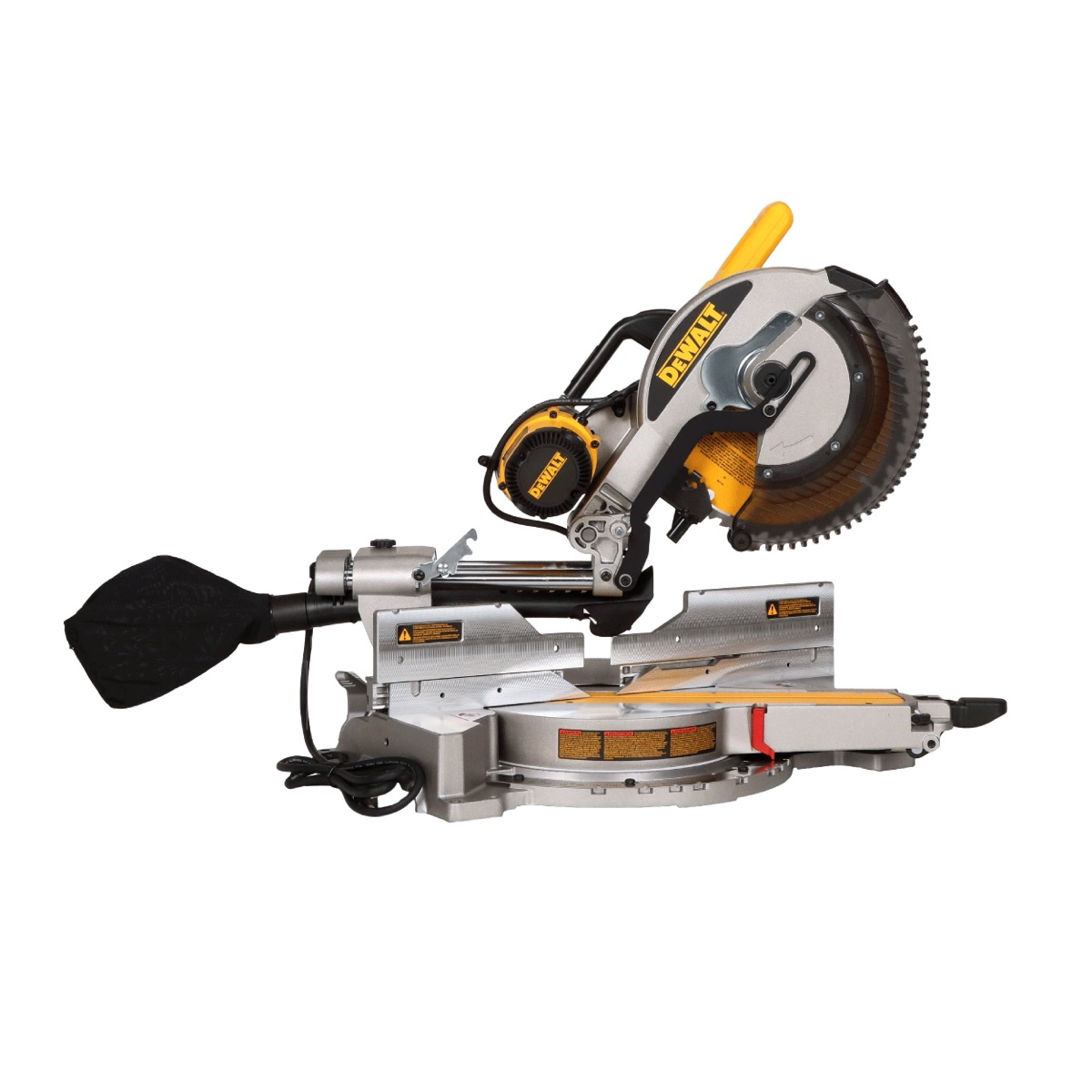
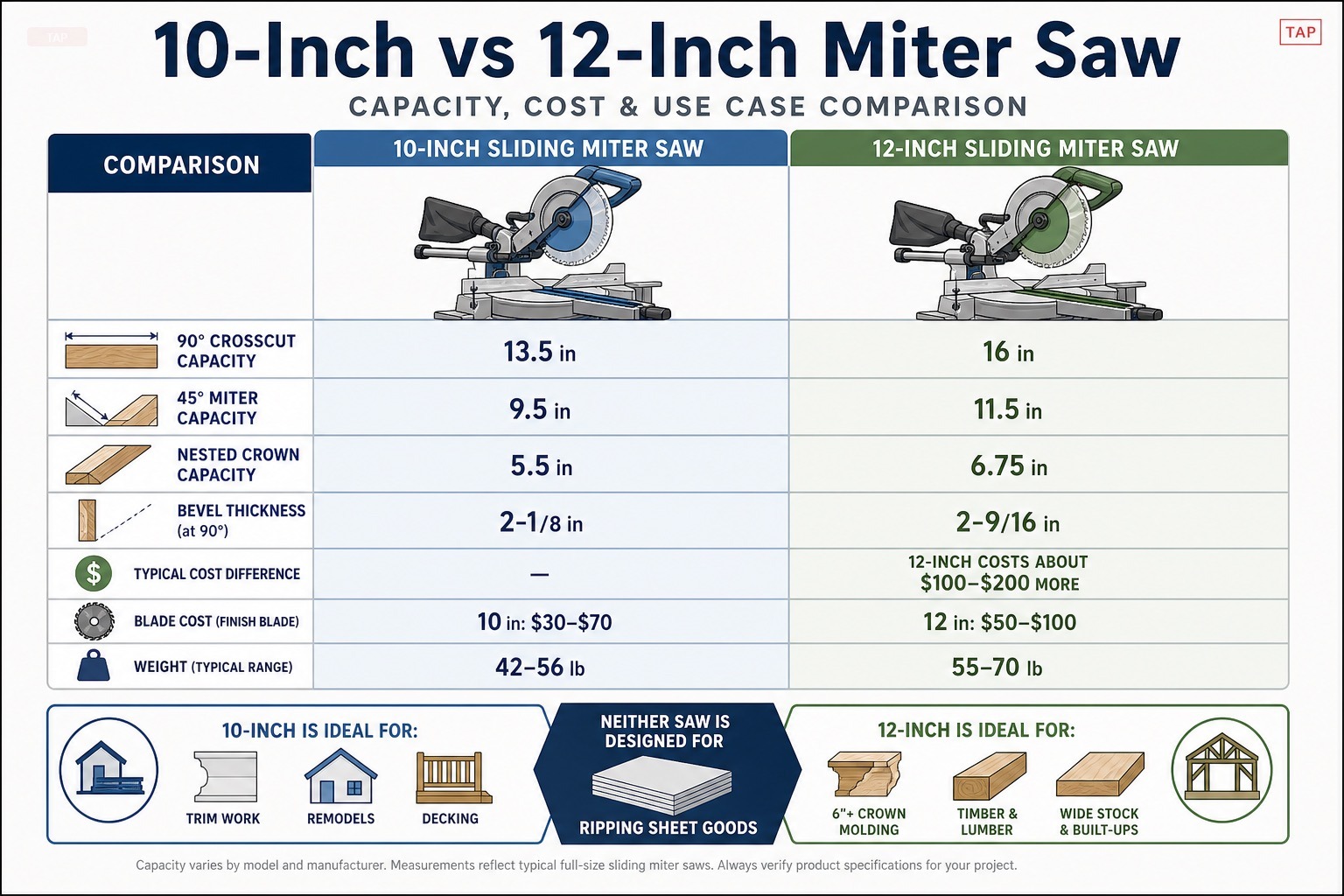
A 10-inch sliding compound miter saw crosscuts a 2x6 at 90 degrees and a 2x4 at 45 degrees. A 12-inch sliding compound miter saw crosscuts a 2x8 at 90 degrees and a 2x6 at 45 degrees. For most contractors and finish carpenters working with standard dimensional lumber, the 10-inch saw covers the work. The 12-inch earns its place in specific situations — wide-format crown molding, large timber framing, and production shops where cutting capacity directly limits throughput.
This guide compares the two blade sizes on cutting capacity, price, weight, blade cost, and practical trade applications.
The Core Difference: Cutting Capacity
Blade diameter determines maximum crosscut width and vertical height. Per manufacturer specifications across major brands (DeWalt, Milwaukee, Makita), the typical capacities for sliding compound models are:
| Cut Type | 10-Inch Sliding | 12-Inch Sliding |
|---|---|---|
| 90° crosscut | 13.5” | 16” |
| 45° miter crosscut | 9.5” | 11.5” |
| Vertical capacity (crown nested) | 5.5” | 6.75” |
| Bevel capacity (material thickness) | 2-1/8” | 2-9/16” |
What this means in practice: A 10-inch saw handles everything up to and including standard 2x10 dimensional lumber at 90 degrees. It cuts crown molding up to 5.5 inches wide nested against the fence. For rough framing with dimensional lumber, trimming 4x4 posts, and installing standard interior trim profiles, the 10-inch covers the entire scope.
A 12-inch saw adds capacity for 2x12 decking boards, wide-format crown (6 inches and above), and large-format baseboard profiles over 5 inches. If the work routinely involves cutting material wider than what a 10-inch slide allows, the 12-inch is the correct choice. If the work rarely or never hits that ceiling, the extra capacity costs money and weight without adding production value.
Price Comparison
Per current market pricing, 12-inch sliding compound miter saws cost approximately $100–$200 more than equivalent 10-inch models from the same brand:
| Model | Size | Price Range |
|---|---|---|
| DeWalt DWS779 | 10-inch sliding | $350–$450 |
| DeWalt DWS780 (XPS light) | 10-inch sliding | $500–$600 |
| Milwaukee 6955-20 | 10-inch sliding | $350–$450 |
| Makita LS1040 | 10-inch | $300–$400 |
| DeWalt DHS790AT2 | 12-inch sliding | $550–$700 |
| Makita LS1019L | 12-inch sliding | $600–$750 |
DeWalt DWS779 on Amazon → DeWalt DWS780 on Amazon → Milwaukee 6955-20 on Amazon → Makita LS1019L on Amazon →
The price premium for the 12-inch is justified when the added cutting capacity is used regularly. For a trim carpenter who rarely exceeds 5-inch stock width, the 12-inch premium purchases capacity that sits idle.
Blade Cost and Availability
Per retail pricing, 10-inch finish blades are more widely stocked and less expensive than 12-inch equivalents:
| Blade Type | 10-inch | 12-inch |
|---|---|---|
| General framing (24T) | $15–$35 | $25–$50 |
| Finish crosscut (60T–80T) | $30–$70 | $50–$100 |
| Fine finish (80T–96T) | $50–$90 | $80–$150 |
The 10-inch blade has a larger selection at every price tier. A quality 10-inch finish blade (Freud LU87R010, Diablo D1080X) costs $40–$60; the 12-inch equivalent costs $70–$100. Over the life of a saw with regular blade replacement, the cost difference compounds. For production shops running multiple blades per year, 10-inch blades are meaningfully cheaper to operate.
Weight and Portability
Per manufacturer specifications, 10-inch sliding compound miter saws weigh 42–56 lbs. 12-inch models weigh 55–70 lbs:
| Model | Size | Weight |
|---|---|---|
| Milwaukee 6955-20 | 10-inch | 42 lbs |
| DeWalt DWS779 | 10-inch | 56 lbs |
| DeWalt DHS790 | 12-inch | 56 lbs |
| Makita LS1019L | 12-inch | 65.7 lbs |
For contractors who transport the saw to job sites daily — loading it into a van, carrying it into the work area, setting it on a stand — the weight difference is tangible across a full work week. For permanent shop installations where the saw never moves, weight is irrelevant.
Motor Power
Per manufacturer specifications, 12-inch saws typically carry higher-amperage motors to drive the larger blade:
| Size | Typical Amperage |
|---|---|
| 10-inch corded | 12–15 amps |
| 12-inch corded | 15 amps |
The practical difference is noticeable in hardwoods and thick stock — a 15-amp 12-inch motor maintains blade speed better through a 4-inch oak beam than a 12-amp 10-inch motor. For softwood framing and trim, the 10-inch motor is fully adequate. For production cutting of hardwood furniture parts or heavy timber, the 12-inch motor headroom matters.
Which Saw by Application
Framing and rough carpentry: 10-inch. Per WWPA dimensional lumber standards, the widest common framing lumber is a 2x12 (actual 11.25”). A 10-inch sliding saw crosscuts a 2x12 at 90 degrees. For most dimensional lumber framing tasks, a 10-inch sliding saw is sufficient.
Interior finish carpentry (baseboard, casing, door frames): 10-inch. Standard baseboard profiles run 2-1/4 to 4-1/2 inches. Door casing runs 2-1/4 to 3-1/2 inches. All standard interior trim profiles fit within the 10-inch saw’s miter capacity. A 12-inch adds nothing for standard trim work.
Crown molding: Depends on profile width. Standard residential crown (Colonial, cove, ogee) runs 3-1/2 to 5-1/4 inches wide. A 10-inch sliding saw cuts all standard residential crown profiles nested against the fence. Wide-format architectural crown (6 inches and above, common in commercial and high-end residential) requires a 12-inch saw or the compound cutting technique (crown flat on the table rather than nested), which demands careful setup.
Deck construction: 10-inch. Standard deck framing uses 2x6 through 2x12 lumber, all within 10-inch crosscut capacity. Wide decking boards (5/4 × 6) are 5.5 inches actual — within 10-inch range.
Timber framing and large-format lumber: 12-inch. Timber frame construction uses 6x6, 6x8, and larger stock. A 10-inch saw cannot crosscut a 6x6 (5.5-inch actual) at a compound angle in a single pass. A 12-inch sliding saw with 16-inch crosscut capacity handles 6x6 and most timber frame joinery cuts directly.
Production cabinet and millwork shops: Application-dependent. If the miter saw rarely sees stock wider than 6 inches, a 10-inch is the more economical choice. If the shop regularly crosscuts wide solid-wood drawer fronts or large-format panel components, a 12-inch earns its cost.
Who Should Buy the 10-Inch
- Residential finish carpenters installing baseboard, casing, and standard crown
- Remodelers who move the saw between job sites
- Anyone whose widest regular cut is a 2x8 or standard trim profile
- Buyers who want lower blade replacement costs over the long term
- Contractors who already own a collection of 10-inch finish blades
Who Should Buy the 12-Inch
- Trim carpenters who regularly cut wide-format crown (6”+) or large architectural profiles
- Timber framers and post-and-beam builders
- Production shops cutting wide solid-wood stock
- Contractors whose work frequently requires crosscutting 2x10 and 2x12 at compound angles where the 10-inch slide runs short
Who This Is NOT For
- Anyone considering a non-sliding compound saw. A non-sliding 10-inch saw crosscuts approximately 6–8 inches at 90 degrees — it cannot handle a 2x6 flat. For framing and trim work, a sliding compound model is the minimum. Non-sliding saws are only appropriate for repetitive short crosscuts where the narrow capacity matches the stock.
- Occasional DIY buyers. A 7-1/4-inch or 8-1/2-inch sliding miter saw (often under $200) handles most occasional-use applications at lower cost and weight. Buying a full 10-inch or 12-inch professional saw for infrequent projects is over-capitalized for the use case.
- Buyers expecting sheet goods capability. Neither a 10-inch nor 12-inch miter saw is a substitute for a portable table saw or track saw for ripping plywood and sheet stock. Miter saws are crosscut tools; their depth of cut perpendicular to the fence is 2–3 inches, not suitable for full sheets.
Related Guides
- Best Miter Saws for Contractors — full model comparison with specs on top sliding compound saws in both sizes
- Best Miter Saw Stands — roller extension and folding stands rated for 10- and 12-inch saw weights
- Bosch T4B vs DeWalt DWX726 Miter Saw Stand — the two most-compared jobsite stands head-to-head
- Best Portable Table Saws — for ripping operations that miter saws cannot perform
- Best Track Saws for Contractors — for breaking down sheet goods on site
Sources
- DeWalt DWS779 and DWS780 product specifications (dewalt.com)
- Milwaukee 6955-20 product specifications (milwaukeetool.com)
- Makita LS1019L and LS1040 product specifications (makitatools.com)
- Western Wood Products Association (WWPA) — dimensional lumber actual size standards
- Freud and Diablo blade specification sheets — 10-inch and 12-inch finish blade pricing and tooth counts