Best Miter Saws for Contractors in 2026
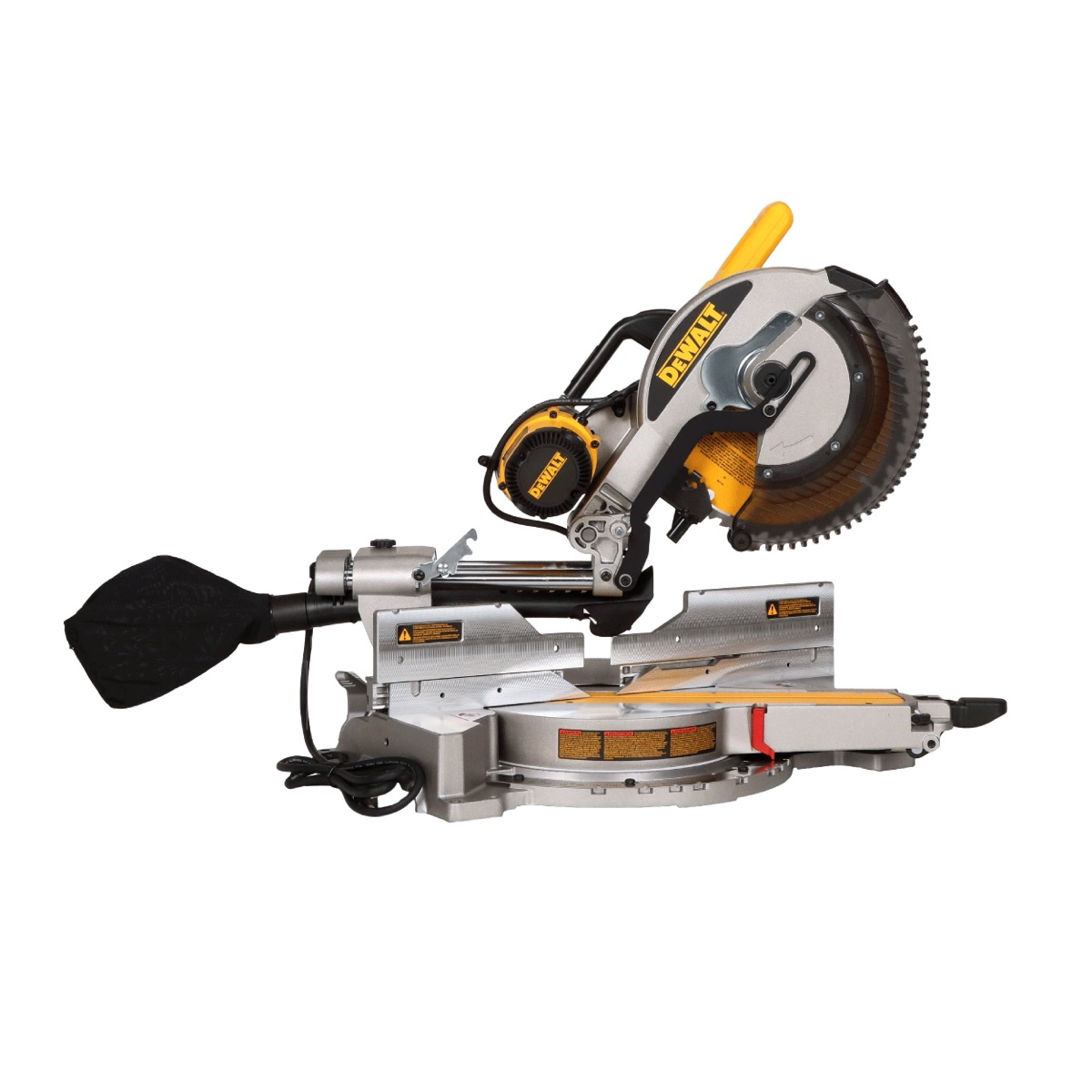
Quick Comparison: Four 12-Inch Sliders
| Model | Crosscut at 90° | Weight | Dust Collection | Warranty | Price |
|---|---|---|---|---|---|
| DeWalt DWS779 | 13-7/8” | 56 lbs | 30-40% captured | 3 years | $380–$430 |
| Bosch GCM12SD | 14” | 65 lbs | Standard bag | 1 year | $600–$700 |
| Milwaukee 6955-20 | 13-3/4” | 56 lbs | ~75% captured | 5 years | $550–$650 |
| Metabo HPT C12RSH2S | 12-5/16” | 47.4 lbs | Standard bag | 5 years | $350–$420 |
If you only read one paragraph: The DeWalt DWS779 is the right call for most contractors — it’s the most widely owned jobsite miter saw in the US for a reason, parts are everywhere, and the XPS shadow-line system doesn’t need calibration. The Milwaukee 6955-20 is worth the premium if dust collection matters (interior remodels, finished spaces). The Metabo HPT C12RSH2S is the pick for contractors who move saws daily and need every pound off the truck.
A miter saw is the centerpiece of trim carpentry, framing, and finish work. For contractors running one daily, the differences between models show up in cut accuracy, dust collection, fence systems, and long-term reliability under jobsite abuse. This guide compares 12-inch sliding compound miter saws — the standard for professional work — based on manufacturer specifications and published performance data. For rip cuts and sheet goods, pair a miter saw with a track saw for a complete cutting solution.
Why 12-Inch Sliding Compound
Per manufacturer specifications, 12-inch sliding compound miter saws crosscut 12–16 inches at 90 degrees — wider than any 10-inch model — and the sliding action extends capacity beyond what a fixed-head saw can reach. Three reasons this configuration dominates contractor use:
- 12-inch blade: Cuts wider stock than 10-inch models. Per manufacturer specs, 12-inch sliders typically crosscut 12-16 inches at 90 degrees
- Sliding action: Extends crosscut capacity beyond what a fixed-head saw can reach
- Compound capability: Allows simultaneous bevel and miter angles for crown molding and complex joinery
10-inch saws are lighter and less expensive, but most contractors standardize on 12-inch for the capacity to handle wider trim, 2x12 lumber, and 4x4 posts without repositioning.
Key Specifications
Crosscut capacity at 90°: The maximum horizontal board width the saw can cut in a single pass. Per manufacturer documentation, 12-inch sliders typically range from 12” to 14” horizontal crosscut. This is the most important spec for cutting wide baseboard, crown molding stacked flat, and wide trim stock — verify it matches the widest piece you cut regularly.
Bevel range and stops: Dual-bevel saws tilt in both directions (left and right), eliminating the need to flip crown molding for compound cuts. Per trim carpentry standards, dual-bevel capability saves significant setup time on crown molding runs. Positive bevel stops at 33.9° and 45° are the critical angles for spring-angle crown.
Fence height: The vertical fence behind the blade determines the maximum crown molding height that can be nested (stood vertically against the fence) for cutting. Per manufacturer specs, 6-5/8” to 7-1/2” vertical fence capacity covers most residential crown profiles.
Detent system: The miter detent plate controls how precisely the saw snaps to and holds common angles (0°, 15°, 22.5°, 31.6°, 45°). Stainless steel detent plates with positive stops hold calibration under jobsite use; stamped steel plates loosen over time.
Top 12-Inch Sliding Miter Saws
DeWalt DWS779 — Best Value for the Money
| Specification | Value |
|---|---|
| Blade Size | 12” |
| Motor | 15 Amp |
| No-Load Speed | 3,800 RPM |
| Crosscut at 90° | 13-7/8” (horizontal) |
| Crosscut at 45° | 9-1/2” |
| Bevel Range | 0-49° left, 0-49° right |
| Miter Range | 60° left, 50° right |
| Weight | 56 lbs |
| Warranty | 3 years |
| Price Range | $380-$430 |
According to DeWalt’s specifications, the DWS779 uses a cam-lock miter handle that adjusts quickly through common detent angles (0°, 15°, 22.5°, 31.6°, 45°). The tall sliding fence supports up to 6-5/8” base molding and 7-1/2” crown molding nested vertically. This saw outsells every other miter saw in its class per industry dealer reports.
Best for: Contractors who need reliable crosscut capacity without paying for features they won’t use. The DWS779 has been in production long enough that replacement parts and accessories are universally available.
Bosch GCM12SD — Best Cut Accuracy
| Specification | Value |
|---|---|
| Blade Size | 12” |
| Motor | 15 Amp |
| No-Load Speed | 3,800 RPM |
| Crosscut at 90° | 14” (horizontal) |
| Crosscut at 45° | 9-1/2” |
| Bevel Range | 0-47° left, 0-47° right |
| Miter Range | 52° left, 60° right |
| Weight | 65 lbs |
| Warranty | 1 year |
| Price Range | $600-$700 |
Bosch’s Axial-Glide system replaces traditional slide rails with a multi-axis articulating arm. Per Bosch’s documentation, this allows the saw to be placed flush against a wall — the head doesn’t extend behind the fence during cuts. The upfront accuracy out of the box is Bosch’s main differentiator, with the stainless steel miter plate and detent system producing repeatable angle settings.
Best for: Trim carpenters and finish workers where cut accuracy is paramount. The Axial-Glide system also saves space in tight workshop installations.
Milwaukee 6955-20 — Best Dust Collection
| Specification | Value |
|---|---|
| Blade Size | 12” |
| Motor | 15 Amp |
| No-Load Speed | 3,200 RPM |
| Crosscut at 90° | 13-3/4” (horizontal) |
| Crosscut at 45° | 9-1/2” |
| Bevel Range | 0-48° left, 0-48° right |
| Miter Range | 50° left, 60° right |
| Weight | 56 lbs |
| Warranty | 5 years |
| Price Range | $550-$650 |
According to Milwaukee’s specifications, the 6955-20 captures up to 75% of dust generated — significantly above the 30-50% typical of competing saws. The integrated dust channel directs material into the included bag or a shop vacuum connection. The constant-speed electronics maintain blade RPM under load, which per Milwaukee’s data, improves cut quality in hardwoods and composite trim.
Best for: Interior remodel contractors where dust control matters for occupied spaces. The 5-year warranty is the longest in this price class.
Metabo HPT C12RSH2S — Best Lightweight Option
| Specification | Value |
|---|---|
| Blade Size | 12” |
| Motor | 15 Amp |
| No-Load Speed | 3,800 RPM |
| Crosscut at 90° | 12-5/16” (horizontal) |
| Crosscut at 45° | 8-1/2” |
| Bevel Range | 0-45° left, 0-45° right |
| Miter Range | 57° left, 57° right |
| Weight | 47.4 lbs |
| Warranty | 5 years |
| Price Range | $350-$420 |
Per Metabo HPT’s specifications (formerly Hitachi), the C12RSH2S is the lightest 12-inch slider on the market at 47.4 lbs — nearly 20 lbs less than the Bosch. The laser marker system projects a cut line on the workpiece. Metabo HPT offers a 5-year warranty that includes a 30-day satisfaction guarantee with full refund.
Best for: Contractors moving the saw between jobsites frequently. The weight savings matter when loading and unloading from trucks daily.
Cut Capacity by Material: What Each Saw Actually Handles
Position specs on spec sheets describe maximum capacity at 90 degrees with no bevel. Real-world cutting adds bevel angles and stacked molding profiles that reduce effective capacity. This table shows what each saw handles across the materials contractors actually cut:
| Material | What 12” slider needs | DWS779 | GCM12SD | 6955-20 | C12RSH2S |
|---|---|---|---|---|---|
| 2×12 flat | 11.25” at 90° | ✓ | ✓ | ✓ | ✓ |
| 4×4 post at 90° | 3.5” × 3.5” | ✓ | ✓ | ✓ | ✓ |
| 4×4 post at 45° | Requires 5” capacity at 45° | ✓ | ✓ | ✓ | — |
| 5-1/2” base flat at 45° | 9.5”+ crosscut at 45° | ✓ | ✓ | ✓ | — |
| 7-1/4” crown nested vertical | 7.25” vertical fence height | ✓ | ✓ | ✓ | — |
| 10” wide crown flat | 13”+ at 90° | ✓ | ✓ | ✓ | — |
| 12” wide base/casing flat | 13”+ at 90° | ✓ | ✓ | ✓ | — |
The Metabo HPT trade-off: The C12RSH2S’s 12-5/16” crosscut capacity handles the large majority of residential trim work, but misses 4×4 posts at 45° and wide crown lying flat. Contractors cutting complex crown or 4×4 structural posts regularly should step up to the DWS779 or Milwaukee for the extra crosscut reach.
Miter Saw by Contractor Type
Trim carpenters and finish contractors Crown molding, casing, baseboard, chair rail — the miter saw runs all day. Per contractor practice, the relevant specs are fence height (to nest crown vertically), dual-bevel capability (to avoid flipping molding), and detent accuracy (to hold exact angle through an entire room run). The Bosch GCM12SD is the trim carpenter’s preference for cut accuracy — the Axial-Glide system eliminates the rear rail extension that causes placement problems in tight spaces, and the stainless steel miter plate holds calibration through daily use. The DeWalt DWS779 is the value alternative when the Bosch’s $600+ price point is hard to justify.
Framing contractors Dimensional lumber cuts — 2×4, 2×6, 2×12, LVL headers, rafter tails, hip and valley angles. The miter saw runs fast and rough, not precise. The relevant spec is crosscut capacity and blade speed, not finish quality. The DeWalt DWS779 or Metabo HPT C12RSH2S both cover standard framing lumber; the Metabo’s lighter weight matters when the saw moves between jobsites daily. Blade choice at the framing stage: 40-tooth general-purpose, not 80-tooth finish.
General contractors and remodelers Mixed-use: rough framing early in a project, trim work at the end. One saw has to do both. For GCs, the DeWalt DWS779 is the standard choice — wide parts availability, 13-7/8” crosscut handles most situations, and the XPS shadow-line system is accurate enough for finish work. Dust collection is not a primary concern at the rough stage, which makes the Milwaukee 6955-20’s premium less justified unless the bulk of work is interior remodel in finished spaces.
Interior remodel contractors (kitchens, baths, occupied spaces) Dust is a constant conflict with homeowners and finished surfaces. The Milwaukee 6955-20 capturing 75% of generated dust per manufacturer specifications is a material operational advantage — less cleanup time, fewer complaints, and reduced plastic sheeting requirements. The 5-year warranty also reflects Milwaukee’s confidence in the saw’s longevity. Price premium over the DWS779 is $120–$220 at street price.
Mobile trim crews (multiple jobsites daily) The Metabo HPT C12RSH2S at 47.4 lbs is nearly 20 lbs lighter than the Bosch GCM12SD and 9 lbs lighter than the DWS779. That difference is meaningful when the saw loads and unloads from a truck bed daily and climbs stairs on multi-story finish jobs. The crosscut limitation at wide crown or 4×4 posts at 45° is the trade-off that limits this pick to crews whose cut profile stays in the mainstream residential range.
Cordless Miter Saws
Jobsites without a reliable 120V drop, upper-floor trim-out, and crews already deep in FLEXVOLT or M18 are a different buying problem than the corded 12-inch sliders above. Dual-power adapters, cuts-per-charge ratings, pack count, and platform lock-in are compared in the cordless miter saws guide.
Corded remains the lower-cost, unlimited-runtime choice for shop use and high-volume production cutting (400+ cuts in a day). A cordless 12-inch kit typically runs $550–$850 versus $350–$700 for the corded saws in this article.
Blade Recommendations by Application
The miter saw blade determines cut quality more than the saw itself. Stock blades that ship with most miter saws are 40-tooth general-purpose — designed for speed over finish quality. Per blade manufacturer data:
| Application | Blade Spec | Why |
|---|---|---|
| General framing | 40T, ATB, 12” | Speed; edge quality doesn’t matter |
| Finish trim, soft wood | 60–80T, ATB, 12” | Clean exit cut, minimal tearout |
| Hardwood trim | 80T, TCG, 12” | Alternate top grind reduces chipping in oak/maple |
| Laminate flooring | 80T, TCG | Prevents face chipping on melamine coating |
| MDF and composite | 80T, ATB | Fewer teeth clog with MDF dust; more teeth = cleaner cut |
| Aluminum threshold | Non-ferrous 60–80T | Standard wood blades overheat and grab on aluminum |
Check Freud Diablo 12-inch 80T finish blade on Amazon →
Check Freud Diablo 12-inch 40T framing blade on Amazon →
Comparison Summary
| Model | Crosscut Capacity | Weight | Warranty | Price |
|---|---|---|---|---|
| DeWalt DWS779 | 13-7/8” | 56 lbs | 3 years | $380-$430 |
| Bosch GCM12SD | 14” | 65 lbs | 1 year | $600-$700 |
| Milwaukee 6955-20 | 13-3/4” | 56 lbs | 5 years | $550-$650 |
| Metabo HPT C12RSH2S | 12-5/16” | 47.4 lbs | 5 years | $350-$420 |
Stand Selection Matters
According to industry data, most contractors pair a miter saw with a portable stand that includes extension arms (8’ minimum reach per side), a quick-mount system for tool-free setup, folding legs with wheels for one-person transport, and 300+ lb weight capacity. For a full model comparison, see the miter saw stands guide.
- Extension arms: Adjustable material supports for long stock (8’ minimum reach per side)
- Quick-mount system: Tool-free saw attachment for setup/breakdown speed
- Wheels: Folding legs with wheels for one-person transport
- Weight capacity: 300+ lbs to handle the saw plus heavy stock
Expect to spend $150-$350 on a quality stand. DeWalt DWX726, Bosch T4B, and Milwaukee 48-08-0561 are the brand-matched options, though universal stands work across brands.
Who This Is NOT For
- Hobbyists cutting fewer than 100 cuts per month. A 10-inch non-sliding miter saw ($150-$250) handles occasional work without the weight, cost, and space of a 12-inch slider
- Shops with a dedicated radial arm saw or panel saw. These stationary tools outperform portable miter saws for repetitive production cuts in a fixed location
- Primarily rough framing work. For 2x4 and 2x6 framing cuts where precision is less critical, a circular saw with a speed square is faster and more portable
- Tight budgets under $300. Sub-$300 12-inch miter saws exist but typically have shorter crosscut capacities, weaker fences, and poor dust collection that costs time on the job
What You’ll Also Need
- Miter saw blade — 10 inch, 80 tooth crosscut — The stock blade on most 10-inch miter saws is a 40T general-purpose blade that leaves rough edges on hardwood and finish trim. An 80-tooth crosscut blade produces a near-zero-tearout cut on oak, poplar, and painted trim, reducing sanding and touch-up time significantly. Search: “miter saw blade 10 inch crosscut 80 tooth,” “Freud miter saw blade 10 inch.” Check price on Amazon →
- Miter saw blade — 12 inch, 80 tooth — For 12-inch miter saws, an 80-tooth fine crosscut blade handles crown molding, casing, and hardwood trim at finish quality. Stock 12-inch blades are typically 40-60T and optimized for speed rather than edge quality on finish materials. Search: “miter saw blade 12 inch 80 tooth,” “12 inch fine crosscut miter blade.” Check price on Amazon →
- Dust bag replacement — Miter saw dust bags fill quickly during production cutting and require emptying or replacement to maintain adequate suction. A replacement bag in the truck prevents a full bag from forcing an early stop on a trim-out day. Search: “miter saw dust bag replacement,” “miter saw dust collection bag.” Check price on Amazon →
- Blade wrench replacement — The blade change wrench is a small, easily misplaced tool that is required for every blade swap. A spare wrench in the tool bag prevents a missing wrench from delaying a blade change. Search: “blade wrench replacement miter saw,” “miter saw blade change wrench.” Check price on Amazon →
- Miter saw laser replacement / alignment kit — The laser guide on most miter saws requires periodic calibration or bulb replacement as the module ages. A replacement laser kit extends the life of the cut-line guide without replacing the entire saw. Search: “miter saw laser replacement kit,” “miter saw laser alignment tool.” Check price on Amazon →
- Freud Diablo 10-inch miter saw blade — combination — A 60-tooth combination blade bridges the gap between speed and finish quality for contractors cutting both dimensional lumber and finish trim in the same session. The Diablo line is widely regarded as the best value in the thin-kerf miter saw blade category per third-party user data. Search: “Freud Diablo miter saw blade 10 inch combination,” “Diablo thin kerf 10 inch miter blade.” Check price on Amazon →
Sources
- DeWalt DWS779 specifications (dewalt.com)
- Bosch GCM12SD product documentation (boschtools.com)
- Milwaukee 6955-20 specifications (milwaukeetool.com)
- Metabo HPT C12RSH2S product data (metabo-hpt.com)
- OSHA miter saw safety standards (29 CFR 1926.304)