How Do Auto-Darkening Welding Helmets Work?
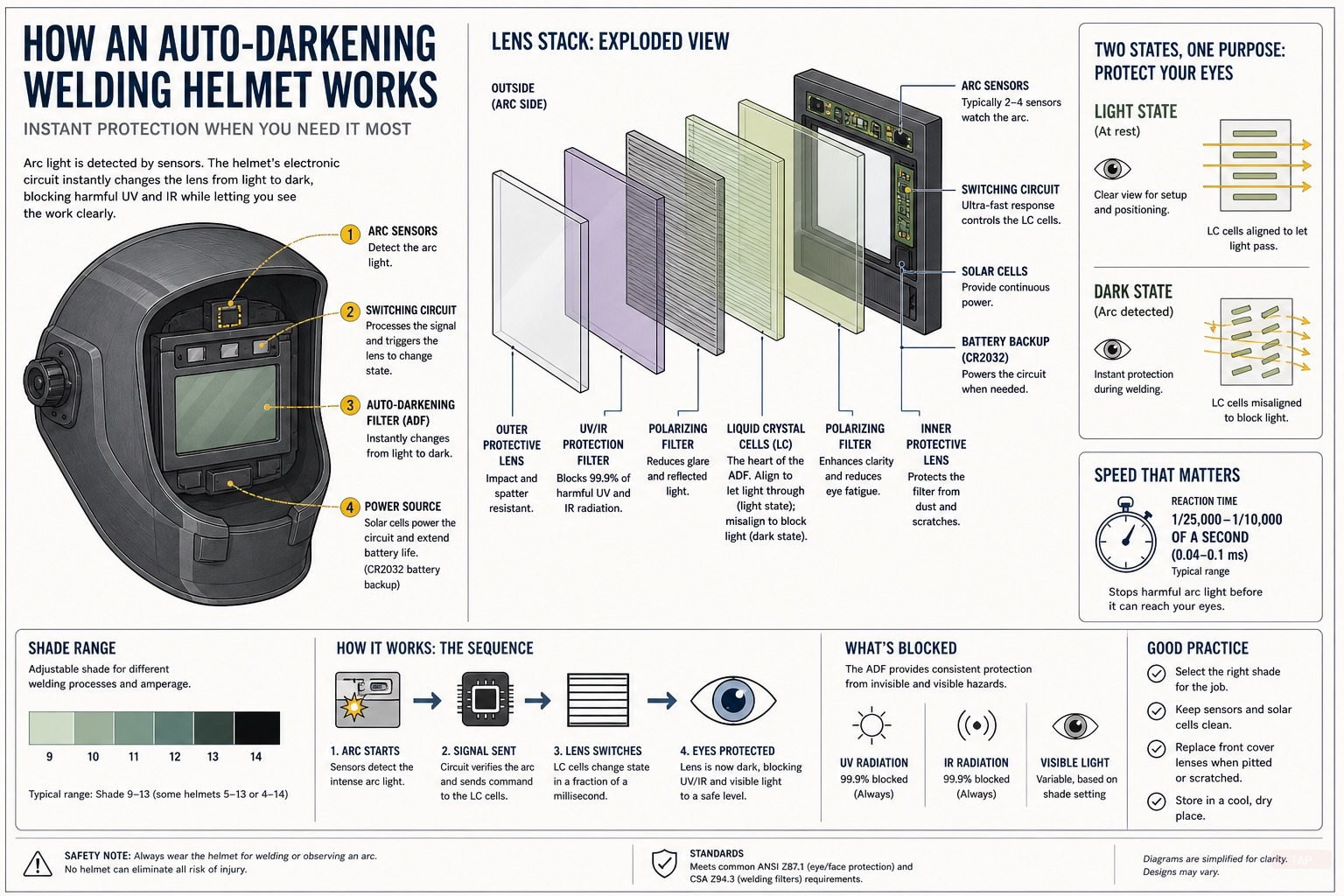
An auto-darkening welding helmet keeps a UV and IR filter in front of the eyes at all times, and it adds a liquid-crystal shutter that drops the visible shade when sensors see an arc. Lincoln, Miller, ESAB’s Sentinel A60, and Hobart publish a light-to-dark time of 1/25,000 second (0.04 millisecond) for the models on the buying page. If the battery dies, UV and IR filtration remains, and the visible lens can stay light — stop welding if it does not darken. Named helmets and prices are on the best auto-darkening welding helmets page. This page stays on the mechanism.
| Constraint | What actually gates it |
|---|---|
| Process | Shade follows amperage. MIG, TIG, and stick set the row before the helmet does |
| Sensors | Two can miss in a corner; four overlap. A dead battery misses with any count |
| Visible shade | Light state about 2.5–4 between arcs; dark state usually 9–13 for arc work, lower if the dial offers it |
| UV/IR | Always in the stack, including the light state and the unpowered state, per ANSI/ISEA Z87.1 |
| Optics | EN379 1/1/1/1 is the top of the four-digit class; it is not the same test as UV/IR |
The filter stack: LCD plus a UV/IR layer that never switches
The window is a stack, not a single piece of green glass.
-
UV/IR filter. This layer blocks ultraviolet and infrared whether the lens looks light or dark. It does not need power. ANSI/ISEA Z87.1 section 7.2.3.2 says that, measured in the lightest state, the filter must meet the UV and IR limits of its darkest marked shade, and that the UV/IR filters must be built in so the user cannot take them out. Lincoln’s Viking 3350 manuals state the same idea in product language: protection up to shade DIN 16 at all times, in both the light state and the dark state.
-
Polarizers. Two polarizing films set the path visible light has to take. On their own they would hold a fixed transmission.
-
Liquid-crystal cell. The crystals sit between those polarizers and rotate when a voltage is applied, which changes how much visible light passes. That is the shade you dial. The light state on helmets in the companion roundup runs from shade 2.5 (Miller Digital Infinity ClearLight 4x) to about shade 4. The dark state is the process shade, commonly somewhere in 5–13.
-
Switching circuit. Sensors trip the circuit, and the circuit drives the cell. Lincoln, Miller, ESAB’s Sentinel A60, and Hobart’s Inventor 770890 publish 1/25,000 second, or 0.04 millisecond, for that light-to-dark step. Those are manufacturer figures. They are not a single number printed by ANSI as “the” requirement.
The light state is bright enough to find the joint and dark enough that the permanent UV/IR layer is already doing its job before the arc. When the arc stops, the cell returns to the light state after the delay you set. Light-to-dark is the fast direction. Dark-to-light is deliberately slow so the puddle’s afterglow does not flash the eyes between tacks.
Arc sensors
The trigger is optical. Photodetectors in the lens housing watch for the bright visible spike of an arc. They are not listening, and they are not measuring heat. A sensitivity dial sets how much light counts as an arc. High sensitivity catches a small TIG arc and also chatters in sun, from a neighbor’s arc, or off a shiny bench. Low sensitivity ignores that clutter and can miss the same small TIG arc.
| Sensors | What the geometry does |
|---|---|
| 2 | One blocked window — joint, torch, or arm — can leave the lens light |
| 4 | Overlapping angles from around the lens; the usual professional layout |
ESAB’s own helmet guidance describes four sensors as the arrangement that still sees an arc out of position, and two sensors as the hobby layout that misses those angles. The current Lincoln Viking 3350, Miller Digital Infinity, ESAB Sentinel A60, Hobart 770890, and YesWelder LYG-M800H sheets each list four. Sensor count on a specific model belongs to the roundup; the point here is why the count exists.
X-Mode on the Miller Digital Infinity adds electromagnetic sensing of the weld, which is how that helmet deals with sunlight that fools a photodetector. It is an extra channel, not a fifth optical window.
Spatter or a filthy cover plate in front of a sensor is the ordinary shop failure. The electronics can be fine and the lens still stays light because the detector is looking at a dirty plate.
Shade range and the process
Shade numbers are a logarithmic visible-light scale. Higher shade, less visible light. AWS Fact Sheet No. 31, adapted from the AWS F2.2 lens shade selector, is the table to use. Numbers are a guide. Start darker than the puddle and lighten until the joint is visible, without dropping below the minimum.
| Process | Current | Minimum | Suggested |
|---|---|---|---|
| MIG / flux-core | Under 60 A | 7 | — |
| MIG / flux-core | 60–160 A | 10 | 11 |
| MIG / flux-core | 160–250 A | 10 | 12 |
| MIG / flux-core | 250–500 A | 10 | 14 |
| Stick | Under 60 A | 7 | — |
| Stick | 60–160 A | 8 | 10 |
| Stick | 160–250 A | 10 | 12 |
| Stick | 250–550 A | 11 | 14 |
| TIG | Under 50 A | 8 | 10 |
| TIG | 50–150 A | 8 | 12 |
| TIG | 150–500 A | 10 | 14 |
A helmet whose dark dial starts at 9 can hit the suggested MIG and stick shades in the middle rows and the suggested shade 10 for TIG under 50 A. It cannot be set to shade 8 if that lighter minimum is the one that shows the puddle. A dial that starts at 5 (Lincoln Viking 3350 publishes DIN 5–13) covers that lighter step. Which model publishes which dial is on the roundup. Which process you are actually running is on MIG vs TIG vs stick. Flux-core shares the MIG rows of this chart; the wire decision is on MIG vs flux-core.
The light state (about 2.5–4) is not a welding shade. It is the between-arc view. Plasma and air-carbon-arc cutting have their own rows on the same AWS chart; a “weld” range of 9–13 does not automatically include them.
Reaction time and delay time
These are different clocks.
- Reaction time (switching index, light to dark) is how fast visible transmission falls after the arc is detected. Shorter protects the eyes from the visible flash at the start of the weld. Lincoln’s current Viking 3350 listing and Miller’s ClearLight 4x page both print 1/25,000 second. ESAB prints 0.04 millisecond for the Sentinel A60, which is that same interval. Older “1/20,000 second” figures for the Viking do not match Lincoln’s current listing.
- Delay (dark to light) is how long the lens holds the dark shade after the arc stops. Typical published ranges are on the order of 0.1 second to about 1 second. Longer delay covers a bright puddle and a short pause in the middle of a bead. Shorter delay helps when you are tacking and need to see the part between strikes.
ANSI/ISEA Z87.1 does not publish one reaction-time number for every helmet. Section 7.2.3.3 and Table 12 set a maximum switching index, in milliseconds, for each pair of light shade and dark shade, checked at cold, room, and hot temperatures. A manufacturer figure of 0.04 millisecond sits inside those maxima for ordinary shade pairs. Meeting the table is the certification bar. Advertising 1/25,000 second is a separate, tighter claim, and it has to be read off that model’s sheet.
A slow lens can still be inside Table 12 and still be a poor choice for a small TIG arc, because the sensor may not be the thing that trips in time even when the cell itself can switch quickly. Sensitivity and sensor aim matter as much as the switching-index number.
Power, and what fails when the cell is dead
Most hoods in current professional lines combine a solar cell with a replaceable lithium coin cell (CR2450 on the Lincoln, Miller, ESAB A60, and YesWelder manuals in the roundup). The solar cell extends the battery. It is not a promise that the helmet runs with the battery removed. A low-battery lamp is the warning, on the order of days of life on Miller’s Digital Infinity manuals, not a surprise mid-bead if you watch it.
UV/IR and the visible shade split when power fails.
ANSI/ISEA Z87.1 tests UV and IR in the lightest state, powered or unpowered, against the darkest shade’s UV and IR limits. Lincoln states UV/IR protection up to DIN 16 at all times in both states, and lists a low battery among the reasons the filter does not darken. Miller states continuous UV and IR protection at all shades, and the troubleshooting line is explicit: if the auto-lens stays light and will not darken, stop welding immediately, then check power, sensitivity, and whether the sensors can see the arc.
That is the rule this site uses on both helmet pages. A dead battery can leave the visible shade in the light state. It does not remove the UV/IR filter. It also does not make the visible arc safe. Stop. Replace the cell. Confirm the lens darkens on a test — Lincoln describes a sensor-cover test and a striker test — before the next weld. A design that locks visually dark on an electronic fault would have to say so in that model’s manual. It is not the ANSI requirement, and it is not what these Lincoln and Miller troubleshooting tables describe.
The same split is why “unprotected” is the wrong word for a dead battery, and why “the lens stays dark, so keep welding” is the wrong instruction. UV and IR are still filtered. The visible flash is not.
EN379 optical class
EN 379’s four-digit code is scored 1 to 3 on each digit, 1 best. The order is fixed:
- Optical class — refractive power, the distortion of the view.
- Diffusion of light — scatter, the haze in the view.
- Variation in luminous transmittance — whether one region of the lens passes more light than another.
- Angle dependence — whether the shade changes as you look off-axis.
1/1/1/1 is the top of that scale. 1/1/1/2 means the first three are at the top and angle dependence is one step down, so the shade shifts more as the eye moves toward the edge. Miller’s Digital Infinity series spec sheet AY/42.5 prints 1/1/1/2 for the ClearLight 4x lens. Lincoln’s Viking 3350 listing and ESAB’s Sentinel A60 page print 1/1/1/1. ClearLight, 4C, OpTCS, and PureColor are manufacturer names for color and brightness. They are not substitutes for the four digits.
Optical class is comfort and puddle readability over a long arc-on day. The UV/IR test is what stands between the arc and a photokeratitis or a retinal burn. A 1/1/1/2 lens that is marked to ANSI Z87.1 is still a welding filter. A 1/1/1/1 lens with an unmarked, uncertified stack is not a reason to skip the standard.
Grind mode
Grind mode locks the light state and turns the sensors off. Grinding sparks are bright enough to trip the shutter, and a lens that chatters between light and dark is useless for prep. With detection off, the shell can stay down for light grinding, chipping, and wire brushing at shade 2.5–4, depending on the model.
That light shade is not a welding shade, and grind mode is not automatically a heavy-grinding face shield. The impact marking has to cover the work. Switch the mode off before the next arc. If the lens still darkens on sparks, grind mode is not engaged.
What this means when you buy
Buy from the process, then from the sheet.
- The shade dial has to include the AWS suggested shade for the amperage, and the lighter minimum if you may need it.
- Four sensors for out-of-position work. Two sensors are a corner-risk.
- Read the reaction time off the manual when the product page disagrees with it.
- Read the EN379 digits off the spec sheet, not off a “true color” slogan.
- Plan on CR2450 cells and shell-matched cover plates. A dead cell is a visible-light problem you can prevent, with UV/IR still in place if you get caught once.
- Confirm the lens darkens before every session if the low-battery light has been on.
The model-by-model sheet — Lincoln Viking 3350, Miller Digital Infinity, ESAB Sentinel A60, Hobart 770890, and YesWelder LYG-M800H — is the best auto-darkening welding helmets roundup. If you have not chosen MIG, TIG, or stick, do that on MIG vs TIG vs stick or the welder quiz first. This page does not rank machines or helmets.
Frequently asked questions
How does an auto-darkening welding helmet work?
Arc sensors see the light from the arc and a switching circuit drives a liquid-crystal cell between polarizers. That cell changes how much visible light gets through, from a light state around shade 2.5–4 to the shade dialed for the weld. A separate UV and IR filter stays in the stack the whole time, light or dark, powered or not. The lens returns to the light state when the arc stops, after a delay the user can usually set.
What happens if the battery dies while welding?
UV and IR protection stays. ANSI/ISEA Z87.1 requires the filter, measured in its lightest state and even unpowered, to meet the UV and IR limits of the darkest marked shade, and that filter cannot be removed by the user. Lincoln states UV/IR protection up to shade DIN 16 at all times in both light and dark states. Miller states that all shades provide continuous UV and IR protection. The visible shade can stay light. Miller’s manuals say to stop immediately if the lens does not darken when the arc is struck, and Lincoln lists a low battery as a cause of that fault. A dead battery is not a locked-dark lens under those manuals, and it is not a loss of UV/IR filtration. Stop, replace the cell, and confirm the lens darkens before the next arc.
What shade should I use for MIG, TIG, and stick?
Use the AWS Fact Sheet No. 31 guide, adapted from AWS F2.2. MIG and flux-core at 60–160 A: minimum shade 10, suggested 11. TIG under 50 A: minimum 8, suggested 10. Stick at 60–160 A: minimum 8, suggested 10. Heavier arcs move the suggested shade to 12 or 14. Start darker than the puddle and lighten only until the joint is clear, without going under the minimum. Process choice is on the MIG vs TIG vs stick guide; helmets that can hit these shades are on the auto-darkening roundup.
Why do four sensors matter?
Each sensor is a photodetector aimed out through the lens housing. Two sensors leave a blind side when the joint, the torch, or an arm covers one of them, and the lens stays light. Four sensors, typically near the corners, overlap those angles. Four sensors still miss an arc if sensitivity is set too low, the cover plate is coated with spatter, or the battery is dead. Out-of-position and pipe work is where the extra sensors earn their place.
What does 1/1/1/1 optical class mean?
EN 379 prints four digits, each scored 1 (best) to 3. In order they are optical class, diffusion of light, variation in luminous transmittance, and angle dependence of luminous transmittance. A 1/1/1/1 filter is the top published class on all four. A 1/1/1/2 filter is one step worse on angle dependence, which shows up as shade shift when the eye is off the center of the lens. The score is an optical class, not a safety certification. UV and IR requirements are a separate ANSI test.
Are cheap auto-darkening helmets safe?
Safe enough to use means a helmet marked to ANSI/ISEA Z87.1, so the UV/IR test in the light state applies, plus a switch that actually darkens on the arc you strike. An unmarked bargain lid has no such claim to check. A marked helmet with a slow published reaction time, or with two sensors, can still meet the standard and still flash the welder on a low-amperage TIG arc or in a tight corner. For a named shortlist with those specs side by side, use the auto-darkening roundup.
Related
- Best auto-darkening welding helmets — the buying page for this mechanism
- MIG vs TIG vs stick — the process that sets the shade row
- MIG vs flux-core — same shade family, different wire
- Welder quiz — when the process is still open
Sources
- ANSI/ISEA Z87.1, sections 7.2.3.1 (luminous transmittance in light and dark states), 7.2.3.2 (UV and IR in the lightest state, powered or unpowered; filter not user-removable), and 7.2.3.3 with Table 12 (switching index by light-shade and dark-shade pair)
- Lincoln Electric Viking 3350 operator manuals and current product listing: UV/IR up to DIN 16 at all times in light and dark states; low battery as a cause when the filter does not darken; light-to-dark time 1/25,000 second
- Miller Electric Digital Infinity owner’s manuals and ClearLight 4x product page: continuous UV and IR protection at all shades; stop welding if the lens stays light; 1/25,000-second reaction time; spec sheet AY/42.5 optical class 1/1/1/2
- ESAB Sentinel A60 product page: four sensors, 0.04 millisecond switching, EN379 1/1/1/1, passive shade 3
- EN 379, automatic welding filters: four-digit class order (optical class, diffusion of light, variation in luminous transmittance, angle dependence)
- AWS Safety and Health Fact Sheet No. 31, Eye and Face Protection for Welding and Cutting Operations, shade guide adapted from AWS F2.2