Best Slip Rolls for Metal Fabrication in 2026
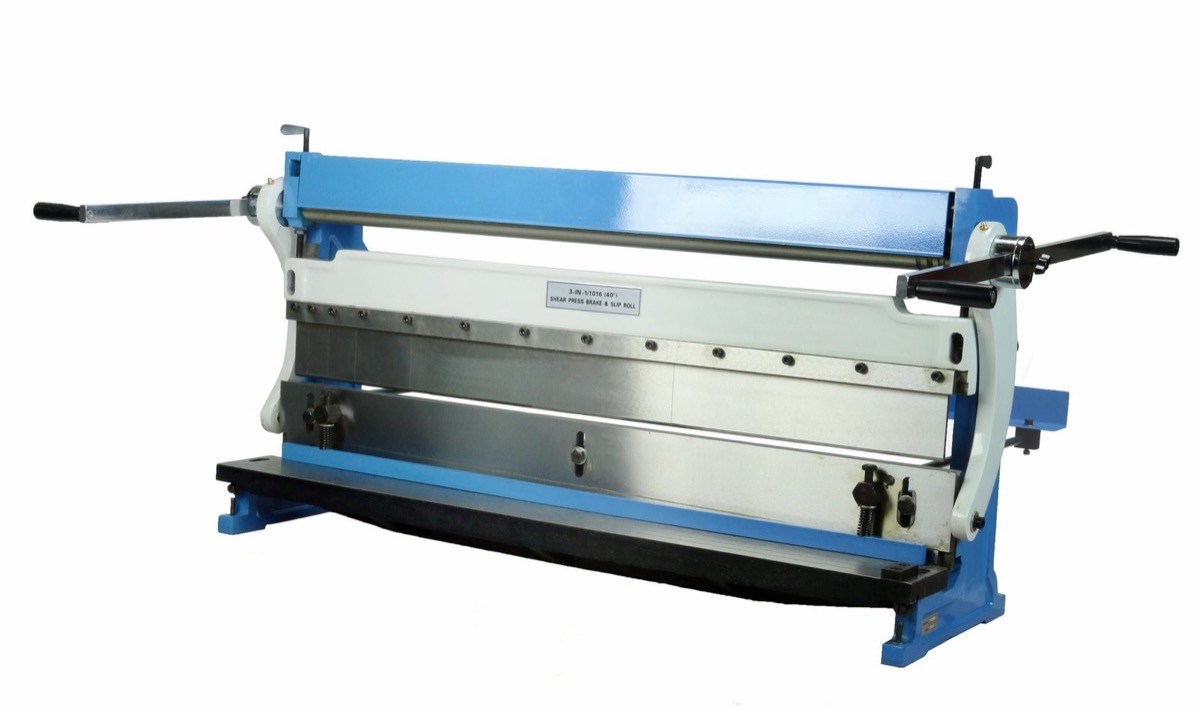
A slip roll (also called a plate roller or sheet metal roller) uses three parallel rolls to bend flat sheet stock into curves, cylinders, and cones. The two lower rolls grip the material and feed it forward; the adjustable upper roll defines the bend radius by pressing the sheet from above as it passes through. By making multiple passes with progressively lower upper roll settings, any radius from a gentle curve to a near-closed cylinder can be achieved in a single sheet.
For HVAC fabricators building round duct, weld shops forming cylindrical housings, and custom metal shops making curved panels and exhaust components, a slip roll is the tool that produces consistent curves without the kinking that results from using a brake or bending by hand.
3-Roll Slip Roll vs. 4-Roll Plate Roller: The Key Difference
Per fabrication equipment documentation:
| Type | Construction | Flat End | Best For |
|---|---|---|---|
| 3-roll slip roll | Two lower rolls, one upper | Yes — first inch doesn’t roll | Sheet metal, HVAC, cylindrical forms |
| 4-roll plate roller | Two lower, two upper | No — material bends end-to-end | Thick plate, pressure vessels |
A 3-roll slip roll has one inherent limitation: the leading and trailing edges of the sheet pass between the rolls without being formed, leaving a flat section approximately equal to the lower roll spacing. For round duct and cylinders, this flat spot must be planished out or the piece formed slightly oversized and the ends trimmed. For shops building HVAC ductwork and cylindrical tanks, this is a known and manageable limitation. 4-roll plate rollers eliminate the flat spot but cost significantly more and are sized for thicker plate than typical sheet metal shops handle.
Key Specifications
Working width: The maximum sheet width the machine can roll. HVAC round duct sections are typically 36”–48” wide; automotive and general fab work is often 24”–36”.
Material thickness capacity: Rated in gauge for mild steel. Aluminum rolls at approximately two gauges thicker than the steel rating for the same machine (a 16-gauge steel machine handles approximately 14-gauge aluminum). Stainless requires more force than mild steel of the same gauge — verify stainless capacity separately.
Roll diameter: Larger upper rolls produce a larger minimum bend radius. Per Machinery’s Handbook, the minimum achievable cylinder diameter is approximately 3–4× the upper roll diameter for thin material. A machine with a small upper roll achieves tighter cylinders; a large upper roll is more rigid under heavy sheets.
Upper roll release: The upper roll must be removable (or swingable) to extract completed cylinders that have been rolled closed. Without upper roll release, the completed ring cannot be removed from the machine. All quality slip rolls include this feature; verify before purchasing.
Cone forming: Some slip rolls taper the upper roll angle to form cone sections. This requires adjusting one end of the upper roll lower than the other, causing the sheet to curve more on one side than the other.
Top Slip Rolls by Specification
VEVOR 30” Manual Slip Roll — Best Budget Entry
| Specification | Value |
|---|---|
| Working Width | 30” |
| Capacity | 18-gauge mild steel |
| Upper Roll Diameter | 2-3/8” |
| Lower Roll Diameter | 2-3/8” |
| Upper Roll Release | Yes (swing-out) |
| Drive | Manual (hand crank) |
| Mount | Benchtop with clamp |
| Weight | 44 lbs |
| Price Range | $150-$250 |
Per VEVOR’s product specifications, this 30” manual slip roll handles 18-gauge mild steel — adequate for HVAC duct and light sheet metal work. The upper roll swing-out allows cylinder extraction. At 44 lbs, it mounts to a workbench with the included clamps. For shops doing occasional light-gauge rolling, this covers basic cylindrical form work at minimum investment. The manual crank requires more physical effort per pass than a geared machine; for thin material in short widths, this is not a practical issue.
Best for: Light fabrication shops and hobbyists forming 18-gauge and lighter sheet in widths up to 30”. HVAC contractors forming small-diameter round sections, and custom shops doing occasional curved panel work.
Limitation: 18-gauge steel maximum limits usefulness for structural applications. Manual operation becomes fatiguing for wide sheets and multiple passes. No geared mechanical advantage.
Grizzly H8149 30” Slip Roll — Best Mid-Range Manual
| Specification | Value |
|---|---|
| Working Width | 30” |
| Capacity | 16-gauge mild steel |
| Upper Roll Diameter | 2-1/8” |
| Lower Roll Diameter | 1-3/4” |
| Upper Roll Release | Yes |
| Cone Forming | Yes (adjustable taper) |
| Drive | Manual (geared crank) |
| Weight | 113 lbs |
| Warranty | 1 year |
| Price Range | $400-$600 |
Per Grizzly’s product documentation, the H8149 handles 16-gauge mild steel with a geared drive that provides mechanical advantage over a direct crank — reducing the effort required for stiffer material. The cone forming capability allows one end of the upper roll to be adjusted lower than the other for tapered cone sections, which is the correct approach for HVAC transitions and tapered exhaust components. At 113 lbs, this is a floor-mounted or heavy bench installation. The 1-year warranty is standard for this category.
Best for: HVAC shops, general fab operations, and metal artists doing regular cylindrical and conical forming in 16-gauge and lighter material. The geared drive and cone capability make this a significantly more capable machine than light-duty benchtop rolls at a fraction of the JET’s cost.
Limitation: 30” working width limits sheet size. Manual operation still requires physical effort for multiple passes in heavy material.
JET R-3N 30” Slip Roll — Best Overall
| Specification | Value |
|---|---|
| Working Width | 30” |
| Capacity | 16-gauge mild steel / 14-gauge aluminum |
| Upper Roll Diameter | 2-3/4” |
| Lower Roll Diameter | 2-3/4” |
| Upper Roll Release | Yes (hinged) |
| Cone Forming | Yes |
| Drive | Manual (geared) |
| Adjustability | Independent end adjustments |
| Weight | 186 lbs |
| Warranty | 2 years |
| Price Range | $700-$900 |
Per JET’s product documentation, the R-3N uses matched 2-3/4” roll diameters — larger than the Grizzly — with independent end adjustments that allow precise taper control for cone forming without shimming. JET specifies independent adjustment of both ends of the upper roll independently, which is the correct mechanism for repeatable cone production. The 186-lb frame provides rigidity that reduces roll deflection across the full 30” width — relevant when rolling wide sheets, where roll flex causes the middle of the sheet to roll at a different radius than the edges. The 2-year warranty reflects JET’s commercial focus.
Best for: HVAC contractors, exhaust fabricators, and metal shops that roll regularly and need consistent, repeatable results across the full working width. The JET’s rigidity, independent end adjustments, and 2-year warranty justify the premium over the Grizzly for professional use.
Limitation: 30” width — same as the Grizzly. The step up to the Baileigh is required for wider stock.
Baileigh SR-2440-M 40” Manual Slip Roll — Best for Wide Sheet
| Specification | Value |
|---|---|
| Working Width | 40” |
| Capacity | 14-gauge mild steel |
| Upper Roll Diameter | 3-1/2” |
| Lower Roll Diameter | 2-3/8” |
| Upper Roll Release | Yes |
| Cone Forming | Yes |
| Drive | Manual (geared) |
| Weight | 370 lbs |
| Warranty | 1 year (parts) |
| Price Range | $2,000-$2,800 |
Per Baileigh’s specifications, the SR-2440-M handles 14-gauge mild steel across a 40” bed — wider and thicker than the JET, with a 3-1/2” upper roll diameter that produces a larger minimum bend radius (better for tank and large-diameter duct work) while reducing deflection under load. The 370-lb construction reflects heavier structural components throughout. For shops regularly forming 36”–40” wide sheet into cylinders and large-diameter HVAC components, the Baileigh’s width and material capacity justify the premium.
Best for: Production HVAC fabricators, custom tank builders, and large-format sheet metal shops where 30” bed width is regularly insufficient. The 14-gauge steel capacity and 40” width serve applications the JET cannot.
Limitation: $2,000–$2,800 and 370 lbs is a capital purchase. Manual operation of 14-gauge steel at 40” width is physically demanding; a powered slip roll may be the correct next step for high-volume shops.
Comparison Table
| Model | Width | Max Steel Gauge | Cone Forming | Upper Roll Release | Weight | Warranty | Price |
|---|---|---|---|---|---|---|---|
| VEVOR 30” | 30” | 18-gauge | No | Yes | 44 lbs | — | $150-$250 |
| Grizzly H8149 | 30” | 16-gauge | Yes | Yes | 113 lbs | 1 year | $400-$600 |
| JET R-3N | 30” | 16-gauge | Yes | Yes | 186 lbs | 2 years | $700-$900 |
| Baileigh SR-2440-M | 40” | 14-gauge | Yes | Yes | 370 lbs | 1 year | $2,000-$2,800 |
Who This Is NOT For
- Buyers who need to roll plate 3/16” and thicker. Manual slip rolls are designed for sheet metal — typically 16-gauge (0.060”) to 12-gauge (0.105”). Plate rolling 3/16” and thicker requires a powered plate roller, which is a separate category of machine designed around much higher roll forces.
- Shops needing a flat end on rolled cylinders. All 3-roll slip rolls leave a flat section at the leading and trailing edge equal to the lower roll spacing — typically 1–2”. For applications requiring a fully formed edge (pressure vessels, tank heads), a 4-roll plate roller or a press brake pre-bend operation is required before rolling.
- Buyers using this for bending (angular forming). A slip roll produces curves, not angular bends. For making 90° angles, flanges, and box forms, a sheet metal brake is the correct tool — a slip roll produces only radial curves and cannot make a sharp-cornered bend. Because heavy brakes hold mechanical condition for decades, it is worth checking the used sheet metal brake market before buying new. Bending round tube or pipe to a radius is a different operation again — that calls for a pipe bender, not a slip roll.
- High-volume production without a powered roll. Manual slip rolls require multiple passes per cylinder and significant physical effort in wider gauges. Production shops forming more than 10–15 cylinders per day in material above 16-gauge should evaluate a motorized slip roll.
Parts You’ll Need
These consumables and accessories are what slip roll operators search for most — often bought independently of the machine from Amazon.
- Slip roll upper roll replacement — upper rolls wear at the contact surfaces over time, especially when rolling abrasive material. Search: “slip roll upper roll replacement,” “sheet metal roller replacement roll.” Confirm machine brand and working width before ordering. Check price on Amazon →
- Sheet metal layout fluid (Dykem) — scribe lines on layout fluid show the exact roll start and stop position for consistent cylinder dimensions. Search: “Dykem layout fluid,” “machinist layout fluid blue.” Check price on Amazon →
- Sheet metal forming lubricant — a light oil or dedicated forming lubricant on the rolls and sheet reduces surface marring on aluminum and stainless. Search: “sheet metal forming lubricant,” “slip roll lubricant.” Check price on Amazon →
- Sheet metal scribe tool — precision layout requires a hardened scribe, not a pencil, which compresses and shifts under roll pressure. Search: “machinist scribe tool,” “carbide tip scribe.” Check price on Amazon →
- Steel plate shims for roll adjustment — precision shimming of roll ends for cone work requires thin shim stock in specific thicknesses. Search: “steel shim stock assortment,” “precision shim stock roll.” Check price on Amazon →
- Inside diameter measuring tape (pi tape) — a pi tape directly reads the diameter of a rolled cylinder without calculating from circumference — the correct tool for verifying cylinder OD during rolling. Search: “pi tape outside diameter,” “circumference tape measure OD.” Check price on Amazon →
Sources
- Grizzly H8149 30” Slip Roll product specifications (grizzly.com)
- JET R-3N 30” Slip Roll product documentation (jettools.com)
- Baileigh SR-2440-M product documentation (baileighindustrial.com)
- VEVOR Slip Roll product specifications (vevor.com)
- Machinery’s Handbook, 30th Edition — Sheet Metal Rolling and Bending Allowances
- SMACNA Sheet Metal and Air Conditioning Contractors’ National Association — Round Duct Fabrication Standards