Best Desktop CNC Mills for Home Shops in 2026
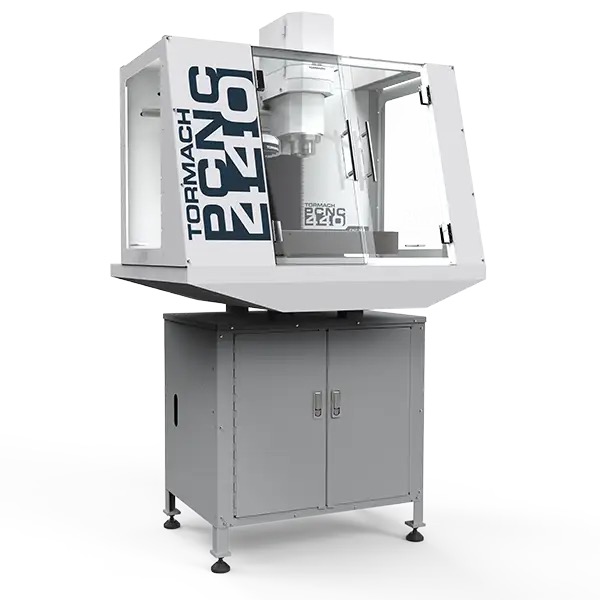
Answer first: A desktop CNC mill is for metal in a garage or small shop: ballscrews, T-slot tables, and usable spindle torque under about 5,000 RPM. A CNC router is for wood and plastic. In this comparison the usual home-shop pick is the Tormach PCNC 440 (120V / 15A, about 250 lbs, PathPilot included) unless an automatic tool changer or Haas control is the constraint.
| Constraint | Typical threshold in this class |
|---|---|
| Circuit | 120V / 15A (Tormach, Bantam) vs ~20A (Haas Desktop Mill) |
| Floor load | ~250 lbs vs ~600 lbs |
| Work envelope | Match the largest part finished in one setup; Z travel after vise height |
| Steel work | Light cuts only under ~500 lbs machine mass; production steel needs a knee mill |
Desktop CNC mills occupy a specific niche between hobby-grade CNC routers and full-size industrial machining centers. These machines are designed to cut metal — aluminum, brass, steel, and sometimes titanium — within a footprint that fits a garage, basement, or small commercial shop. According to industry data, the desktop CNC mill market has expanded significantly as controller technology and compact spindle designs have matured, making real metal-cutting capability accessible below the $15,000 price point.
This guide evaluates five desktop CNC mills based on published manufacturer specifications, focusing on work envelope, spindle performance, machine rigidity, and total cost of ownership.
What Separates a Desktop CNC Mill from a CNC Router
The distinction matters. CNC routers are optimized for high-speed cutting of wood, plastic, and soft materials using lightweight gantry frames. Desktop CNC mills use heavier column-and-knee or column-and-table designs with significantly more rigidity, enabling them to cut ferrous metals without excessive chatter or deflection.
Key differences based on manufacturer specifications:
- Spindle torque: Mills deliver usable torque at lower RPMs (under 5,000) for steel and harder alloys. Routers typically spin fast (10,000-30,000 RPM) with minimal low-end torque.
- Frame mass: Desktop mills weigh 150 to 1,200+ pounds. That mass is structural — it absorbs cutting forces and reduces vibration.
- Axis drive: Mills use ballscrews or leadscrews with anti-backlash nuts. Routers often use belt drives or rack-and-pinion systems that lack the stiffness needed for metal cutting.
- Workholding: Mills use T-slot tables and machinist vises designed for rigid clamping under heavy cutting loads.
Top Desktop CNC Mills by Specification
Tormach PCNC 440 — Best Overall for Serious Home Machinists
| Specification | Value |
|---|---|
| Work Envelope (X/Y/Z) | 10” x 6.25” x 10” |
| Spindle | R8 taper, 1 HP |
| Spindle Speed | 100-10,000 RPM |
| Table Size | 18” x 6.25” |
| Machine Weight | 250 lbs |
| Controller | PathPilot (included) |
| Power Requirements | 120V, 15A |
| Price Range | $5,000-$7,000 |
Per Tormach’s product documentation, the PCNC 440 ships with PathPilot, their proprietary CNC controller built on LinuxCNC. The R8 spindle taper is widely available and affordable for tooling. According to Tormach’s specifications, the 1 HP spindle delivers usable torque across the full speed range, and the machine is rated for aluminum production and light steel work.
The 250-pound weight is modest for a mill, which limits rigidity compared to heavier machines. However, it also means the PCNC 440 can be installed in a home shop without reinforcing floors or hiring riggers.
Best for: Home machinists who need a complete, ready-to-run CNC mill with professional-grade software and a proven ecosystem of accessories.
Bantam Tools Desktop CNC Milling Machine — Best for Precision Small Parts
| Specification | Value |
|---|---|
| Work Envelope (X/Y/Z) | 7” x 5.5” x 3.8” |
| Spindle | ER-11 collet, 0.37 HP (280W) |
| Spindle Speed | 7,000-26,000 RPM |
| Table Size | 9” x 6.5” |
| Machine Weight | 65 lbs |
| Controller | Bantam Tools software (included) |
| Power Requirements | 120V, 5A |
| Price Range | $3,600-$4,200 |
According to Bantam Tools’ specifications, this machine targets precision work in aluminum, brass, and circuit board milling. The high spindle speed range (up to 26,000 RPM) and ER-11 collet system favor small-diameter tooling and fine detail work. Per the manufacturer’s data sheet, positional accuracy is rated at 0.001” (25 microns).
The 65-pound weight and compact footprint make it genuinely desktop-sized, but this limits its material removal rate in harder metals. The 280W spindle is not designed for aggressive roughing cuts in steel.
Best for: Engineers and makers doing precision prototype work in aluminum, brass, and PCB materials where accuracy matters more than material removal rate.
Haas Desktop Mill — Best Industrial Pedigree
| Specification | Value |
|---|---|
| Work Envelope (X/Y/Z) | 12” x 10” x 4” |
| Spindle | 40-taper style, 1 HP |
| Spindle Speed | 0-6,000 RPM |
| Table Size | 15.75” x 7.875” |
| Machine Weight | 600 lbs |
| Controller | Haas control (included) |
| Power Requirements | 120V, 20A |
| Price Range | $9,000-$12,000 |
Per Haas Automation’s documentation, the Desktop Mill uses the same control interface found on their industrial VMCs. This means G-code programs and operator skills transfer directly to full-size Haas machines. According to Haas specifications, the machine includes an 8-station automatic tool changer and a flood coolant system — features uncommon at this price point.
At 600 pounds, this machine offers substantially more rigidity than lighter desktop units. The tradeoff is that it requires more planning for installation and a dedicated 20A circuit.
Best for: Educational settings, pre-production prototyping shops, and users who want industrial CNC controls in a benchtop format.
Pocket NC V2-50 — Best for 5-Axis Capability
| Specification | Value |
|---|---|
| Work Envelope | 50mm (2”) diameter sphere |
| Axes | 5 (X/Y/Z + A/B rotary) |
| Spindle | ER-11 collet, 0.17 HP (125W) |
| Spindle Speed | 2,000-10,000 RPM |
| Machine Weight | 30 lbs |
| Controller | Kinetic Control (included) |
| Power Requirements | 120V, 3A |
| Price Range | $5,500-$6,500 |
According to Pocket NC’s specifications, the V2-50 is a true 5-axis simultaneous milling machine — all five axes can move at the same time, enabling complex geometries impossible on 3-axis machines. Per the manufacturer’s data, the machine handles aluminum, brass, wood, and plastics within its 2-inch working sphere.
The 125W spindle and 30-pound frame mean this is a precision instrument, not a production machine. The 2-inch work envelope is restrictive for general machining. However, no other machine at this price offers genuine 5-axis capability.
Best for: Aerospace prototyping, jewelry, watchmaking, and complex geometry work where 5-axis capability justifies the small work envelope.
LittleMachineShop HiTorque 3990 CNC Mill — Best Budget Entry Point
| Specification | Value |
|---|---|
| Work Envelope (X/Y/Z) | 11” x 5.5” x 11.75” |
| Spindle | R8 taper, 0.75 HP |
| Spindle Speed | 100-2,500 RPM |
| Table Size | 19.5” x 5.5” |
| Machine Weight | 352 lbs |
| Controller | Sold as CNC-ready (controller not included) |
| Power Requirements | 120V, 10A |
| Price Range | $2,200-$2,800 |
Per LittleMachineShop’s product data, the HiTorque 3990 is a bench mill with CNC-ready ballscrews and stepper motor mounts. According to the manufacturer, the cast-iron construction and R8 spindle provide a solid platform for CNC conversion. The 352-pound weight delivers meaningful rigidity for its price class.
The critical caveat: this machine does not include a CNC controller, stepper motors, or software. Those components add $800 to $2,000 depending on the controller platform chosen (Mach3, Mach4, LinuxCNC, or GRBL-based). Total cost after conversion is typically $3,000 to $4,800.
Check price at LittleMachineShop →
Best for: Budget-conscious buyers with electronics and DIY skills who want the most rigid machine per dollar and are willing to handle CNC conversion themselves.
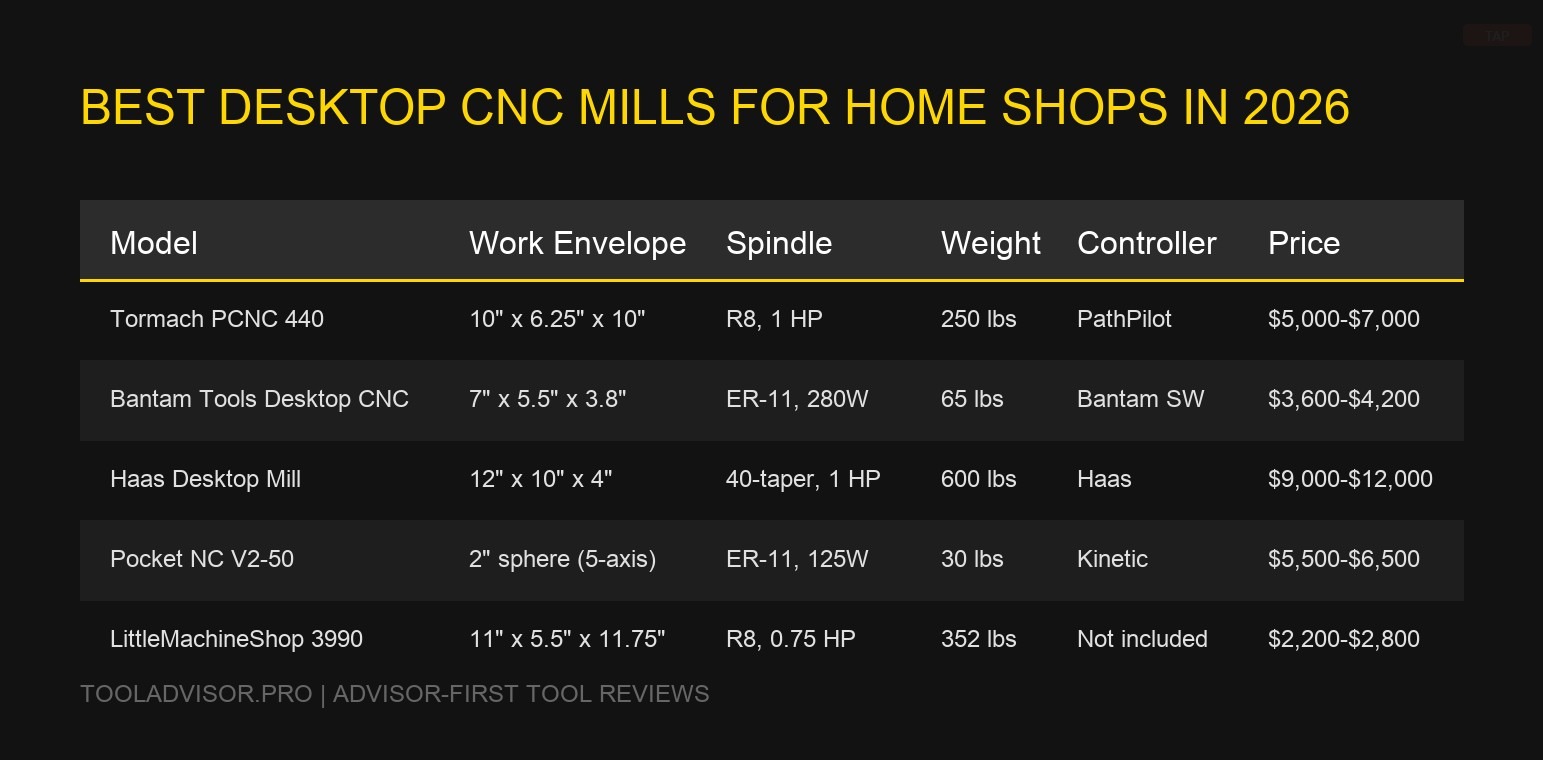
Comparison Table
| Model | Work Envelope | Spindle | Weight | Controller | Price |
|---|---|---|---|---|---|
| Tormach PCNC 440 | 10” x 6.25” x 10” | R8, 1 HP | 250 lbs | PathPilot | $5,000-$7,000 |
| Bantam Tools Desktop CNC | 7” x 5.5” x 3.8” | ER-11, 280W | 65 lbs | Bantam SW | $3,600-$4,200 |
| Haas Desktop Mill | 12” x 10” x 4” | 40-taper, 1 HP | 600 lbs | Haas | $9,000-$12,000 |
| Pocket NC V2-50 | 2” sphere (5-axis) | ER-11, 125W | 30 lbs | Kinetic | $5,500-$6,500 |
| LittleMachineShop 3990 | 11” x 5.5” x 11.75” | R8, 0.75 HP | 352 lbs | Not included | $2,200-$2,800 |
Total Cost of Ownership
The purchase price of a desktop CNC mill is only part of the investment. Based on typical accessory and tooling requirements documented by manufacturers:
Tooling: A starter set of end mills, drill bits, and collets for aluminum and steel work runs $300 to $800. Carbide end mills suitable for steel cost $15 to $50 each and wear with use.
Workholding: A quality machinist vise (Kurt, Glacern, or similar) costs $200 to $600. T-slot clamp sets add $50 to $150.
CAM Software: Some machines include software (Tormach, Bantam, Haas). Others require separate CAM purchases. Fusion 360 offers a free personal-use license with limited CNC features. Professional CAM licenses range from $1,500 to $10,000+.
Enclosure and Coolant: Machines without factory enclosures need chip containment. DIY enclosures cost $200 to $500 in materials. Mist coolant systems run $100 to $300.
Maintenance: Lubricants, way oil, and replacement parts. Budget $200 to $500 annually for a machine in regular use.
Who This Is NOT For
Desktop CNC mills are a significant investment in money, space, and learning time. They are not the right choice for every buyer:
- If your work is exclusively wood, plastic, or foam: A benchtop CNC router delivers faster material removal rates at lower cost for non-metal materials. Desktop mills can cut these materials but are overbuilt and overpriced for the task.
- If you need parts larger than 12 inches in any dimension: Desktop mills have limited work envelopes. Parts exceeding the travel limits require multiple setups, fixturing creativity, or a larger machine. For consistently large work, a full-size knee mill or VMC is the practical answer.
- If you expect production throughput on day one: The learning curve for CNC milling — CAD modeling, CAM programming, workholding strategy, speeds and feeds — takes months to climb. According to machining educators, expect 3 to 6 months of regular use before producing parts efficiently.
- If steel is your primary material and production volume matters: Machines under 500 pounds can cut steel, but material removal rates are limited by machine rigidity. Heavy roughing in steel requires mass that desktop machines do not provide. See our CNC mill guide for small job shops for heavier machines suited to production steel work.
- If your budget cannot absorb tooling and accessories: A $5,000 mill with no vise, no end mills, and no CAM software produces nothing. Budget an additional $1,000 to $3,000 for the supporting ecosystem.
Key Specifications That Matter Most
Not all published specs carry equal weight when evaluating desktop CNC mills. Based on engineering fundamentals documented in the Machinery’s Handbook:
Machine weight correlates directly with rigidity. Heavier machines resist cutting forces better, produce less chatter, and hold tighter tolerances. This is physics, not marketing.
Spindle taper type determines tooling cost and availability. R8 is the most common and affordable for benchtop mills, and it is also the standard on most benchtop milling machines. ER-11 limits tool diameter but enables high-speed operation. CAT40 and BT30 offer industrial-grade toolholding but at higher cost.
Ballscrew vs. leadscrew affects positioning accuracy and backlash. Ballscrews are superior but more expensive. Machines with leadscrews can still produce accurate parts with backlash compensation in the controller.
Controller software determines what the machine can actually do. A rigid, well-built mill with a poor controller is frustrating. PathPilot, Mach4, and Haas controls are established platforms with active user communities and documentation.
What You’ll Also Need
Buyers of desktop CNC mills typically need the following accessories to get started. Per manufacturer setup guides, these are not optional for productive use:
- Accusize R8 Collet Set (15-piece) ($60-$90): R8 collets hold end mills and drills in the spindle — without a set covering common shank sizes, the machine cannot accept standard tooling. Check price on Amazon →
- Glacern GPV-615 Machine Vise ($250-$400): A precision-ground milling vise provides the rigid workholding that CNC cutting forces demand — the vise included with most machines (if any) is inadequate for metal work. Check price on Amazon →
- Kodiak Cutting Tools Carbide End Mill Set (10-piece) ($40-$70): Carbide end mills in 1/8” to 1/2” diameters cover the most common milling operations in aluminum and steel. Check price on Amazon →
- TECO T-Slot Clamp Kit (58-piece) ($50-$80): T-slot clamps secure irregularly shaped workpieces and fixtures directly to the mill table when a vise is not appropriate. Check price on Amazon →
- Haimer Edge Finder ($25-$50): An edge finder locates workpiece edges relative to the spindle centerline — required for setting work coordinates on every job. Check price on Amazon →
Consider Buying Used
For desktop CNC mills in the $3,000-$12,000 range, used equipment from reputable sellers can save 30-50% over new pricing. Per industry resale data, machines like the Tormach PCNC 440 and Haas Desktop Mill hold their value well, and a well-maintained used unit performs identically to new. Check current listings:
Find used desktop CNC mills on eBay →
When buying used, verify: spindle runs smoothly across the full RPM range, all three axes move without binding or excessive backlash, spindle runout is within spec (test with a dial indicator), and the controller boots and homes correctly. For machines over $1,000, request a test cut video before purchasing.
FAQ
Desktop CNC mill vs CNC router — which do I need?
A mill cuts metal with mass, ballscrews, and low-RPM torque. A router cuts wood and plastic at high RPM on a lighter gantry. If the material is aluminum, brass, or steel, stay in this guide. If it is only wood, plastic, or foam, see benchtop CNC routers.
Can these machines cut steel?
Light steel, yes, on the heavier 3-axis mills (Tormach PCNC 440, Haas Desktop Mill). Production roughing in steel, no — machines under about 500 lbs run out of rigidity. The Bantam (65 lbs) and Pocket NC (30 lbs) are not steel-production tools.
What travel do I actually need?
Size to the largest part that must finish in one setup. Tormach lists 10 x 6.25 x 10 inches; Haas 12 x 10 x 4 inches; Bantam 7 x 5.5 x 3.8 inches; Pocket NC a 2-inch sphere. Over ~12 inches in any axis, plan multiple setups or a larger mill.
Tormach PCNC 440 or Haas Desktop Mill?
Tormach if 120V/15A, 250 lb floor load, and $5,000–$7,000 with PathPilot are the constraints. Haas if an ATC, flood coolant, and the Haas control justify $9,000–$12,000 and a 20A circuit. Tormach PCNC 440 listings →
Who should not buy a desktop CNC mill?
Anyone whose work is non-metal only, whose parts exceed the travel table, who needs steel production rates, or who cannot fund vise, tooling, and CAM after the machine. See CNC mills for small job shops for heavier machines.
Sources
- Tormach PCNC 440 specifications and PathPilot documentation (tormach.com)
- Bantam Tools Desktop CNC Milling Machine technical specifications (bantamtools.com)
- Haas Automation Desktop Mill product documentation (haascnc.com)
- Pocket NC V2-50 manufacturer specifications (pocketnc.com)
- LittleMachineShop HiTorque 3990 product data sheet (littlemachineshop.com)
- Machinery’s Handbook, 31st Edition — cutting parameters and machining fundamentals
- ASME B5.54-2005 — Methods for performance evaluation of CNC machining centers