Best Belt Grinders for Knife Making in 2026
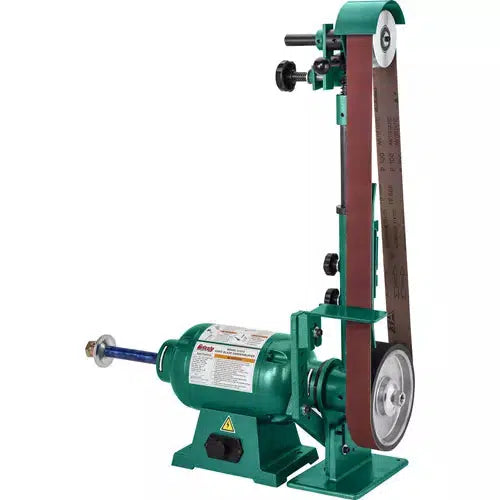
A belt grinder is the single most-used tool in a knife maker’s shop, and buying the wrong one creates problems that no technique can fix. An underpowered motor bogs down during heavy stock removal on O1 or 1084 steel, scorching temper lines and stalling mid-grind. A machine without variable speed makes it nearly impossible to run finishing belts at the low surface feet per minute (SFPM) required for hand-rubbed satin finishes. Excessive vibration from poor construction turns precise plunge cuts into guesswork. The belt grinder decision deserves more research than most makers give it.
What Makes a Good Belt Grinder for Knife Making
Five specifications separate a capable knife-making grinder from an expensive regret.
Belt size determines what work the machine can handle. The 2x72-inch belt is the industry standard for knife making because it provides enough surface area for profiling, beveling, and finishing full-size blades without constant belt changes.
Motor horsepower dictates how aggressively the machine can remove material. According to manufacturer documentation across the category, 1.5 HP is the practical minimum for grinding hardened steel. Below that threshold, the motor labors during stock removal on anything thicker than 3/16-inch bar stock. Serious production shops typically run 2 HP or higher.
Variable speed control is non-negotiable for knife work. Rough grinding demands high belt speed (typically 4,000-5,000 SFPM), while hand-finishing and working near a heat treat line requires dropping below 2,000 SFPM. A single-speed grinder forces compromises at every stage of the process.
Platen flatness and rigidity control bevel geometry. A warped or flexible platen produces convex grinds when flat grinds are intended. Quality machines use ground-flat steel platens at least 3/16-inch thick.
Tooling arm compatibility determines whether the machine grows with the maker. Interchangeable small wheels, contact wheels of various diameters, and slack belt attachments multiply the machine’s capabilities without requiring a second grinder.
1x30 vs 2x42 vs 2x72: Which Belt Size?
| Specification | 1x30 | 2x42 | 2x72 |
|---|---|---|---|
| Belt width | 1 inch | 2 inches | 2 inches |
| Belt length | 30 inches | 42 inches | 72 inches |
| Typical motor | 1/3 HP | 3/4 HP | 1.5-2 HP |
| Belt life (steel grinding) | Minutes | 15-30 min | 45-90 min |
| Price range | $50-$80 | $150-$300 | $350-$2,000+ |
| Knife making suitability | Minimal | Limited | Full capability |
The 1x30 machines (Harbor Freight, WEN) can technically shape a small knife, but the narrow belt width means half the blade hangs off the platen during bevel grinding. Belt life is extremely short on steel — often under ten minutes of aggressive grinding per belt. Per manufacturer specs, these units typically run 1/3 HP motors that stall under moderate pressure on anything harder than mild steel.
The 2x42 occupies an awkward middle ground. The wider belt helps, but the shorter belt length means less abrasive surface area and faster heat buildup. Few aftermarket tooling options exist for this size.
The 2x72 is the standard for a reason. The longer belt dissipates heat better, lasts significantly longer, and the aftermarket ecosystem for 2x72 belts, contact wheels, and tooling attachments is enormous. Every serious belt recommendation below uses this size.
Top Picks Based on Specifications
Grizzly G1015 — Best Value 2x72
| Spec | Detail |
|---|---|
| Belt size | 2 x 72 inches |
| Motor | 1.5 HP, 110V/220V |
| Speed | Variable speed |
| Weight | ~85 lbs |
| Price range | $350-$450 |
According to Grizzly’s product data sheet, the G1015 ships with a 1.5 HP motor that runs on either 110V or 220V circuits. The variable speed control allows the operator to dial belt speed from roughly 1,500 to 5,000 SFPM, covering the full range needed for knife work from rough grinding to finishing. The cast-iron construction provides reasonable vibration damping at this price point.
The primary limitation is the stock platen and tooling arm, which are functional but lack the precision of higher-end machines. Many makers replace the platen with an aftermarket flat-ground option within the first year.
Bader BIII — Industry Standard
| Spec | Detail |
|---|---|
| Belt size | 2 x 72 inches |
| Motor | 1.5-2 HP (user-supplied or optional) |
| Speed | Variable speed (VFD recommended) |
| Weight | ~90 lbs (without motor) |
| Price range | $1,200-$1,500 |
Per Bader’s product specifications, the BIII has been a mainstay in professional knife-making shops for decades. The frame is welded steel with precision-machined contact wheel shafts. Tracking adjustment is smooth and holds position reliably. The machine accepts a wide range of contact wheels and small wheel attachments without modification.
The BIII is often sold without a motor, which adds cost but allows the buyer to select the exact motor and VFD (variable frequency drive) combination that matches their electrical service and performance requirements. Total cost with motor and VFD typically reaches $1,800-$2,200.
Beaumont KMG — Best Mid-Range, Modular Design
| Spec | Detail |
|---|---|
| Belt size | 2 x 72 inches |
| Motor | 2 HP standard |
| Speed | Variable speed via VFD |
| Weight | ~110 lbs |
| Price range | $800-$1,100 |
According to Beaumont Metalworks product documentation, the KMG (Knife Maker’s Grinder) was designed specifically for blade work rather than adapted from a general-purpose industrial grinder. The modular tooling arm system allows quick swaps between flat platen, contact wheels, and small wheel attachments. The standard 2 HP motor paired with a VFD provides consistent torque across the entire speed range.
The KMG’s tool arm design has become something of an aftermarket standard — several third-party manufacturers produce compatible attachments. This ecosystem makes the KMG a machine that can genuinely grow with the maker’s skill level, from basic flat grinds to complex hollow grinds on small-diameter wheels.
Kalamazoo 2FSM — Industrial Build Quality
| Spec | Detail |
|---|---|
| Belt size | 2 x 72 inches |
| Motor | 1.5-2 HP |
| Speed | Variable speed available |
| Weight | ~130 lbs |
| Price range | $600-$800 |
Per Kalamazoo Industries specifications, the 2FSM is built to industrial standards — heavier gauge steel, sealed bearings, and a frame designed for continuous-duty operation. The machine weighs roughly 130 pounds, which contributes to vibration dampening but also means it needs a permanent location in the shop.
The 2FSM was originally designed for industrial deburring and finishing rather than knife making specifically. The stock platen and tooling configuration reflect that origin. Knife makers typically need to add aftermarket platens and small wheel attachments, which adds $100-$300 to the total cost. The base machine, however, is overbuilt for the application — and “overbuilt” is rarely a complaint in a knife shop.
Harbor Freight / WEN 1x30 — Budget Starter (With Honest Limitations)
| Spec | Detail |
|---|---|
| Belt size | 1 x 30 inches |
| Motor | 1/3 HP, 110V |
| Speed | Single speed (~3,400 SFPM) |
| Weight | ~15 lbs |
| Price range | $50-$80 |
According to manufacturer specifications, these 1x30 units run a 1/3 HP motor at a fixed speed. They can shape small knives in soft steels (1080, 1084) with patience, and they work adequately for handle shaping and minor edge refinement. The low price makes them a zero-risk way to determine whether knife making is worth pursuing before committing to a real grinder.
The limitations are severe for anything beyond the most casual experimentation. No variable speed means finishing work is impractical. The 1-inch belt width prevents grinding consistent bevels on blades wider than about 3/4 inch. Belt life on hardened steel is measured in minutes, not hours. Consider this category a trial-period tool, not a long-term solution.
Accessories Worth Budgeting For
Regardless of which grinder lands in the shop, three accessories deserve budget allocation from day one.
Aftermarket platens: A precision-ground flat platen (typically $40-$80) transforms bevel consistency on machines with mediocre stock platens. This is the single highest-impact upgrade for the Grizzly and Kalamazoo models.
Small wheel attachment: A set of 3/4-inch and 1-inch contact wheels ($30-$60 each) enables hollow grinds, choil work, and finger guard shaping that flat platens cannot produce.
Belt variety pack: Stocking ceramic belts (36 and 60 grit for stock removal), aluminum oxide (120-400 grit for finishing), and cork or leather belts for stropping ensures the grinder can handle every phase of blade making without downtime.
For complementary grinding tasks like tool sharpening, deburring castings, or general shop cleanup, a dedicated bench grinder remains the more practical tool. And for work that requires a handheld approach — weld cleanup, surface prep, or tight-radius grinding on larger fabrication projects — an angle grinder under $100 fills a gap that no belt grinder can.
Who This Is NOT For
Occasional sharpening only. If the goal is simply maintaining an edge on kitchen knives or shop tools, a belt grinder is overkill. A bench grinder with a proper rest, or even a guided sharpening system in the $50-$150 range, handles that job with less space, less noise, and less investment.
Woodworkers who do not work metal. Belt grinders for knife making run abrasive belts designed for steel. Wood-specific sanding stations use different belt compositions, tensions, and speeds. Buying a 2x72 metalworking grinder for wood sanding alone is a poor use of capital.
Shops without adequate electrical service. The 2x72 grinders listed above with 1.5-2 HP motors draw significant amperage. Several models strongly prefer or require 220V circuits. Per manufacturer electrical specifications, running a 2 HP motor on an undersized 110V circuit causes voltage drop, motor overheating, and premature failure. Verify electrical capacity before ordering.
Makers not ready to invest in belts. The grinder is only the platform. A working belt inventory — ceramic, aluminum oxide, and finishing grades — costs $100-$200 to establish. Budget for consumables alongside the machine or the grinder becomes an expensive shelf ornament.
Frequently Asked Questions
What size belt grinder do I need for knife making?
A 2x72-inch belt grinder is the industry standard for knife making. According to manufacturer specifications, the 2-inch belt width covers full-size blade profiles without the blade overhanging the platen, and the 72-inch belt length provides enough abrasive surface area for meaningful stock removal sessions. Smaller 1x30 and 2x42 machines can shape small knives but have severe limitations in belt life, motor power, and aftermarket tooling availability.
Can I use a belt grinder for woodworking?
A 2x72 metalworking belt grinder can sand wood, but it is not the ideal tool for that purpose. Belt grinders for knife making run abrasive belts designed for steel at speeds optimized for metal removal, and the platens and tooling are configured for blade geometry. Per manufacturer documentation, dedicated woodworking sanders and drum sanders provide better dust collection, finer grit control, and surface finishes suited to wood finishing workflows.
What is the difference between a 1x30 and 2x72 belt grinder?
The differences are substantial. According to manufacturer specifications, a 1x30 typically runs a 1/3 HP motor at a single speed with belt life measured in minutes on steel, while a 2x72 runs 1.5-2 HP with variable speed and belt life of 45-90 minutes under grinding. The 2x72 also has an extensive aftermarket ecosystem of contact wheels, platens, and tooling attachments that the 1x30 format lacks entirely.
What You’ll Also Need
- 2x72 ceramic grinding belts — 36 grit — Ceramic alumina belts are the standard for hogging steel on a knife grinder; they cut faster and cooler than aluminum oxide and are worth the price premium for production knifemaking. Search: “2x72 belt grinder belts ceramic,” “2x72 ceramic abrasive belt 36 grit.” Check price on Amazon →
- 2x72 grinding belts — 36 grit, multipacks — Bulk packs in 36–60 grit are the most economical way to stock aggressive-cut belts for profiling and hollow grinding; having spares on hand prevents downtime mid-bevel. Search: “2x72 grinding belt 36 grit,” “2x72 abrasive belt bulk pack.” Check price on Amazon →
- 2x72 sanding belts — 120 grit zirconia — Zirconia belts in 120 grit are used for finishing the primary bevel before hand sanding; they hold their cut longer than aluminum oxide at this grit range. Search: “2x72 sanding belt 120 grit zirconia,” “2x72 finishing belt 120.” Check price on Amazon →
- 2x72 belt grinder work rest — An adjustable work rest is critical for consistent bevel angles; most grinder frames accept bolt-on tool rests that provide a stable reference surface during grinding. Search: “2x72 belt grinder work rest,” “knife grinder tool rest adjustable.” Check price on Amazon →
- Contact wheel — 2x72 belt grinder — Rubber contact wheels in 4–10 inch diameters control hollow grind radius; a harder durometer (70A) gives a flatter grind while softer (40A) produces a deeper hollow. Search: “contact wheel 2x72 belt grinder,” “rubber contact wheel 8 inch knife grinder.” Check price on Amazon →
- Slack belt attachment — 2x72 — A slack belt platen removes the rigid backing from the belt, allowing it to conform to curved surfaces for handle shaping and convex edge work; standard flat platens cannot replicate this. Search: “slack belt attachment 2x72,” “2x72 grinder slack belt platen.” Check price on Amazon →
Sources
- Grizzly Industrial product data sheets and specifications — grizzly.com
- Bader BIII product specifications and documentation — bfrb.com
- Beaumont Metalworks KMG product documentation — beaumontmetalworks.com
- Kalamazoo Industries belt grinder specifications — kfrb.com
- WEN Products belt grinder specifications — wenproducts.com
- Manufacturer electrical requirements and motor specifications as published in product manuals