Best Cordless Shop Vacuums in 2026: Which Ones Actually Meet OSHA's Silica Standard?
OSHA’s silica standard (29 CFR 1926.1153), effective in 2017 and actively enforced on construction sites, requires dust controls for silica-generating tasks. For most handheld cutting, grinding, and drilling operations on concrete and masonry, vacuum extraction with H-class or HEPA filtration meets the engineering control requirement. Cordless dust extractors eliminate the cord and compressor-style hose management that made corded extractors impractical for mobile work — a trim carpenter moving between rooms, a tile setter working across a floor, or a demo contractor cutting out openings can use the vacuum without hunting for an outlet. This guide compares four cordless models based on published manufacturer specifications.
Shop Vacuum vs. Dust Extractor: The Compliance Difference
Per OSHA 29 CFR 1926.1153 and NIOSH engineering control guidance, the distinction is critical:
| Feature | Shop Vacuum | Dust Extractor |
|---|---|---|
| Filter efficiency | Standard (≥5 microns typical) | HEPA (99.97% at 0.3 microns) or H-class |
| Silica compliance | No | Yes (with HEPA/H-class) |
| Auto-clean filter | Rarely | Common on professional models |
| Hose compatibility | General purpose | Tool-port specific adapters |
| Liquid collection | Yes (most models) | No (filter damage) |
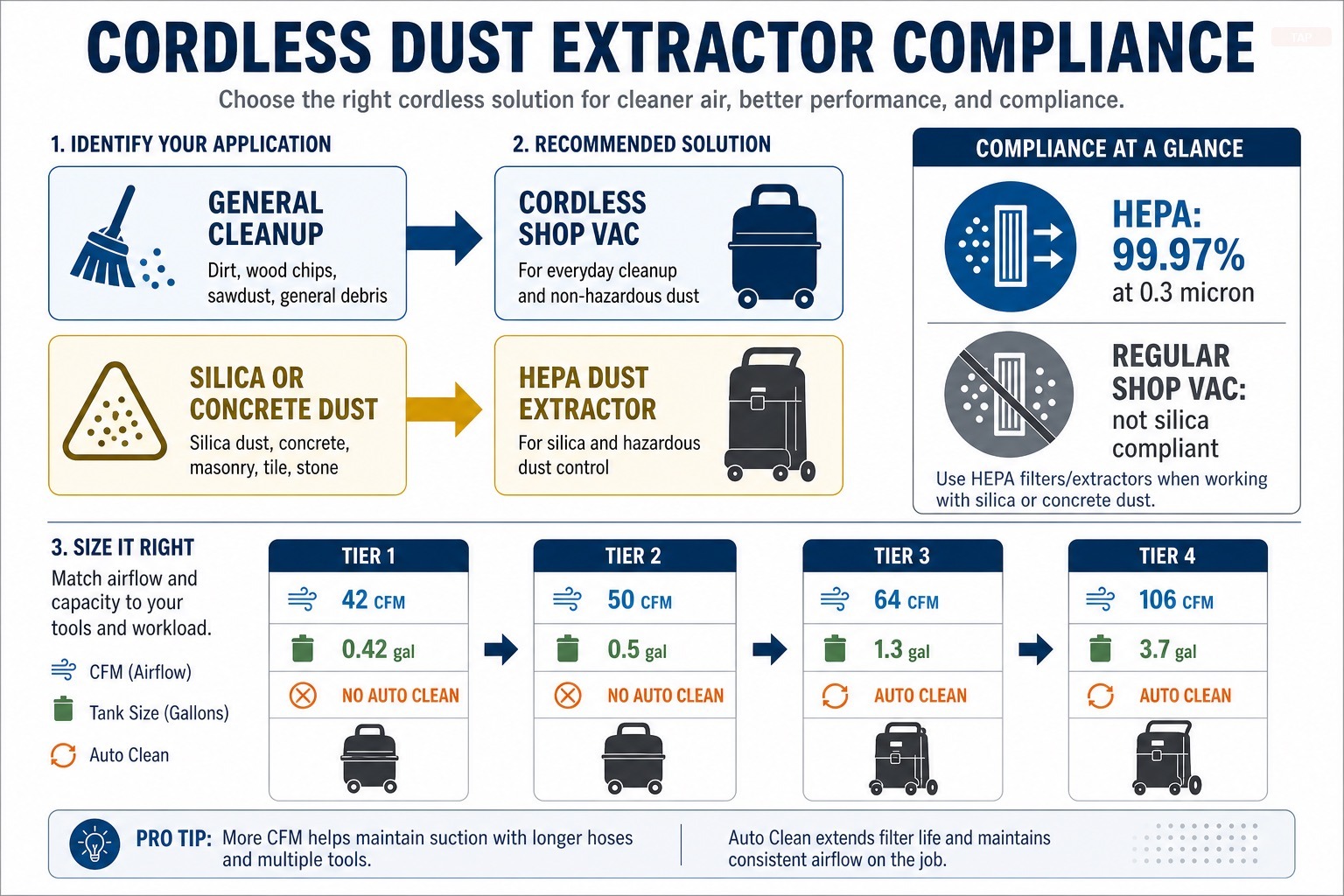
For general job site cleanup — drywall debris, sawdust, concrete chips, liquids — a standard shop vacuum is adequate. For tasks that generate respirable silica (cutting masonry, grinding concrete, drilling into cured concrete, cutting engineered stone), OSHA requires a compliant dust control method. A HEPA dust extractor connected to the cutting tool is the standard engineering control.
Key Specifications
CFM (cubic feet per minute): Airflow rate — how much air the vacuum moves per minute. Higher CFM means more effective dust capture at the tool nozzle, particularly for larger tool ports and longer hose runs. Per tool manufacturer data, most handheld grinders and sanders need 35–55 CFM for effective source capture.
Filtration class: HEPA (99.97% at 0.3 microns) or H-class (per IEC 60335-2-69, equivalent to HEPA for construction purposes) are OSHA-compliant for silica. Standard filtration (labeled M-class or similar) does not meet the silica standard.
Hose diameter and length: Standard hose sizes are 1-1/4 inch (handheld tools) and 1-7/8 inch (larger tools). Longer hoses reduce CFM at the tool port due to friction losses — most cordless extractors ship with 6–8 foot hoses.
Auto-clean: Periodic pulse cleaning of the filter prevents clogging and maintains suction throughout the work session. More critical for fine-dust applications (drywall, concrete) where filters load quickly.
Tank capacity: Cordless extractors are compact — 1/2 to 1.5 gallons. For production work, frequent emptying is required. Corded extractors with larger tanks (5–16 gallons) are more practical for high-volume dust collection.
Top Cordless Dust Extractors
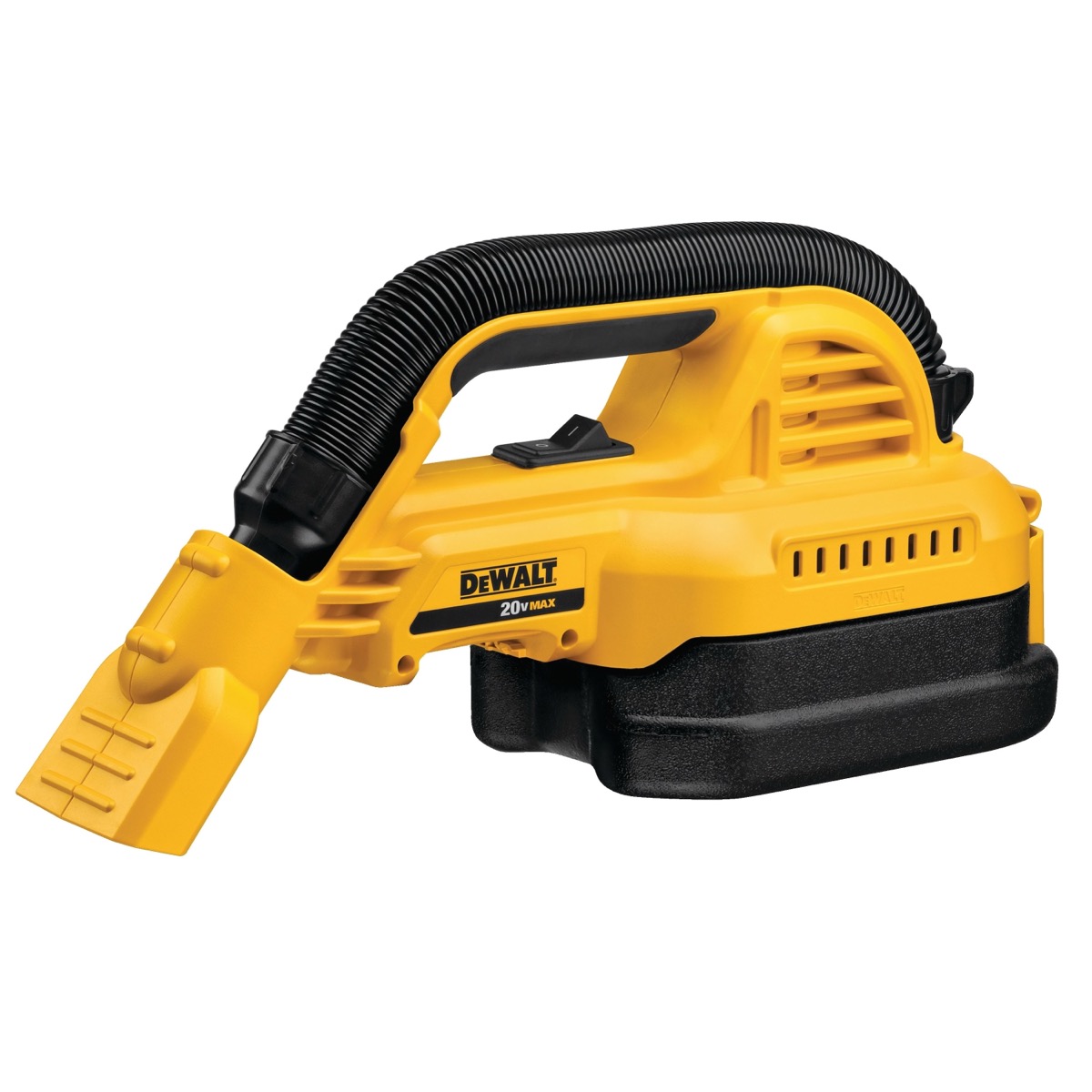
DeWalt DCV517B — Best Overall Cordless Extractor
| Specification | Value |
|---|---|
| Battery Platform | 20V MAX |
| Airflow | 50 CFM |
| Filtration | HEPA (99.97% at 0.3 microns) |
| Tank Capacity | 1/2 gallon |
| Hose Diameter | 1-7/8” and 1-1/4” adapters included |
| Hose Length | 6.5 ft |
| Auto-Clean Filter | No |
| Weight (bare tool) | 5.9 lbs |
| Warranty | 3 years |
| Price Range | $90–$120 (bare tool) |
Per DeWalt’s specifications, the DCV517B delivers 50 CFM of airflow with a certified HEPA filter — meeting OSHA’s engineering control requirement for silica-generating tasks. The compact 1/2-gallon tank and 5.9 lb weight make it the most portable option in this comparison. DeWalt includes both 1-7/8-inch and 1-1/4-inch hose adapters, covering the most common tool port sizes. The hose connects to DeWalt’s standard flexible hose, which is also compatible with Festool and other major tool adapters. Per DeWalt’s data, the 20V MAX 4.0 Ah battery provides approximately 30–40 minutes of continuous operation.
Best for: DeWalt 20V MAX platform users who need OSHA-compliant dust capture for mobile masonry, tile, and concrete work. The compact form factor and platform compatibility make it the easiest integration for existing DeWalt tool crews.
Limitation: No auto-clean filter — in heavy concrete or drywall cutting applications, the filter requires manual cleaning during long sessions to maintain suction. The 1/2-gallon tank requires emptying every 30–45 minutes of production silica work.
Milwaukee 0885-20 M18 — Best for M18 Platform Crews
| Specification | Value |
|---|---|
| Battery Platform | M18 |
| Airflow | 42 CFM |
| Filtration | HEPA (99.97% at 0.3 microns) |
| Tank Capacity | 0.42 gallon |
| Hose Diameter | 1-7/8” and 1-1/4” adapters included |
| Hose Length | 7.5 ft |
| Auto-Clean Filter | No |
| Weight (bare tool) | 7.2 lbs |
| Warranty | 5 years |
| Price Range | $120–$160 (bare tool) |
Per Milwaukee’s specifications, the 0885-20 integrates with the M18 system and delivers HEPA filtration at 42 CFM — adequate for most handheld tool connections. The 7.5-foot hose is the longest in this comparison, useful when the vacuum must be positioned away from the work area. Milwaukee’s 5-year warranty is the strongest coverage available. At 7.2 lbs, the 0885-20 is the heaviest model compared here — a consideration for workers who carry the vacuum while working. The ONE-KEY Bluetooth connectivity allows tracking the tool’s location in Milwaukee’s fleet management system.
Best for: M18 platform crews who want dust extraction that shares batteries and falls under the same fleet management system as their other Milwaukee tools. The extended hose and 5-year warranty are practical differentiators.
Makita XCV11Z — Best HEPA Filtration and Airflow
| Specification | Value |
|---|---|
| Battery Platform | 18V LXT (2 batteries) |
| Airflow | 64 CFM |
| Filtration | HEPA (99.97% at 0.3 microns) |
| Tank Capacity | 1.3 gallons |
| Hose Diameter | 1-7/8” included |
| Hose Length | 6.5 ft |
| Auto-Clean Filter | Yes (automatic) |
| Weight (bare tool) | 11.8 lbs |
| Warranty | 3 years |
| Price Range | $230–$280 (bare tool) |
Per Makita’s specifications, the XCV11Z uses two 18V LXT batteries in series for higher power, delivering 64 CFM — the highest airflow in this comparison. The automatic filter cleaning mechanism pulses the filter during operation to maintain suction without manual intervention, which is the critical differentiator for production silica work where filter loading is constant. The 1.3-gallon tank reduces emptying frequency significantly compared to the DeWalt and Milwaukee. At 11.8 lbs, it is substantially heavier — closer to a stationary extractor than a handheld tool. Per Makita’s data, the auto-clean system activates every 15 seconds during use, preventing the suction drop that signals a clogged filter on non-auto-clean models.
Best for: Tile contractors and concrete cutters who run the extractor continuously for hours and cannot interrupt production to clean the filter. The auto-clean system and larger tank are the features that justify the premium price.
Festool CT MIDI 5 — Best for Integrated Tool Auto-Start
| Specification | Value |
|---|---|
| Power | Corded, 120V |
| Airflow | 106 CFM |
| Filtration | HEPA (certified to OSHA silica standard) |
| Tank Capacity | 3.7 gallons |
| Hose Diameter | 27mm (1-1/16”) standard Festool |
| Hose Length | 11.5 ft |
| Auto-Clean Filter | Yes (Jetstream automatic) |
| Weight | 14.3 lbs |
| Auto-Start | Yes (activates when connected tool starts) |
| Warranty | 3 years |
| Price Range | $550–$650 |
Per Festool’s specifications, the CT MIDI 5 is a corded unit included here as the professional benchmark for integrated dust extraction. The 106 CFM airflow is nearly double any cordless model in this comparison. The Bluetooth plug-in module (sold separately, ~$60) enables auto-start with any Bluetooth-equipped Festool tool — the extractor activates when the saw or sander starts and shuts off when it stops. The Jetstream filter-cleaning system activates during operation to maintain constant suction. At $550–$650, the CT MIDI 5 is a significant investment. For contractors working all day with a track saw or router, the auto-start, higher airflow, and larger tank capacity reduce interruption time meaningfully.
Best for: Finish carpenters and cabinet makers who run a track saw or router continuously and need full auto-start integration. The corded format is a trade-off but delivers airflow that cordless models cannot match.
Limitation: Corded operation requires an outlet or extension cord — the primary reason most contractors choose cordless models for mobile work.
Comparison Table
| Model | Platform | CFM | Filter | Auto-Clean | Tank | Warranty | Price |
|---|---|---|---|---|---|---|---|
| DeWalt DCV517B | 20V MAX | 50 | HEPA | No | 0.5 gal | 3 years | $90–$120 |
| Milwaukee 0885-20 | M18 | 42 | HEPA | No | 0.42 gal | 5 years | $120–$160 |
| Makita XCV11Z | 18V LXT ×2 | 64 | HEPA | Yes (auto) | 1.3 gal | 3 years | $230–$280 |
| Festool CT MIDI 5 | Corded | 106 | HEPA | Yes (auto) | 3.7 gal | 3 years | $550–$650 |
Who This Is NOT For
- General cleanup without silica exposure. For sweeping drywall scraps, collecting sawdust, and routine site cleanup, a standard shop vacuum ($30–$100) is more economical and easier to empty than a HEPA dust extractor. Reserve the extractor for silica-generating operations.
- High-volume continuous dust production. For demolition, grinding large concrete surfaces, or any task generating dust at rates that fill a 1-gallon tank in under an hour, a large-tank corded extractor (5–16 gallon) is more practical. The cordless models above require too-frequent emptying for sustained heavy dust production.
- Wet pickup. HEPA dust extractors are dry-use only — liquid infiltration damages the HEPA filter media and can destroy the motor. For wet and dry pickup, a dedicated shop vacuum is required.
- Anyone who does not generate silica dust. If the work is exclusively wood, drywall, and non-silica materials, a standard shop vacuum meets OSHA requirements. The premium cost of HEPA extraction is only justified by the materials being processed.
What You’ll Also Need
- HEPA filter replacement — HEPA filters require replacement when suction drops significantly or on the manufacturer’s recommended schedule. A spare filter prevents a clogged filter from shutting down work. Search: “HEPA filter replacement DeWalt DCV517,” “HEPA vacuum filter replacement contractor.” Check price on Amazon →
- Tool port adapter set — Most dust extractors include 2–3 adapters; a full adapter set covers uncommon port sizes on third-party tools and older equipment. Search: “dust extractor adapter set tool port,” “shop vacuum hose adapter set.” Check price on Amazon →
- Dust collection bags — Disposable collection bags inside the tank simplify emptying and reduce fine dust release during disposal. Required for silica-compliant disposal practices. Search: “dust extractor collection bag replacement,” “shop vac dust bags HEPA.” Check price on Amazon →
Related Guides
- Best Rotary Hammers for Contractors — SDS drilling into concrete generates silica requiring extractor capture
- Best Angle Grinders Under $100 — grinding concrete and welds is a primary silica exposure task
- Best Circular Saws for Contractors — masonry blades on circular saws require dust extraction at source
- Best Tile Saws — wet saws suppress silica in the tray; dry-cutting tile with a grinder or drill needs extractor capture
- DeWalt vs Milwaukee vs Makita Battery Platform — match the cordless extractor to the batteries already on the truck
Sources
- DeWalt DCV517B product specifications and data sheet (dewalt.com)
- Milwaukee 0885-20 M18 product documentation (milwaukeetool.com)
- Makita XCV11Z product specifications (makitatools.com)
- Festool CT MIDI 5 product documentation (festoolusa.com)
- OSHA Standard 29 CFR 1926.1153 — Respirable Crystalline Silica in Construction
- NIOSH Engineering Controls for Silica Dust in Construction (Publication 2009-117)