Best Cordless Angle Grinders in 2026: Milwaukee vs DeWalt vs Makita
A cordless angle grinder removes the one friction point that made corded grinders impractical on certain jobsites: the cord. Welding prep on structural steel, cutting rebar before a pour, grinding flush welds in a confined space, removing rust from a vehicle frame — all tasks where running 25 feet of extension cord through a finished space or up a ladder is the slowest part of the job. The major battery platforms now offer grinders that match corded no-load RPM specs while sharing batteries with drills, impact drivers, and saws already on the truck.
This guide compares four cordless angle grinders based on manufacturer specifications, covering the models that dominate professional use in 2026.
Key Specifications Explained
No-load RPM: The speed at which the disc spins without load. Most professional 4.5-inch cordless grinders run 8,500–10,000 RPM at no load. Under load (grinding, cutting), RPM drops — the brushless motor electronics in top-tier models manage this drop to maintain consistent cut speed.
Switch type: Paddle switches require constant grip pressure to keep the tool running — release the handle and the grinder stops. This is the ANSI-preferred safety design for angle grinders. Trigger/button switches require deliberate action to stop the tool. Per ANSI B7.1, paddle switches are recommended for disc-diameter applications where kickback risk is present.
Spindle size: 5/8-11 UNC is the universal standard for angle grinder accessories in the US. All four grinders reviewed here use this thread, meaning disc accessories (cut-off wheels, grinding discs, flap discs, wire cups) are interchangeable across brands.
Guard adjustment: Tool-free guard rotation allows repositioning without a wrench between cuts. Important for contractors who switch between cutting, grinding, and surface preparation positions frequently.
Disc compatibility: 4.5-inch and 5-inch discs are not interchangeable — verify disc size before purchasing accessories. The Milwaukee 2880-20 accepts both 4.5 and 5-inch discs; the DeWalt DCG413B is 4.5-inch specific.
Top Cordless Angle Grinders
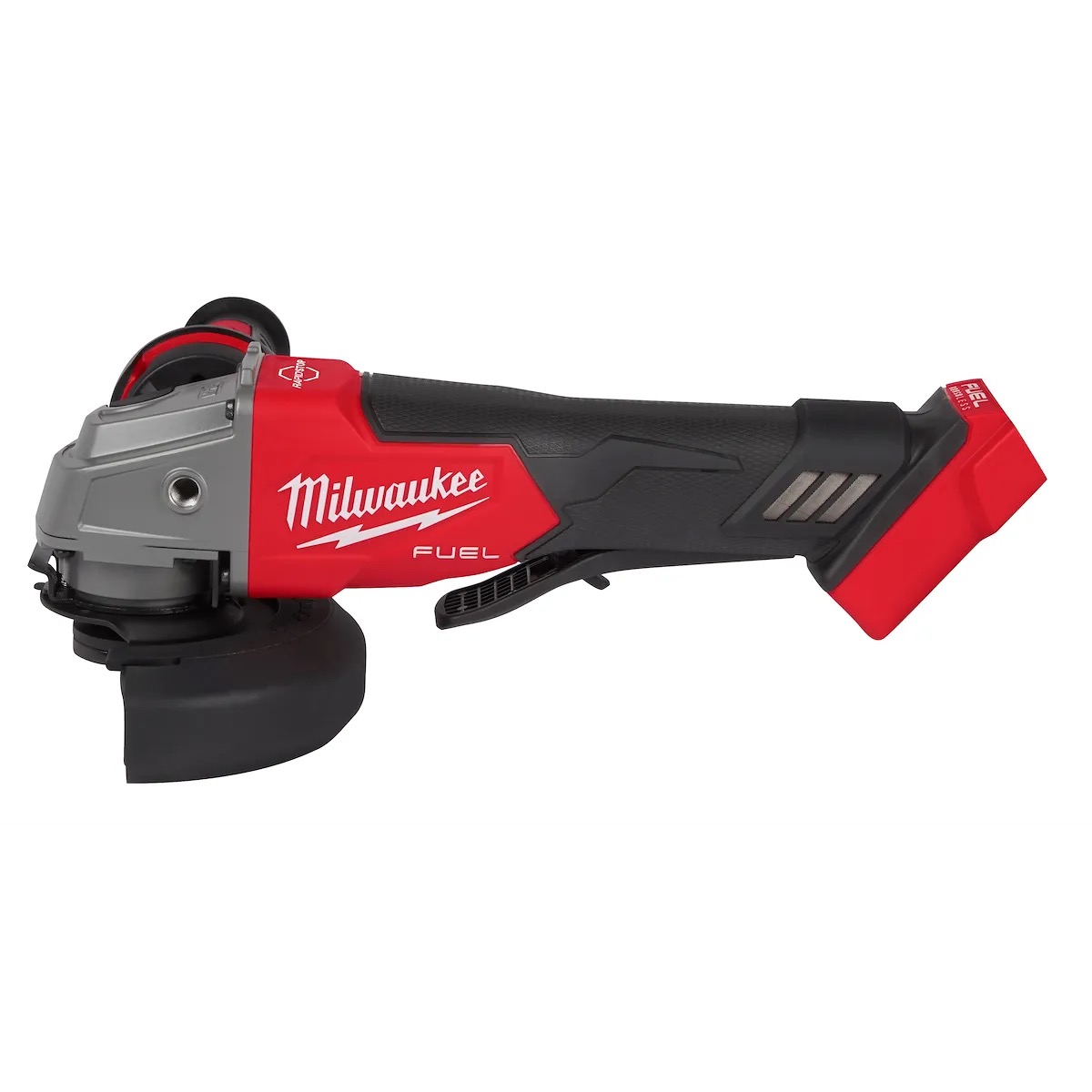
Milwaukee 2880-20 M18 FUEL — Best Overall
| Specification | Value |
|---|---|
| Battery Platform | M18 18V |
| Motor | Brushless (POWERSTATE) |
| No-Load Speed | 9,000 RPM |
| Disc Capacity | 4.5” or 5” |
| Switch Type | Paddle (dead-man) |
| Spindle | 5/8-11 UNC |
| Guard | Tool-free adjustable |
| Weight (bare tool) | 5.1 lbs |
| Warranty | 5 years |
| Price Range | $130–$165 (bare tool) |
Per Milwaukee’s specifications, the 2880-20 uses a POWERSTATE brushless motor with REDLINK PLUS electronics that manage power delivery under load — maintaining cutting speed as the disc engages the workpiece rather than allowing significant RPM drop. The paddle switch design meets ANSI B7.1 dead-man requirements. Milwaukee offers this grinder in both 4.5/5-inch disc capacity, which provides accessory flexibility at job supply houses that may stock one size more readily than the other. The 5-year tool warranty is the longest in this comparison. The M18 platform includes over 250 tools, making battery compatibility a practical advantage for crews already running M18 equipment.
Best for: Contractors on the M18 platform who need a professional-grade grinder for sustained welding prep, rebar cutting, and surface grinding. The dead-man paddle switch and REDLINK electronics are the differentiators over lower-tier cordless options.
DeWalt DCG413B 20V MAX — Best for DeWalt Platform Users
| Specification | Value |
|---|---|
| Battery Platform | 20V MAX |
| Motor | Brushless |
| No-Load Speed | 9,000 RPM |
| Disc Capacity | 4.5” |
| Switch Type | Paddle with lock-off |
| Spindle | 5/8-11 UNC |
| Guard | Tool-free adjustable |
| Weight (bare tool) | 4.2 lbs |
| Warranty | 3 years |
| Price Range | $100–$140 (bare tool) |
Per DeWalt’s specifications, the DCG413B is the lightest professional-grade cordless grinder in this comparison at 4.2 lbs bare. The brushless motor pairs with electronic brake — the disc stops within 2 seconds of releasing the paddle switch, faster than unpowered spin-down. The 20V MAX platform shares batteries across DeWalt’s 300+ tool lineup. The 4.5-inch-only disc capacity is standard for most contractor applications. At $100–$140 bare tool, the DCG413B is the lowest entry price for a professional brushless cordless grinder in this comparison.
Best for: DeWalt platform users who prioritize lighter tool weight — particularly useful for overhead grinding and extended sessions where arm fatigue accumulates. The electronic brake is a genuine safety feature that the platform-equivalent competition doesn’t always include at this price point.
Makita XAG04Z 18V LXT — Best for Makita Platform Users
| Specification | Value |
|---|---|
| Battery Platform | 18V LXT |
| Motor | Brushless |
| No-Load Speed | 8,500 RPM |
| Disc Capacity | 4.5” |
| Switch Type | Paddle with lock-off |
| Spindle | 5/8-11 UNC |
| Guard | Tool-free adjustable |
| Weight (bare tool) | 4.5 lbs |
| Warranty | 3 years |
| Price Range | $110–$145 (bare tool) |
Per Makita’s product documentation, the XAG04Z delivers 8,500 RPM no-load — slightly below the Milwaukee and DeWalt — with a brushless motor and Star Protection battery communication that prevents overloading, over-discharging, and overheating. The anti-restart function prevents accidental starts when battery is inserted while the switch is engaged. Makita’s 18V LXT platform spans over 300 tools. The slim barrel profile is a design differentiator — the smaller grip circumference makes single-handed control easier for operators with smaller hand sizes, reducing grip fatigue on sustained passes.
Best for: Makita LXT platform users and contractors who prioritize ergonomic grip design for sustained use. The anti-restart feature adds a layer of operational safety relevant to professional environments.
Bosch GWS18V-45 18V PROFACTOR — Best for Bosch Platform
| Specification | Value |
|---|---|
| Battery Platform | 18V PROFACTOR |
| Motor | Brushless |
| No-Load Speed | 9,000 RPM |
| Disc Capacity | 4.5” |
| Switch Type | Paddle with lock-off |
| Spindle | 5/8-11 UNC |
| Guard | Tool-free adjustable |
| Weight (bare tool) | 5.0 lbs |
| Warranty | 3 years |
| Price Range | $120–$155 (bare tool) |
Per Bosch’s specifications, the GWS18V-45 PROFACTOR uses a KickBack Control sensor that detects sudden disc binding events — a primary cause of grinder injuries — and cuts power within milliseconds of detecting a stall or kickback. According to Bosch’s documentation, KickBack Control activates based on angular momentum change, not user input, providing protection before the operator reacts. The PROFACTOR platform is Bosch’s professional tier, distinct from the 18V consumer line. Battery compatibility is within the PROFACTOR/18V CORE system.
Best for: Contractors who grind in conditions with elevated kickback risk — cutting in confined spaces, working near the end of a disc’s life, or operators newer to angle grinder use. The active kickback sensor is a meaningful safety feature not available on the Milwaukee or DeWalt models at this price point.
Comparison Table
| Model | Platform | RPM | Disc Size | Switch | Weight | Warranty | Price |
|---|---|---|---|---|---|---|---|
| Milwaukee 2880-20 | M18 | 9,000 | 4.5” or 5” | Paddle | 5.1 lbs | 5 years | $130–$165 |
| DeWalt DCG413B | 20V MAX | 9,000 | 4.5” | Paddle | 4.2 lbs | 3 years | $100–$140 |
| Makita XAG04Z | 18V LXT | 8,500 | 4.5” | Paddle | 4.5 lbs | 3 years | $110–$145 |
| Bosch GWS18V-45 | 18V PROFACTOR | 9,000 | 4.5” | Paddle | 5.0 lbs | 3 years | $120–$155 |
Cordless vs. Corded: When Cordless Wins
For most contractor applications, cordless angle grinders have reached functional parity with corded models. Per application data:
Cordless wins when: The work moves frequently (cutting rebar down a foundation line, grinding welds across a structural frame), the jobsite has limited or no power, the grinder operates in finished spaces where cord management is impractical, or the operator moves between overhead and ground-level work repeatedly.
Corded wins when: The work involves sustained grinding sessions exceeding 10–15 continuous minutes, battery management across multiple tools is already at capacity, or the work environment is stationary (shop welding bench, fabrication table). For extended sessions, a corded grinder at $50–$100 and a 25-foot extension cord remains a cost-effective choice. See the best corded angle grinders under $100 for the corded comparison.
Disc Types and Application Guide
Per ANSI B7.1 classification and manufacturer application data:
| Disc Type | Application | RPM Rating Required |
|---|---|---|
| Type 27 grinding disc | Weld grinding, surface preparation | Full RPM |
| Type 1 cut-off wheel | Rebar, pipe, thin metal | Full RPM |
| Flap disc (T29) | Blending, finishing welds | Full RPM |
| Wire cup brush | Rust removal, paint stripping | Check RPM limit |
| Diamond cup wheel | Concrete, masonry surface prep | Check RPM limit |
Critical safety note: Per ANSI B7.1, never use a disc rated below the grinder’s maximum RPM. All discs must be rated at or above the grinder’s no-load speed. Check the disc’s maximum RPM printed on the label before installation.
Who This Is NOT For
- Occasional weekend use. A corded angle grinder at $50–$80 handles infrequent grinding, cutting, and wire brush work without the $100–$165 bare-tool premium for cordless. The cordless format is justified by workflow frequency — contractors who use a grinder daily benefit from the mobility; weekend users rarely do
- Contractors without an existing 18V platform. Each grinder reviewed here requires a platform battery ($60–$100) and charger ($40–$70) if not already owned. Starting from zero, a corded grinder plus a dedicated 25-foot extension cord costs $80–$130 total — half the cost of a cordless setup; weigh the battery platform comparison before committing to an ecosystem for a single grinder
- Sustained production grinding (10+ minutes continuous). On a grinder, battery heat accumulates faster under continuous load than on a drill or saw. Production grinding sessions — rust removal on vehicles, weld cleanup on structural steel — are better served by a corded tool that eliminates battery management
- Masonry and concrete cutting. 4.5-inch cordless grinders lack the power headroom for aggressive concrete cutting. A 7-inch corded grinder or dedicated cut-off saw is the right tool for masonry cutting applications
What You’ll Also Need
- Type 27 grinding discs — 4.5 inch, A24R or A36N — The standard consumable for weld grinding and surface prep on mild steel. 24-grit (A24R) for rapid material removal; 36-grit (A36N) for controlled blending. Buy in bulk packs of 10–25 to reduce per-disc cost. Check price on Amazon →
- Cut-off wheels — 4.5 inch, .045 thick — Ultra-thin cut-off wheels (0.045”) cut faster and with less heat than standard 1/8” wheels. Required for clean cuts on rebar, bolt stock, and angle iron. Verify RPM rating matches your grinder’s no-load speed. Check price on Amazon →
- Flap discs — T29, 40 grit — A flap disc replaces both the grinding disc and finishing disc in weld blending applications. T29 (conical) shape maintains aggressive contact angle while the wheel wears down. 40-grit handles most contractor weld-blending work. Check price on Amazon →
- Wire cup brush — knotted, 5/8-11 — Knotted wire cups remove surface rust, mill scale, and paint faster than crimped wire. The 5/8-11 thread fits all four grinders reviewed here. Verify the brush’s RPM rating before use — some wire cups have lower RPM limits than the grinder’s no-load speed. Check price on Amazon →
- Side handle (auxiliary handle) — ANSI B7.1 requires two-handed operation for angle grinders 4.5 inches and larger. Most grinders ship with one side handle; a replacement or spare is useful when the original is misplaced or damaged. Verify the thread size matches your grinder. Check price on Amazon →
Sources
- Milwaukee 2880-20 M18 FUEL product specifications (milwaukeetool.com)
- DeWalt DCG413B 20V MAX specifications (dewalt.com)
- Makita XAG04Z 18V LXT product documentation (makitatools.com)
- Bosch GWS18V-45 PROFACTOR specifications and KickBack Control documentation (boschtools.com)
- ANSI B7.1-2010 Safety Code for Use, Care and Protection of Abrasive Wheels