Best Drip Irrigation Kits for Spring 2026 Garden Setup
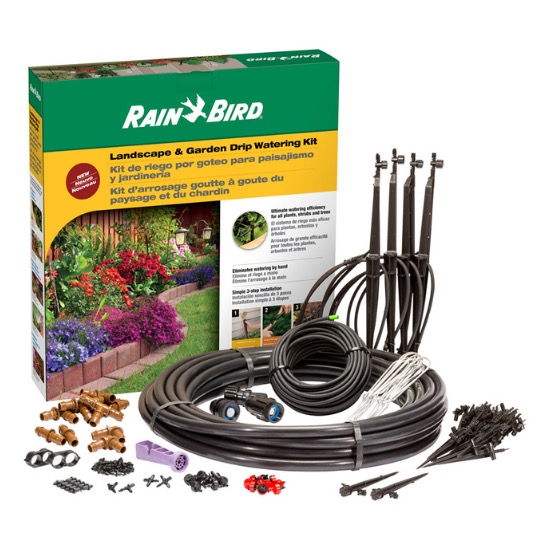
Drip irrigation applies water directly to the root zone — bypassing the evaporation loss, foliar disease, and runoff that overhead sprinklers cause. For vegetable gardens, orchards, raised beds, and perennial plantings, it is the most water-efficient irrigation method available. The appeal of a complete kit is getting started without designing a custom system from components. The problem with most consumer kits is that they are sized for marketing — “covers 150 plants” on the box counts 1/4-GPH button emitters that deliver meaningful moisture only in ideal conditions.
This guide compares five drip irrigation kits based on actual system capacity, component quality, and suitability for small-farm and garden applications — from 50-square-foot raised beds to 1-acre market gardens. Pricing reflects spring 2026 market ranges verified across major retail channels.
Drip Irrigation vs. Soaker Hose vs. Sprinkler: Which System Fits Your Garden?
Before selecting a kit, understanding how the three primary irrigation types differ prevents buying the wrong system entirely. Per University of California ANR Publication 8000 and University of Arizona Cooperative Extension guidance on home garden irrigation:
Drip Irrigation (Individual Emitters)
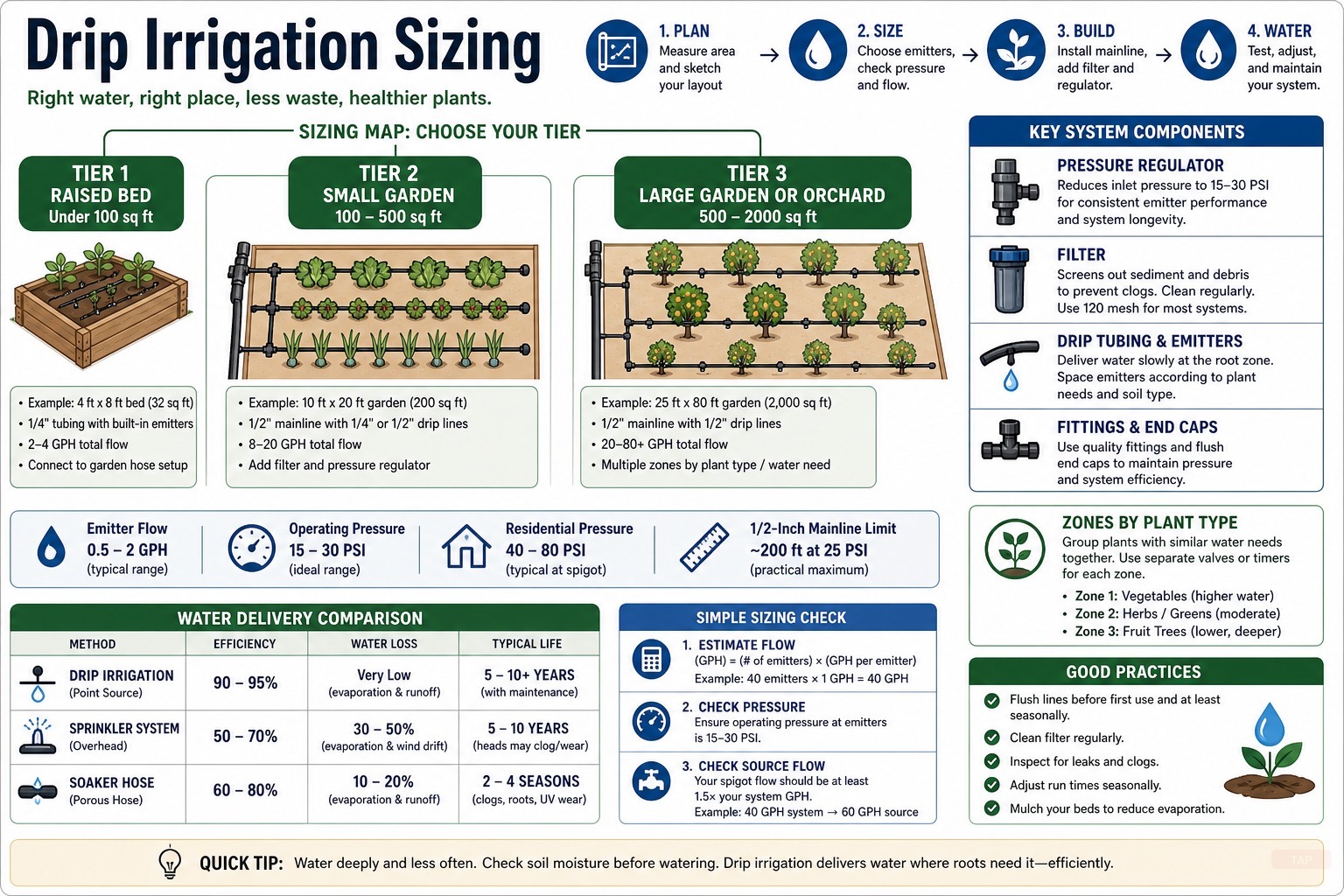
Drip systems deliver water through discrete emitters mounted at or near individual plants. Water is released at low flow rates (0.5–2 GPH per emitter) directly into the root zone.
Strengths: Precise per-plant control; low evaporation loss (typically 90–95% application efficiency per NRCS); foliage stays dry, reducing fungal disease pressure; adapts to mixed plantings with varied spacing; longer service life (5–10+ years for quality components).
Weaknesses: More components to install; emitters can clog without filtration; requires pressure regulation; not suitable for germinating seeds (surface must remain moist during emergence).
Best application: Established vegetable gardens, raised beds, orchards, vineyards, container collections, and any planting where plant spacing is irregular.
Soaker Hose
Soaker hoses are porous rubber or recycled-material tubes that sweat water uniformly along their entire length when pressurized.
Strengths: Simple installation — one connection, unroll along the row; no emitter spacing decisions; lower initial cost; works well for dense row plantings (lettuce, spinach, brassicas) where uniform moisture across the full row length is the goal.
Weaknesses: No per-plant flow control; inefficient for widely spaced plants (water applied between plants is wasted); degrades faster (typically 2–4 seasons) than quality drip components; susceptible to mineral clogging in hard water; flow rate varies with line length and pressure, making coverage estimates unreliable per the University of Arizona Cooperative Extension.
Best application: Dense, uniform row plantings — lettuce, brassicas, strawberries — where the entire row length should receive moisture.
Overhead Sprinkler
Sprinklers apply water in a pattern above the canopy, covering a defined radius from the sprinkler head.
Strengths: Best for establishing seedbeds where surface moisture is required for germination; covers large areas quickly; can provide cooling and frost protection.
Weaknesses: High evaporation loss (30–50% vs. drip at 5–10% per NRCS data); wets foliage, increasing fungal and bacterial disease pressure in humid climates; not suitable for fruit-bearing plants during harvest; subject to wind drift losses.
Best application: Lawn areas, seedbed establishment, cover crops, frost protection. Poor choice for established vegetable gardens or orchards where water efficiency and disease control matter.
Decision Summary
| Your Situation | Best System |
|---|---|
| Raised bed or mixed-spacing garden | Drip (individual emitters) |
| Dense row crops (lettuce, brassicas) | Soaker hose OR drip tape |
| Orchard or fruit trees | Drip (individual emitters) |
| New seedbed establishment | Overhead sprinkler |
| Lawn or turf | Overhead sprinkler |
| Containers or pots | Drip (individual emitters) |
| Budget-constrained, short-term setup | Soaker hose |
What Size Drip System Do You Need?
Per USDA NRCS irrigation design guidelines and manufacturer system specifications, plot size and plant type are the two primary sizing inputs. The three practical tiers for home and small-farm use:
Raised Bed (Under 100 sq ft)
A standard 4×8 or 4×12 raised bed is served by any entry-level kit. A single 25–50 ft main line run and 10–40 emitters cover most configurations.
Recommended approach: Use a 4-outlet manifold kit (like the DIG B47) to run four parallel 1/4-inch distribution lines down the bed’s plant rows. For a 4×8 bed with 8-inch plant spacing, 12 emitters at 1 GPH running 30–45 minutes delivers approximately 6–9 gallons — sufficient for most warm-season vegetable crops per UC ANR irrigation guidance.
Kits that fit: DIG B47-4GP, Rain Bird DRIP6. Budget: $25–$45.
Small Garden (100–500 sq ft)
A small garden of 100–500 square feet requires 25–100 emitters and typically 50–150 feet of main line, depending on layout. Single-zone operation from one hose bib is practical at this scale.
Recommended approach: A single mid-range kit (Orbit 69525) or two entry-level kits run as separate zones from a dual-outlet hose timer. Separate vegetable rows from perennials or fruit trees — they have different water requirements and should not share a zone. Per NRCS design standards, maintain ±10% emitter flow uniformity across each zone.
Kits that fit: Orbit 69525, Rain Bird DRIP6 (extended with additional tubing). Budget: $40–$80 plus timer ($20–$35).
Large Garden or Orchard (500–2,000 sq ft)
At 500–2,000 square feet, a single-zone kit is insufficient. Per NRCS guidance on trickle irrigation system design, zoning by plant type is required to prevent over-application to water-sensitive crops and under-application to high-demand trees.
Recommended approach: A 2–4 zone manifold with a multi-program irrigation timer controlling separate solenoid valves — one zone for row vegetables, one for trees/perennials, one for containers if applicable. Each zone runs independently on its own schedule. Main line totals of 200–500 feet are common at this scale. For row crops, Netafim Techline drip tape (purchased by the roll) provides the most uniform coverage per linear foot. For trees, individual 2 GPH emitters on 1/4-inch distribution tubing, 2–4 per tree depending on canopy size.
Kits that fit: Netafim Techline CV (row zones), Rain Bird DRIP6 extended (tree zones), with a separate multi-zone timer/controller. Budget: $150–$400 depending on zone count and tubing footage.
Key design constraint per NRCS guidance: A single 1/2-inch poly main line has a practical run limit of approximately 200 feet at 25 PSI before pressure drop degrades emitter uniformity at the far end. Systems over 200 feet of total run require either larger-diameter header pipe or multiple independent zones.
What Separates a Functional Drip Kit from a Disposable One
Per USDA NRCS irrigation engineering guidance and manufacturer component specifications, four factors determine whether a drip system performs over multiple seasons:
Tubing wall thickness. Main line poly tubing (1/2-inch) should have a minimum wall thickness of 0.060 inches for durability under UV exposure and foot traffic. Thin-wall tubing (0.030–0.040 inches) kinks permanently, cracks after 1–2 seasons of UV exposure, and collapses under light loads. Most budget kits use thin-wall tubing to reduce kit cost.
Pressure regulation. Residential water lines run at 40–80 PSI. Drip emitters are designed for 15–30 PSI. Without a pressure regulator in the kit, emitters blow out, connectors leak, and flow rates are erratic. Per Rain Bird’s installation documentation, unregulated pressure is the primary cause of drip system failure in residential installations.
Emitter construction. Self-cleaning emitters use a flexible membrane that opens and closes with each irrigation cycle, flushing debris from the orifice. Fixed-orifice emitters (most budget kits) clog permanently from mineral deposits and sediment within 1–2 seasons in most municipal water systems.
Filter. A Y-strainer or inline mesh filter (150–200 mesh) prevents sediment from reaching emitters. Kits without a filter require manual emitter cleaning or replacement annually in most water conditions.
Top Drip Irrigation Kits
Rain Bird DRIP6 Drip Irrigation Starter Kit — Best Overall
| Specification | Value |
|---|---|
| Coverage | Up to 5 trees or 50 shrubs |
| Main Line | 1/2” poly tubing (50 ft included) |
| Distribution Tubing | 1/4” vinyl (100 ft included) |
| Emitters | Adjustable 0–10 GPH (10 included) |
| Pressure Regulator | Yes (25 PSI) |
| Filter | Yes (inline mesh) |
| Timer Compatible | Yes |
| Connection | Standard hose thread (3/4”) |
| Price Range | $30–$45 (spring 2026) |
Search used/open-box on eBay →
Per Rain Bird’s product documentation, the DRIP6 includes both a pressure regulator and inline filter — the two components most often omitted from budget kits. The adjustable emitters (0–10 GPH) allow flow calibration per plant without purchasing multiple emitter types. Rain Bird’s 1/2-inch poly tubing uses a heavier wall construction than most entry-level kits. The kit connects to a standard 3/4-inch hose thread, compatible with hose bibs, timers, and valves without adapters. Rain Bird provides a 5-year limited warranty on the pressure regulator and filter assembly.
Best for: Homeowners and small-farm operators starting a drip system for trees, shrubs, or a small vegetable garden (under 500 square feet). The included pressure regulator and filter make it the most complete entry-level kit for consistent performance.
Limitation: 50 feet of main line limits coverage to a single short bed or plant cluster. Larger installations require purchasing additional main line tubing and distribution fittings separately.
DIG B47-4GP Drip Irrigation System — Best for Raised Bed Gardens
| Specification | Value |
|---|---|
| Coverage | Up to 40 plants |
| Main Line | 1/2” poly tubing (25 ft) + 1/4” distribution (50 ft) |
| Emitters | Button emitters, 1 GPH (40 included) |
| Pressure Regulator | Yes (25 PSI) |
| Filter | Yes |
| Multi-outlet manifold | Yes (4-outlet) |
| Timer Compatible | Yes |
| Connection | 3/4” hose thread |
| Price Range | $25–$40 (spring 2026) |
Search used/open-box on eBay →
Per DIG Corporation’s product documentation, the B47-4GP includes a 4-outlet manifold that distributes from a single supply line to four independent 1/4-inch distribution runs — a practical configuration for rectangular raised beds where four parallel rows of plants can each have their own run. The 1 GPH button emitters are pressure-compensating, meaning they maintain consistent flow between 10–50 PSI, reducing sensitivity to pressure variation along the main line. For raised beds with 12-inch plant spacing, 40 emitters covers approximately 40 linear feet of planting area.
Best for: Vegetable gardeners with raised beds or row crops where multiple parallel distribution lines branch from one supply connection. The manifold design eliminates the need for multiple inline tee connectors.
Raindrip R560DP Automatic Watering Kit — Best with Timer Included
| Specification | Value |
|---|---|
| Coverage | Up to 10 plants |
| Main Line | 1/2” poly (25 ft) |
| Distribution | 1/4” tubing (50 ft) |
| Emitters | 1 GPH adjustable (10 included) |
| Pressure Regulator | Yes |
| Filter | Yes |
| Timer | Digital programmable timer included |
| Connection | 3/4” hose thread |
| Price Range | $45–$65 (spring 2026) |
Per Raindrip’s product documentation, the R560DP includes a digital hose-end timer that connects between the hose bib and the drip system. The timer supports multiple daily watering cycles, adjustable duration from 1–360 minutes, and delay settings for rain suspension. For operators who cannot water manually on a consistent schedule — travel, extended farm work days, or remote plots — the timer eliminates manual operation. The system is limited to 10 plants in the base kit, but main line and distribution tubing can be extended with compatible fittings.
Best for: Small-plot operators who need automated watering without a full irrigation controller installation. Ideal for container gardens, potted trees, or a small planting that requires consistent moisture during hot weather or owner absence.
Orbit 69525 1/2-Inch Drip Irrigation Starter Kit — Best for Larger Coverage
| Specification | Value |
|---|---|
| Coverage | Up to 100 plants |
| Main Line | 1/2” poly (50 ft) |
| Distribution Tubing | 1/4” (150 ft) |
| Emitters | Mixed 1 GPH and 2 GPH (50 included) |
| Multi-outlet stakes | 8 included |
| Pressure Regulator | Yes |
| Filter | Yes |
| Connection | 3/4” hose thread |
| Price Range | $40–$60 (spring 2026) |
Search used/open-box on eBay →
Per Orbit’s product data, the 69525 includes 150 feet of 1/4-inch distribution tubing — the most distribution footage in this comparison — along with mixed 1 GPH and 2 GPH emitters and 8 multi-outlet distribution stakes. The multi-outlet stakes distribute from a single 1/4-inch supply to 4 or 8 individual emitter points per stake, which suits closely spaced plantings (herb gardens, flower beds) or container clusters where multiple plants receive water from one distribution run.
Best for: Gardeners with larger, densely planted areas — herb gardens, annual flower beds, container collections — where high plant count per square foot requires many emitter points from a limited main line run.
Netafim Techline CV Drip System — Best for Orchard and Row Crop Applications
| Specification | Value |
|---|---|
| Coverage | 50–500 linear feet per zone |
| Emitter Spacing | 12”, 18”, or 24” factory-installed |
| Flow Rate | 0.42 or 0.62 GPH per emitter |
| Pressure Compensation | Yes (6–43 PSI) |
| Check Valve | Yes (per emitter) |
| Tubing | 0.634” ID, 0.060” wall |
| Connection | Barbed fittings, standard compatibility |
| Price Range | $0.18–$0.35 per linear foot (spring 2026, purchased by roll) |
Per Netafim’s product documentation, Techline CV is a subsurface or surface drip tape with factory-installed pressure-compensating emitters at fixed spacing intervals. The check valve per emitter prevents siphoning of soil into the emitter orifice when the system drains, which is the primary cause of clogging in drip tape on undulating terrain. Pressure compensation maintains consistent 0.42 or 0.62 GPH output across a 6–43 PSI operating range — meaning a 300-foot row on sloped terrain delivers uniform water application from top to bottom.
Unlike the kit-based options above, Techline is purchased by the roll (100, 250, or 500 feet) and requires separate filter, pressure regulator, and connection fittings. It represents the professional-grade option for market gardens, orchards, and row crop irrigation where system longevity and uniformity matter more than ease of installation.
Best for: Market gardeners, orchard operators, and small farms with row crops (vegetables, strawberries, melons) where uniform water distribution across 50–500 feet of crop row is required. Not suitable for mixed-spacing plantings — emitter spacing is fixed at manufacture.
Comparison Table
| Kit | Coverage | Emitters | Pressure Reg | Filter | Timer | Spring 2026 Price |
|---|---|---|---|---|---|---|
| Rain Bird DRIP6 | 5 trees/50 shrubs | Adjustable 0–10 GPH | Yes | Yes | No | $30–$45 |
| DIG B47-4GP | 40 plants | 1 GPH pressure-comp. | Yes | Yes | No | $25–$40 |
| Raindrip R560DP | 10 plants | 1 GPH adjustable | Yes | Yes | Included | $45–$65 |
| Orbit 69525 | 100 plants | 1 and 2 GPH mixed | Yes | Yes | No | $40–$60 |
| Netafim Techline | Row crops | 0.42/0.62 GPH fixed | Sold separately | Sold separately | Sold separately | $0.18–0.35/ft |
Sizing Your System: Step-by-Step
Per USDA NRCS Technical Reference guidance on drip irrigation design:
Step 1 — Calculate peak daily water demand. Multiply plant count by daily water requirement (gallons per plant per day). Vegetable crops: 0.5–1.5 gallons per plant per day during peak summer. Fruit trees: 5–15 gallons per day depending on maturity and temperature.
Step 2 — Determine run time. Divide daily demand by emitter output. Example: 1 GPH emitter running 2 hours delivers 2 gallons. For a tomato plant requiring 1.5 gallons per day, a 1 GPH emitter needs 90 minutes of daily runtime.
Step 3 — Check pressure. Measure static pressure at the hose bib with a pressure gauge (available for $8–$15 at hardware stores). If above 40 PSI, a pressure regulator is required. Most municipal systems run 50–80 PSI — higher than any drip kit is designed to handle unregulated. If the source is a pond, creek, or well rather than a pressurized municipal line, an irrigation pump sized to your zones supplies the pressure the emitters need.
Step 4 — Zone by plant type. Trees and shrubs require more water per plant than row vegetables. Grouping plants with similar water requirements on the same valve/zone prevents over- or under-watering individual plants.
Who This Is NOT For
- Field crops over 5 acres. At field scale, drip tape is installed by specialized equipment and managed as a full irrigation engineering project. The consumer kits reviewed here are designed for garden and small-plot use. Commercial field drip systems require NRCS design assistance and infrastructure investment that is outside the scope of any kit.
- High-sediment well water without filtration. Drip emitters clog within days in high-sediment water without proper filtration. Most kits include a basic mesh filter adequate for municipal water; well water with measurable turbidity requires a dedicated sediment filter upstream of the drip system. The mesh filters included in kits are insufficient as stand-alone filtration for most well water sources.
- Frost-prone climates without drainage provisions. Water left in drip tubing through a hard freeze splits the tubing and destroys emitters. Systems in freeze zones require either seasonal removal and storage or blow-out drainage with a compressor at season’s end. This is a recurring seasonal cost and time commitment that is easy to overlook when evaluating initial kit price.
- Operators who want overhead coverage. Drip irrigation wets only the root zone — it does not provide overhead cooling, dust suppression, or germination moisture for newly seeded beds where surface moisture is required during emergence. Overhead sprinkler systems remain the right tool for seedbed establishment and lawn areas.
- Buyers who expect set-and-forget at the first installation. Any drip system requires seasonal inspection: checking emitters for clogging, replacing cracked fittings, flushing lines, and adjusting run times as plant size and season change. Operators unwilling to perform basic seasonal maintenance will experience system degradation within 1–2 seasons regardless of kit quality.
What You’ll Also Need
- Hose timer — digital, dual-outlet — A battery-powered digital timer automates watering without a controller or irrigation system. Dual-outlet models allow two independent zones to run on different schedules from one hose bib. Check price on Amazon →
- Inline pressure regulator — 25 PSI — Kits that include a pressure regulator usually include a 25 PSI unit; replacement and add-on regulators for expanding systems are sold separately. Match the PSI rating to the emitters’ design pressure. Check price on Amazon →
- Y-filter — 150 mesh inline — A Y-strainer installed at the hose bib connection protects the entire system from sediment. Replace or clean the screen at the start of each season. Check price on Amazon →
- 1/2-inch poly tubing — 100-foot roll — Extend main line runs beyond the kit’s included footage. Standard 1/2-inch barbed fittings connect extensions without special tools. Check price on Amazon →
- Goof plugs and hole punch — Moving emitter locations requires plugging the old hole and punching a new one. A 10-pack of 1/4-inch goof plugs and a barbed punch tool are the standard repair kit for any drip system. Check price on Amazon →
Internal Links
- Best Electric Fence Chargers — perimeter fencing considerations for garden protection
- Best Post Hole Diggers for Small Farms — installing stake-supported drip line structures
Sources
- Rain Bird DRIP6 product specifications and installation documentation (rainbird.com)
- DIG B47-4GP product documentation (digcorp.com)
- Raindrip R560DP specifications (raindrip.com)
- Orbit 69525 product data (orbitonline.com)
- Netafim Techline CV product documentation (netafim.com)
- USDA NRCS Irrigation Guide, Part 652, Chapter 7 — Trickle Irrigation
- University of California ANR Publication 8000 — Drip Irrigation in the Home Landscape
- University of Arizona Cooperative Extension Publication AZ1400 — Drip Irrigation for Home Gardens