Best Battery Maintainers for Farm Equipment in 2026
Farm equipment that sits idle between seasons — tractors, UTVs, mowers, backup generators, grain augers — shares a common failure point: dead batteries. Lead-acid batteries self-discharge at roughly 1-3% per week at room temperature, and faster in cold storage. Parasitic drain from onboard electronics (GPS modules, fuel injection controllers, security systems) accelerates the problem. According to Battery Council International data, a lead-acid battery that drops below 12.4V and stays there begins sulfation — a crystalline buildup on the plates that permanently reduces capacity. A $25-50 battery maintainer prevents a $150-250 battery replacement. The math is straightforward.
This guide compares five battery maintainers based on manufacturer specifications, focusing on charging amperage, charging stages, safety features, and suitability for the cold-storage conditions typical of farm equipment sheds and barns.
Trickle Charger vs. Smart Charger vs. Float Charger — Terminology Matters
These terms are used interchangeably in marketing, but they describe different charging behaviors:
- Trickle charger: Delivers a constant low-amperage charge regardless of battery state. Older designs that lack automatic shutoff can overcharge and boil electrolyte out of flooded lead-acid batteries. True trickle chargers without automatic cutoff are largely obsolete for good reason.
- Smart charger (multi-stage): Monitors battery voltage and adjusts charging current through multiple stages — typically bulk charge, absorption, and float. Transitions automatically and will not overcharge. All five products reviewed here are smart chargers despite some using “trickle charger” in their marketing.
- Float charger (maintenance charger): Maintains a fully charged battery at a precise float voltage (typically 13.2-13.6V for a 12V lead-acid battery). Applies charge only when voltage drops below the float threshold. This is the final stage of a multi-stage smart charger, but some single-stage units do only this.
For farm equipment sitting weeks or months between use, a multi-stage smart charger that can both recover a partially discharged battery and then maintain it at float voltage is the correct tool. All five units reviewed below qualify.
Key Specifications That Matter for Farm Use
- Amperage: Determines charge speed. A 1A charger takes roughly 30-50 hours to fully charge a dead 50Ah battery. A 6A charger does it in 8-10 hours. For maintenance (keeping an already-charged battery topped off), amperage barely matters — even 0.75A is sufficient.
- Voltage detection: Smart chargers detect whether a battery is 6V or 12V (some support both). Most farm equipment uses 12V, but older tractors and some implements use 6V systems.
- Temperature compensation: Adjusts float voltage based on ambient temperature. Per manufacturer data, optimal float voltage for a 12V lead-acid battery ranges from approximately 13.8V at 32°F to 13.2V at 90°F. Chargers without temperature compensation may undercharge in cold barns or overcharge in hot equipment sheds.
- Spark-proof connections: All five chargers reviewed feature spark-proof clamp designs, which matters when connecting to batteries near fuel tanks and hay storage.
- Reverse polarity protection: Prevents damage if clamps are accidentally connected to wrong terminals. Standard on all modern smart chargers.
- Battery chemistry support: Most farm equipment uses flooded lead-acid or AGM batteries. Some newer equipment uses lithium starting batteries. Not all chargers support all chemistries — verify before connecting.
Top Battery Maintainers for Farm Equipment
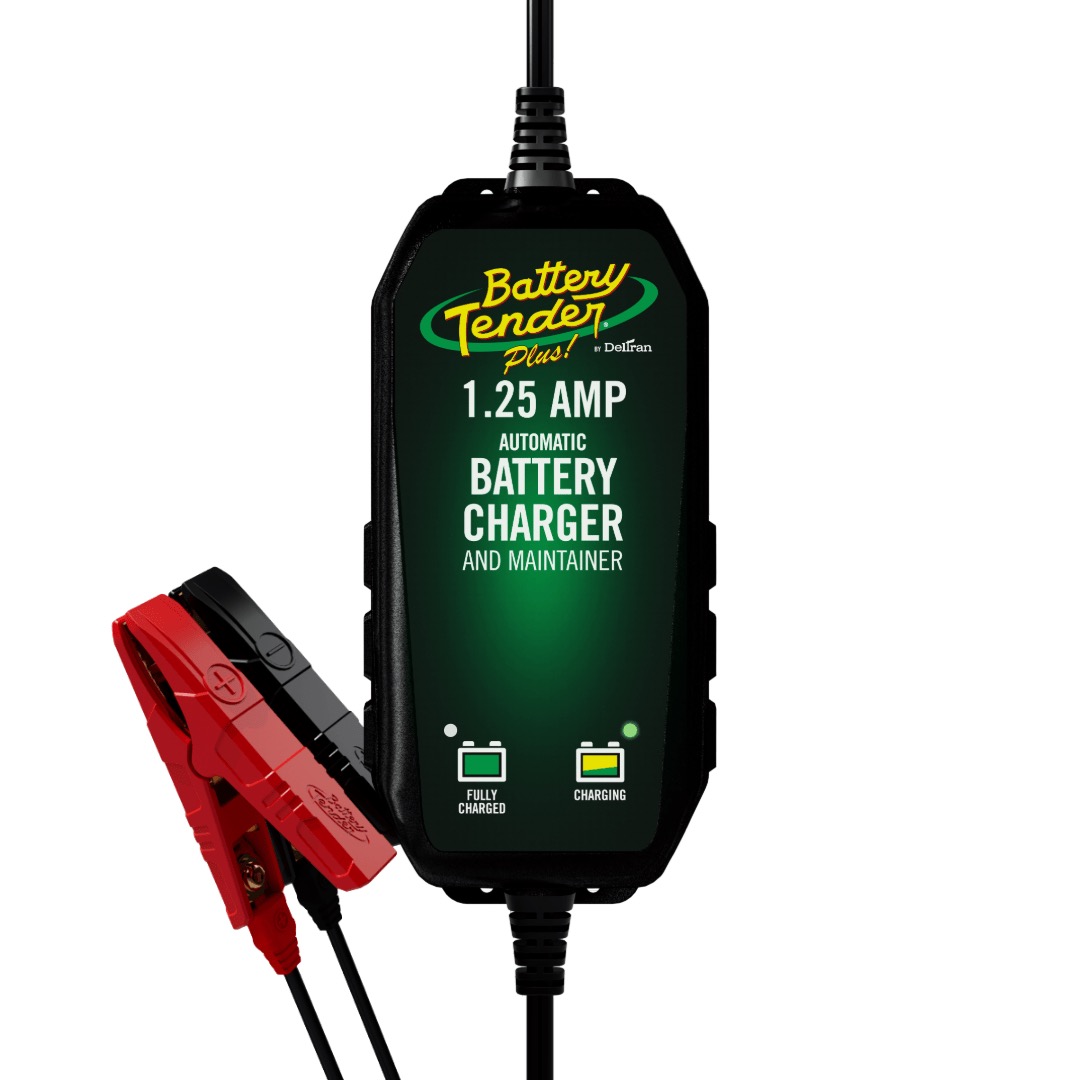
Battery Tender Plus 021-0128 — Best Overall for Farm Use
| Specification | Value |
|---|---|
| Amperage | 1.25A |
| Voltage | 12V only |
| Charging Stages | 4 (initialization, bulk, absorption, float) |
| Battery Types | Flooded lead-acid, AGM, gel |
| Temperature Compensation | No (standard model) |
| Spark-Proof | Yes |
| Reverse Polarity Protection | Yes |
| Output Cord Length | 12 feet |
| Warranty | 10-year limited |
| Price Range | $40-$50 |
According to Battery Tender’s product specifications, the Plus 021-0128 is their flagship maintainer — the model that essentially defined the “battery tender” category. The 4-stage charging algorithm transitions from a 1.25A bulk charge to absorption and then to a float stage at 13.2V. Per the manufacturer, the unit monitors battery voltage continuously and re-initiates a charge cycle if voltage drops below 12.6V.
The 12-foot output cord is a practical detail for farm use — it provides enough reach to route from an outlet to equipment parked in a standard barn stall without extension cords. The unit ships with both alligator clamps and a ring terminal harness that bolts permanently to battery terminals, allowing quick connect/disconnect without tools.
The 10-year warranty is the longest on this list and reflects the simplicity of the design — there is very little to fail in a well-built single-output charger.
Best for: The default choice for operators who need reliable, set-and-forget maintenance on one piece of equipment at a time. The 1.25A output is sufficient to recover a moderately discharged battery overnight and maintain it indefinitely. The ring terminal harness is particularly useful for equipment with batteries in hard-to-access locations — install it once and plug in the charger whenever the equipment is parked.
Limitation: No temperature compensation. In unheated barns where winter temperatures regularly drop below freezing, the fixed float voltage may be slightly low for optimal cold-weather charging. The practical impact is minimal for maintenance purposes but worth noting. Also limited to 12V — owners of older 6V equipment need a different unit.
NOCO Genius1 — Best Budget Smart Charger
| Specification | Value |
|---|---|
| Amperage | 1A |
| Voltage | 6V and 12V (auto-detect) |
| Charging Stages | 7 |
| Battery Types | Flooded, AGM, gel, lithium (LiFePO4), maintenance-free |
| Temperature Compensation | Yes (thermal sensor) |
| Spark-Proof | Yes |
| Reverse Polarity Protection | Yes |
| Force Mode | Yes (recovers batteries down to 1V) |
| Output Cord Length | ~6 feet |
| Warranty | 3-year limited |
| Price Range | $25-$35 |
Per NOCO’s product documentation, the Genius1 packs more features into a $30 charger than the Battery Tender Plus offers at $45. The 7-stage algorithm includes desulfation, soft start, bulk, absorption, optimization, float, and pulse maintenance stages. According to NOCO specifications, the integrated thermal sensor adjusts charging parameters based on ambient temperature — a genuine advantage for unheated farm buildings.
The Force Mode is a standout feature for farm applications: per the manufacturer, it can detect and begin charging batteries that have discharged below 1V, which standard smart chargers often reject as defective. Equipment that has sat for an entire off-season with a parasitic drain may discharge deeply enough to trigger this scenario.
The unit auto-detects 6V and 12V batteries, covering both modern 12V equipment and older 6V systems without manual switching.
Best for: Operators wanting maximum versatility at the lowest price point. The temperature compensation, 6V/12V auto-detect, lithium compatibility, and force-start mode make this the most feature-dense charger on the list. At $25-35, it costs less than a single battery replacement.
Limitation: The 1A output is the lowest on this list, meaning full recharges from deep discharge take longer. The shorter cord length (~6 feet) may require an extension cord in farm settings. The 3-year warranty is significantly shorter than the Battery Tender’s 10-year coverage.
Schumacher SC1281 — Best for Charging and Maintaining
| Specification | Value |
|---|---|
| Max Amperage | 100A engine start / 30A boost / 6A charge / 2A maintain |
| Voltage | 6V and 12V (selectable) |
| Charging Stages | Multi-stage automatic |
| Battery Types | Flooded, AGM, gel, deep-cycle |
| Temperature Compensation | No |
| Spark-Proof | Yes |
| Reverse Polarity Protection | Yes |
| Digital Display | Yes (voltage, charge rate, battery status) |
| Warranty | 3-year limited |
| Price Range | $70-$90 |
According to Schumacher’s product data sheet, the SC1281 is not just a maintainer — it is a full-featured charger with engine start assist. The 100A engine start mode provides emergency cranking power for equipment with severely discharged batteries. The 30A boost mode charges faster than any dedicated maintainer, and the 2A maintenance mode provides long-term float charging.
Per manufacturer specifications, the digital display shows real-time voltage, amperage, and charge percentage, which eliminates guesswork about battery condition. The unit automatically selects the appropriate charge rate and transitions to maintenance mode when the battery reaches full charge.
The multi-mode capability makes this unit practical as both a shop charger and a seasonal maintainer. Per Schumacher’s documentation, the microprocessor-controlled algorithm prevents overcharging in all modes.
Best for: Operators who need one unit that both charges dead batteries quickly and maintains batteries long-term. The engine start assist is valuable for cold-morning starts on diesel equipment that has been sitting. If the budget allows only one charging device for the entire farm, this is the most versatile option.
Limitation: The larger size and higher price point are unnecessary if the only goal is long-term maintenance. The SC1281 is overkill for connecting to a UTV battery that just needs to stay topped off between weekend use. No temperature compensation — same caveat as the Battery Tender Plus for cold barn installations.
Battery Tender Junior 021-0123 — Best Ultra-Budget Option
| Specification | Value |
|---|---|
| Amperage | 0.75A |
| Voltage | 12V only |
| Charging Stages | 3 (bulk, absorption, float) |
| Battery Types | Flooded lead-acid, AGM |
| Temperature Compensation | No |
| Spark-Proof | Yes |
| Reverse Polarity Protection | Yes |
| Output Cord Length | ~6 feet |
| Warranty | 5-year limited |
| Price Range | $20-$30 |
Per Battery Tender’s specifications, the Junior is a stripped-down version of the Plus that delivers 0.75A through a 3-stage algorithm. The lower amperage means slower recovery from discharge — roughly 40-70 hours for a fully depleted 50Ah battery — but for pure maintenance duty where the battery starts at or near full charge, the difference in amperage is negligible.
According to manufacturer documentation, the Junior uses the same float-mode monitoring as the Plus, re-initiating charge cycles when voltage drops below the threshold. The simplified 3-stage process (versus 4-stage on the Plus) omits the initialization diagnostic stage.
Best for: Operators who need multiple maintainers on a tight budget. At $20-30 each, buying three or four Juniors to keep on individual pieces of equipment costs less than a single premium charger. For maintaining batteries that are already charged — lawnmowers, generators, seasonal implements — the Junior does the job.
Limitation: The 0.75A output is too slow for practical recharging of deeply discharged batteries. No 6V support. No temperature compensation. The shorter cord requires careful outlet placement or extension cords. This is a pure maintenance device, not a recovery charger.
CTEK MXS 5.0 — Best Premium Maintainer
| Specification | Value |
|---|---|
| Amperage | 4.3A (max) |
| Voltage | 12V only |
| Charging Stages | 8 (desulfation, soft start, bulk, absorption, analysis, recond, float, pulse) |
| Battery Types | Flooded, AGM, gel, calcium, EFB |
| Temperature Compensation | Yes (automatic) |
| Spark-Proof | Yes |
| Reverse Polarity Protection | Yes |
| Recondition Mode | Yes (stratification reversal) |
| Warranty | 5-year limited |
| Price Range | $70-$90 |
According to CTEK’s product documentation, the MXS 5.0 uses a patented 8-step charging algorithm that includes two stages most competitors omit: an analysis stage that tests whether the battery can accept and hold a charge, and a recondition stage that applies a controlled overcharge to reverse acid stratification in flooded batteries. Per CTEK’s data, the recondition mode can recover capacity in batteries that have experienced extended periods of undercharge — exactly the scenario that farm equipment batteries face during off-seasons.
The 4.3A maximum charge rate is the highest among the dedicated maintainers on this list (excluding the Schumacher’s multi-mode design), meaning faster recovery from partial discharge. Per manufacturer specifications, the automatic temperature compensation adjusts charging voltage based on ambient conditions without requiring an external sensor.
CTEK is a Swedish manufacturer whose chargers are widely specified as OEM accessories by European automotive manufacturers including BMW, Porsche, and Bentley. Per industry data, CTEK chargers are used as standard equipment in numerous dealership service departments.
Best for: Operators willing to pay a premium for the most sophisticated charging algorithm available in a consumer maintainer. The recondition mode is genuinely useful for batteries that have experienced neglect — it can restore measurable capacity that simpler chargers cannot. The 4.3A charge rate also means practical recharge times, not just maintenance.
Limitation: At $70-90, the CTEK costs 2-3 times more than the NOCO Genius1, which offers many of the same features (temperature compensation, multi-chemistry, multiple stages). The premium buys the recondition mode and faster charge rate, but for operators who just need basic maintenance, the price difference is hard to justify. Also limited to 12V only.
Comparison Summary
| Model | Amps | Voltage | Stages | Temp Comp | Force/Recond Mode | Price |
|---|---|---|---|---|---|---|
| Battery Tender Plus | 1.25A | 12V | 4 | No | No | $40-$50 |
| NOCO Genius1 | 1A | 6V/12V | 7 | Yes | Force (1V recovery) | $25-$35 |
| Schumacher SC1281 | 2A-100A | 6V/12V | Multi | No | Engine start | $70-$90 |
| Battery Tender Junior | 0.75A | 12V | 3 | No | No | $20-$30 |
| CTEK MXS 5.0 | 4.3A | 12V | 8 | Yes | Recondition | $70-$90 |
What You Will Also Need
A battery maintainer alone handles the charging. These accessories complete the maintenance system:
Ring Terminal Harnesses
Every Battery Tender ships with one, but operators maintaining multiple pieces of equipment should buy extras. A ring terminal harness bolts permanently to the battery terminals and routes a quick-disconnect plug to an accessible location on the equipment frame. This eliminates the need to open battery compartments, remove covers, or fumble with clamp connections each time. Per Battery Tender’s documentation, their harnesses include a built-in 7.5A fuse for short-circuit protection.
Battery Disconnect Switches
For equipment with known parasitic drain (aftermarket GPS, fuel injection computers, alarm systems), a battery disconnect switch physically breaks the circuit when the equipment is parked. According to manufacturer data, a typical marine-grade disconnect switch handles 275-350 continuous amps and installs on the negative battery terminal in minutes. Combined with a maintainer, a disconnect switch eliminates parasitic drain entirely so the maintainer only compensates for natural self-discharge.
Digital Multimeter
A basic multimeter verifies battery voltage before and after charging, measures parasitic drain (by reading milliamp draw with the key off), and confirms the maintainer’s output. Per manufacturer specifications, the Amprobe AM-530 provides accurate DC voltage and current readings suitable for battery diagnostics. Any multimeter with a DC milliamp range works for parasitic drain testing.
Installation Tips for Farm Buildings
For operators maintaining multiple batteries across a farm, a practical setup involves:
- Permanent ring terminal harnesses on every piece of seasonal equipment. Route the quick-disconnect plug to a visible, accessible location — zip-tied to the frame rail or mounted near the seat.
- One maintainer per high-value battery for equipment that sits longest (the combine, the hay equipment, the backup generator). At $25-50 each, dedicated maintainers are cheaper than one battery replacement.
- One shared maintainer on a rotation for equipment that sits weeks rather than months. Move the charger between machines on a weekly schedule.
- A power strip in each equipment bay with individual switches, so maintainers can be de-energized without unplugging when equipment is in active use.
For buildings without convenient outlets, a heavy-gauge extension cord (12 AWG minimum for runs over 25 feet) from the nearest outlet is acceptable. Maintainers draw minimal current — typically under 0.5A from the wall — so voltage drop over long cord runs is negligible.
Who This Is NOT For
- Equipment used daily or near-daily. A battery that gets charged by an alternator through regular use does not need supplemental maintenance. The alternator provides the same bulk-absorption-float charging that a maintainer does. Maintainers solve the storage problem, not the daily-use problem.
- Batteries already showing physical damage. Swollen cases, cracked terminals, visible corrosion eating into the posts, or electrolyte leaking from a flooded battery indicate a battery that needs replacement, not maintenance. A maintainer cannot reverse physical degradation.
- Lithium starting batteries (unless the charger explicitly supports them). Only the NOCO Genius1 on this list is rated for lithium (LiFePO4) batteries. Connecting a non-lithium-compatible charger to a lithium battery risks overcharging — lithium cells require a different float voltage (typically 13.6V vs. 13.2V for lead-acid) and do not tolerate trickle charging in the traditional sense.
- Large battery banks (solar systems, off-grid storage). The maintainers reviewed here are designed for single 12V starting batteries in the 20-100Ah range. Multi-battery bank charging requires purpose-built chargers with higher output and bank-management features.
- Operators who expect a maintainer to fix a bad battery. A maintainer keeps a good battery good. If a battery cannot hold 12.4V for 24 hours after a full charge, it has likely lost enough plate capacity that replacement is the correct action. The CTEK’s recondition mode can recover some lost capacity from sulfation, but it cannot restore a battery with dead cells.
Sources
- Battery Tender Plus 021-0128 and Junior 021-0123 product specifications (batterytender.com)
- NOCO Genius1 product documentation and specifications (no.co)
- Schumacher SC1281 product data sheet (schumacherelectric.com)
- CTEK MXS 5.0 product specifications and 8-step charging documentation (ctek.com)
- Battery Council International — lead-acid battery maintenance and sulfation guidelines
- SAE International — automotive battery charging standards