Best Belt Sanders for Knife Making (Budget Picks)
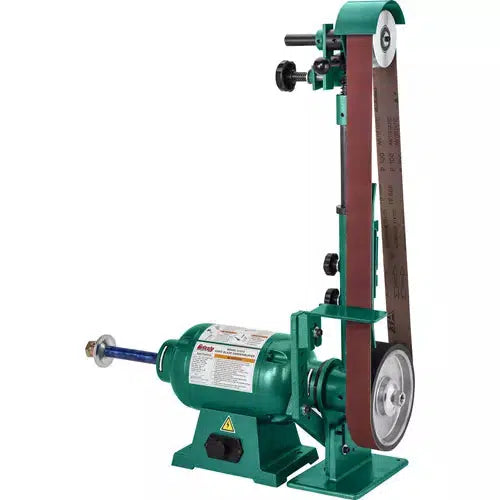
For bladesmiths who cannot justify $1,500-$2,500 for a 2x72 belt grinder, a small belt sander is the realistic entry point — and the WEN 6502T 4x36 combination unit is the most defensible budget pick for early knife work. The 4-inch belt width covers full bevel grinds on small to mid-size blades without overhang, the disc handles handle profiling and squaring tang shoulders, and the price keeps total tool investment under $200. It is not a 2x72 substitute. It is the machine that lets a beginner finish 5-15 knives well enough to decide whether to commit to a real grinder.
The 2x72 vs Small Belt Sander Trade-Off
Small belt sanders work for knife making the way a benchtop drill press works for metalworking — possible, but slower and with more limitations than the dedicated tool. According to manufacturer specs across the category, the trade-off comes down to four numbers.
Belt surface area. A 2x72 belt has 144 square inches of abrasive. A 2x42 has 84. A 1x30 has only 30. Less surface means heat builds faster, belts load with steel particles sooner, and belt life drops. Per Norton and 3M technical data, ceramic belts on a 2x72 grinding 1084 steel typically last 45-90 minutes of active grinding. The same job on a 1x30 burns through a belt in 5-10 minutes.
Belt speed (SFPM). Most 2x72 grinders run variable from ~1,500 to 5,000 surface feet per minute. Most 1x30 and 4x36 benchtop sanders are single-speed at roughly 3,000-3,400 SFPM. Single speed forces compromises — too slow for aggressive stock removal, too fast to safely work near a heat-treated edge.
Motor power. Per manufacturer data, 1x30 sanders typically run 1/3 HP, 4x36 combos run 1/3 to 1/2 HP, and 2x42 stand-alone units run 3/4 to 1 HP. A 2x72 grinder runs 1.5-2 HP. Hardened steel grinding bogs down underpowered motors and produces inconsistent bevels.
Belt selection. This is the quiet killer. Standard 2x72 belt inventories include ceramic alumina (the modern standard for steel), zirconia, J-flex for finishing, cork, and leather. The 1x30 and 4x36 sizes are dominated by aluminum oxide woodworking belts; ceramic options exist but are limited and often only available online from specialty abrasive suppliers like Pop’s Knife Supply or TruGrit Abrasives.
The honest answer: a small belt sander grinds knives. It does not grind them efficiently, and it does not grind them at production volume. Buyers should plan accordingly.
Top 5 Picks for Knife Making on a Budget
WEN 6502T — Best Overall Budget Pick (4x36 Belt + 6-inch Disc)
| Spec | Detail |
|---|---|
| Belt size | 4 x 36 inches |
| Disc | 6 inches |
| Motor | 4.3 amp (~1/2 HP) |
| Belt speed | ~3,160 SFPM |
| Tilting belt | Yes, 0-90 degrees |
| Price range | $130-$170 |
According to WEN’s product specifications, the 6502T pairs a 4x36 belt platen with a 6-inch disc on a single 4.3-amp motor. The belt assembly tilts from horizontal to vertical, which is the configuration most usable for blade bevel work. The 4-inch belt width is the meaningful advantage over 1x30 units — full-tang chef knives, paring knives, and small hunters fit on the platen without overhang.
The disc handles handle profiling, scale shaping, and squaring up the tang shoulder cleanly. Per the manual, the work table tilts 0-45 degrees for grind angle reference. The motor is non-direct-drive (belt-driven internally), so noise is moderate and vibration is acceptable for benchtop mounting.
Limitations are honest: single speed, no variable control, and the platen behind the belt is plastic-backed rather than ground steel. Bladesmiths who pursue this seriously usually replace or shim the platen with a flat metal backer within the first few months.
WEN 6515T 1x30 — Cheapest Way to Start
| Spec | Detail |
|---|---|
| Belt size | 1 x 30 inches |
| Motor | 2.3 amp (~1/3 HP) |
| Belt speed | ~3,160 SFPM |
| Weight | ~15 lbs |
| Price range | $50-$80 |
Per WEN’s product data sheet, the 6515T is the prototypical 1x30 — small motor, small belt, single speed. It is the lowest-cost path to practicing knife grinding. Folder makers, kitchen knife converters, and hobbyists doing small fixed blades under 4 inches can produce acceptable bevels with patience and ceramic belts from a specialty supplier.
The 1-inch belt width is the binding constraint. Anything wider than about 3/4 inch hangs off the platen during a flat grind, which forces multi-pass work and produces uneven geometry without careful technique. Belt life on 1080 or 1084 steel is short — figure on 5-15 belts per blade depending on grit progression.
For a maker who genuinely does not know whether knife making will stick, the 1x30 is the lowest-risk experiment. For anyone who already knows they want to make knives long-term, the 4x36 or 2x42 is a better starting point.
Grizzly G1015 / 2x42 Class — Best Step-Up Below 2x72
| Spec | Detail |
|---|---|
| Belt size | 2 x 42 inches |
| Motor | 3/4 HP, 110V |
| Belt speed | ~3,600 SFPM (varies by model) |
| Tilting head | Most models, 0-90 degrees |
| Price range | $200-$350 |
According to Grizzly’s product data sheets, 2x42 stand-alone sanders in this class run a 3/4 HP motor and a tilting head. The 2-inch belt width matches a real knife grinder, which means bevels can be ground in a single pass without overhang on most blades up to 10 inches. The 42-inch belt length is meaningfully better than 30 inches — more belt surface dissipates heat and extends belt life.
The 2x42 class is the realistic ceiling for budget knife work. Aftermarket ceramic belts in 2x42 are widely available from Pop’s Knife Supply, Combat Abrasives, and TruGrit. Some models accept slack-belt operation for handle convex work.
The honest limit is still belt length. A 2x42 belt at the same SFPM has roughly 60% the abrasive surface of a 2x72, and belt life reflects that ratio. Heat management on hardened steel requires light pressure and frequent dunks in water — more so than on a full 2x72.
Kalamazoo 1SM — Compact Industrial 1x42
| Spec | Detail |
|---|---|
| Belt size | 1 x 42 inches |
| Motor | 1/3 HP (1SM) up to 1 HP optional |
| Belt speed | ~3,600 SFPM |
| Build | Cast aluminum/steel, industrial duty |
| Price range | $400-$600 |
Per Kalamazoo Industries product documentation, the 1SM is built to industrial standards rather than benchtop hobbyist quality. The frame is cast aluminum, the bearings are sealed, and the contact wheel is precision-balanced. It is the only 1-inch class machine on this list that approaches the rigidity of a real belt grinder.
The 1-inch belt width is still a constraint for full-size blade bevels. The 1SM finds its niche in detailed work — choil grinding, ricasso refinement, finger guard shaping, and small folder blades where the narrow belt is an advantage rather than a limitation. Many makers buy a 1SM as a second machine alongside a 2x72, not as a primary grinder.
The 1SM is overkill as a first knife sander. It is listed here because it is the small-belt option that does not feel disposable — buyers who want a tool that lasts decades, not the tool that is cheapest today, should consider it.
6x48 Vertical Belt Sander — Stationary Upgrade Path
| Spec | Detail |
|---|---|
| Belt size | 6 x 48 inches |
| Disc (typical) | 9-12 inches |
| Motor | 3/4 HP to 1.5 HP |
| Configuration | Vertical or horizontal platen |
| Price range | $300-$700 |
According to manufacturer specs from Grizzly, JET, and Rikon, 6x48 vertical belt sanders are not marketed for knife making — they are stationary woodworking tools. For pure woodworking surface work, wider stationary machines like wide belt and drum sanders are the dedicated tools. Bladesmiths working on long camp knives, kukris, and machetes still find them useful because the 48-inch belt length extends life, and the wide platen gives full blade contact during flat grinds.
The trade-off is that 6-inch wide ceramic belts for steel are uncommon and expensive. Most 6x48 belt inventory is wood-grade aluminum oxide. Knife makers using a 6x48 typically buy specialty 6-inch ceramic belts in bulk and accept the higher per-belt cost in exchange for the longer belt life.
This is not a starter machine. It is a viable path for makers who already own a 4x36 or 2x42 and want a second platform for larger blades without jumping to a 2x72.
Belt Selection for Knife Steel
The grinder is the platform. The belts do the cutting. Per Norton and 3M abrasive technical data sheets, three belt types matter for knife work:
Ceramic alumina (the modern standard). Self-fracturing grain that exposes fresh cutting edges as it wears. Cuts cool, lasts 3-5x longer than aluminum oxide on hardened steel. Use ceramic for stock removal grits 36-120. The cost premium ($8-$15 per belt vs $3-$5 for aluminum oxide) is offset by longer life on steel.
Zirconia alumina. Older self-sharpening grain, performs well in 50-120 grit for primary bevel finishing. A reasonable middle-ground option when ceramic is unavailable in the size needed.
Aluminum oxide. Standard hardware-store belt. Acceptable for handle material (wood, micarta, G10) and finishing. Loads quickly on hot steel. Not the right grain for serious blade stock removal.
A reasonable starter grit progression for a budget sander: 36 grit ceramic (profiling), 60 grit ceramic (bevel rough-in), 120 grit ceramic or zirconia (bevel refinement), 220-400 aluminum oxide or J-flex (finishing before hand sanding). Specialty suppliers like Pop’s Knife Supply, Combat Abrasives, and TruGrit Abrasives stock all four sizes (1x30, 1x42, 2x42, 4x36) in ceramic, which big-box stores do not.
Who This Is NOT For
Bladesmiths producing more than 10-15 knives per year. The math turns against small belt sanders fast at volume. A 2x72 grinder pays for itself in saved belts, saved time, and consistent bevel quality once production crosses roughly a knife per month. Anyone certain they want to make knives long-term should save for a proper 2x72 belt grinder rather than buy and replace a budget sander.
Anyone working hardened high-carbon steel where heat-treat integrity is critical. Per manufacturer SFPM data and abrasive heat-management literature, smaller belts heat the steel faster because the same heat is concentrated in less abrasive surface. A 1x30 grinding 1095 or O1 above the temper line will draw the temper before the maker realizes the steel is hot. A 2x72 with variable speed and ceramic belts handles the same job at low SFPM with margin to spare. Bladesmiths heat-treating their own steel to demanding hardness (60+ HRC) should not learn on a small sander.
Stock-removal makers working stainless steel above 1/8 inch thick. Per third-party abrasive performance data, stainless work-hardens under low-pressure grinding and demands ceramic belts at moderate SFPM with heavy pressure. Underpowered motors stall, belts glaze, and the work hardens further. Stainless above 1/8 inch is realistically a 2x72 job.
Anyone expecting woodworking-quality finish from a metalworking workflow. A 1x30 or 4x36 sold as a “benchtop sander” is built and tooled for wood. The platen is plastic-backed, the work rest is loose, and the dust collection is sized for sawdust, not steel. Handheld belt sanders such as the Makita belt sander line are even less suited to blade bevels — they have no fixed platen to register a grind against. Knife work on these machines requires platen modifications, dedicated steel belts, and patience.
Buyers without bench space and a dust strategy. Steel grinding produces fine ferrous dust that contaminates everything in the shop. A budget sander still needs a ventilated location, a dedicated bench mount, and a cleanup plan. Setting one up on a kitchen table is a recipe for ruined finishes and respiratory problems.
Frequently Asked Questions
Can you make knives on a 1x30 belt sander?
Yes, but with limitations. According to manufacturer specs, a 1x30 has a 1/3 HP motor at fixed speed and a narrow belt that hangs off most full-size blades. Small folder blades, paring knives, and kitchen knives under 6 inches can be ground successfully with patience and ceramic belts. Production knife making or hardened high-carbon steel work is impractical on a 1x30 — heat builds too fast and belt life is measured in minutes.
Is a 2x42 belt sander good enough for knife making?
A 2x42 is the realistic budget ceiling for serious knife work. The 2-inch belt width matches a 2x72 grinder for bevel coverage, and aftermarket ceramic belts are widely available. Per manufacturer data, 2x42 belt life on hardened steel runs about 60% of an equivalent 2x72 belt. Hobbyists making 5-20 knives a year can produce excellent results on a 2x42. Higher production volume favors a 2x72.
What belts should I buy for a budget knife sander?
Start with ceramic alumina belts in 36, 60, and 120 grit for stock removal and bevel work, then aluminum oxide or J-flex in 220-400 grit for finishing. Specialty suppliers (Pop’s Knife Supply, Combat Abrasives, TruGrit Abrasives) carry ceramic in 1x30, 1x42, 2x42, and 4x36 sizes. Hardware-store aluminum oxide belts are not the right grain for serious blade work — they load and burn out quickly on hardened steel.
Sources
- WEN Products belt sander product specifications and operator manuals — wenproducts.com
- Grizzly Industrial 2x42 belt sander and combination sander product data sheets — grizzly.com
- Kalamazoo Industries 1SM and 2SM belt sander specifications — kalamazooind.com
- Norton Abrasives technical data sheets, ceramic alumina vs zirconia vs aluminum oxide grain comparison
- 3M Cubitron II abrasive belt technical documentation
- VSM Abrasives ceramic belt performance data on hardened tool steel
- Pop’s Knife Supply, Combat Abrasives, and TruGrit Abrasives belt size and compound availability
- Manufacturer motor horsepower, amperage, and surface feet per minute (SFPM) ratings as published in product manuals