Best Arbor Presses for Small Shops in 2026
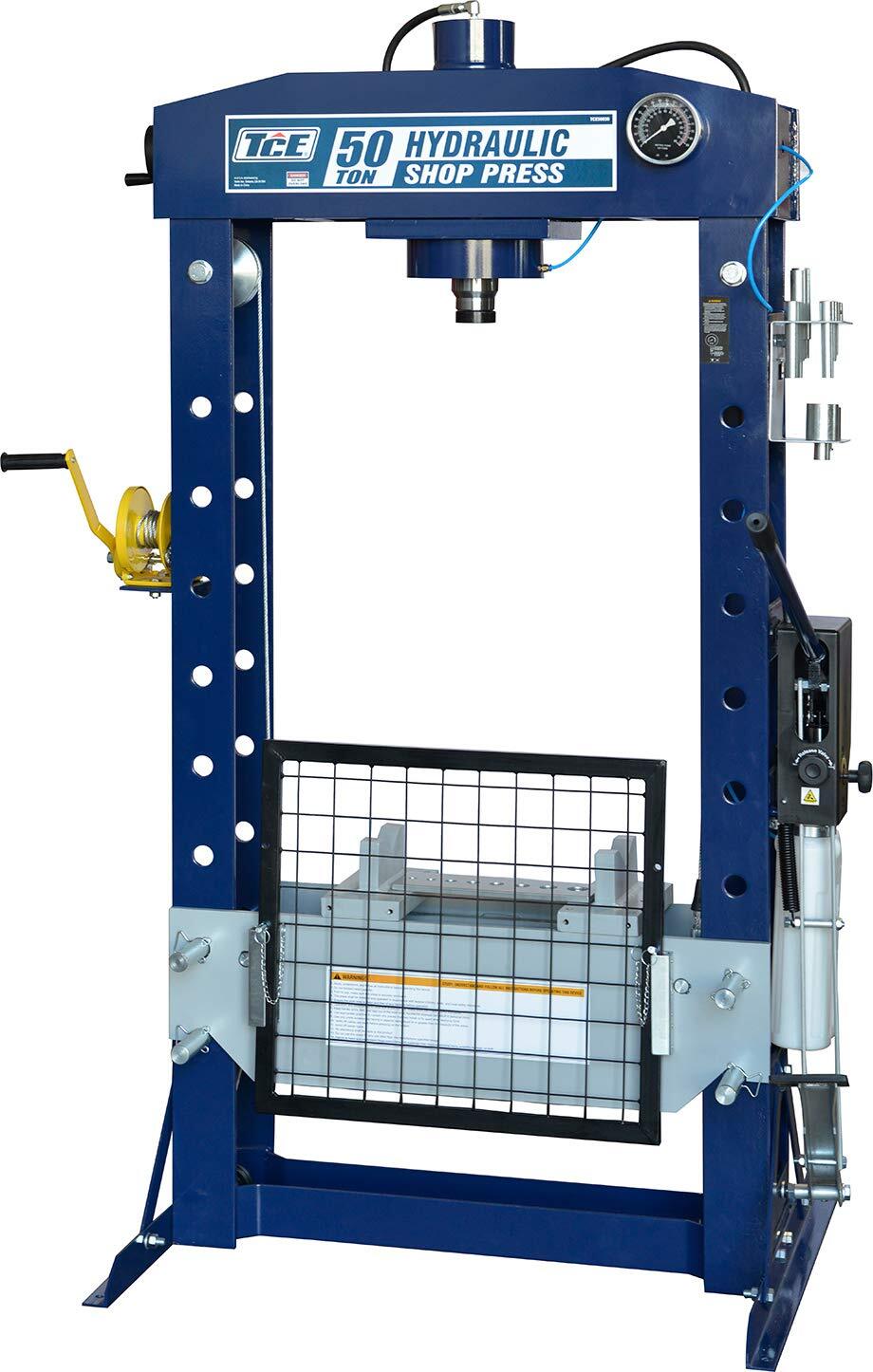
An arbor press applies controlled, repeatable force through a rack-and-pinion mechanism — pressing bearings into housings, removing pressed pins, seating bushings, punching soft materials, and staking operations that require more force than a bench vise but more control than a hydraulic press. The rack-and-pinion drive translates handle rotation into vertical ram force, allowing the operator to feel resistance and stop precisely when the part seats, without the overshoot risk of a hydraulic press with an imprecise feel.
This guide compares four bench arbor presses based on published specifications, focusing on tonnage capacity, ram stroke, throat depth, and ram-to-column fit — the specification that most affects press accuracy on close-tolerance bearing and bushing work.
Arbor Press vs. Hydraulic Press: When to Use Each
Per manufacturing tooling standards and shop practice data:
| Factor | Arbor Press | Hydraulic Press |
|---|---|---|
| Force control | Fine (feel through handle) | Coarse (gauge reading) |
| Overshoot risk | Low | Higher at low pressure settings |
| Cycle speed | Fast (one motion) | Slower (pump strokes) |
| Tonnage | 0.5-4 ton typical | 6-50 ton common |
| Precision | High for controlled force | Lower for light work |
| Applications | Bearings, pins, bushings, staking | Heavy press fits, bending |
| Space required | Small (bench mount) | Larger (floor or heavy bench) |
Per tooling industry data, arbor presses are the preferred tool for bearing and bushing installation because the rack-and-pinion mechanism allows the operator to feel the bearing seat fully without the sudden overshoot that hydraulic presses can produce when pressure builds before the part seats. For operations requiring more than 4 tons, a hydraulic press is appropriate.
Key Specifications
Tonnage: The maximum rated force the press can apply. Per manufacturer standards, 1-ton (2,000 lb) capacity handles most bearing and bushing press fits in small engine and automotive work. 3-ton handles larger interference fits and punch tooling.
Ram stroke: The vertical travel distance of the ram. Longer stroke accommodates taller fixtures and deeper operations without repositioning the workpiece.
Throat depth: The horizontal distance from the ram centerline to the column face. Greater throat depth allows pressing off-center features and working with wider workpieces without the part overhanging the table.
Ram fit to column: The clearance between the ram and its guide in the column. Per machinist forum data and industry reviews, this is the primary quality differentiator among arbor presses — a loose ram deflects under side load, producing off-axis press fits that damage bearings and misalign bushings. Higher-quality presses have tighter ram-to-column fit that holds the ram on-axis throughout the stroke.
Top Arbor Presses by Specification
Dake 1-Ton Arbor Press (5-1000-000) — Best Overall
| Specification | Value |
|---|---|
| Capacity | 1 ton (2,000 lb) |
| Ram Stroke | 3.15” |
| Throat Depth | 4.5” |
| Table Size | 5” x 5” |
| Ram Diameter | 7/8” |
| Ram Taper | 3/4” Morse |
| Height | 16.5” |
| Weight | 26 lbs |
| Manufacture | Grand Haven, Michigan, USA |
| Warranty | 1 year |
| Price Range | $250-$350 |
Per Dake’s specifications, the 5-1000-000 is manufactured in Grand Haven, Michigan. Dake has produced arbor presses in the US since 1938. Per independent machinist assessments and tooling forum data, Dake arbor presses are the reference standard for ram-to-column fit in the under-$500 price range — the ram has minimal lateral play compared to imported presses in the same price tier. The 3/4” Morse taper ram accepts Morse taper tooling (punches, pilots, press fixtures) from any tooling supplier. The 4.5” throat depth handles most automotive and small engine work.
Best for: Machinists, engine builders, and fabricators who need an arbor press for bearing and bushing installation where press fit accuracy matters. The US manufacture and tight ram fit justify the price premium over imported alternatives. The 1-year warranty is standard.
Limitation: 1-ton capacity limits this to smaller interference fits. The $250-$350 price is higher than imported alternatives of similar spec. No depth stop included.
Jet 333600 1-Ton Arbor Press — Best with Depth Stop
| Specification | Value |
|---|---|
| Capacity | 1 ton (2,000 lb) |
| Ram Stroke | 4” |
| Throat Depth | 4-3/4” |
| Table Size | 4-3/4” x 4” |
| Ram Diameter | 15/16” |
| Ram Taper | Morse #1 |
| Height | 18” |
| Weight | 26 lbs |
| Depth Stop | Yes (included) |
| Warranty | 2 years |
| Price Range | $200-$260 |
Per Jet’s specifications, the 333600 includes a depth stop — a collar that limits ram travel at a preset depth, allowing repeatable press depth for production operations (pressing bearings to a consistent depth in identical housings). The 4-inch stroke is longer than the Dake’s 3.15 inches, and the 4-3/4-inch throat is deeper. Per Jet’s documentation, the press uses Morse #1 taper (slightly smaller than Morse 3/4” standard) for tooling compatibility.
Best for: Small production operations pressing bearings or pins to a consistent depth — electric motor shops, pump rebuilders, and production manufacturing where the same operation repeats across multiple identical parts. The depth stop removes the need to measure each press operation.
Limitation: Imported manufacture. Per user reports, ram-to-column fit is adequate but not as precise as Dake. The Morse #1 taper is less common in aftermarket tooling than 3/4” Morse taper.
Palmgren 9680140 1-Ton Arbor Press — Best Budget Option
| Specification | Value |
|---|---|
| Capacity | 1 ton (2,000 lb) |
| Ram Stroke | 3” |
| Throat Depth | 4” |
| Table Size | 4” x 4” |
| Ram Taper | 3/4” Morse |
| Height | 16” |
| Weight | 21 lbs |
| Warranty | 1 year |
| Price Range | $130-$175 |
Per Palmgren’s specifications, the 9680140 is a standard 1-ton bench arbor press using 3/4” Morse taper — the most common taper for aftermarket tooling compatibility. At 21 lbs, it is the lightest in this comparison. The $130-$175 price point makes this accessible for occasional use — hobbyists, small engine repair, and low-frequency bushing and bearing work.
Best for: Hobby machinists, small engine hobbyists, and shops that need an arbor press for occasional use where the cost of the Dake or Jet is difficult to justify. Per user reports, adequate for light bearing and pin work where close-tolerance fits aren’t required.
Limitation: Per user reports, ram-to-column fit shows more lateral play than Dake — acceptable for light work, not ideal for precision interference fits. 3” stroke is the shortest in the comparison.
Baileigh AP-3-H 3-Ton Hydraulic-Assist Arbor Press — Best for Heavy Work
| Specification | Value |
|---|---|
| Capacity | 3 tons (6,000 lb) |
| Ram Stroke | 6” |
| Throat Depth | 6” |
| Table Size | 8” x 10” |
| Ram Taper | 3/4” Morse |
| Height | 27” |
| Weight | 68 lbs |
| Warranty | 1 year |
| Price Range | $600-$800 |
Per Baileigh’s specifications, the AP-3-H is a 3-ton hydraulic-assist arbor press — the rack-and-pinion drive is supplemented by hydraulic assist to achieve 3-ton force from a standard lever handle. The 6-inch stroke and 6-inch throat depth handle larger fixtures and off-center work. Per Baileigh’s documentation, the 10-inch x 8-inch table accommodates larger assemblies — truck wheel bearings, large electric motor armatures, and industrial press-fit applications.
Best for: Heavy industry, fleet maintenance, and shops regularly pressing large bearings (front wheel bearings, differential bearings, industrial motor bearings) that exceed 1-ton capacity. The hydraulic assist allows 3-ton force without the long lever arm that pure mechanical presses require at high force.
Limitation: $600-$800 is significantly more expensive than 1-ton options. At 68 lbs, this is a permanent bench installation, not a portable tool. Overkill for standard small-engine and automotive light bearing work.
Comparison Table
| Model | Capacity | Stroke | Throat | Table | Taper | Depth Stop | Weight | Price |
|---|---|---|---|---|---|---|---|---|
| Dake 5-1000-000 | 1 ton | 3.15” | 4.5” | 5”x5” | 3/4” Morse | No | 26 lbs | $250-$350 |
| Jet 333600 | 1 ton | 4” | 4-3/4” | 4-3/4”x4” | Morse #1 | Yes | 26 lbs | $200-$260 |
| Palmgren 9680140 | 1 ton | 3” | 4” | 4”x4” | 3/4” Morse | No | 21 lbs | $130-$175 |
| Baileigh AP-3-H | 3 ton | 6” | 6” | 8”x10” | 3/4” Morse | No | 68 lbs | $600-$800 |
Arbor Press Applications by Shop Type
Where an arbor press fits in a shop depends on the work it will see. For buyers outfitting a bench from scratch, the home shop setup cost guide covers where a press sits in the overall equipment budget.
Engine rebuilding shops: Cylinder head valve guides, camshaft bearing shells, crankshaft seal pressing, and piston pin removal and installation are all standard arbor press operations. Per engine rebuilding practice data, most automotive engine operations fall within 1-ton capacity — valve guide installation, piston pin bushing reaming, and cam bearing installation. The Dake 5-1000-000 with its tight ram fit handles precision automotive engine work cleanly, and its 3/4” Morse taper accepts automotive-specific press tooling from major suppliers (Kent-Moore, OTC, Lisle).
Small fabrication and job shops: Fabricators press bearings into plate-mounted pillow block housings, install bushings in custom brackets, and stake pins into assemblies. For a fab shop where the arbor press sees daily use on production parts, the Jet 333600 depth stop provides repeatable production depth without measuring each press operation — relevant for shops running production quantities of identical assemblies.
Gunsmithing and precision toolmaking: Gunsmithing operations include pressing barrel pins, installing action screws, removing and reinstalling barrel bushings. Per gunsmithing trade data, precision is the primary requirement — a deflecting ram produces an off-axis press that can damage tight-tolerance components. The Dake press’s US manufacturing and tight ram fit make it the reference standard for precision-critical operations.
Fleet and heavy equipment maintenance: Truck wheel bearing replacement, differential component pressing, and large hydraulic cylinder seal pressing exceed 1-ton capacity and require the Baileigh 3-ton or a dedicated hydraulic press. Per maintenance shop data, wheel bearing press fits for 3/4-ton and 1-ton trucks commonly require 1.5-3 ton force — the Baileigh’s hydraulic assist makes this achievable without a full-size floor press.
Who This Is NOT For
- High-volume production stamping. Arbor presses are for controlled, precision pressing operations — not high-speed production stamping. A mechanical punch press or hydraulic press with proper tooling handles production stamping.
- Operations requiring more than 3-4 tons. Heavy interference fits, large structural pins, and industrial shaft-to-hub presses require a dedicated hydraulic press (6-50 ton). An arbor press overloaded beyond its rated capacity is a serious safety hazard — the column can deflect or fracture.
- Bending flat stock. A sheet metal brake or press brake handles sheet metal bending. An arbor press can make point-contact bends on thin material but is not designed for the distributed load of metal forming.
- Log splitting or heavy agricultural pressing. Arbor presses are precision shop tools. Agricultural and farm press applications (wheel hub pressing on tractors, implement frame work) require hydraulic presses rated for the specific operation.
What You’ll Also Need
- SE Tools 77-Piece Bearing and Race Driver Set ($40-$60): Interchangeable bearing driver cups that accept Morse taper arbors — allows pressing bearings without machining custom fixtures for each bearing OD. Check price on Amazon →
- Jet V-Block Set (2-piece) ($30-$45): V-blocks on the press table provide stable support for round stock, shaft work, and cylindrical assemblies during pressing operations. Check price on Amazon →
- Anti-seize compound ($10-$15): Applied to press-fit surfaces reduces galling during disassembly and prevents corrosion welding on steel-to-steel interference fits that will need future service. Check price on Amazon →
Sources
- Dake Corporation 1-ton arbor press specifications (dakecorp.com)
- Palmgren 9680140 arbor press product documentation (palmgren.com)
- Jet 333600 arbor press specifications (jettools.com)
- Baileigh Industrial AP-3-H product documentation (baileighindustrial.com)
- Machinery’s Handbook — Press Fits and Interference Fits section (Industrial Press)
- ASME B4.1 — Preferred Limits and Fits for Cylindrical Parts