Pneumatic vs Cordless Framing Nailers: Which Is Right for Your Work?
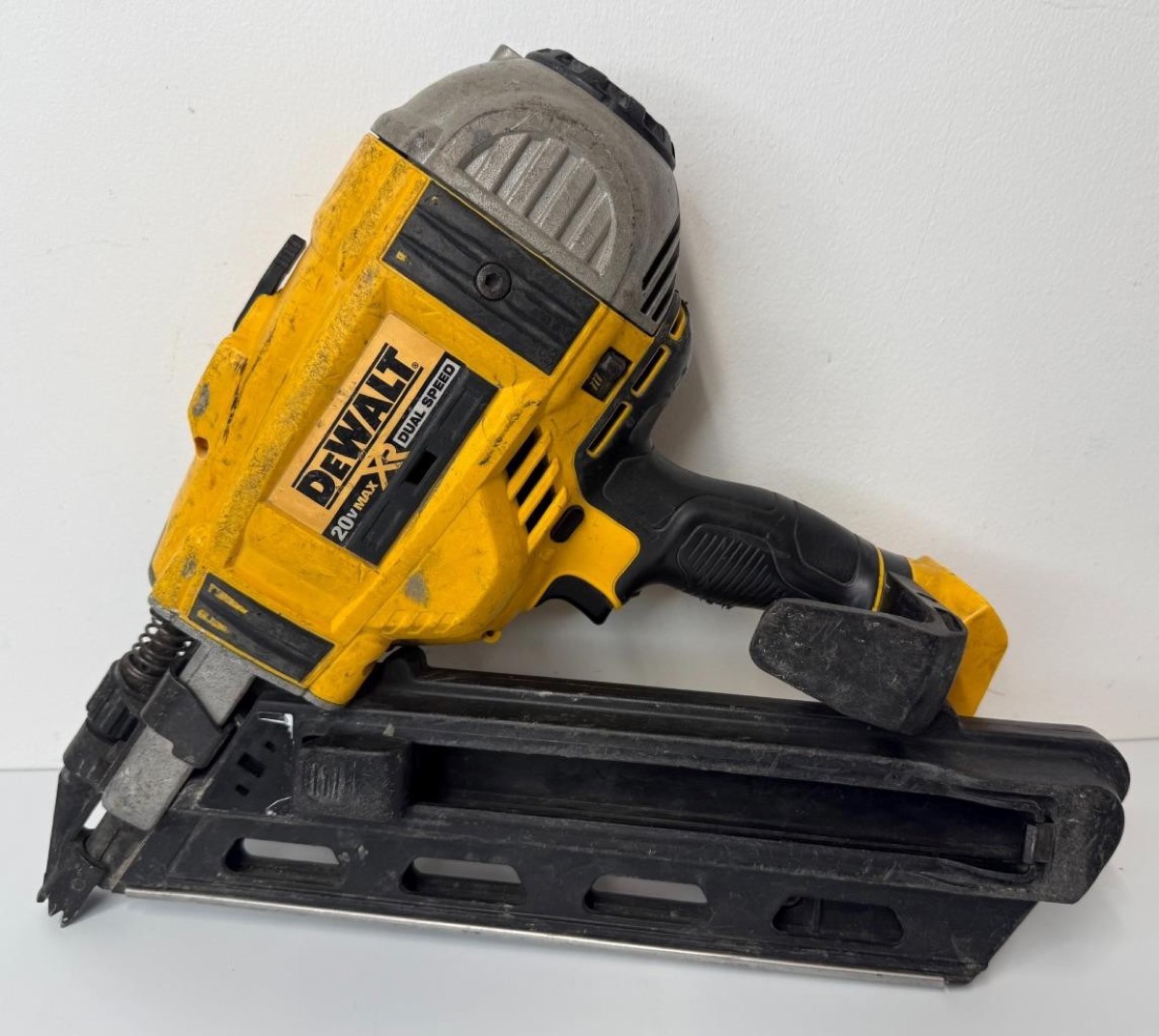
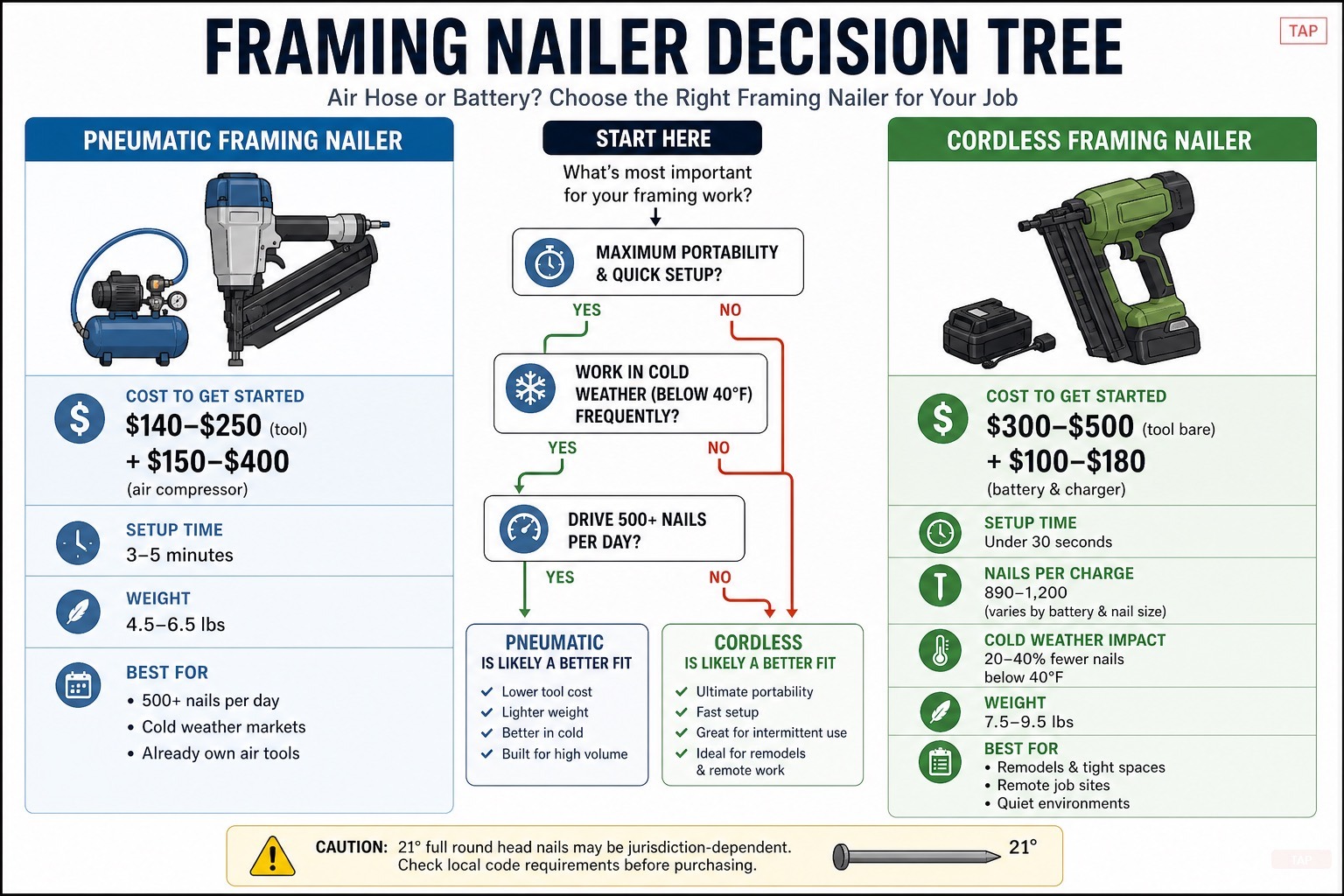
The choice between a pneumatic and a cordless framing nailer is not primarily a question of which drives nails better. Modern cordless framing nailers — DeWalt’s DCN692, Milwaukee’s M18 FUEL 2745-20, Makita’s XGT AF601PT — drive 3-1/2-inch nails into LVL and engineered lumber with force that manufacturer specifications show to be comparable to pneumatic tools in the same duty class. The real question is how you work, where you work, and what the total cost of that work is across a season.
This guide compares the two types across seven dimensions that determine real-world fit: cost, power, portability, cold weather performance, nail compatibility, setup time, and long-term operating cost. For the model-by-model cordless field, see the best cordless framing nailers roundup.
Side-by-Side Comparison
| Factor | Pneumatic | Cordless |
|---|---|---|
| Tool cost | $140–$250 | $300–$500 (bare) |
| Required accessories | Compressor ($150–$400) + hose | Battery + charger ($100–$180 if needed) |
| Total entry cost | $300–$650 | $300–$500 (if already on platform) |
| Nails per charge/tank | Unlimited (continuous air) | 890–1,200 per charge (4.0–5.0 Ah battery) |
| Performance in cold | Unaffected | 20–40% capacity reduction below 40°F |
| Setup time | 3–5 min (compressor, hose) | Under 30 seconds |
| Weight (bare tool) | 4.5–6.5 lbs | 7.5–9.5 lbs |
| Sustained drive consistency | Constant (air pressure) | Slight reduction as battery depletes |
| Nail angle options | 21°, 30°, 34° | 21°, 28°, 30° (model dependent) |
| Noise level | High (compressor + exhaust) | Moderate (no compressor) |
Cost Analysis
The sticker price difference between pneumatic and cordless framing nailers — roughly $150–$300 — understates the full cost comparison in both directions.
Pneumatic total cost includes a compressor. A framing nailer requires a compressor delivering at least 2.0–2.5 CFM at 90 PSI. A capable 6-gallon pancake compressor runs $150–$250. A hose adds $30–$60. Total pneumatic entry cost for a contractor without existing air infrastructure: $300–$500 — comparable to cordless.
Cordless total cost varies by platform investment. For contractors already running DeWalt 20V MAX or Milwaukee M18, a bare-tool cordless framing nailer uses the batteries they already own. The $300–$380 bare-tool price is the complete incremental cost. For contractors starting from scratch, add $100–$180 for a battery and charger — putting total cordless entry at $400–$560.
The compressor’s value is spread across the pneumatic tools that use it. Contractors with air nailers, finish nailers, staplers, and blow guns amortize the compressor cost across an entire air tool collection. Contractors whose only air tool would be a framing nailer get no such benefit.
Power and Drive Consistency
Per DeWalt’s specifications for the DCN692, the cordless model drives 2-inch to 3-1/2-inch framing nails into Douglas fir and engineered lumber (LVL, LSL) with two user-selectable speed modes: sequential (precision placement) and bump (production rate). Per Milwaukee’s specifications, the M18 FUEL 2745-20 uses a brushless POWERSTATE motor to deliver drive force that Milwaukee’s data characterizes as matching pneumatic performance across standard framing applications.
The measurable difference is at the margins:
In sustained high-volume use, pneumatic nailers maintain constant drive depth regardless of how many nails have been driven. A cordless nailer on a depleting battery may require depth-of-drive adjustment as the charge drops — a minor calibration, but one that production framers firing 500+ nails per day will encounter.
In cold weather, lithium-ion batteries lose 20–40% capacity below 40°F per battery specification data. A pneumatic nailer performs identically at 20°F as at 70°F. For winter framing — a common condition in most of the US — this is a real operational factor, not a theoretical edge case.
In engineered lumber and LVL, both tool types perform adequately. Per DeWalt’s data, the DCN692 handles LVL header stock. For truss nailing with dense engineered wood, some framers report the pneumatic edge is more noticeable — though manufacturer data does not quantify the difference.
Portability and Setup
This is where cordless tools hold a decisive advantage for certain work patterns.
Remodeling and addition framing involves moving between rooms, floors, and locations. A pneumatic setup requires hose management — routing the hose through finished spaces, around corners, up stairs — and repositioning the compressor as the work moves. A cordless tool with a charged battery picks up and moves in under 30 seconds with no trailing hose.
New construction production framing works differently. A crew frames in one location (a wall section, a floor joist bay) for extended periods before moving. The hose is repositioned infrequently. Setup time and portability matter less; sustained power and consistent drive depth matter more.
Remote locations — additions far from the house, outbuildings, decks in areas without power — require either a generator to run a compressor or a cordless tool. No compressor alternative exists. Per Paslode’s product documentation, the fuel-cell IM350CT (a gas-powered cordless option) was specifically designed for this use case, predating battery cordless nailers by decades.
Nail Compatibility and Code Requirements
Per International Residential Code (IRC Table R602.3) and local amendments:
- 21-degree framing nailers use full round head nails (the only paper-tape strip nailer that does). Full round head nails are required by code in many southern coastal regions.
- 30-degree framing nailers use paper-tape collated nails with clipped or offset heads. Accepted in most US jurisdictions for structural framing.
- 34-degree framing nailers use plastic-collated nails with clipped heads. Common in older pneumatic catalogs; less common in current cordless offerings.
Most cordless framing nailers are 30-degree tools. If your work includes hurricane-zone structural framing, verify the magazine angle before purchasing — some cordless models also offer 21-degree configurations.
Operating Cost Over Time
Pneumatic operating cost is essentially compressed air, which costs only the electricity to run the compressor (a few cents per hour). Nail costs are identical between the two types — same nails, same strips. Air hose maintenance and occasional compressor oil changes (on oil-lubricated models) are the primary ongoing costs.
Cordless operating cost is battery replacement. Per lithium-ion cycle life data, a well-maintained battery at normal operating temperatures retains adequate capacity for 300–500 full charge cycles before meaningful degradation. At 2–3 charges per day on a full framing crew, a battery may need replacement in 1–2 seasons. Per current pricing, replacement 4.0 Ah or 5.0 Ah batteries run $60–$100.
The other cordless variable is cold storage and charging. Discharging a lithium-ion battery in cold weather and then leaving it depleted in a cold truck overnight accelerates degradation. Standard practice: remove batteries at day’s end, store inside. This adds a step that pneumatic tools do not require.
Fuel-Cell Nailers: A Third Option
Paslode fuel-cell nailers (IM350CT, IM360Ci) occupy a distinct category. A small disposable fuel cell powers the drive mechanism via controlled combustion; a small lithium battery provides only the ignition spark. Per Paslode’s documentation, this design produces approximately 1,200 shots per fuel cell regardless of temperature — addressing cold-weather battery degradation. Fuel cells cost $15–$20 each.
The tradeoff: fuel cells are a recurring operating cost of roughly $1.25–$1.50 per 100 nails. For a framing crew driving 5,000 nails per week, that’s $60–$75/week in fuel cells. For an occasional user driving 500 nails per month, it’s $7–$10/month. The fuel-cell model also tends to be lighter than battery cordless alternatives — 4.5 lbs versus 7.5–9.5 lbs for battery cordless — making it the preferred choice for finish framers and contractors who hold the nailer overhead for extended periods.
Who Should Choose Pneumatic
Pneumatic framing nailers are the better choice for:
- Production framing crews driving 500+ nails per day in one location, where compressor setup is a one-time daily cost and sustained drive consistency across a full charge matters
- Contractors already invested in air tools who use compressors for finish nailers, trim and brad guns, and blow guns — the compressor cost is already justified
- Cold-weather markets where sub-40°F framing is a regular condition and lithium-ion performance degradation is a real operational concern
- Budget-constrained situations where $140–$180 for a nailer plus an existing compressor is the practical path
Who Should Choose Cordless
Cordless framing nailers are the better choice for:
- Remodelers and addition framers who move between rooms and locations frequently, where hose management through finished spaces adds friction to every move
- Contractors on a single battery platform (DeWalt 20V MAX or Milwaukee M18) who already own compatible batteries — the incremental cost is tool-only, not tool + compressor
- Remote and off-grid locations where running a compressor requires a generator that adds cost, noise, and setup complexity
- Single-tool framing applications where buying a compressor solely for one tool is not cost-justified
- Quiet jobsites — occupied renovations, commercial spaces, residential work where compressor noise creates friction with occupants
Who This Is NOT For
- Contractors looking for an entry-level framing nailer — cordless framing nailers start at $300 bare and $400+ with a battery. The entry-level pneumatic option at $140–$180 is a different product for a different budget. The cordless category is not a value proposition; it is a mobility proposition.
- Anyone who will primarily frame in sub-freezing conditions — lithium-ion capacity loss in sustained cold is real and operational. Pneumatic or fuel-cell tools are the reliable choice for winter framing.
- Contractors who frame production volume (500+ nails per day) without an existing battery platform — the economics favor pneumatic + compressor at high production rates where battery swaps interrupt workflow.
What You’ll Also Need
- 30-degree framing nails — 3-1/2-inch paper-tape collated — The standard consumable for 30-degree framing nailers (the most common angle in cordless tools). Used for wall framing through-plates, stud-to-plate connections, and header installation. Buy ring-shank for decking applications; smooth-shank for structural framing where hold-through matters less than driveability. Check price on Amazon →
- 21-degree full round head framing nails — 3-1/4-inch — Required in hurricane-zone jurisdictions and preferred by inspectors in coastal markets for structural wall sheathing. Specify “full round head” (not clipped) when ordering. Check price on Amazon →
- 6-gallon pancake compressor — For contractors choosing the pneumatic path. A 6-gallon, 2.6 CFM unit at 90 PSI provides adequate recovery for a single framing nailer with minimal short-cycling. Brands: DeWalt, Makita, California Air Tools. Check price on Amazon →
- Hybrid air hose — 3/8-inch, 50-foot — A hybrid hose (PVC/rubber blend) remains flexible in cold weather and resists kinking under foot traffic, unlike standard PVC hoses that stiffen below 40°F and crack at bends. Check price on Amazon →
- Replacement driver blade — The driver blade is the highest-wear component in a framing nailer — in pneumatic tools, it’s the part most likely to need replacement after 50,000+ nails. OEM replacement blades ensure the fit tolerances are correct. Search your specific model number. Check price on Amazon →
Sources
- DeWalt DCN692 and DCN21PL product specifications (dewalt.com)
- Milwaukee M18 FUEL 2745-20 specifications (milwaukeetool.com)
- Paslode IM350CT specifications and fuel cell operating cost data (paslode.com)
- Metabo HPT NR90AES1 specifications and compressor sizing data (metabohpt.com)
- 2021 International Residential Code Table R602.3 — nail schedule for structural framing